Help us get this right
Does this portrait look right for Tzeltal?
Nobody has judged this one yet. You would be the first.
Tzeltal Erotic
Highlands and eastern lowlands of Chiapas, Mexico, from Oxchuc and Tenejapa east through Ocosingo to the edge of the Lacandon forest.
Tzeltal, called bats'il k'op by its speakers (Mayan, Tzeltalan branch); Spanish widely as a second language.
Catholicism fused with Maya practice and organized around saints and the cargo system, with substantial Presbyterian and other Protestant minorities since the mid twentieth century.
Tzeltalan branch of the Mayan family, paired with Tzotzil; internally divided by municipality, including Oxchuc, Tenejapa, Cancuc, Chanal, Amatenango del Valle, Bachajón, Chilón and Ocosingo.
About Tzeltal People
The Tzeltal are the largest Maya people in Chiapas, and what identifies them first is a stretch of pine and oak country east of San Cristóbal de las Casas where the mountains break into canyons and fall away toward the Lacandon rainforest. More than half a million people speak the language, which they call bats'il k'op, the true word. It belongs to the Tzeltalan branch of the Mayan family and sits beside Tzotzil, spoken in the towns immediately west, close enough that outsiders treat the two as one continuum and speakers never do. Identity here is municipal before it is ethnic. A woman from Tenejapa and a woman from Oxchuc are both Tzeltal, but the brocade on their blouses says which town, and within living memory it also said whom they could marry.
Catholicism arrived with the Dominicans in the sixteenth century and was absorbed rather than swallowed: saints took up residence in a landscape that already had owners, and the civil-religious cargo system made sponsoring a saint's festival the main route to standing among men. That arrangement has been under pressure for fifty years, from Protestant conversion, from the catechist movement the San Cristóbal diocese built under Bishop Samuel Ruiz, and from the ordination of hundreds of Tzeltal permanent deacons. Two dates stand out. In 1712 a young woman in Cancuc reported an apparition of the Virgin, and the rebellion that followed put dozens of Tzeltal towns briefly beyond Spanish reach, with priests of their own choosing and soldiers who fought in the Virgin's name. In 1994, Tzeltal speakers from the colonized canyons around Ocosingo made up much of the Zapatista base. Between the two, the ordinary work: maize on slopes too steep for a plow, coffee lower down, and migration to Cancún, to the northern border and to the United States, then back.
Two things about the Tzeltal are well known to specialists and almost nobody else. Their language does not use left and right to locate things in space. Position runs on an uphill, downhill and across axis anchored to the real slope of the land, so a fork lies downhill of a plate rather than to its right, and speakers keep the bearing indoors, out of sight of any hill. The plant vocabulary recorded in Tenejapa runs to hundreds of named categories, sorted with enough consistency that the town became a reference point for how folk classification works anywhere. In Amatenango del Valle the potters are women, coiling unglazed jars and small animals and firing them in open wood fires in the yard.
Related ethnic groups
Groups that share Tzeltal's homeland, region, language, or religious tradition. These are likely candidates for comparative phenotype reference.
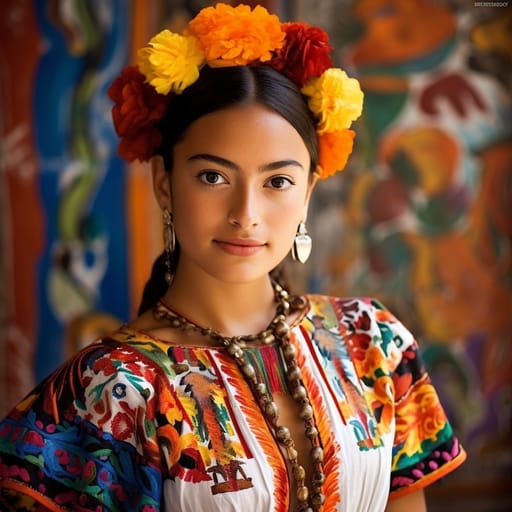
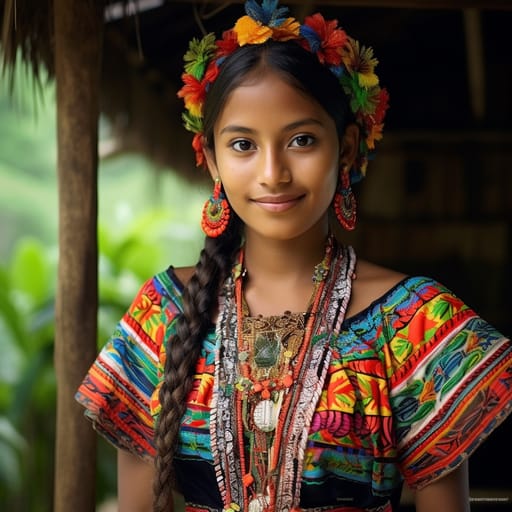
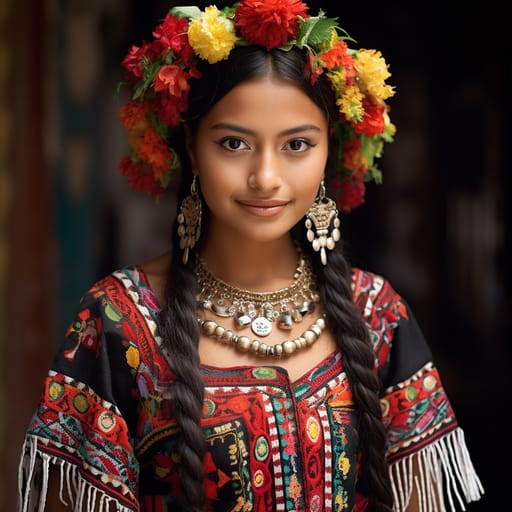
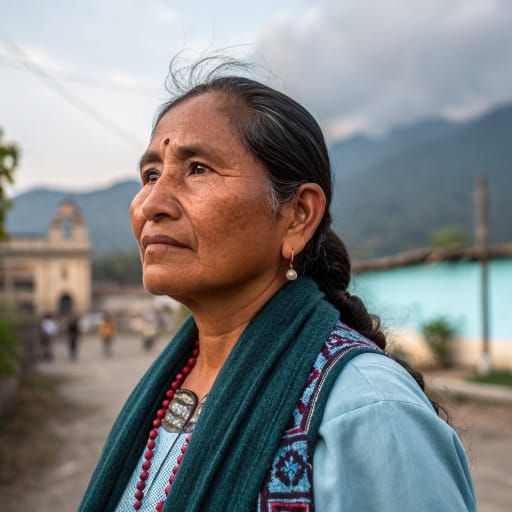
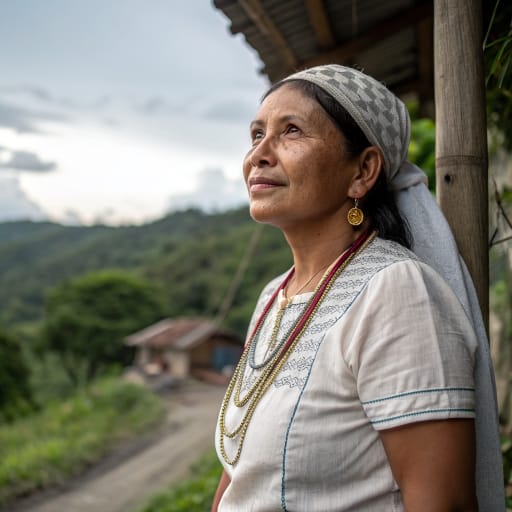
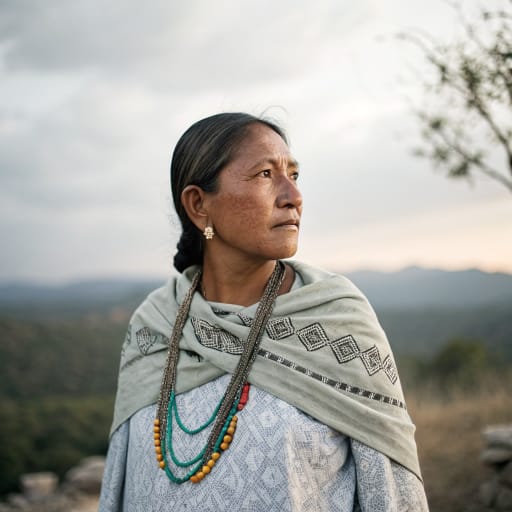
Typical Tzeltal Phenotypes
Reference for AI generation: hair, eyes, skin, facial structure, build
Tzeltal Body & Anatomy Reference
Anatomy by feature, Mesoamerican Indigenous / Mestizo phenotype
Tzeltal Boobs & Breasts
Tzeltal tits and boobs run medium-to-large cup, full, moderate-to-high projection, the classic Mesoamerican Indigenous / Mestizo bust profile. Tzeltal nipples and areolas show medium-brown to dark-brown areolar pigmentation against the tan-to-medium-brown skin tone, with areolar diameter typically in the 32-46mm range and forward-set positioning rather than the smaller East Asian bust. Tzeltal breasts trend full and projecting, classic Latina curvy bust profile, a function of the endomorph-to-mesomorph with strong hip-and-bust deposition body habitus and the mean adult female BMI 26-29. For anatomically accurate AI-generated Tzeltal nudes the render preserves the medium-to-large cup, full, moderate-to-high projection shape, 32-46mm areolas with medium-brown to dark-brown pigmentation, and the torso proportions of the Mesoamerican Indigenous / Mestizo phenotype.
Tzeltal Ass & Hips
Tzeltal hips and butt usually read as medium-to-full, high projection, classic Latina curvy hip profile. The skeletal base is wide iliac crests, full gluteal-femoral fat deposition, the Mesoamerican Indigenous / Mestizo pattern. Set against the slim narrow-hip East Asian profile, the difference is easy to see, and the hip-to-waist ratio is often what identifies Tzeltal women in photos.
Tzeltal Vagina & Pussy
Expect medium-brown to dark-brown labial pigmentation, fuller labia minora on Tzeltal women, in keeping with Mesoamerican Indigenous / Mestizo ancestry. The pubic hair is straight-to-wavy coarse dark texture, dense distribution. Coloring should run evenly from the tan to medium-brown skin of the thighs to the labia, and Tzeltal nude imagery should keep the hair's straight-to-wavy coarse dark texture.
Tzeltal Dicks & Penis
Tzeltal dick and penile anatomy in adult AI generation should anchor on the regional reference data: regional mean ~13cm erect, moderate girth, and medium-brown shaft pigmentation. The Tzeltal cock profile reflects the Mesoamerican Indigenous / Mestizo population's anthropometric measurements. The shaft pigmentation should track the surrounding tan to medium-brown skin tone, and the pubic hair should keep its straight-to-wavy coarse dark texture in the typical inverted-V escutcheon.
Tzeltal Body, Curves & Build
Tzeltal body type: endomorph-to-mesomorph with strong hip-and-bust deposition, with mean adult female BMI 26-29. This is the typical Mesoamerican Indigenous / Mestizo build. Height range, shoulder-to-hip ratio and fat distribution all follow from it, which is what an accurate Tzeltal nude body should show.
Tzeltal Skin Tone & Hair Texture
Tzeltal skin tone falls in the tan to medium-brown (Fitzpatrick III-V) band, the surface signal most often miscalibrated by generic AI nude generators. Tzeltal hair texture is typically straight-to-wavy 1A-2B, dense dark-brown to black, characteristic of the Mesoamerican Indigenous / Mestizo phenotype. In Tzeltal nude renders the skin should hold that band consistently across the body.
Explore phenotype categories
Structured taxonomy with peer-reviewed scales · 22 anatomical categories
Erotic Poses & Sex Positions
From the pose catalog: 219 named positions with reference skeletons
Frequently asked questions about Tzeltal people
Where is the Tzeltal homeland?
The Tzeltal homeland is Highlands and eastern lowlands of Chiapas, Mexico, from Oxchuc and Tenejapa east through Ocosingo to the edge of the Lacandon forest. in Central America.
What language do Tzeltal people speak?
Tzeltal people primarily speak Tzeltal, called bats'il k'op by its speakers (Mayan, Tzeltalan branch); Spanish widely as a second language..
What religion do Tzeltal people practice?
The predominant religion among Tzeltal people is Catholicism fused with Maya practice and organized around saints and the cargo system, with substantial Presbyterian and other Protestant minorities since the mid twentieth century..






Make your own Tzeltal images
Five a day, free, no credits to buy. The studio starts from this group's phenotype data, so you can set body type, pose and style and keep the traits accurate.
Start with Tzeltal