Help us get this right
Does this portrait look right for Wiradjuri?
Nobody has judged this one yet. You would be the first.
Wiradjuri Erotic
Central New South Wales, Australia: the Macquarie, Lachlan and Murrumbidgee river country west of the Great Dividing Range, including Bathurst, Orange, Dubbo, Wagga Wagga and Albury
Wiradjuri (Pama-Nyungan, Wiradhuric group, related to Gamilaraay and Ngiyampaa), now being revived; English
Largely Christian since the mission era, with traditional law and belief centered on the creator Baiame still honored by many
Koori (Aboriginal peoples of New South Wales and Victoria); related by language to the Gamilaraay and Ngiyampaa; historically many local clans along the three rivers
About Wiradjuri People
The Wiradjuri are named for the way they speak. The usual explanation of the name joins wiray, the word for no, to a suffix meaning having: the people who say wiray. That suits a nation that has rebuilt much of its modern identity around its language. Wiradjuri country is the largest Aboriginal territory in New South Wales. It is a broad inland sweep running west from the Great Dividing Range across slopes and plains, held together by three rivers: the Macquarie, the Lachlan and the Murrumbidgee. Wiradjuri often call themselves the people of the three rivers, and Bathurst, Orange, Dubbo, Cowra, Wagga Wagga and Albury all stand on their land. Before colonization, life followed those rivers. Clans moved with the seasons, fishing for Murray cod, hunting kangaroo and emu, and gathering plant foods. People took bark from river red gums for canoes and shelters, and the scars still show on old trees. Possum-skin cloaks, stitched from dozens of pelts and cut with designs on the inside, carried people through frosty winters, and cloak-making has come back as a living craft. Wiradjuri also carved patterns into standing trees to mark burials and the grounds of the burbung. That was the initiation that brought boys into adult law, a law tied to the creator Baiame.
British settlement crossed the Blue Mountains in 1815 and reached Wiradjuri country almost at once. By 1824 the fighting around Bathurst had become open war. The resistance leader Windradyne led raids on settler stations, Governor Brisbane declared martial law, and soldiers and settlers killed Wiradjuri people in numbers never properly recorded. Sheep and cattle runs and then gold rushes followed, and after them missions and reserves such as Warangesda and Erambie. The Cootamundra home, which held Aboriginal girls taken from their families, also stood in Wiradjuri country. Most Wiradjuri today are Christian, a legacy of the mission years, but that faith often sits beside duties to kin, to country and to the stories tied to particular places. They are one of the largest Aboriginal nations in Australia, living in regional towns, on former reserves and in Sydney and Canberra. Reviving the language has been the defining work of recent decades. Elder Stan Grant Sr. spent years with linguist John Rudder building a Wiradjuri dictionary, and the language is now taught in schools and at university. One word has traveled furthest: yindyamarra, which means respect, gentleness and going slowly, and which many Wiradjuri treat as a guide to living well. Tennis champion Evonne Goolagong Cawley, politician Linda Burney and writer Anita Heiss are all Wiradjuri.
Related ethnic groups
Groups that share Wiradjuri's homeland, region, language, or religious tradition. These are likely candidates for comparative phenotype reference.
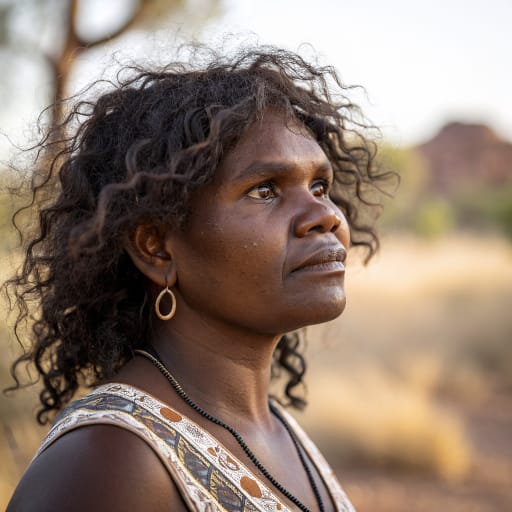
Arrernte
same region (Australia / New Zealand)
Noongar
same region (Australia / New Zealand)
Yolngu
same region (Australia / New Zealand)
Tiwi
same region (Australia / New Zealand)
Wodiwodi
same region (Australia / New Zealand)
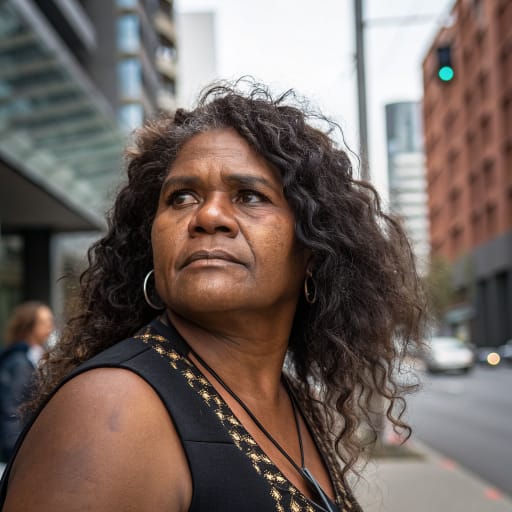
Aboriginal Tasmanians
same region (Australia / New Zealand)
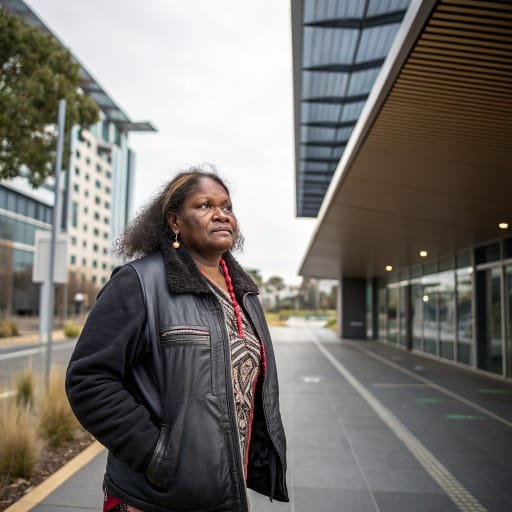
Djab Wurrung
same region (Australia / New Zealand)
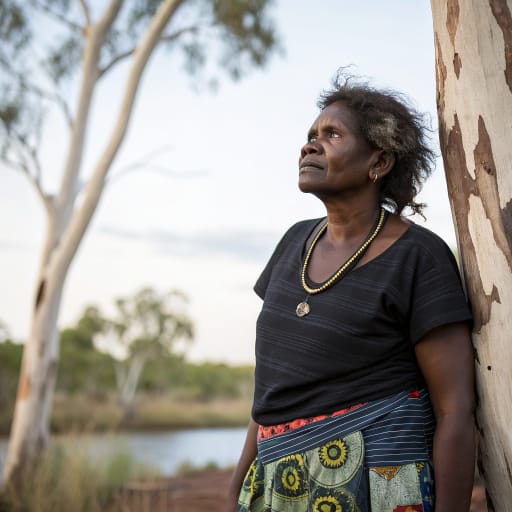
Gurindji
same region (Australia / New Zealand)
Typical Wiradjuri Phenotypes
Reference for AI generation: hair, eyes, skin, facial structure, build
Wiradjuri Body & Anatomy Reference
Per-feature anatomical profile for AI nude generation: Aboriginal Australian phenotype
Wiradjuri Boobs & Breasts
Bust reference for Wiradjuri women: small-to-medium cup, modest-to-moderate projection, which is typical of Aboriginal Australian ancestry. Areolas measure about 28-42mm across, with deep-brown to near-black pigmentation. Body type (ectomorph-to-mesomorph, lean elongated frame adapted to arid environment) shapes the bust as well, so Wiradjuri tits are usually modest projection, firm. In AI imagery, keep the forward-set shape rather than drifting toward the fuller Polynesian or West African bust.
Wiradjuri Ass & Hips
The Wiradjuri ass is typically small-to-medium, modest projection, narrower hip profile, which sets it apart from the very full Polynesian gluteal projection. Underneath, the pelvis shows narrow-to-medium iliac crests, longer torso and limb proportions, part of the Aboriginal Australian skeletal pattern. For Wiradjuri butt pics and AI renders, match that silhouette and the overall build (ectomorph-to-mesomorph, lean elongated frame adapted to arid environment).
Wiradjuri Vagina & Pussy
Wiradjuri pussy and vulvar anatomy presents deep-brown labial pigmentation, consistent with the Aboriginal Australian phenotype's pigmentation pattern. Wiradjuri pubic hair is typically wavy-to-coiled coarse texture, in the inverted-triangle pattern. For anatomically accurate Wiradjuri pussy renders the labial coloration should match the surrounding deep-brown skin tone with a continuous gradient, and the hair should keep its wavy-to-coiled coarse texture.
Wiradjuri Dicks & Penis
Wiradjuri dicks follow the Aboriginal Australian reference data: regional mean ~13cm erect; moderate girth; deep-brown shaft pigmentation. Shaft color should track the deep-brown skin tone with a smooth change toward the glans, and Wiradjuri pubic hair keeps its wavy-to-coiled coarse texture.
Wiradjuri Body, Curves & Build
Wiradjuri body type and overall build presents as ectomorph-to-mesomorph, lean elongated frame adapted to arid environment, with mean adult female BMI 23-26: the characteristic Aboriginal Australian habitus. Wiradjuri curves and proportions should keep the regional skeletal frame (height, shoulder-to-hip ratio, limb proportions) rather than a generic mesomorph default.
Wiradjuri Skin Tone & Hair Texture
Wiradjuri skin sits in the deep-brown (Fitzpatrick V-VI) band. Hair is typically wavy-to-curly 2C-3B, dark-brown to black; the distinctive blond-haired Aboriginal sub-population in Central Australia is documented and pigmentation-independent, in keeping with the Aboriginal Australian phenotype. In nude renders the skin should stay one even tone from face to body, and body, pubic and head hair should match.
Explore phenotype categories
Structured taxonomy with peer-reviewed scales · 22 anatomical categories
Erotic Poses & Sex Positions
From the pose catalog: 219 named positions with reference skeletons
Frequently asked questions about Wiradjuri people
Where is the Wiradjuri homeland?
The Wiradjuri homeland is Central New South Wales, Australia: the Macquarie, Lachlan and Murrumbidgee river country west of the Great Dividing Range, including Bathurst, Orange, Dubbo, Wagga Wagga and Albury in Australia / New Zealand.
What language do Wiradjuri people speak?
Wiradjuri people primarily speak Wiradjuri (Pama-Nyungan, Wiradhuric group, related to Gamilaraay and Ngiyampaa), now being revived; English.
What religion do Wiradjuri people practice?
The predominant religion among Wiradjuri people is Largely Christian since the mission era, with traditional law and belief centered on the creator Baiame still honored by many.






Make your own Wiradjuri images
Five a day, free, no credits to buy. The studio starts from this group's phenotype data, so you can set body type, pose and style and keep the traits accurate.
Start with Wiradjuri