Help us get this right
Does this portrait look right for Wichí?
Nobody has judged this one yet. You would be the first.
Wichí Erotic
Gran Chaco, northern Argentina (Salta, Formosa, Chaco) and southern Bolivia
Wichí Lhamtés (Matacoan)
Traditional Wichí beliefs; Anglican and evangelical Christianity
Historically called Mataco (name now widely rejected)
About Wichí People
Wichí are an Indigenous people of the Gran Chaco, the vast dry lowland plain of northern Argentina and southern Bolivia, living along the Bermejo and Pilcomayo river systems. Historically called Mataco, a name now widely rejected as offensive, they speak varieties of Wichí Lhamtés in the Matacoan family and number in the tens of thousands, among the most numerous Indigenous peoples of the Argentine Chaco.
Society and subsistence
Traditionally the Wichí lived as mobile hunters, fishers and gatherers, moving through the forest and along rivers to hunt game, catch fish during seasonal runs, and gather wild fruits, honey and the fibrous chaguar plant. The forest is a larder: the pods of the algarrobo, a carob like tree, are ground into flour and brewed into a traditional drink, and wild honey is especially prized. Bands were small and egalitarian, led by respected elders and shamans rather than formal chiefs. Colonization, ranching, logging and the rapid clearing of the Chaco for soy and cattle have sharply reduced their territory and pushed many into settled communities, wage labor and mission towns, where fishing, craft sales and seasonal work now supplement a much diminished foraging base. Christianity, especially Anglican and evangelical, is widespread alongside enduring beliefs about forest spirits and the shaman's role.
Appearance and adornment
In the hot Chaco climate traditional clothing was minimal, and today most Wichí wear ordinary modern cotton dress. The people are best known for their fiber craft: women process chaguar, a bromeliad, into strong thread and twine it into yicas, sturdy carrying bags patterned with earth tone geometric bands in natural and vegetable dyed color. Necklaces of seeds, wood and other natural materials serve as simple adornment. Elaborate body decoration is not a marked feature of Wichí life today, but their weaving is a celebrated expression of identity and a valued source of income.
Related ethnic groups
Groups that share Wichí's homeland, region, language, or religious tradition. These are likely candidates for comparative phenotype reference.
Quechua
same region (South America)
Aymara
same region (South America)
Guaraní
same region (South America)
Emberá
same region (South America)
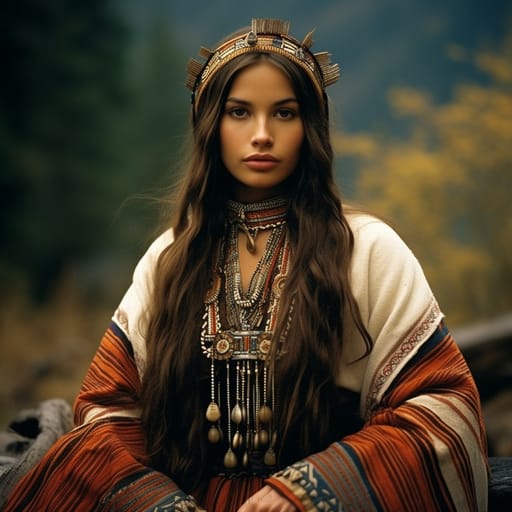
Mapuche
same region (South America)
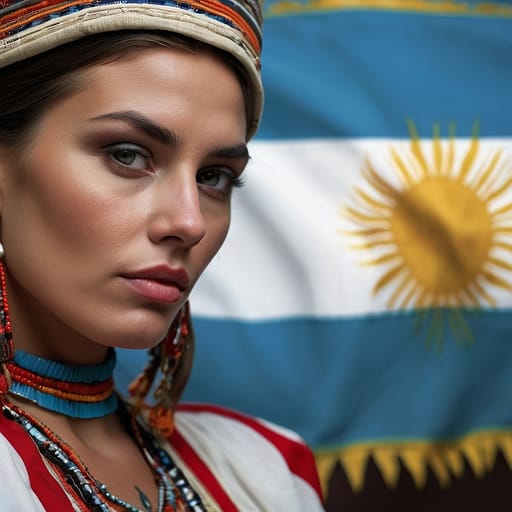
White Argentine
same region (South America)
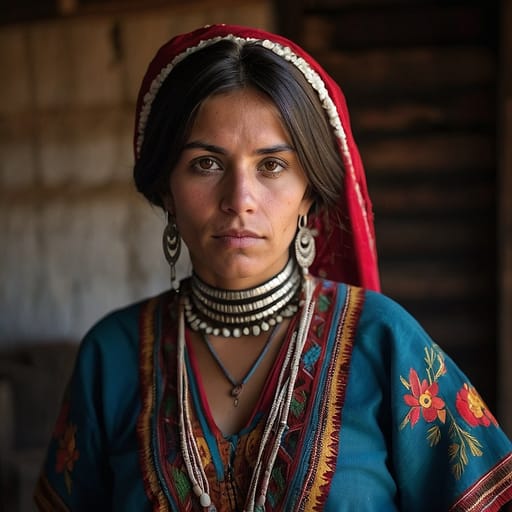
Mestizo Argentine
same region (South America)
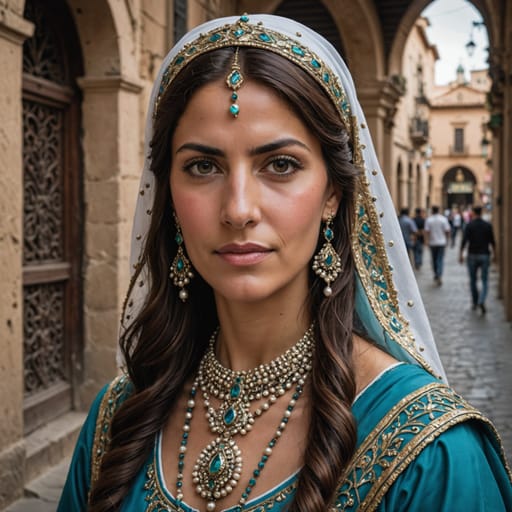
Middle Eastern Argentine
same region (South America)
Typical Wichí Phenotypes
Reference for AI generation: hair, eyes, skin, facial structure, build
Wichí Body & Anatomy Reference
Per-feature anatomical profile for AI nude generation: South American Indigenous / European-Mestizo / Afro-Latino mix phenotype
Wichí Boobs & Breasts
Wichí boobs follow the South American Indigenous / European-Mestizo / Afro-Latino mix profile: medium-to-large cup, full, high projection. Areolar diameter is usually 32-46mm, and the coloring is medium-brown to dark-brown areolar pigmentation against the tan-to-deep-brown skin tone. Breast shape tracks body composition (endomorph-to-mesomorph with high gluteal-femoral deposition, mean adult female BMI 25-28), so Wichí breasts tend to be the classic Brazilian / Latina curvy bust profile in lowland populations; smaller and shorter-set in Andean Indigenous populations. Expect a forward-set shape, not the smaller bust profile of Andean Indigenous sub-populations.
Wichí Ass & Hips
Wichí ass and hip morphology presents as full, high projection, the famous Brazilian / Latina bunda profile, distinctly different from the slim narrow-hip East Asian profile. The Wichí pelvic profile shows wide iliac crests, very full gluteal-femoral fat deposition (the hallmark Brazilian / Latina hip-to-waist ratio), anchored in the South American Indigenous / European-Mestizo / Afro-Latino mix skeletal pattern. Wichí butt shots in adult AI imagery should render the full, high projection, the famous Brazilian / Latina bunda profile silhouette with the overall build (endomorph-to-mesomorph with high gluteal-femoral deposition) and the fat distribution typical of the South American Indigenous / European-Mestizo / Afro-Latino mix phenotype.
Wichí Vagina & Pussy
Wichí pussy anatomy typically shows medium-brown to dark-brown labial pigmentation, fuller labia minora. Pubic hair is usually wavy-to-curly coarse dark texture, dense distribution. In AI-generated Wichí nudes, labial color should blend into the tan to deep-brown skin with a gradual transition, and the hair should keep its wavy-to-curly coarse dark texture.
Wichí Dicks & Penis
Penis reference for Wichí men: regional mean ~13cm erect, moderate-to-above-average girth. Coloring: medium-brown shaft pigmentation. An accurate Wichí cock in AI imagery matches the surrounding tan to deep-brown skin rather than a generic porn default. Circumcision depends on religion and custom, not ancestry.
Wichí Body, Curves & Build
The Wichí figure is generally endomorph-to-mesomorph with high gluteal-femoral deposition, with mean adult female BMI 25-28, characteristic of South American Indigenous / European-Mestizo / Afro-Latino mix ancestry. AI image tools tend to flatten regional body types into a few stock shapes; here the Wichí build is kept as its own reference.
Wichí Skin Tone & Hair Texture
Skin: tan to deep-brown (Fitzpatrick III-VI). Hair: straight-to-curly 1A-3C, varies widely by ancestral composition. Both are typical of South American Indigenous / European-Mestizo / Afro-Latino mix ancestry. The most common mistake in AI nudes of Wichí women is a body rendered lighter than the face.
Explore phenotype categories
Structured taxonomy with peer-reviewed scales · 22 anatomical categories
Erotic Poses & Sex Positions
From the pose catalog: 219 named positions with reference skeletons
Frequently asked questions about Wichí people
Where is the Wichí homeland?
The Wichí homeland is Gran Chaco, northern Argentina (Salta, Formosa, Chaco) and southern Bolivia in South America.
What language do Wichí people speak?
Wichí people primarily speak Wichí Lhamtés (Matacoan).
What religion do Wichí people practice?
The predominant religion among Wichí people is Traditional Wichí beliefs; Anglican and evangelical Christianity.






Make your own Wichí images
Five a day, free, no credits to buy. The studio starts from this group's phenotype data, so you can set body type, pose and style and keep the traits accurate.
Start with Wichí