Help us get this right
Does this portrait look right for Uru (Uros)?
Nobody has judged this one yet. You would be the first.
Uru (Uros) Erotic
Floating totora islands, Lake Titicaca, Peru and Bolivia
Uru / Uchumataqu (Uru-Chipaya; largely shifted to Aymara and Spanish)
Catholicism blended with Andean lake traditions
Uros; sister people of the Chipaya
About Uru (Uros) People
Uru, also known as the Uros, are an Indigenous Andean people best known for the artificial floating islands they build from totora reeds on Lake Titicaca, on the border of Peru and Bolivia. Their ancestral Uru language belongs to the small Uru-Chipaya family, though most Uru of Titicaca now speak Aymara and Spanish. They consider themselves among the oldest peoples of the Andes.
Society and subsistence
The Uros construct and continually rebuild dozens of floating islands by layering cut totora reeds over buoyant root mats anchored in the shallows. Near the city of Puno some islands are home to a single extended family while others hold small communities with schools and chapels, and because the reeds rot from below, fresh layers must be added constantly, so that a well kept island can last for decades. The same reed provides material for houses, watchtowers, furniture and the graceful balsa boats once central to travel and fishing. Traditional livelihood rested on fishing, hunting and trapping lake birds, and gathering reeds and eggs, with goods exchanged with mainland Aymara communities. In recent decades tourism has become a major source of income, and many families now host visitors, sell reed handicrafts and combine island life with time on the mainland.
Appearance and adornment
Uru dress closely follows the wider Aymara style of the Titicaca basin rather than a separate costume. Women wear layered gathered skirts called polleras, embroidered blouses and blankets, bright shawls fastened at the shoulder, and their hair in two long braids often linked at the back by a woolen tassel, topped by a bowler or brimmed hat. Men wear woven ponchos, trousers and knitted ear flap caps against the cold and glare of the high plateau. Faces are often ruddy and weathered by sun and altitude. The most distinctive element of Uru material culture is not personal ornament but the reed itself, worked into everything from their islands to their boats.
Related ethnic groups
Groups that share Uru (Uros)'s homeland, region, language, or religious tradition. These are likely candidates for comparative phenotype reference.
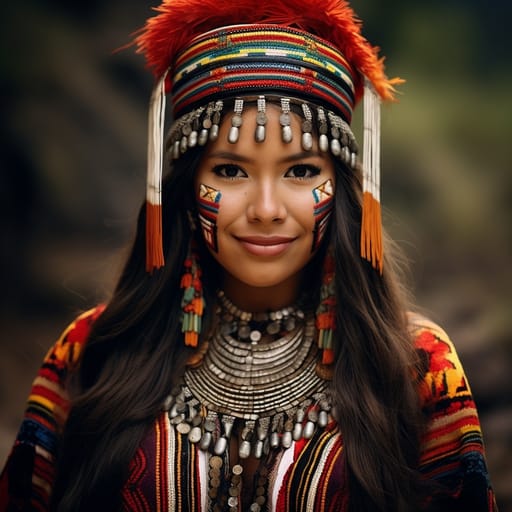
Quechua
same region (South America)
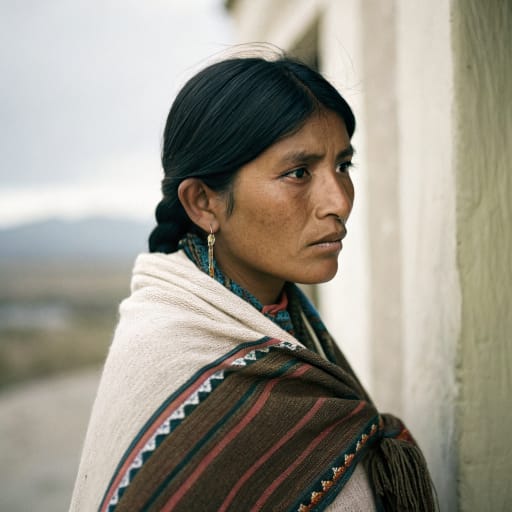
Aymara
same region (South America)
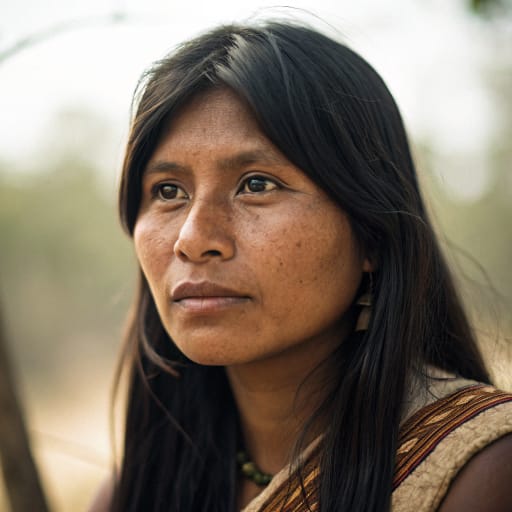
Guaraní
same region (South America)
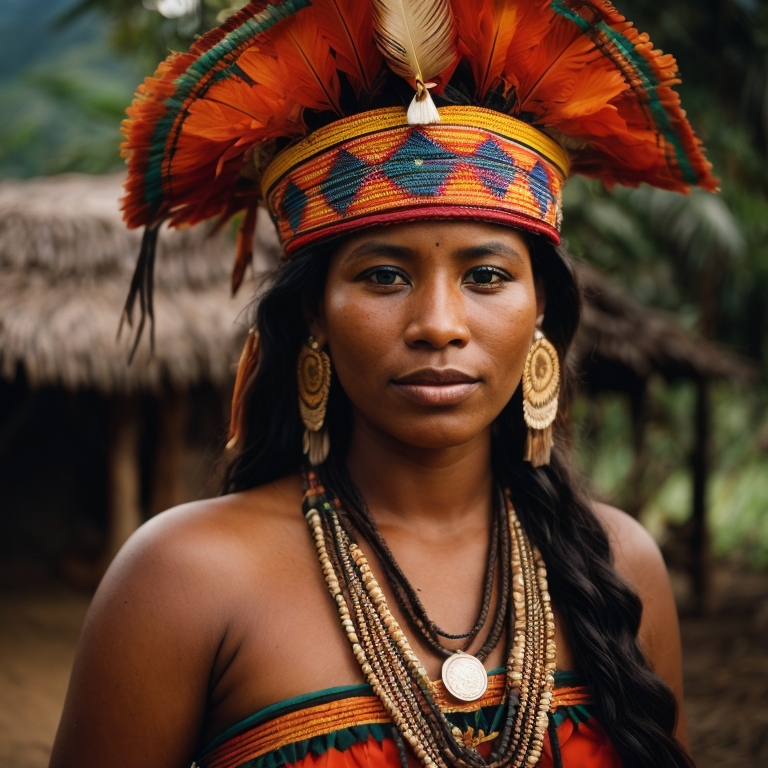
Emberá
same region (South America)
Mapuche
same region (South America)
White Argentine
same region (South America)
Mestizo Argentine
same region (South America)
Middle Eastern Argentine
same region (South America)
Typical Uru (Uros) Phenotypes
Reference for AI generation: hair, eyes, skin, facial structure, build
Uru (Uros) Body & Anatomy Reference
Anatomy by feature, South American Indigenous / European-Mestizo / Afro-Latino mix phenotype
Uru (Uros) Boobs & Breasts
Uru (Uros) tits and boobs run medium-to-large cup, full, high projection, the classic South American Indigenous / European-Mestizo / Afro-Latino mix bust profile. Uru (Uros) nipples and areolas show medium-brown to dark-brown areolar pigmentation against the tan-to-deep-brown skin tone, with areolar diameter typically in the 32-46mm range and forward-set positioning rather than the smaller bust profile of Andean Indigenous sub-populations. Uru (Uros) breasts trend the classic Brazilian / Latina curvy bust profile in lowland populations; smaller and shorter-set in Andean Indigenous populations, a function of the endomorph-to-mesomorph with high gluteal-femoral deposition body habitus and the mean adult female BMI 25-28. For anatomically accurate AI-generated Uru (Uros) nudes the render preserves the medium-to-large cup, full, high projection shape, 32-46mm areolas with medium-brown to dark-brown pigmentation, and the torso proportions of the South American Indigenous / European-Mestizo / Afro-Latino mix phenotype.
Uru (Uros) Ass & Hips
Uru (Uros) hips and butt usually read as full, high projection, the famous Brazilian / Latina bunda profile. The skeletal base is wide iliac crests, very full gluteal-femoral fat deposition (the hallmark Brazilian / Latina hip-to-waist ratio), the South American Indigenous / European-Mestizo / Afro-Latino mix pattern. Set against the slim narrow-hip East Asian profile, the difference is easy to see, and the hip-to-waist ratio is often what identifies Uru (Uros) women in photos.
Uru (Uros) Vagina & Pussy
Expect medium-brown to dark-brown labial pigmentation, fuller labia minora on Uru (Uros) women, in keeping with South American Indigenous / European-Mestizo / Afro-Latino mix ancestry. The pubic hair is wavy-to-curly coarse dark texture, dense distribution. Coloring should run evenly from the tan to deep-brown skin of the thighs to the labia, and Uru (Uros) nude imagery should keep the hair's wavy-to-curly coarse dark texture.
Uru (Uros) Dicks & Penis
Uru (Uros) dick and penile anatomy in adult AI generation should anchor on the regional reference data: regional mean ~13cm erect, moderate-to-above-average girth, and medium-brown shaft pigmentation. The Uru (Uros) cock profile reflects the South American Indigenous / European-Mestizo / Afro-Latino mix population's anthropometric measurements. The shaft pigmentation should track the surrounding tan to deep-brown skin tone, and the pubic hair should keep its wavy-to-curly coarse dark texture in the typical inverted-V escutcheon.
Uru (Uros) Body, Curves & Build
Uru (Uros) body type: endomorph-to-mesomorph with high gluteal-femoral deposition, with mean adult female BMI 25-28. This is the typical South American Indigenous / European-Mestizo / Afro-Latino mix build. Height range, shoulder-to-hip ratio and fat distribution all follow from it, which is what an accurate Uru (Uros) nude body should show.
Uru (Uros) Skin Tone & Hair Texture
Uru (Uros) skin tone falls in the tan to deep-brown (Fitzpatrick III-VI) band, the surface signal most often miscalibrated by generic AI nude generators. Uru (Uros) hair texture is typically straight-to-curly 1A-3C, varies widely by ancestral composition, characteristic of the South American Indigenous / European-Mestizo / Afro-Latino mix phenotype. In Uru (Uros) nude renders the skin should hold that band consistently across the body.
Explore phenotype categories
Structured taxonomy with peer-reviewed scales · 22 anatomical categories
Erotic Poses & Sex Positions
From the pose catalog: 219 named positions with reference skeletons
Frequently asked questions about Uru (Uros) people
Where is the Uru (Uros) homeland?
The Uru (Uros) homeland is Floating totora islands, Lake Titicaca, Peru and Bolivia in South America.
What language do Uru (Uros) people speak?
Uru (Uros) people primarily speak Uru / Uchumataqu (Uru-Chipaya; largely shifted to Aymara and Spanish).
What religion do Uru (Uros) people practice?
The predominant religion among Uru (Uros) people is Catholicism blended with Andean lake traditions.






Make your own Uru (Uros) images
Five a day, free, no credits to buy. The studio starts from this group's phenotype data, so you can set body type, pose and style and keep the traits accurate.
Start with Uru (Uros)