Help us get this right
Does this portrait look right for Gamela?
Nobody has judged this one yet. You would be the first.
Gamela Erotic
Baixada Maranhense floodplain around Viana, Maranhão state, northeastern Brazil, centered on the Taquaritiua territory
Portuguese (Indo-European, Romance); historical Gamela language (extinct, unclassified), known only from a short word list
Largely Catholic, with local saint festivals and revived Indigenous ritual
Self-identify as Akroá-Gamella; communities of the Taquaritiua territory in Viana and neighboring municipalities of Maranhão
About Gamela People
For most of the twentieth century, anyone asking who the Gamela were got an answer in the past tense. Colonial writers placed them in the lake country and river valleys of Maranhão, in northeastern Brazil, as a people who resisted Portuguese expansion and wore wooden discs in their lower lips and earlobes. Their Portuguese name comes from those discs: a gamela is a wooden bowl or trough. Over time the state stopped counting them as a distinct people and folded them into the rural poor of the region. The families around Viana never accepted that. Today they call themselves Akroá-Gamella, and they say it in public.
Their core territory, Taquaritiua, lies in the Baixada Maranhense, a low floodplain of seasonal lakes and fields southwest of São Luís. Viana itself grew out of an eighteenth-century Jesuit mission where Indigenous people were gathered and settled, and Gamela families point to that colonial history when they defend their claim to the land. Over the last century, ranchers fenced off fields and lakeshores where earlier generations had fished and farmed. In the 2010s the Gamela began moving back onto those lands, a practice Brazil's Indigenous movements call retomada, or retaking. The response was violent. In April 2017 an attack in Viana left more than a dozen people wounded, some with gunshot and machete injuries, and put the group in the national news. Official recognition of their territory has moved slowly since.
The Gamela language is gone. What survives is a short word list collected in the 1930s by the ethnographer Curt Nimuendajú from elderly people who still remembered some words. That is too little for linguists to place the language in any family with confidence. Daily life runs in Portuguese, and religious life is largely Catholic, built around the saint festivals common in rural Maranhão. What the community has rebuilt shows up at gatherings and on retaken land: body paint, feather headdresses and collective rituals. None of it is costume. It tells the country that a people it declared finished are still here, fishing and farming the same floodplain.
Related ethnic groups
Groups that share Gamela's homeland, region, language, or religious tradition. These are likely candidates for comparative phenotype reference.
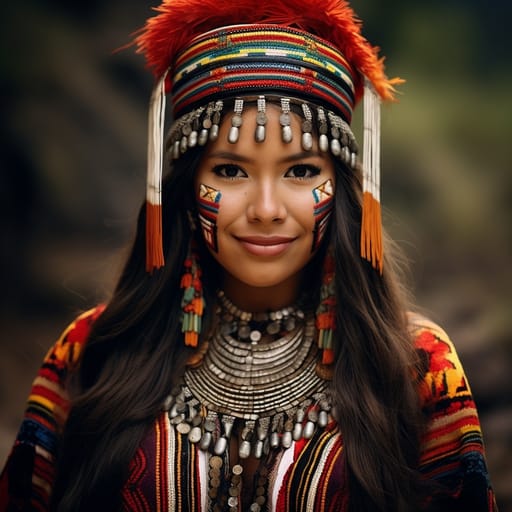
Quechua
same region (South America)
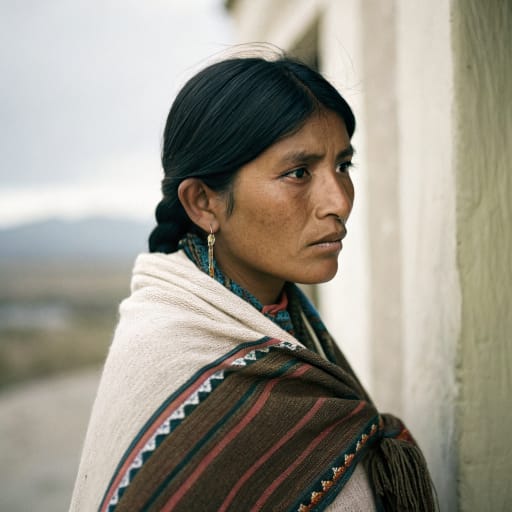
Aymara
same region (South America)
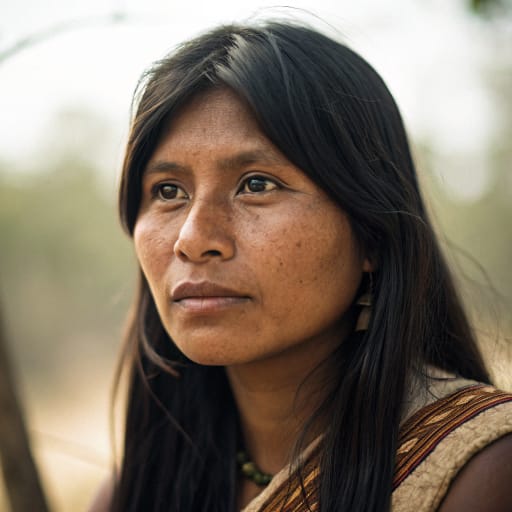
Guaraní
same region (South America)
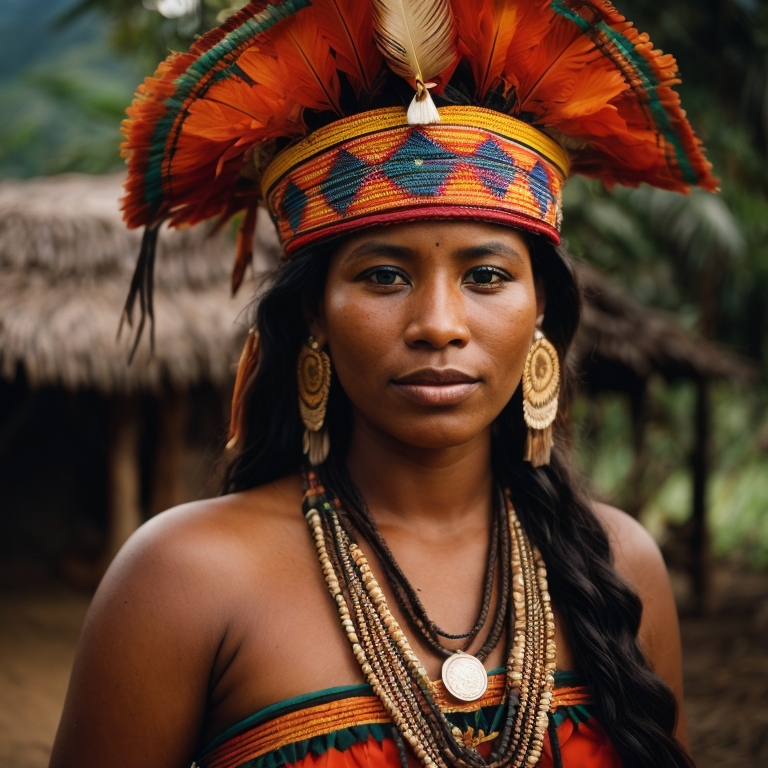
Emberá
same region (South America)
White Brazilian
same region (South America)
Quimbaya
same region (South America)
Ye'kuana
same region (South America)
Amazonian Indigenous Ecuadorian
same region (South America)
Typical Gamela Phenotypes
Reference for AI generation: hair, eyes, skin, facial structure, build
Gamela Body & Anatomy Reference
Per-feature anatomical profile for AI nude generation: South American Indigenous / European-Mestizo / Afro-Latino mix phenotype
Gamela Boobs & Breasts
Bust reference for Gamela women: medium-to-large cup, full, high projection, which is typical of South American Indigenous / European-Mestizo / Afro-Latino mix ancestry. Areolas measure about 32-46mm across, with medium-brown to dark-brown pigmentation. Body type (endomorph-to-mesomorph with high gluteal-femoral deposition) shapes the bust as well, so Gamela tits are usually the classic Brazilian / Latina curvy bust profile in lowland populations; smaller and shorter-set in Andean Indigenous populations. In AI imagery, keep the forward-set shape rather than drifting toward the smaller bust profile of Andean Indigenous sub-populations.
Gamela Ass & Hips
The Gamela ass is typically full, high projection, the famous Brazilian / Latina bunda profile, which sets it apart from the slim narrow-hip East Asian profile. Underneath, the pelvis shows wide iliac crests, very full gluteal-femoral fat deposition (the hallmark Brazilian / Latina hip-to-waist ratio), part of the South American Indigenous / European-Mestizo / Afro-Latino mix skeletal pattern. For Gamela butt pics and AI renders, match that silhouette and the overall build (endomorph-to-mesomorph with high gluteal-femoral deposition).
Gamela Vagina & Pussy
Gamela pussy and vulvar anatomy presents medium-brown to dark-brown labial pigmentation, fuller labia minora, consistent with the South American Indigenous / European-Mestizo / Afro-Latino mix phenotype's pigmentation pattern. Gamela pubic hair is typically wavy-to-curly coarse dark texture, dense distribution, in the inverted-triangle pattern. For anatomically accurate Gamela pussy renders the labial coloration should match the surrounding tan to deep-brown skin tone with a continuous gradient, and the hair should keep its wavy-to-curly coarse dark texture.
Gamela Dicks & Penis
Gamela dicks follow the South American Indigenous / European-Mestizo / Afro-Latino mix reference data: regional mean ~13cm erect; moderate-to-above-average girth; medium-brown shaft pigmentation. Shaft color should track the tan to deep-brown skin tone with a smooth change toward the glans, and Gamela pubic hair keeps its wavy-to-curly coarse dark texture.
Gamela Body, Curves & Build
Gamela body type and overall build presents as endomorph-to-mesomorph with high gluteal-femoral deposition, with mean adult female BMI 25-28: the characteristic South American Indigenous / European-Mestizo / Afro-Latino mix habitus. Gamela curves and proportions should keep the regional skeletal frame (height, shoulder-to-hip ratio, limb proportions) rather than a generic mesomorph default.
Gamela Skin Tone & Hair Texture
Gamela skin sits in the tan to deep-brown (Fitzpatrick III-VI) band. Hair is typically straight-to-curly 1A-3C, varies widely by ancestral composition, in keeping with the South American Indigenous / European-Mestizo / Afro-Latino mix phenotype. In nude renders the skin should stay one even tone from face to body, and body, pubic and head hair should match.
Explore phenotype categories
Structured taxonomy with peer-reviewed scales · 22 anatomical categories
Erotic Poses & Sex Positions
From the pose catalog: 219 named positions with reference skeletons
Frequently asked questions about Gamela people
Where is the Gamela homeland?
The Gamela homeland is Baixada Maranhense floodplain around Viana, Maranhão state, northeastern Brazil, centered on the Taquaritiua territory in South America.
What language do Gamela people speak?
Gamela people primarily speak Portuguese (Indo-European, Romance); historical Gamela language (extinct, unclassified), known only from a short word list.
What religion do Gamela people practice?
The predominant religion among Gamela people is Largely Catholic, with local saint festivals and revived Indigenous ritual.






Make your own Gamela images
Five a day, free, no credits to buy. The studio starts from this group's phenotype data, so you can set body type, pose and style and keep the traits accurate.
Start with Gamela