No portrait yet
Western Apache Erotic
East-central Arizona, United States: the White Mountains, the Mogollon Rim and the Salt, Gila and Verde river country, centered on the Fort Apache and San Carlos reservations
Western Apache (Na-Dene, Southern Athabaskan branch), with White Mountain, Cibecue, San Carlos and Tonto dialects; English is widely spoken
Traditional Apache ceremonial religion alongside Lutheran, Catholic and evangelical Christianity; also the Holy Ground religion founded by Silas John Edwards
Apachean (Southern Athabaskan) peoples. Groups: White Mountain, Cibecue, San Carlos (incl. Aravaipa, Pinal), Northern and Southern Tonto. Tribes: White Mountain Apache, San Carlos Apache, Tonto Apache, Yavapai-Apache Nation
About Western Apache People
Western Apache people call themselves Ndee, the People, and what holds them together is less a single tribal government than a web of matrilineal clans and local bands spread across the mountains, rims and river valleys of east-central Arizona. Twentieth-century ethnographers sorted them into five groups: White Mountain, Cibecue, San Carlos, Northern Tonto and Southern Tonto. The clans cut across those lines, many named for the place where the clan is said to have first farmed, and membership still matters for marriage and for who owes help at a ceremony. They are not Geronimo's people. That was the Chiricahua, and Western Apache men served in large numbers as Army scouts in the campaigns against them. The old economy paired small streamside plots of corn, beans and squash with hunting and a seasonal round of gathering: acorns, pinyon nuts, saguaro fruit, and agave hearts slow-roasted in rock-lined pits. The language is Southern Athabaskan, close kin to Navajo and Chiricahua and distant kin to languages of Alaska and western Canada, and it is still spoken at home on the Fort Apache and San Carlos reservations, more by grandparents than by teenagers. At Cibecue, fieldworkers documented how place-names carry compact stories, so that naming a spot on the land can remind someone how a person ought to behave. Silence carries weight too, expected when meeting strangers or facing someone whose mood is uncertain.
Lutheran missionaries arrived in the 1890s, and Catholic and evangelical churches followed, but ceremonial life never gave way. Early in the twentieth century Silas John Edwards founded the Holy Ground religion, complete with its own system of written prayer symbols. The best-known rite today is the Sunrise Dance, Na'ii'ees, a four-day coming-of-age ceremony in which a girl takes on the power of Changing Woman, is blessed with cattail pollen, and dances for hours while masked Crown Dancers, the Gaan, embody the Mountain Spirits. Sponsoring one takes months of preparation and a serious outlay of food and gifts. In 1871 the Camp Grant Massacre killed more than a hundred Aravaipa and Pinal Apache, most of them women and children, and in 1875 Tonto Apache and Yavapai were force-marched out of the Verde Valley to San Carlos. Today the White Mountain Apache Tribe governs the Fort Apache Reservation and owns a ski resort in its high country. The San Carlos Apache have turned Oak Flat, a ceremonial ground near Superior that Congress approved trading to a copper-mining company, into a national cause. Smaller communities at Payson and Camp Verde, the latter shared with the Yavapai, complete the map.
Related ethnic groups
Groups that share Western Apache's homeland, region, language, or religious tradition. These are likely candidates for comparative phenotype reference.
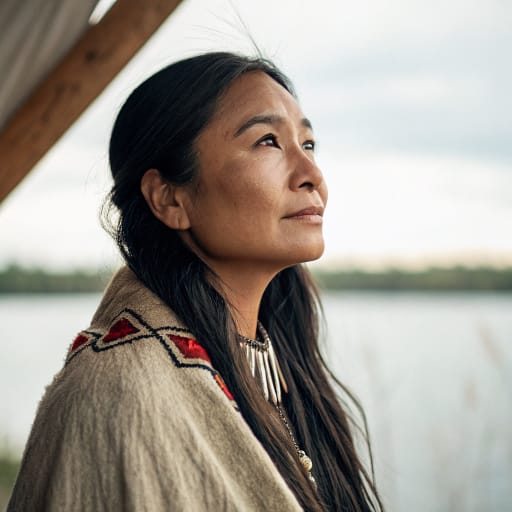
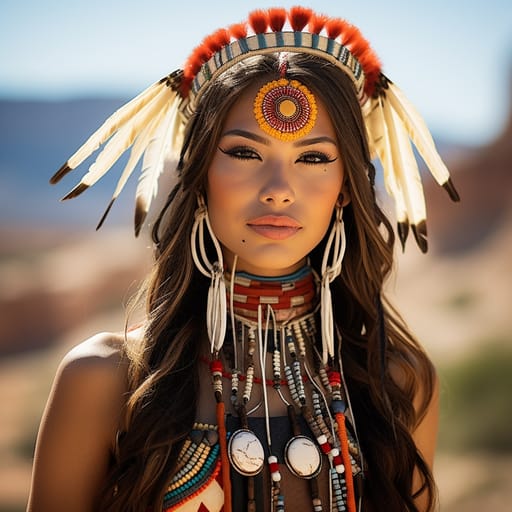
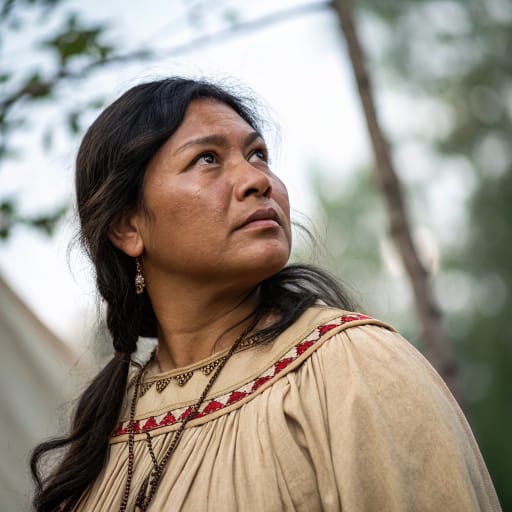
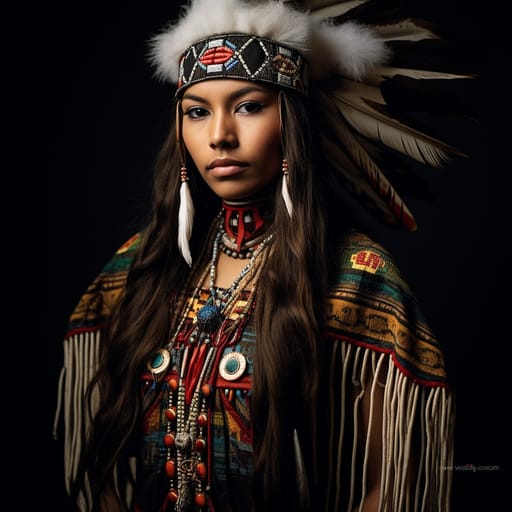
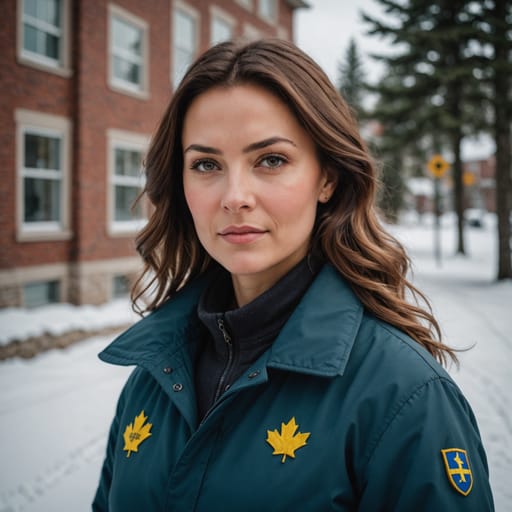
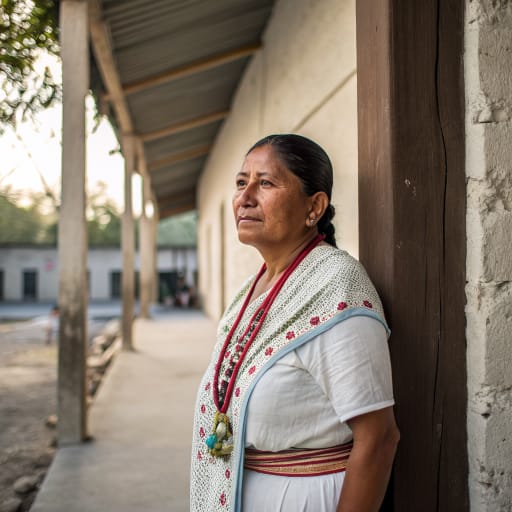
Typical Western Apache Phenotypes
Reference for AI generation: hair, eyes, skin, facial structure, build
Western Apache Body & Anatomy Reference
Anatomy by feature, Indigenous Northern American / Algonquian-Iroquoian phenotype
Western Apache Boobs & Breasts
Western Apache boobs follow the Indigenous Northern American / Algonquian-Iroquoian profile: medium cup, moderate projection. Areolar diameter is usually 30-44mm, and the coloring is medium-brown areolar pigmentation against the copper-to-medium-brown skin tone. Breast shape tracks body composition (mesomorph, broader frame in northern Indigenous populations, mean adult female BMI 25-28), so Western Apache breasts tend to be full and moderate projection. Expect a forward-set shape, not the smaller East Asian bust.
Western Apache Ass & Hips
Western Apache ass and hip morphology presents as medium, moderate-to-full projection, distinctly different from the slim East Asian narrow-hip profile. The Western Apache pelvic profile shows medium iliac crests, anchored in the Indigenous Northern American / Algonquian-Iroquoian skeletal pattern. Western Apache butt shots in adult AI imagery should render the medium, moderate-to-full projection silhouette with the overall build (mesomorph, broader frame in northern Indigenous populations) and the fat distribution typical of the Indigenous Northern American / Algonquian-Iroquoian phenotype.
Western Apache Vagina & Pussy
Western Apache pussy anatomy typically shows medium-brown labial pigmentation. Pubic hair is usually straight medium-coarse texture. In AI-generated Western Apache nudes, labial color should blend into the copper to medium-brown skin with a gradual transition, and the hair should keep its straight medium-coarse texture.
Western Apache Dicks & Penis
Penis reference for Western Apache men: regional mean ~13cm erect, moderate girth. Coloring: medium-brown shaft pigmentation. An accurate Western Apache cock in AI imagery matches the surrounding copper to medium-brown skin rather than a generic porn default. Circumcision depends on religion and custom, not ancestry.
Western Apache Body, Curves & Build
The Western Apache figure is generally mesomorph, broader frame in northern Indigenous populations, with mean adult female BMI 25-28, characteristic of Indigenous Northern American / Algonquian-Iroquoian ancestry. AI image tools tend to flatten regional body types into a few stock shapes; here the Western Apache build is kept as its own reference.
Western Apache Skin Tone & Hair Texture
Skin: copper to medium-brown (Fitzpatrick III-V). Hair: straight 1A, dark-brown to black, often thick and dense. Both are typical of Indigenous Northern American / Algonquian-Iroquoian ancestry. The most common mistake in AI nudes of Western Apache women is a body rendered lighter than the face.
Explore phenotype categories
Structured taxonomy with peer-reviewed scales · 22 anatomical categories
Erotic Poses & Sex Positions
From the pose catalog: 219 named positions with reference skeletons
Frequently asked questions about Western Apache people
Where is the Western Apache homeland?
The Western Apache homeland is East-central Arizona, United States: the White Mountains, the Mogollon Rim and the Salt, Gila and Verde river country, centered on the Fort Apache and San Carlos reservations in North America.
What language do Western Apache people speak?
Western Apache people primarily speak Western Apache (Na-Dene, Southern Athabaskan branch), with White Mountain, Cibecue, San Carlos and Tonto dialects; English is widely spoken.
What religion do Western Apache people practice?
The predominant religion among Western Apache people is Traditional Apache ceremonial religion alongside Lutheran, Catholic and evangelical Christianity; also the Holy Ground religion founded by Silas John Edwards.






Make your own Western Apache images
Five a day, free, no credits to buy. The studio starts from this group's phenotype data, so you can set body type, pose and style and keep the traits accurate.
Start with Western Apache