Help us get this right
Does this portrait look right for Wana (Tau Taa Wana)?
Nobody has judged this one yet. You would be the first.
Wana (Tau Taa Wana) Erotic
Morowali interior, eastern Central Sulawesi, Indonesia
Indigenous shamanistic religion; some Christianity and Islam
part of the broader To Wana
About Wana (Tau Taa Wana) People
Wana (Tau Taa Wana), who call themselves Tau Taa Wana, are an Austronesian people of the mountainous interior of eastern Central Sulawesi, Indonesia, in the hinterland around Morowali. They speak a Celebic language and live in dispersed swidden farming settlements away from the coast. The Wana became widely known through the anthropologist Jane Monnig Atkinson, whose study of Wana shamanship examined the art and politics of their ritual life.
Society and subsistence
The Wana practise swidden (shifting) cultivation, with hill rice as the central crop alongside maize, cassava, and forest produce. Settlements are small and mobile, and social life is relatively egalitarian, without the ranked nobility found among some neighbouring Sulawesi peoples. Kin ties and reciprocity, rather than formal offices, order daily affairs. Religious life centres on shamanism: the shaman, or tau walia, mediates with unseen spirit powers, and the mabolong curing ceremony brings the community together through night-long singing, drumming, and trance. Wana communities value autonomy and mobility, shifting their small hamlets as gardens are cleared and abandoned, and they have historically kept a wary distance from lowland administration. While many keep their ancestral religion, some have adopted Christianity or Islam.
Appearance and adornment
The Wana share the physical type of upland Sulawesi, with brown skin, straight to waved black hair, and a slight, wiry build suited to steep forest terrain. Traditionally, clothing was made from beaten barkcloth, and simple wrapped garments, plaited fibre, and modest bead or seed ornaments remained common in the interior. Betel chewing, plaited rattan bands, and simple metal and bead jewellery complete everyday adornment. Everyday dress is understated compared with the elaborate regalia of Sulawesi's lowland courts, and at curing ceremonies dress and decoration mark the ritual role of the shaman rather than personal rank, while forest knowledge and skill in healing carry more social weight than display.
Related ethnic groups
Groups that share Wana (Tau Taa Wana)'s homeland, region, language, or religious tradition. These are likely candidates for comparative phenotype reference.
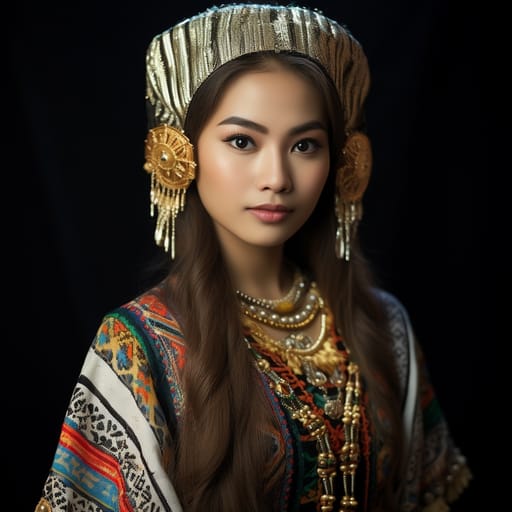
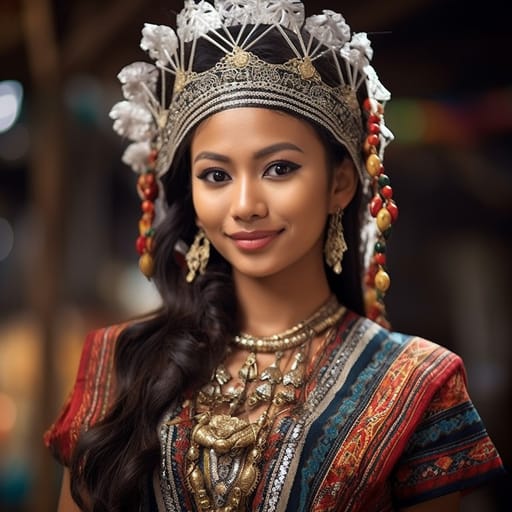


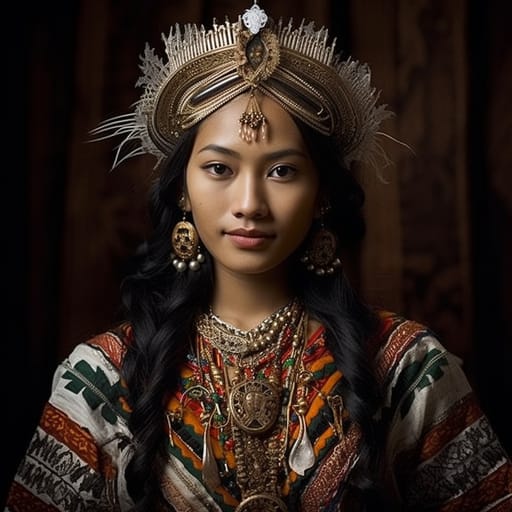

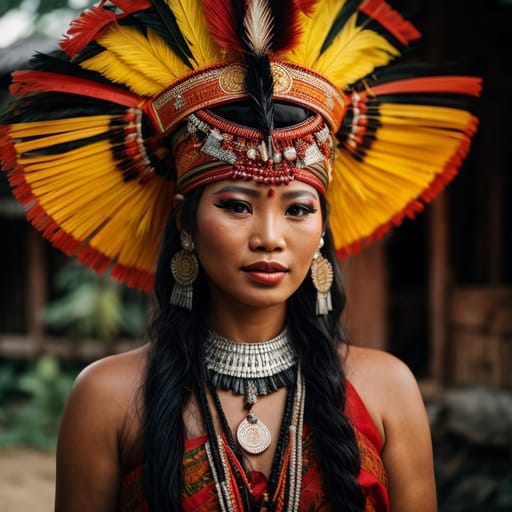
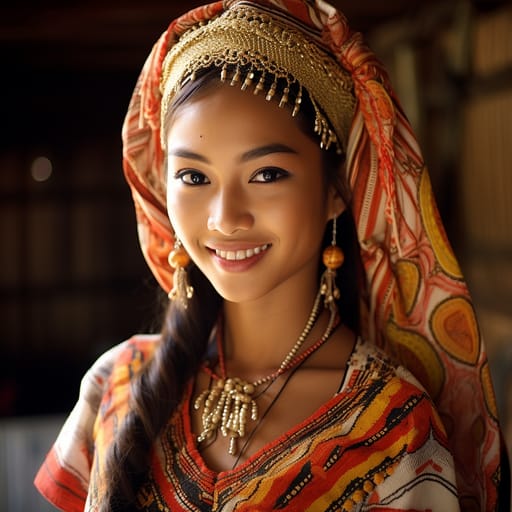
Typical Wana (Tau Taa Wana) Phenotypes
Reference for AI generation: hair, eyes, skin, facial structure, build
Wana (Tau Taa Wana) Body & Anatomy Reference
Anatomy by feature, Southeast Asian Austronesian / Austroasiatic phenotype
Wana (Tau Taa Wana) Boobs & Breasts
Bust reference for Wana (Tau Taa Wana) women: small-to-medium cup, modest projection, which is typical of Southeast Asian Austronesian / Austroasiatic ancestry. Areolas measure about 26-38mm across, with medium-brown to dark-brown pigmentation. Body type (ectomorph, petite frame) shapes the bust as well, so Wana (Tau Taa Wana) tits are usually firm, modest projection. In AI imagery, keep the forward-set shape rather than drifting toward the fuller South Asian or Polynesian bust.
Wana (Tau Taa Wana) Ass & Hips
The Wana (Tau Taa Wana) ass is typically small-to-medium, modest projection, narrower hip profile, which sets it apart from the fuller glutes of the Pacific Islander phenotype. Underneath, the pelvis shows narrow-to-medium iliac crests, part of the Southeast Asian Austronesian / Austroasiatic skeletal pattern. For Wana (Tau Taa Wana) butt pics and AI renders, match that silhouette and the overall build (ectomorph, petite frame).
Wana (Tau Taa Wana) Vagina & Pussy
Wana (Tau Taa Wana) pussy and vulvar anatomy presents medium-brown to dark-brown labial pigmentation, consistent with the Southeast Asian Austronesian / Austroasiatic phenotype's pigmentation pattern. Wana (Tau Taa Wana) pubic hair is typically straight-to-wavy fine-to-medium texture, in the inverted-triangle pattern. For anatomically accurate Wana (Tau Taa Wana) pussy renders the labial coloration should match the surrounding tan to medium-brown skin tone with a continuous gradient, and the hair should keep its straight-to-wavy fine-to-medium texture.
Wana (Tau Taa Wana) Dicks & Penis
Wana (Tau Taa Wana) dicks follow the Southeast Asian Austronesian / Austroasiatic reference data: regional mean ~11cm erect; moderate girth; medium-brown shaft pigmentation. Shaft color should track the tan to medium-brown skin tone with a smooth change toward the glans, and Wana (Tau Taa Wana) pubic hair keeps its straight-to-wavy fine-to-medium texture.
Wana (Tau Taa Wana) Body, Curves & Build
Wana (Tau Taa Wana) body type and overall build presents as ectomorph, petite frame, with mean adult female BMI 20-23: the characteristic Southeast Asian Austronesian / Austroasiatic habitus. Wana (Tau Taa Wana) curves and proportions should keep the regional skeletal frame (height, shoulder-to-hip ratio, limb proportions) rather than a generic mesomorph default.
Wana (Tau Taa Wana) Skin Tone & Hair Texture
Wana (Tau Taa Wana) skin sits in the tan to medium-brown (Fitzpatrick III-V) band. Hair is typically straight-to-wavy 1A-2A, dark-brown to black, in keeping with the Southeast Asian Austronesian / Austroasiatic phenotype. In nude renders the skin should stay one even tone from face to body, and body, pubic and head hair should match.
Explore phenotype categories
Structured taxonomy with peer-reviewed scales · 22 anatomical categories
Erotic Poses & Sex Positions
From the pose catalog: 219 named positions with reference skeletons
Frequently asked questions about Wana (Tau Taa Wana) people
Where is the Wana (Tau Taa Wana) homeland?
The Wana (Tau Taa Wana) homeland is Morowali interior, eastern Central Sulawesi, Indonesia in Southeast Asia.
What language do Wana (Tau Taa Wana) people speak?
Wana (Tau Taa Wana) people primarily speak Wana (Austronesian, Celebic).
What religion do Wana (Tau Taa Wana) people practice?
The predominant religion among Wana (Tau Taa Wana) people is Indigenous shamanistic religion; some Christianity and Islam.






Make your own Wana (Tau Taa Wana) images
Five a day, free, no credits to buy. The studio starts from this group's phenotype data, so you can set body type, pose and style and keep the traits accurate.
Start with Wana (Tau Taa Wana)