Help us get this right
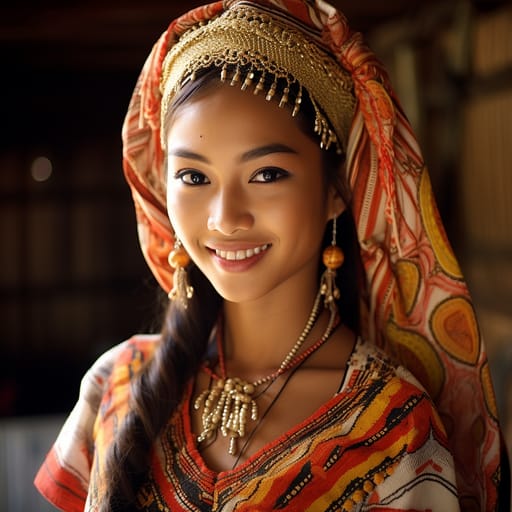
Does this portrait look right for Katu (Cơ Tu)?
Nobody has judged this one yet. You would be the first.
Katu (Cơ Tu) Erotic
Annamite Range, Quảng Nam and Thừa Thiên Huế, central Vietnam (and southern Laos)
Animism (ancestor and nature spirits); some Christianity
Katuic peoples; highland and lowland Katu groups
About Katu (Cơ Tu) People
The Katu, known in Vietnamese as the Cơ Tu, are an Austroasiatic people of the Annamite mountains of central Vietnam (chiefly Quảng Nam and Thừa Thiên Huế) and adjacent parts of southern Laos. They number well over sixty thousand and speak Katu, a Katuic language of the Mon-Khmer branch. Their culture is animist, centered on ancestral and nature spirits, though Christianity and Buddhism are also present today.
Society and subsistence
The Katu are swidden farmers of upland rice, maize, and cassava, supplemented by hunting, fishing, and forest gathering. Houses traditionally stood in a ring or row around the Gươl, a tall communal house at the village center with a soaring roof and richly carved and painted posts and beams that serves as the ritual and political heart of the settlement. Buffalo sacrifice is the central rite of the ceremonial calendar: the animal is tethered to a carved ritual pole and honored before the community shares its meat, a rite accompanied by gong music and a distinctive circular dance that binds the living and the dead and marks major social events.
Appearance and adornment
The Katu are noted weavers whose women produce dark indigo and black cloth patterned with rows of white lead beads worked directly into the textile, forming geometric and figural designs. Both sexes traditionally wore wrapped skirts and loincloths of this cloth, with beaded sashes, and festive dress adds bead necklaces, silver, bone or ivory ear ornaments, and feathered or beaded headwear for dancers.
Heritage and change
State programs, sedentarization, and the spread of schooling and Christianity have reshaped Katu life since the mid-twentieth century, and many now farm wet rice and live in modern housing. The Gươl house, gong culture, buffalo sacrifice, and bead-figured weaving remain powerful emblems of Katu identity, sustained at festivals and through community craft.
Related ethnic groups
Groups that share Katu (Cơ Tu)'s homeland, region, language, or religious tradition. These are likely candidates for comparative phenotype reference.
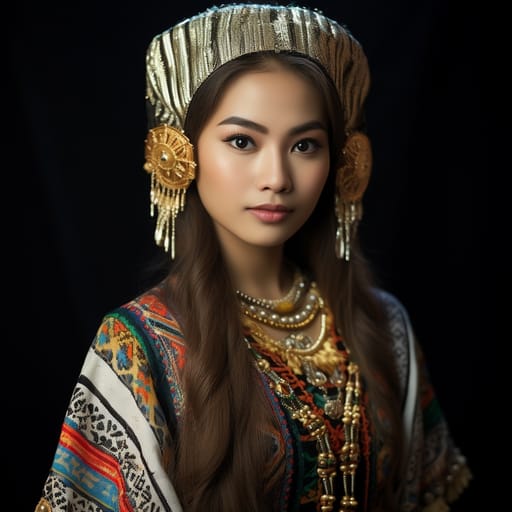
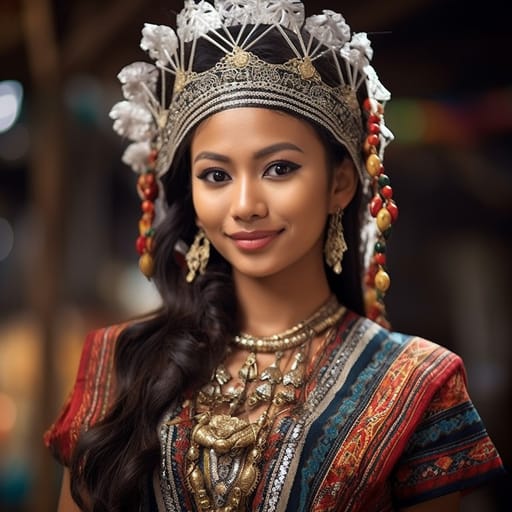


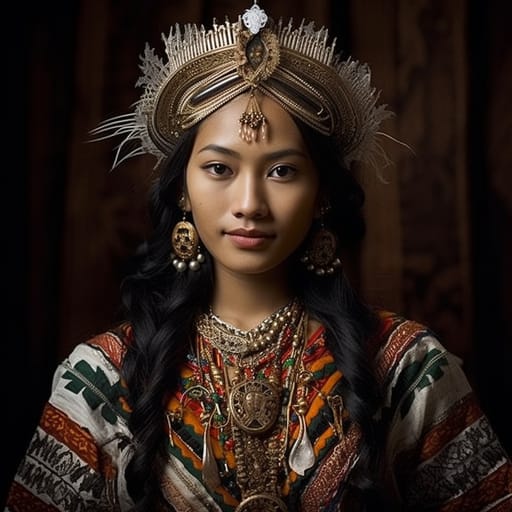

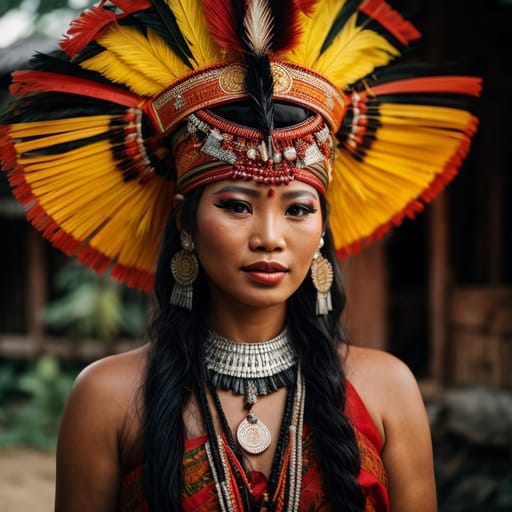
Typical Katu (Cơ Tu) Phenotypes
Reference for AI generation: hair, eyes, skin, facial structure, build
Katu (Cơ Tu) Body & Anatomy Reference
Anatomy by feature, Southeast Asian Austronesian / Austroasiatic phenotype
Katu (Cơ Tu) Boobs & Breasts
Bust reference for Katu (Cơ Tu) women: small-to-medium cup, modest projection, which is typical of Southeast Asian Austronesian / Austroasiatic ancestry. Areolas measure about 26-38mm across, with medium-brown to dark-brown pigmentation. Body type (ectomorph, petite frame) shapes the bust as well, so Katu (Cơ Tu) tits are usually firm, modest projection. In AI imagery, keep the forward-set shape rather than drifting toward the fuller South Asian or Polynesian bust.
Katu (Cơ Tu) Ass & Hips
The Katu (Cơ Tu) ass is typically small-to-medium, modest projection, narrower hip profile, which sets it apart from the fuller glutes of the Pacific Islander phenotype. Underneath, the pelvis shows narrow-to-medium iliac crests, part of the Southeast Asian Austronesian / Austroasiatic skeletal pattern. For Katu (Cơ Tu) butt pics and AI renders, match that silhouette and the overall build (ectomorph, petite frame).
Katu (Cơ Tu) Vagina & Pussy
Katu (Cơ Tu) pussy and vulvar anatomy presents medium-brown to dark-brown labial pigmentation, consistent with the Southeast Asian Austronesian / Austroasiatic phenotype's pigmentation pattern. Katu (Cơ Tu) pubic hair is typically straight-to-wavy fine-to-medium texture, in the inverted-triangle pattern. For anatomically accurate Katu (Cơ Tu) pussy renders the labial coloration should match the surrounding tan to medium-brown skin tone with a continuous gradient, and the hair should keep its straight-to-wavy fine-to-medium texture.
Katu (Cơ Tu) Dicks & Penis
Katu (Cơ Tu) dicks follow the Southeast Asian Austronesian / Austroasiatic reference data: regional mean ~11cm erect; moderate girth; medium-brown shaft pigmentation. Shaft color should track the tan to medium-brown skin tone with a smooth change toward the glans, and Katu (Cơ Tu) pubic hair keeps its straight-to-wavy fine-to-medium texture.
Katu (Cơ Tu) Body, Curves & Build
Katu (Cơ Tu) body type and overall build presents as ectomorph, petite frame, with mean adult female BMI 20-23: the characteristic Southeast Asian Austronesian / Austroasiatic habitus. Katu (Cơ Tu) curves and proportions should keep the regional skeletal frame (height, shoulder-to-hip ratio, limb proportions) rather than a generic mesomorph default.
Katu (Cơ Tu) Skin Tone & Hair Texture
Katu (Cơ Tu) skin sits in the tan to medium-brown (Fitzpatrick III-V) band. Hair is typically straight-to-wavy 1A-2A, dark-brown to black, in keeping with the Southeast Asian Austronesian / Austroasiatic phenotype. In nude renders the skin should stay one even tone from face to body, and body, pubic and head hair should match.
Explore phenotype categories
Structured taxonomy with peer-reviewed scales · 22 anatomical categories
Erotic Poses & Sex Positions
From the pose catalog: 219 named positions with reference skeletons
Frequently asked questions about Katu (Cơ Tu) people
Where is the Katu (Cơ Tu) homeland?
The Katu (Cơ Tu) homeland is Annamite Range, Quảng Nam and Thừa Thiên Huế, central Vietnam (and southern Laos) in Southeast Asia.
What language do Katu (Cơ Tu) people speak?
Katu (Cơ Tu) people primarily speak Katu (Austroasiatic, Katuic).
What religion do Katu (Cơ Tu) people practice?
The predominant religion among Katu (Cơ Tu) people is Animism (ancestor and nature spirits); some Christianity.






Make your own Katu (Cơ Tu) images
Five a day, free, no credits to buy. The studio starts from this group's phenotype data, so you can set body type, pose and style and keep the traits accurate.
Start with Katu (Cơ Tu)