Help us get this right
Does this portrait look right for Ubykh?
One tap. It takes a second and it is recorded.
1 says it looks right, 0 say it looks off.
Ubykh Erotic
Historically the Sochi Black Sea coast, northwest Caucasus; now Anatolia, Turkey
Ubykh (Northwest Caucasian), extinct since 1992; community shifted to Turkish
Sunni Islam (historically)
Northwest Caucasian peoples; related to Abkhaz and Adyghe (Circassians)
About Ubykh People
The Ubykh are a Northwest Caucasian people who once inhabited the Black Sea coast around present-day Sochi, between the lands of the Abkhaz and the Circassians (Adyghe). Following the Russian conquest of the Caucasus, almost the entire nation was expelled or fled to the Ottoman Empire in 1864. Their language, Ubykh, celebrated by linguists for having one of the largest consonant inventories of any known language, became extinct in 1992 with the death of its last fluent speaker, Tevfik Esenc, in Turkey.
Society and subsistence
In their homeland the Ubykh were Sunni Muslims and lived much as their Circassian and Abkhaz neighbors did, with an economy of mountain and coastal farming, orchards, stock raising, and beekeeping, and a warrior aristocratic society organized by rank and clan. After exile they were resettled in Anatolia, where they lived among and gradually merged with Circassian and Turkish communities. Within a few generations they shifted to Adyghe and then Turkish speech, and today their descendants in Turkey identify broadly as Circassian while preserving the memory of Ubykh origin. Before the language died, scholars such as Georges Dumezil and Hans Vogt worked closely with its last speakers, and the recordings and texts they gathered from Tevfik Esenc make Ubykh one of the best-documented of extinct languages, while descendants and Circassian activists have sought to keep its heritage in memory.
Appearance and adornment
The Ubykh shared the physical type and material culture of the western Caucasus peoples: generally fair to olive skin, dark hair, and dark eyes. Their traditional dress was the classic Circassian costume: for men the cherkeska coat with rows of cartridge holders across the chest, a papakha or hood, a slender belt, and a dagger and saber; for women long flowing gowns with a fitted bodice, a silver belt, and a tall embroidered headdress with a veil.
Related ethnic groups
Groups that share Ubykh's homeland, region, language, or religious tradition. These are likely candidates for comparative phenotype reference.
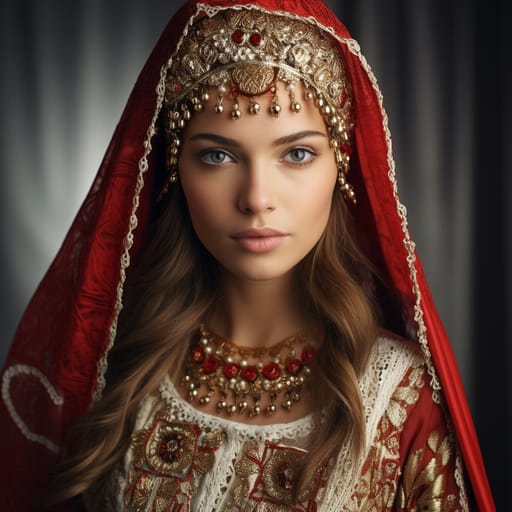
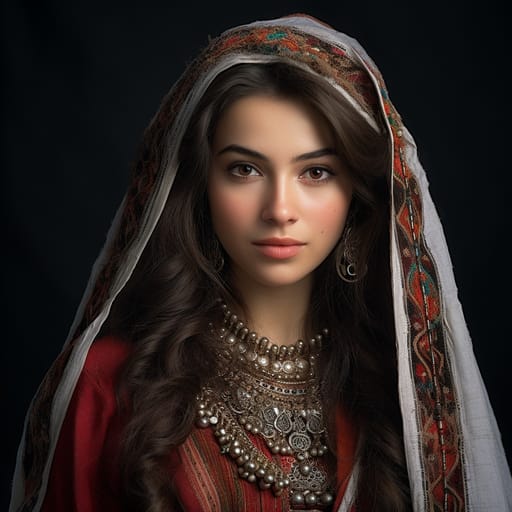
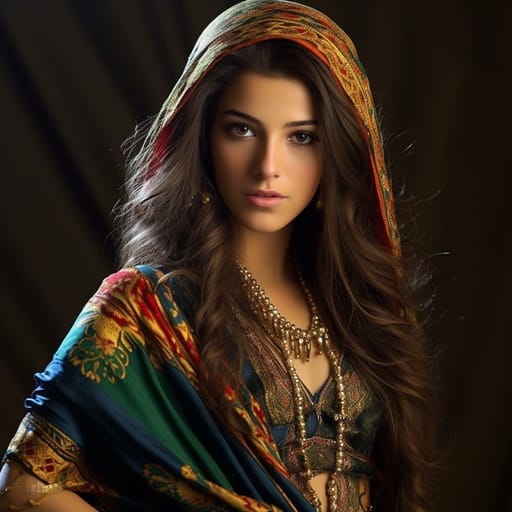
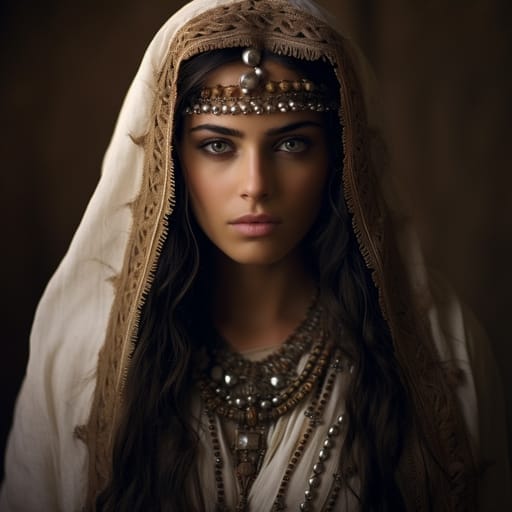
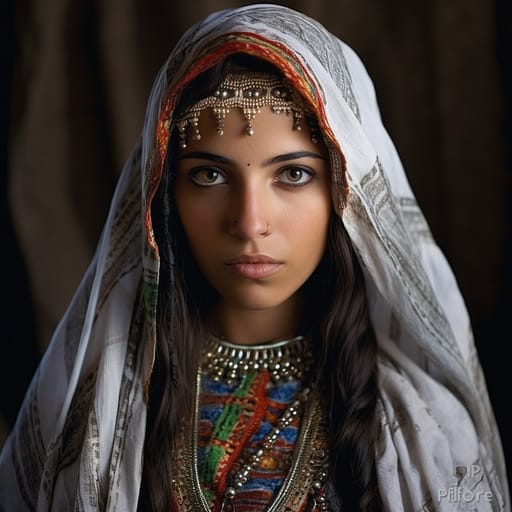
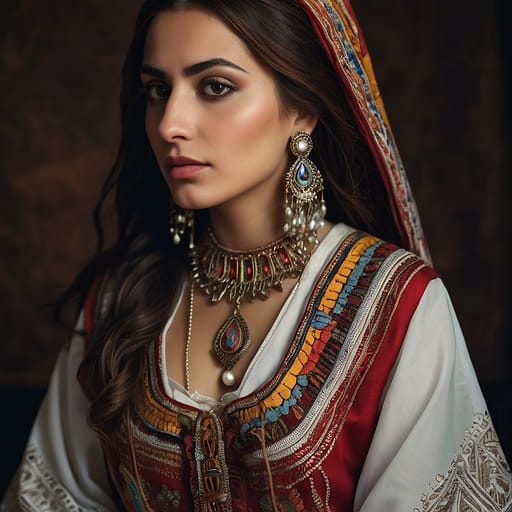
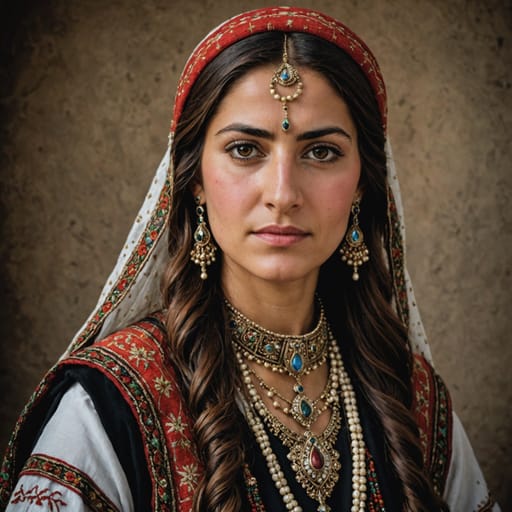
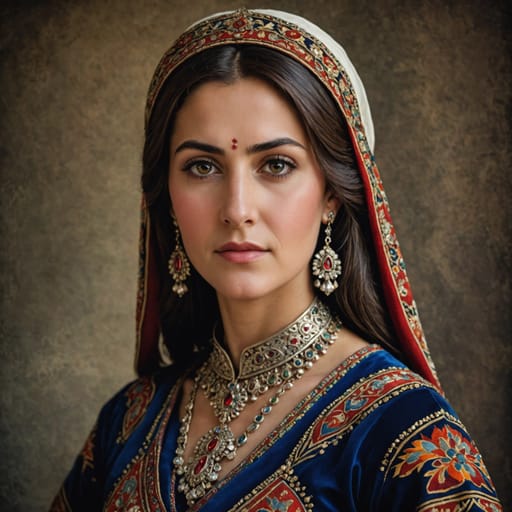
Typical Ubykh Phenotypes
Reference for AI generation: hair, eyes, skin, facial structure, build
Ubykh Body & Anatomy Reference
Anatomy by feature, Levantine / Mediterranean Middle Eastern phenotype
Ubykh Boobs & Breasts
The typical Ubykh bust is medium-to-large cup, full, moderate-to-high projection, in line with the wider Levantine / Mediterranean Middle Eastern pattern. Areolas usually fall in the 32-46mm range, with medium-brown to dark-brown areolar pigmentation against the olive-to-light-brown skin tone. Compared with the smaller East Asian bust profile, Ubykh breasts sit forward and are generally full and soft, fuller projection than the North-African Berber norm. A faithful AI render of Ubykh tits keeps that shape and areola size.
Ubykh Ass & Hips
Butt shape among Ubykh women: medium-to-full, moderate projection, broader hip profile, over medium-to-wide iliac crests, fuller gluteal-femoral deposition. This follows Levantine / Mediterranean Middle Eastern ancestry and looks quite unlike the slim East Asian narrow-hip profile. An accurate Ubykh ass in adult AI imagery keeps both the silhouette and the overall build (mesomorph with fuller hip-and-bust deposition) instead of a generic average.
Ubykh Vagina & Pussy
Vulvar anatomy among Ubykh women: medium-brown to dark-brown labial pigmentation, fuller labia minora. Pubic hair tends to be wavy-to-coiled medium-coarse dark texture, dense distribution, in the usual inverted-triangle pattern. Both follow Levantine / Mediterranean Middle Eastern pigmentation, which is why Ubykh pussy renders should not fall back on a pale, sparse Western template.
Ubykh Dicks & Penis
The Ubykh cock profile, from Levantine / Mediterranean Middle Eastern anthropometric data: regional mean ~14cm erect; moderate-to-above-average girth; medium-brown shaft pigmentation. Pubic hair has a wavy-to-coiled medium-coarse dark texture and forms the usual inverted-V pattern. Whether Ubykh men are circumcised follows religious and cultural practice rather than phenotype.
Ubykh Body, Curves & Build
Build and curves among Ubykh women follow the Levantine / Mediterranean Middle Eastern pattern: mesomorph with fuller hip-and-bust deposition, mean adult female BMI 25-28. Proportions matter as much as skin tone, so Ubykh figures should keep their regional height and limb ratios.
Ubykh Skin Tone & Hair Texture
The Ubykh skin range is olive to medium-brown (Fitzpatrick III-V), and hair tends to be wavy-to-curly 2B-3B, predominantly dark-brown to black. That combination marks the Levantine / Mediterranean Middle Eastern phenotype, and skin tone is the trait AI generators most often get wrong for Ubykh women.
Explore phenotype categories
Structured taxonomy with peer-reviewed scales · 22 anatomical categories
Notable Ubykh People
14 reference figures, sourced from Wikipedia
- Cyprus, historical)
- Bulgaria, historical)
- Kosovo, historical)
- Romania, historical)
- East Circassian, Kabardian)
- Circassian Union and Charity Society, historical)
- Keriman Halis Ece, of Пщызэмыгъу family, winner of Miss Turkey 1932 and Miss Universe 1932 beaut…
- Perestü Valide Sultan, of Гогэн family, Valide Sultan (Empress mother) of Abdulhamid II of the Ottom…
- Şevkefza Valide Sultan, of Заурмыкъу family, Valide Sultan (Empress mother) of Murad V of the Ottoman…
- Düzdidil Kadın, consort of Sultan Abdulmejid I of the Ottoman empire.
- Tevfik Esenç, politician, last known speaker of the Ubykh language (1904-1992)
- Çerkez Ethem, He was a commander in the Kuva-yi Milliye troops during the War of Independen…
- Ubykhia, a region in Circassia
- Other Circassian tribes, Abzakh Besleney Bzhedug Hatuqwai Kabardians Mamkhegh Natukhai Shapsug Temirgo…
Erotic Poses & Sex Positions
From the pose catalog: 219 named positions with reference skeletons
Frequently asked questions about Ubykh people
Where is the Ubykh homeland?
The Ubykh homeland is Historically the Sochi Black Sea coast, northwest Caucasus; now Anatolia, Turkey in Western Asia.
What language do Ubykh people speak?
Ubykh people primarily speak Ubykh (Northwest Caucasian), extinct since 1992; community shifted to Turkish.
What religion do Ubykh people practice?
The predominant religion among Ubykh people is Sunni Islam (historically).






Make your own Ubykh images
Five a day, free, no credits to buy. The studio starts from this group's phenotype data, so you can set body type, pose and style and keep the traits accurate.
Start with Ubykh