No portrait yet
Thathera Erotic
Northern India: Punjab (craft center at Jandiala Guru near Amritsar), Haryana, Uttar Pradesh, Bihar, Rajasthan, Madhya Pradesh and Gujarat; also Punjab province, Pakistan
Punjabi, Hindi and Urdu (Indo-Aryan), with regional languages such as Bhojpuri, Rajasthani and Gujarati where settled
Hindu and Sikh in India; Muslim in Pakistan
Occupational metalworking caste of North India, kin to the Kasera, Tamrakar and Kansari brass and copper communities; Hindu, Sikh and Muslim branches; listed as Other Backward Class in several Indian states
About Thathera People
The Thathera are the hammer-and-anvil metalworkers of northern India, a community whose name is the sound of its trade: the steady beating of brass, copper and bell metal into pots, water vessels and plates. They are not defined by a valley or a river but by a workshop. Thathera families are scattered across Punjab, Haryana, Uttar Pradesh, Bihar, Rajasthan, Madhya Pradesh and Gujarat, and across the border in Pakistan's Punjab, speaking whatever Indo-Aryan language surrounds them, Punjabi, Hindi or Urdu. What binds them is craft, caste and marriage. Like the related Kasera, Tamrakar and Kansari, they form an endogamous occupational caste, and for most of their history a Thathera boy learned the trade at his father's anvil rather than in any school.
Religion follows geography. In India most Thathera are Hindu, and in Punjab, where the craft's most famous center sits, Hindu and Sikh families work side by side. In Pakistan they are Muslim. Faith and trade overlap in the vessels themselves: kansa (bell metal) plates and copper lotas are ritual objects as much as kitchenware, carried into temples and weddings and backed by the old Ayurvedic conviction that food eaten off bell metal is better for you. A Thathera is, in effect, a maker of the tools of household religion.
The defining chapter in their story is Jandiala Guru, a town outside Amritsar. In the early nineteenth century Maharaja Ranjit Singh encouraged skilled metalworkers, many from Kashmir, to settle there, and a quarter of narrow lanes filled with forges. The method has barely changed since. Metal is melted into flat cakes, hammered into thin sheets, then heated and beaten again over a curved anvil until a bowl or a tall gagar emerges, its surface dimpled with thousands of strikes, before being scoured bright with sand and tamarind. In 2014 UNESCO inscribed the craft on its list of Intangible Cultural Heritage, the first Indian craft tradition on that list. The recognition came late. Stainless steel and aluminum had already emptied most of the workshops in the late twentieth century, and many Thathera drifted into shopkeeping and wage labor.
Yet the trade has not died. Government revival schemes and design collaborations now route hand-beaten brass to urban kitchens, where it sells precisely because no machine made it. Some younger Thathera who had never held a hammer are returning to the anvil, and the dimpled skin of a Jandiala vessel has become a signature rather than a flaw. The Thathera remain what they have always been: a people you can hear from the end of the street.
Related ethnic groups
Groups that share Thathera's homeland, region, language, or religious tradition. These are likely candidates for comparative phenotype reference.
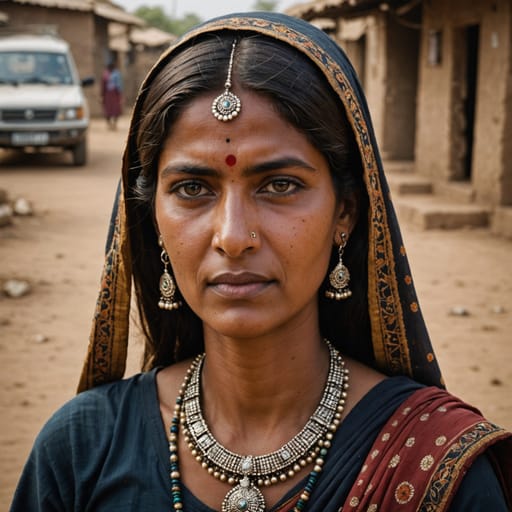
Typical Thathera Phenotypes
Reference for AI generation: hair, eyes, skin, facial structure, build
Thathera Body & Anatomy Reference
Per-feature anatomical profile for AI nude generation: Indo-Aryan / Dravidian South Asian phenotype
Thathera Boobs & Breasts
The typical Thathera bust is medium-to-large cup, moderate-to-full projection, in line with the wider Indo-Aryan / Dravidian South Asian pattern. Areolas usually fall in the 32-46mm range, with medium-brown to dark-brown areolar pigmentation against the wheatish-to-brown skin tone. Compared with the smaller East Asian bust profile, Thathera breasts sit forward and are generally full and soft, generally fuller than the East Asian norm. A faithful AI render of Thathera tits keeps that shape and areola size.
Thathera Ass & Hips
Butt shape among Thathera women: medium-to-full, moderate-to-high projection, classic curvy hip profile, over medium-to-wide iliac crests, full gluteal-femoral fat distribution. This follows Indo-Aryan / Dravidian South Asian ancestry and looks quite unlike the slim hip profile of East Asian women. An accurate Thathera ass in adult AI imagery keeps both the silhouette and the overall build (endomorph-to-mesomorph with fuller hip deposition) instead of a generic average.
Thathera Vagina & Pussy
Vulvar anatomy among Thathera women: medium-brown to dark-brown labial pigmentation, fuller labia minora projection. Pubic hair tends to be straight-to-wavy coarse texture, dense distribution, in the usual inverted-triangle pattern. Both follow Indo-Aryan / Dravidian South Asian pigmentation, which is why Thathera pussy renders should not fall back on a pale, sparse Western template.
Thathera Dicks & Penis
The Thathera cock profile, from Indo-Aryan / Dravidian South Asian anthropometric data: regional mean ~13cm erect; moderate girth; medium-brown shaft pigmentation. Pubic hair has a straight-to-wavy coarse texture and forms the usual inverted-V pattern. Whether Thathera men are circumcised follows religious and cultural practice rather than phenotype.
Thathera Body, Curves & Build
Build and curves among Thathera women follow the Indo-Aryan / Dravidian South Asian pattern: endomorph-to-mesomorph with fuller hip deposition, mean adult female BMI 22-25. Proportions matter as much as skin tone, so Thathera figures should keep their regional height and limb ratios.
Thathera Skin Tone & Hair Texture
The Thathera skin range is wheatish to brown (Fitzpatrick III-V), and hair tends to be straight-to-wavy 1A-2B, dense, dark-brown to black. That combination marks the Indo-Aryan / Dravidian South Asian phenotype, and skin tone is the trait AI generators most often get wrong for Thathera women.
Explore phenotype categories
Structured taxonomy with peer-reviewed scales · 22 anatomical categories
Erotic Poses & Sex Positions
From the pose catalog: 219 named positions with reference skeletons
Frequently asked questions about Thathera people
Where is the Thathera homeland?
The Thathera homeland is Northern India: Punjab (craft center at Jandiala Guru near Amritsar), Haryana, Uttar Pradesh, Bihar, Rajasthan, Madhya Pradesh and Gujarat; also Punjab province, Pakistan in Southern Asia.
What language do Thathera people speak?
Thathera people primarily speak Punjabi, Hindi and Urdu (Indo-Aryan), with regional languages such as Bhojpuri, Rajasthani and Gujarati where settled.
What religion do Thathera people practice?
The predominant religion among Thathera people is Hindu and Sikh in India; Muslim in Pakistan.






Make your own Thathera images
Five a day, free, no credits to buy. The studio starts from this group's phenotype data, so you can set body type, pose and style and keep the traits accurate.
Start with Thathera