Help us get this right
Does this portrait look right for Khasi?
Nobody has judged this one yet. You would be the first.
Khasi Erotic
Khasi and Jaintia Hills of Meghalaya, northeast India, with communities in neighboring Assam and in the Sylhet region of Bangladesh.
Khasi, with related varieties such as Pnar, War and Bhoi (Austroasiatic, Khasic branch); written in Latin script.
Mostly Christian, chiefly Presbyterian and Catholic, with a small Unitarian church; a significant minority follows the indigenous Niam Khasi faith.
Khynriam, Pnar (Jaintia), War, Bhoi, Lyngngam and Maram, together known as the Hynniewtrep; part of the Khasic branch of Austroasiatic peoples.
About Khasi People
A Khasi child belongs to the mother's clan and carries its name. Property passes down the female line, and the youngest daughter, the khadduh, inherits the ancestral house along with the duty of caring for her parents and keeping the family's rites. It is one of the few matrilineal systems still working at scale anywhere, and it is often misread as a matriarchy. It is not: the maternal uncle has long carried real weight in clan affairs, and village councils have traditionally been the business of men. A husband often moves into his wife's family home, not the other way around.
Home is the Khasi Hills of Meghalaya, a high, rain-soaked plateau in India's northeast that drops steeply toward the plains of Bangladesh. The Pnar of the Jaintia Hills, the War of the southern slopes and the Bhoi of the northern foothills are generally counted as part of the same people. Together they call themselves Hynniewtrep, the seven huts, after the seven families said to have stayed on earth when the ladder to heaven was cut. Khasi is an Austroasiatic language, a distant cousin of Khmer and Vietnamese and unrelated to the Bengali, Assamese and Garo spoken on its borders. It has been written in Roman letters since Welsh missionaries put it on paper in the 1840s.
Most Khasi today are Christian, chiefly Presbyterian and Catholic, and there is also a small Unitarian church that a Khasi reformer started in the 1880s. A steady minority keeps Niam Khasi, the indigenous faith built around a creator god and the clan's ancestors. The Seng Khasi association has defended it since 1899, most visibly through the spring dance Shad Suk Mynsiem in Shillong. Before British rule the hills were divided into small states, or hima, most of them headed by a syiem chosen from a ruling clan, and several still play a part in customary matters. U Tirot Sing, syiem of Nongkhlaw, fought the British from 1829 to 1833 and is still the best-known name of resistance in the hills.
Some customs are little known outside the hills. War villages on the southern escarpment grow footbridges from the aerial roots of rubber fig trees, training them across streams over many years. Memorial stones raised for the dead and for clan ancestors stand in clusters across the hills, and the largest group is at Nartiang in the Jaintia Hills. Sacred groves such as the forest at Mawphlang are protected by a rule that nothing growing or fallen inside may be carried out. And kwai, areca nut with betel leaf and lime, is still the ordinary courtesy offered to any guest.
Related ethnic groups
Groups that share Khasi's homeland, region, language, or religious tradition. These are likely candidates for comparative phenotype reference.
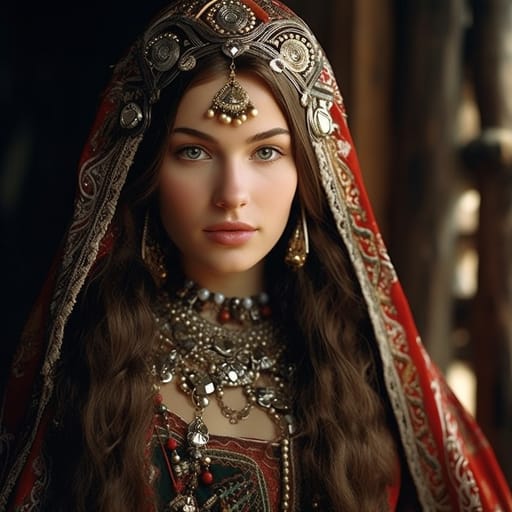
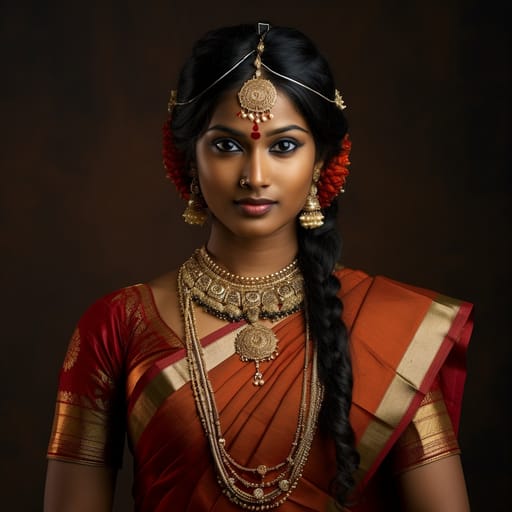
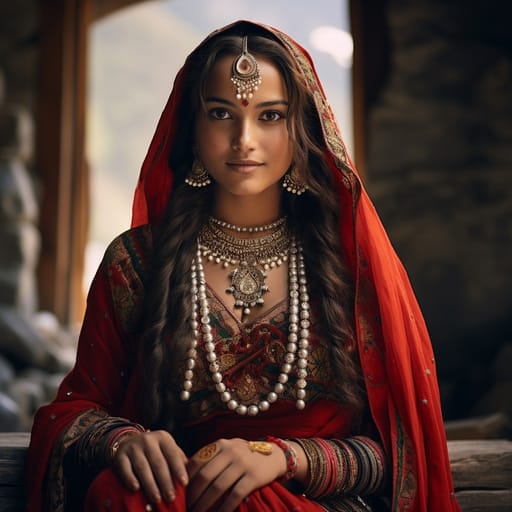
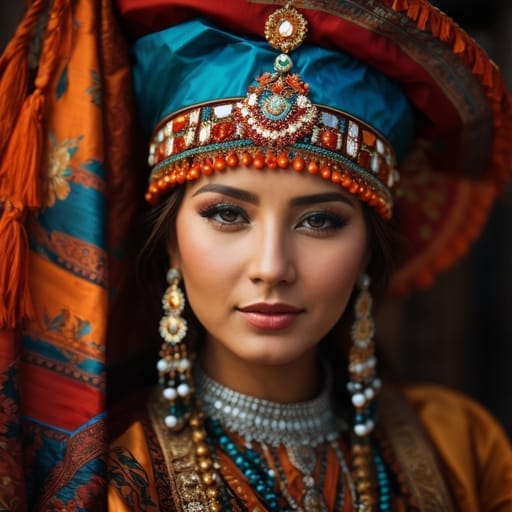
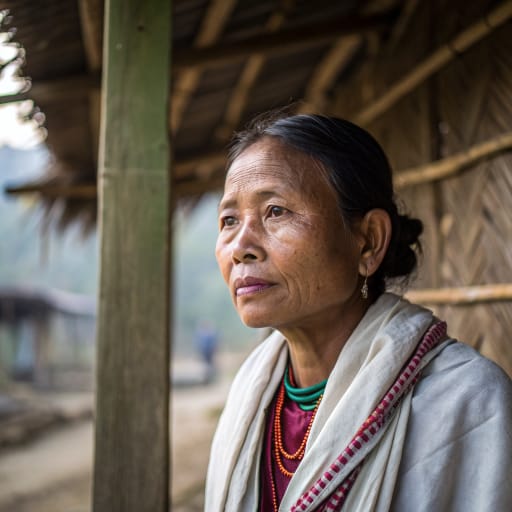
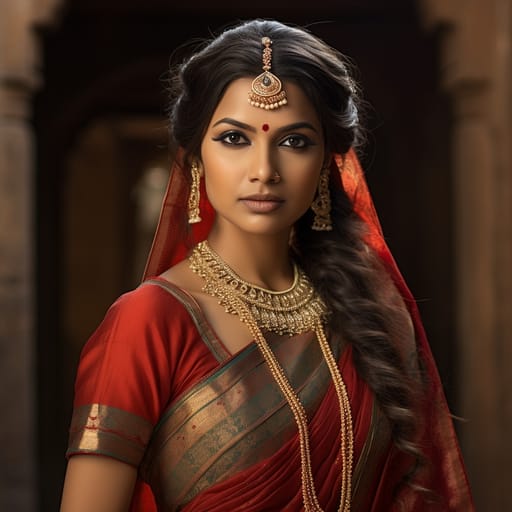
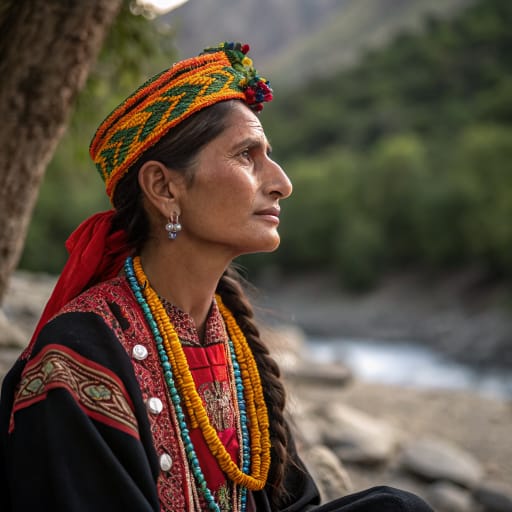
Typical Khasi Phenotypes
Reference for AI generation: hair, eyes, skin, facial structure, build
Khasi Body & Anatomy Reference
Indo-Aryan / Dravidian South Asian phenotype: anatomy reference for AI nude generation
Khasi Boobs & Breasts
Khasi boobs follow the Indo-Aryan / Dravidian South Asian profile: medium-to-large cup, moderate-to-full projection. Areolar diameter is usually 32-46mm, and the coloring is medium-brown to dark-brown areolar pigmentation against the wheatish-to-brown skin tone. Breast shape tracks body composition (endomorph-to-mesomorph with fuller hip deposition, mean adult female BMI 22-25), so Khasi breasts tend to be full and soft, generally fuller than the East Asian norm. Expect a forward-set shape, not the smaller East Asian bust profile.
Khasi Ass & Hips
Khasi ass and hip morphology presents as medium-to-full, moderate-to-high projection, classic curvy hip profile, distinctly different from the slim hip profile of East Asian women. The Khasi pelvic profile shows medium-to-wide iliac crests, full gluteal-femoral fat distribution, anchored in the Indo-Aryan / Dravidian South Asian skeletal pattern. Khasi butt shots in adult AI imagery should render the medium-to-full, moderate-to-high projection, classic curvy hip profile silhouette with the overall build (endomorph-to-mesomorph with fuller hip deposition) and the fat distribution typical of the Indo-Aryan / Dravidian South Asian phenotype.
Khasi Vagina & Pussy
Khasi pussy anatomy typically shows medium-brown to dark-brown labial pigmentation, fuller labia minora projection. Pubic hair is usually straight-to-wavy coarse texture, dense distribution. In AI-generated Khasi nudes, labial color should blend into the wheatish to brown skin with a gradual transition, and the hair should keep its straight-to-wavy coarse texture.
Khasi Dicks & Penis
Penis reference for Khasi men: regional mean ~13cm erect, moderate girth. Coloring: medium-brown shaft pigmentation. An accurate Khasi cock in AI imagery matches the surrounding wheatish to brown skin rather than a generic porn default. Circumcision depends on religion and custom, not ancestry.
Khasi Body, Curves & Build
The Khasi figure is generally endomorph-to-mesomorph with fuller hip deposition, with mean adult female BMI 22-25, characteristic of Indo-Aryan / Dravidian South Asian ancestry. AI image tools tend to flatten regional body types into a few stock shapes; here the Khasi build is kept as its own reference.
Khasi Skin Tone & Hair Texture
Skin: wheatish to brown (Fitzpatrick III-V). Hair: straight-to-wavy 1A-2B, dense, dark-brown to black. Both are typical of Indo-Aryan / Dravidian South Asian ancestry. The most common mistake in AI nudes of Khasi women is a body rendered lighter than the face.
Explore phenotype categories
Structured taxonomy with peer-reviewed scales · 22 anatomical categories
Erotic Poses & Sex Positions
From the pose catalog: 219 named positions with reference skeletons
Frequently asked questions about Khasi people
Where is the Khasi homeland?
The Khasi homeland is Khasi and Jaintia Hills of Meghalaya, northeast India, with communities in neighboring Assam and in the Sylhet region of Bangladesh. in Southern Asia.
What language do Khasi people speak?
Khasi people primarily speak Khasi, with related varieties such as Pnar, War and Bhoi (Austroasiatic, Khasic branch); written in Latin script..
What religion do Khasi people practice?
The predominant religion among Khasi people is Mostly Christian, chiefly Presbyterian and Catholic, with a small Unitarian church; a significant minority follows the indigenous Niam Khasi faith..






Make your own Khasi images
Five a day, free, no credits to buy. The studio starts from this group's phenotype data, so you can set body type, pose and style and keep the traits accurate.
Start with Khasi