Help us get this right
Does this portrait look right for Tharus?
Nobody has judged this one yet. You would be the first.
Tharus Erotic
Also known as: Tharu
Terai Region (India, Nepal)
Hinduism, Buddhism
Kathariya, Danuwar, Lampucchwa, Kochila, Sonha, Dangaura, Rana
About Tharus People
The Tharus are the people of the Terai — the long, low strip of forest, marsh, and floodplain that runs along the southern foot of the Himalayas, straddling the Nepal–India border. For centuries they were the only population that could live there year-round. The Terai is malarial country; outsiders who tried to settle it tended to die, and the Tharus, who carry a notable degree of inherited resistance to the local strain of malaria, did not. That single biological fact shaped almost everything else about them: their isolation, their relationship to the surrounding hill and plains peoples, and the late date at which the Terai was opened up to migration after DDT campaigns cleared the forests in the 1950s.
"Tharu" is less a single ethnicity than a family of related groups stretched across roughly a thousand kilometres of frontier. The Rana Tharu of the far west, the Dangaura of the Dang and Deukhuri valleys, and the Kochila of the eastern Terai do not all speak the same language or recognize each other as close kin; the Kathariya, Sonha, Lampucchwa, and Danuwar each occupy their own pockets. The Tharu languages belong to the Indo-Aryan branch and sit close to Bhojpuri, Awadhi, Maithili, and Nepali — close enough that outsiders sometimes dismiss Tharu as a dialect of whichever neighbour they themselves speak, which the Tharus themselves push back on.
Religious practice is layered. Most Tharus identify as Hindu, with a smaller Buddhist presence in some districts, but the older substrate is a clan-based system of village deities, ancestor spirits, and ritual specialists called guruwa who handle illness, misfortune, and the agricultural calendar. Households are often organized around longhouses called badaghar, traditionally headed by an elected male leader who manages farming and dispute resolution for an extended joint family. Women historically held more economic autonomy than was usual in the surrounding Hindu plains — they farmed, fished, brewed rice beer, and moved publicly in ways that Brahminical norms didn't permit further south.
The modern Tharu story is partly a story of dispossession: when the Terai opened up, hill migrants and plains landowners arrived with paperwork, and many Tharu families ended up as bonded labourers — the kamaiya system — on land their ancestors had cleared. That system was formally abolished in Nepal in 2000 after sustained Tharu organizing, and Tharu political identity today is shaped as much by that fight as by any older custom.
Related ethnic groups
Groups that share Tharus's homeland, region, language, or religious tradition. These are likely candidates for comparative phenotype reference.
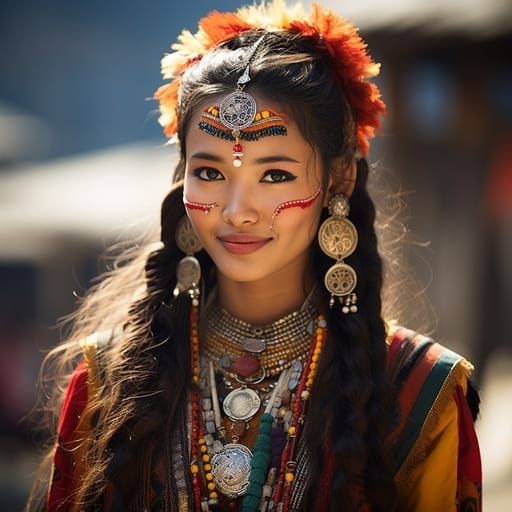
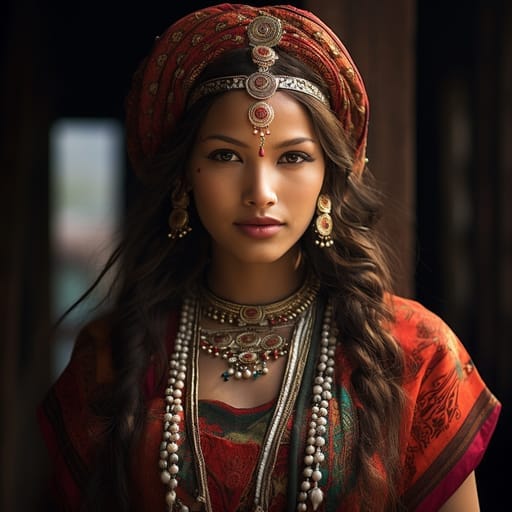
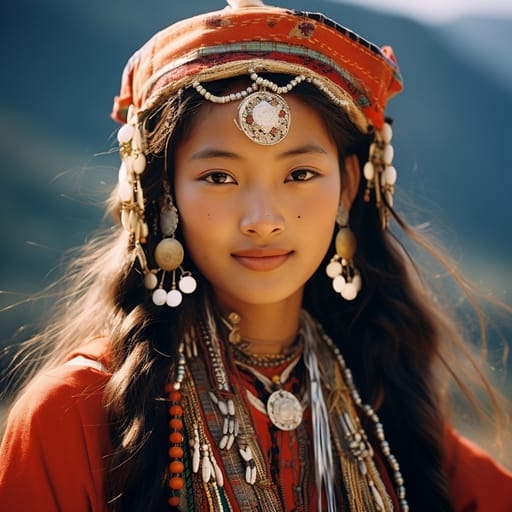
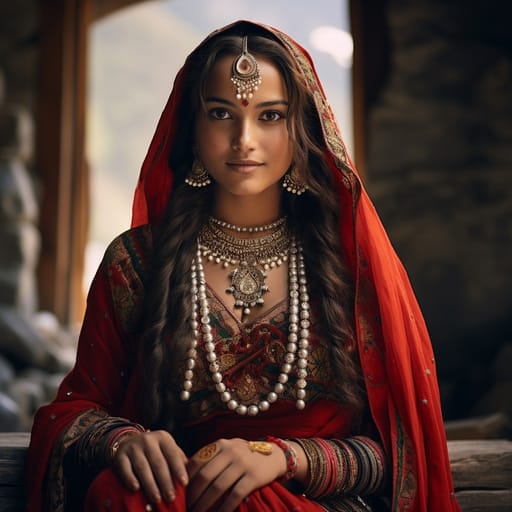
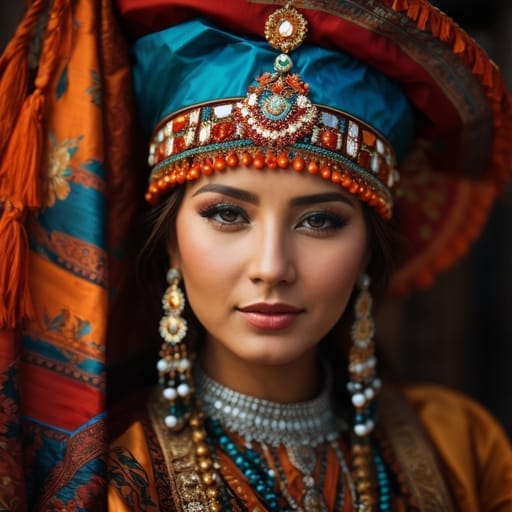
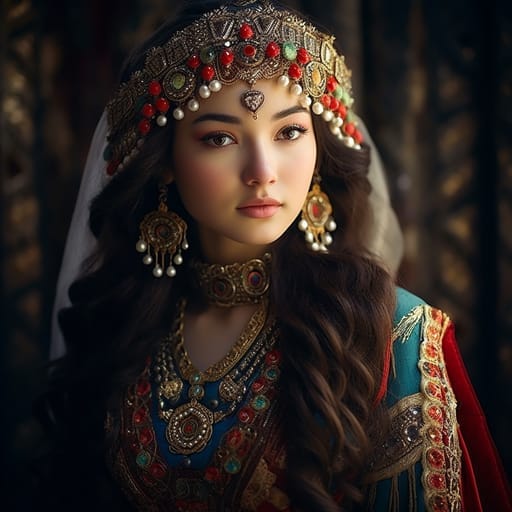
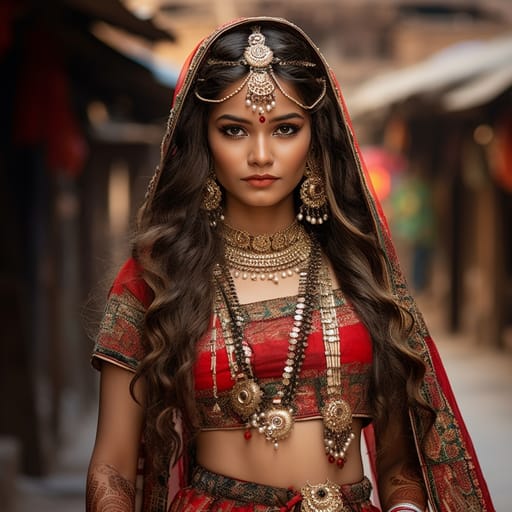
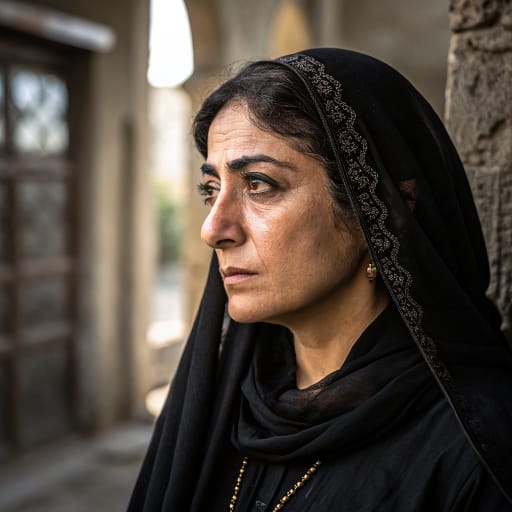
Typical Tharus Phenotypes
Reference for AI generation: hair, eyes, skin, facial structure, build
The Tharu phenotype is shaped by long residence in the Terai — the malarial lowland belt running along the southern edge of Nepal and into adjacent Indian states — and reads as a distinct South Asian subset rather than a generic Indo-Aryan one. Hair is uniformly black or near-black, straight to softly wavy, with the coarse-to-medium thickness typical of the region; premature graying is uncommon before middle age, and natural lightening or curl is rare enough to register as outside the norm.
Eyes run from dark brown to near-black, occasionally a warmer mid-brown. A partial epicanthic fold is noticeably more common among Tharus than among hill-caste Nepalis or North Indian Indo-Aryans — a soft inner-corner crease and a mildly almond-shaped opening, reflecting old admixture with Tibeto-Burman and east-Himalayan populations. Lashes are dark and full; brows are usually defined but not heavy.
Skin sits in the Fitzpatrick III–V band, most often a warm wheat-brown to medium tan with golden or olive undertones. Subgroups closer to the western Terai (Dangaura, Rana, Kathariya) trend slightly lighter and more olive; Kochila and Danuwar groups in the eastern Terai often run a shade deeper and warmer. Heavy agricultural sun exposure pushes many adults toward the darker end of their natural range.
Facial structure is the clearest tell. Cheekbones are broad and high-set, the midface is relatively flat, and the jaw is rounded rather than angular — closer to a Himalayan template than a Gangetic-plain one. Noses are typically short with a low-to-medium bridge and moderate alar width; lips are medium-full and well-defined, as seen on Barsha Lekhi.
Build is compact and wiry. Stature is modest — adult men commonly 5'3"–5'7", women 4'10"–5'2" — with narrow shoulders, lean limbs, and low body-fat tendencies maintained by labor-heavy lifestyles. The combination of soft epicanthic fold, broad flat midface, and warm wheat-brown skin is what most reliably distinguishes Tharus from neighboring Indo-Aryan and Pahari populations.
Tharus Body & Anatomy Reference
Indo-Aryan / Dravidian South Asian phenotype: anatomy reference for AI nude generation
Tharus Boobs & Breasts
The typical Tharus bust is medium-to-large cup, moderate-to-full projection, in line with the wider Indo-Aryan / Dravidian South Asian pattern. Areolas usually fall in the 32-46mm range, with medium-brown to dark-brown areolar pigmentation against the wheatish-to-brown skin tone. Compared with the smaller East Asian bust profile, Tharus breasts sit forward and are generally full and soft, generally fuller than the East Asian norm. A faithful AI render of Tharus tits keeps that shape and areola size.
Tharus Ass & Hips
Butt shape among Tharus women: medium-to-full, moderate-to-high projection, classic curvy hip profile, over medium-to-wide iliac crests, full gluteal-femoral fat distribution. This follows Indo-Aryan / Dravidian South Asian ancestry and looks quite unlike the slim hip profile of East Asian women. An accurate Tharus ass in adult AI imagery keeps both the silhouette and the overall build (endomorph-to-mesomorph with fuller hip deposition) instead of a generic average.
Tharus Vagina & Pussy
Vulvar anatomy among Tharus women: medium-brown to dark-brown labial pigmentation, fuller labia minora projection. Pubic hair tends to be straight-to-wavy coarse texture, dense distribution, in the usual inverted-triangle pattern. Both follow Indo-Aryan / Dravidian South Asian pigmentation, which is why Tharus pussy renders should not fall back on a pale, sparse Western template.
Tharus Dicks & Penis
The Tharus cock profile, from Indo-Aryan / Dravidian South Asian anthropometric data: regional mean ~13cm erect; moderate girth; medium-brown shaft pigmentation. Pubic hair has a straight-to-wavy coarse texture and forms the usual inverted-V pattern. Whether Tharus men are circumcised follows religious and cultural practice rather than phenotype.
Tharus Body, Curves & Build
Build and curves among Tharus women follow the Indo-Aryan / Dravidian South Asian pattern: endomorph-to-mesomorph with fuller hip deposition, mean adult female BMI 22-25. Proportions matter as much as skin tone, so Tharus figures should keep their regional height and limb ratios.
Tharus Skin Tone & Hair Texture
The Tharus skin range is wheatish to brown (Fitzpatrick III-V), and hair tends to be straight-to-wavy 1A-2B, dense, dark-brown to black. That combination marks the Indo-Aryan / Dravidian South Asian phenotype, and skin tone is the trait AI generators most often get wrong for Tharus women.
Data depth
0/100Coverage of image-grounded phenotype observations · drives AI generation diversity
- Sample size
- 0/40· 0 images
- Image quality
- 0/30· 0% high
- Confidence
- 0/20
- Source diversity
- 0/10
- ·No image observations yet
Explore phenotype categories
Structured taxonomy with peer-reviewed scales · 22 anatomical categories
Notable Tharus People
19 reference figures, sourced from Wikipedia
- Barsha Lekhi, Miss Nepal 2016
- Bijay Kumar Gachhadar, politician and Former Deputy Prime Minister of Nepal
- Dilli Bahadur Chaudhary, politician and chief minister of Lumbini Province
- Aman Lal Modi, Nepalese Minister of Federal Affairs
- Umakant Chaudhary, politician and the former minister for Water Supply of Nepal
- Gopal Dahit, Nepalese politician
- Resham Lal Chaudhary, Nepalese politician
- Sarswati Chaudhary, Nepalese track and field athlete
- Tilak Ram Tharu, Nepalese track and field athlete
- Ganga Chaudhary Satgauwa, politician
- Mamta Chaudhary, cricketer
- Teju Lal Chaudhary, politician
- Dipendra Chaudhary, cricketer
- Aditya Chaudhary, Nepali footballer
- Shanta Chaudhary, politician, Nepalese Women Writer
- Arun Kumar Chaudhary, politician
- Mangal Prasad Tharu, politician
- Shivani Singh Tharu, Nepalese former talk show host, model, and playwright
- Arti Rana, Indian social entrepreneur
Erotic Poses & Sex Positions
From the pose catalog: 219 named positions with reference skeletons
Frequently asked questions about Tharus people
Where is the Tharus homeland?
The Tharus homeland is Terai Region (India, Nepal) in Southern Asia.
What language do Tharus people speak?
Tharus people primarily speak Indo-European / Indo-Aryan / Tharu.
What religion do Tharus people practice?
The predominant religion among Tharus people is Hinduism, Buddhism.
What are other names for Tharus people?
Tharus people are also known as Tharu.






Make your own Tharus images
Five a day, free, no credits to buy. The studio starts from this group's phenotype data, so you can set body type, pose and style and keep the traits accurate.
Start with Tharus