Help us get this right
Does this portrait look right for Tboli?
Nobody has judged this one yet. You would be the first.
Tboli Erotic
South Cotabato (Philippines)
Anitism
About Tboli People
The Tboli live in the highlands around Lake Sebu in South Cotabato, on the southern Philippine island of Mindanao — a country of mist, terraced slopes, and forested ridges that has kept them somewhat apart from the lowland Christian and Muslim populations who dominate the rest of the south. They are one of the Lumad, the umbrella term for Mindanao's non-Islamized, non-Christianized indigenous peoples, and they have held that distinction stubbornly. Spanish colonization barely reached them. The American period grazed them. Even now, the Tboli world tends to orbit Lake Sebu and the surrounding municipalities rather than the coastal cities below.
Their language belongs to the South Mindanao branch of the Philippine Austronesian family, related to Blaan and Tiruray but not mutually intelligible with the Cebuano spoken by their lowland neighbors. It carries a vocabulary heavy with terms for weaving, dreaming, and the spirit world — three things that, for the Tboli, are not really separate. Religious life is anitist: a layered cosmology of spirits inhabiting rivers, forests, sky, and household, mediated through ritual specialists and dreams. Christian and evangelical missions have made inroads, and many Tboli today identify nominally with one church or another, but the older spirit-knowledge has not so much been replaced as folded underneath.
The textile the Tboli are best known for is t'nalak, a cloth woven from abaca fiber in deep red, black, and ivory. It is made only by women, and the patterns are said to come to the weaver in dreams, transmitted from Fu Dalu, the spirit of the abaca. A weaver does not sketch a design; she remembers one. The cloth is not cut casually, and stepping over it is a serious offense. This is the kind of detail that distinguishes Tboli craft from the souvenir-grade weaving sold in Manila markets — the object is a record of a relationship with a spirit, not a decorative pattern.
Beyond textile, the Tboli are recognized for their brassware, beadwork, and the hegalong, a two-stringed lute whose music accompanies courtship and storytelling. Marriages traditionally involve elaborate exchanges of horses and brass goods, and polygyny was — and in some families still is — practiced among those who can afford it. The community has fought, with mixed success, to keep its ancestral domain intact against logging, hydroelectric projects, and the encroachment of agribusiness; that struggle is now part of what it means to be Tboli.
Related ethnic groups
Groups that share Tboli's homeland, region, language, or religious tradition. These are likely candidates for comparative phenotype reference.
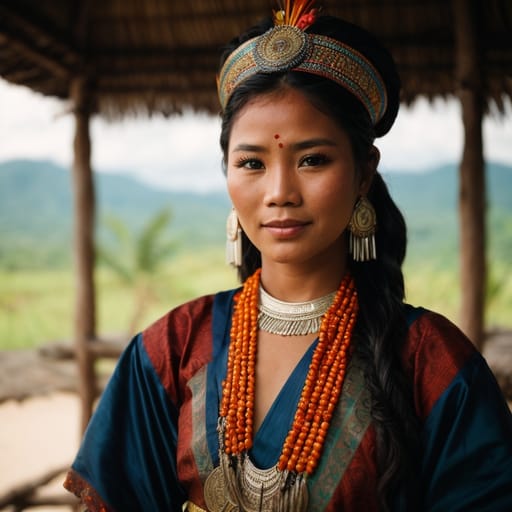
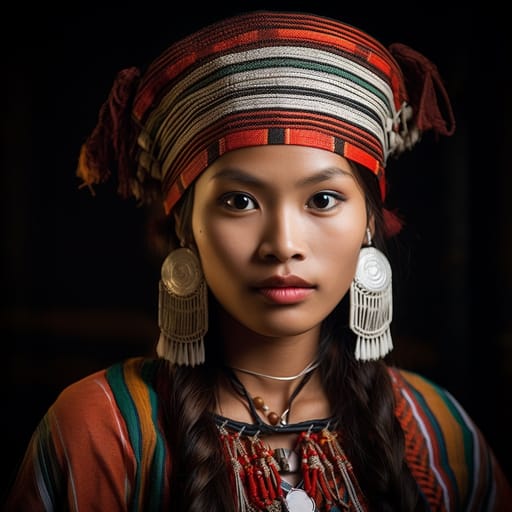
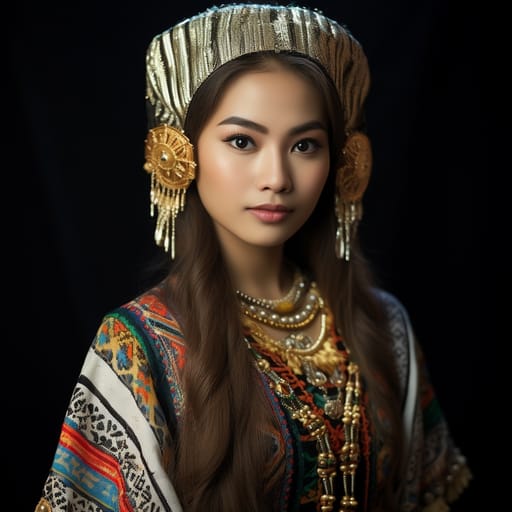
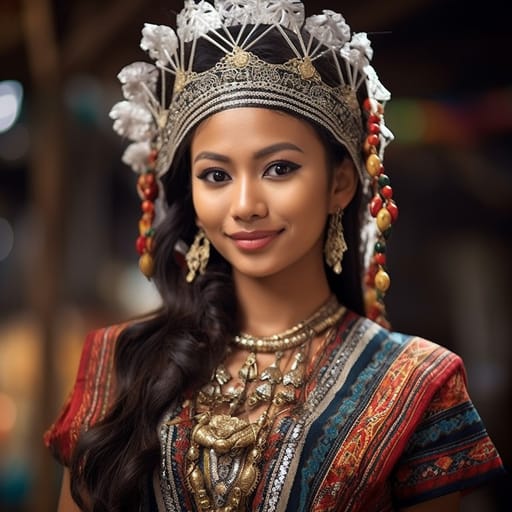
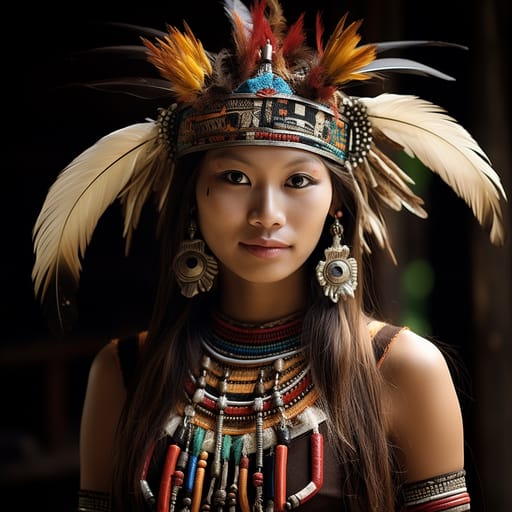

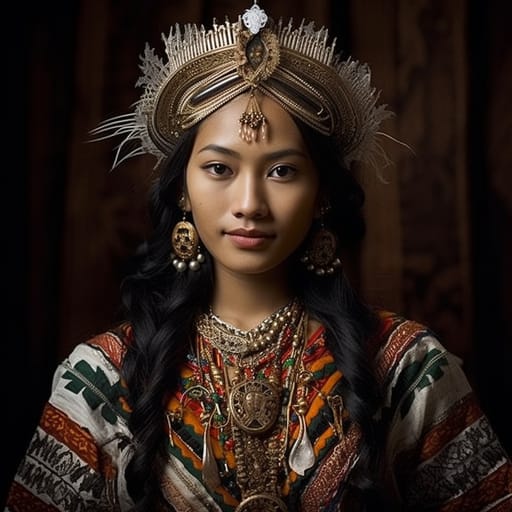
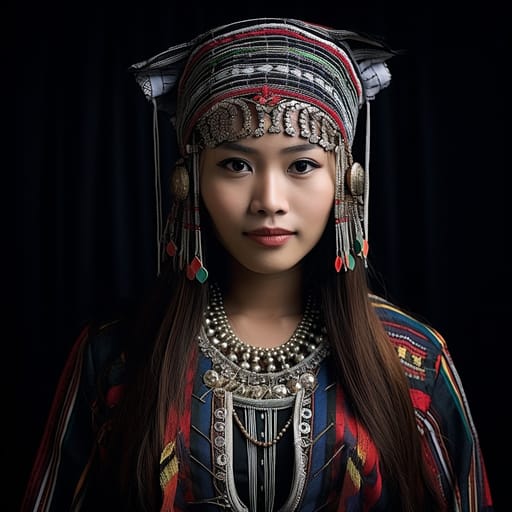
Typical Tboli Phenotypes
Reference for AI generation: hair, eyes, skin, facial structure, build
The Tboli are an indigenous Lumad people of the South Cotabato highlands in southern Mindanao, and their phenotype reflects a long-isolated Southern Philippine Austronesian population with deeper Negrito admixture than lowland Filipino groups. The result is a recognizably highland Mindanaoan look — compact, dark-eyed, fine-featured — distinct from both Tagalog-Visayan lowlanders and the more East-Asian-leaning northern Cordillera peoples.
Hair is uniformly black, often with a soft brown cast in sunlight, and predominantly straight to gently wavy with a coarse, heavy strand. A notable minority — particularly in older interior communities around Lake Sebu — show looser curls or pronounced wave, a visible legacy of Negrito-era ancestry. Traditionally women wore it floor-length, and the texture takes a polished sheen when long. Eyes are dark brown to near-black, almond-shaped, with a moderate epicanthic fold that is consistently present but less pronounced than in East Asian populations; the eye opening tends to be narrow and slightly downturned, set under low, straight brows.
Skin spans Fitzpatrick IV to V, running from warm tan to a deep coppery brown, with golden-olive undertones rather than the yellow cast common further north. Sun-darkened mid-tones dominate among farming and weaving communities. Facial structure is the Tboli signature: round, broad faces with full, rounded cheeks, a short and notably broad nose with a low bridge and wide alar base, and full, well-defined lips often described as bow-shaped. Jaws are soft and rounded rather than angular, and the overall impression is youthful even in adulthood — a feature long emphasized in Tboli portraiture and the brass beadwork that frames the face.
Build is small and compact. Adult women typically stand around 4'10"–5'2" and men 5'2"–5'5", with short limbs, narrow shoulders, and a tendency toward soft, even body composition rather than lean angularity. Hands and feet are notably small. There is little phenotypic split within the Tboli themselves, though Lake Sebu lakeside communities trend slightly taller and lighter than those of the higher inland ridges.
Tboli Body & Anatomy Reference
Per-feature anatomical profile for AI nude generation: Southeast Asian Austronesian / Austroasiatic phenotype
Tboli Boobs & Breasts
Tboli tits and boobs run small-to-medium cup, modest projection, the classic Southeast Asian Austronesian / Austroasiatic bust profile. Tboli nipples and areolas show medium-brown to dark-brown areolar pigmentation against the tan-to-medium-brown skin tone, with areolar diameter typically in the 26-38mm range and forward-set positioning rather than the fuller South Asian or Polynesian bust. Tboli breasts trend firm, modest projection, a function of the ectomorph, petite frame body habitus and the mean adult female BMI 20-23. For anatomically accurate AI-generated Tboli nudes the render preserves the small-to-medium cup, modest projection shape, 26-38mm areolas with medium-brown to dark-brown pigmentation, and the torso proportions of the Southeast Asian Austronesian / Austroasiatic phenotype.
Tboli Ass & Hips
Tboli hips and butt usually read as small-to-medium, modest projection, narrower hip profile. The skeletal base is narrow-to-medium iliac crests, the Southeast Asian Austronesian / Austroasiatic pattern. Set against the fuller glutes of the Pacific Islander phenotype, the difference is easy to see, and the hip-to-waist ratio is often what identifies Tboli women in photos.
Tboli Vagina & Pussy
Expect medium-brown to dark-brown labial pigmentation on Tboli women, in keeping with Southeast Asian Austronesian / Austroasiatic ancestry. The pubic hair is straight-to-wavy fine-to-medium texture. Coloring should run evenly from the tan to medium-brown skin of the thighs to the labia, and Tboli nude imagery should keep the hair's straight-to-wavy fine-to-medium texture.
Tboli Dicks & Penis
Tboli dick and penile anatomy in adult AI generation should anchor on the regional reference data: regional mean ~11cm erect, moderate girth, and medium-brown shaft pigmentation. The Tboli cock profile reflects the Southeast Asian Austronesian / Austroasiatic population's anthropometric measurements. The shaft pigmentation should track the surrounding tan to medium-brown skin tone, and the pubic hair should keep its straight-to-wavy fine-to-medium texture in the typical inverted-V escutcheon.
Tboli Body, Curves & Build
Tboli body type: ectomorph, petite frame, with mean adult female BMI 20-23. This is the typical Southeast Asian Austronesian / Austroasiatic build. Height range, shoulder-to-hip ratio and fat distribution all follow from it, which is what an accurate Tboli nude body should show.
Tboli Skin Tone & Hair Texture
Tboli skin tone falls in the tan to medium-brown (Fitzpatrick III-V) band, the surface signal most often miscalibrated by generic AI nude generators. Tboli hair texture is typically straight-to-wavy 1A-2A, dark-brown to black, characteristic of the Southeast Asian Austronesian / Austroasiatic phenotype. In Tboli nude renders the skin should hold that band consistently across the body.
Data depth
0/100Coverage of image-grounded phenotype observations · drives AI generation diversity
- Sample size
- 0/40· 0 images
- Image quality
- 0/30· 0% high
- Confidence
- 0/20
- Source diversity
- 0/10
- ·No image observations yet
Explore phenotype categories
Structured taxonomy with peer-reviewed scales · 22 anatomical categories
Erotic Poses & Sex Positions
From the pose catalog: 219 named positions with reference skeletons
Frequently asked questions about Tboli people
Where is the Tboli homeland?
The Tboli homeland is South Cotabato (Philippines) in Southeast Asia.
What language do Tboli people speak?
Tboli people primarily speak Austronesian / Philippine / Tboli.
What religion do Tboli people practice?
The predominant religion among Tboli people is Anitism.






Make your own Tboli images
Five a day, free, no credits to buy. The studio starts from this group's phenotype data, so you can set body type, pose and style and keep the traits accurate.
Start with Tboli