Help us get this right
Does this portrait look right for Tajiks?
One tap. It takes a second and it is recorded.
1 says it looks right, 1 says it looks off.
Tajiks Erotic
Also known as: Tajik
Islam / Sunni Islam
Chagatai
About Tajiks People
Tajiks are the Persian-speaking people of Central Asia — the only major group in the region whose language is Iranian rather than Turkic. That single fact does most of the work of explaining who they are and how they sit among their neighbors. While Uzbeks, Kyrgyz, Kazakhs, and Turkmen all speak Turkic languages brought in by waves of steppe migration from the east, Tajiks descend from the older Iranian-speaking populations who farmed the river valleys and built the cities of Transoxiana long before those migrations arrived. Their tongue, Tajik, is mutually intelligible with the Persian of Iran and the Dari of Afghanistan; the three are essentially regional standards of the same language, separated more by alphabet and political border than by grammar. Tajik is written in Cyrillic in Tajikistan, in Perso-Arabic script in Afghanistan, and the difference can feel like a fault line running through a single literature.
The homeland is mountains and the valleys cut into them. Tajikistan itself is more than ninety percent highland — the Pamirs in the east are sometimes called the Roof of the World — and most of the population is squeezed into the narrow lowlands of the Fergana and the Vakhsh. Across the border in Afghanistan, Tajiks form the second-largest ethnic group and dominate the northeast, including the Panjshir Valley made famous in the wars against the Soviets and later the Taliban. Significant Tajik populations also live in the historic cities of Uzbekistan — Samarkand and Bukhara are, by older reckoning, Tajik cities, though Soviet border-drawing assigned them to a Turkic republic and a long, quiet argument about their character has run ever since.
Most Tajiks are Sunni Muslims of the Hanafi school, with a strong Sufi inheritance — the shrines of figures like Baha-ud-Din Naqshband near Bukhara still draw pilgrims, and the poetry of Rumi and Hafez is read as living literature, not classroom material. The Pamiri Tajiks of Badakhshan are a notable exception: they follow Ismaili Shia Islam and look to the Aga Khan, and their mountain languages — Shughni, Wakhi, Rushani and others — are distinct enough from standard Tajik that linguists treat them as a separate Eastern Iranian branch. Hospitality runs deep and is taken seriously as an obligation rather than a courtesy; a guest at the dastarkhan, the spread cloth that serves as the table, is fed before anyone asks why they came.
Related ethnic groups
Groups that share Tajiks's homeland, region, language, or religious tradition. These are likely candidates for comparative phenotype reference.
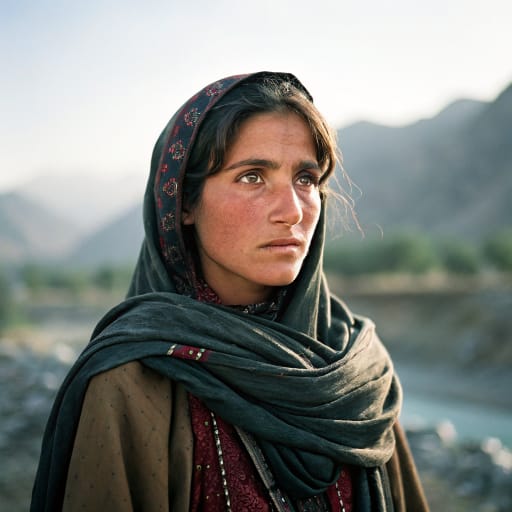
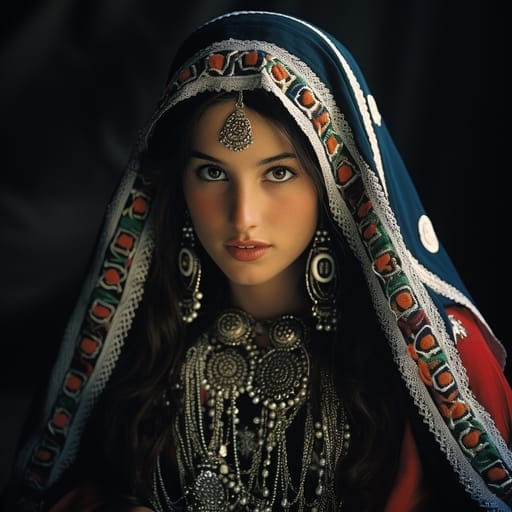
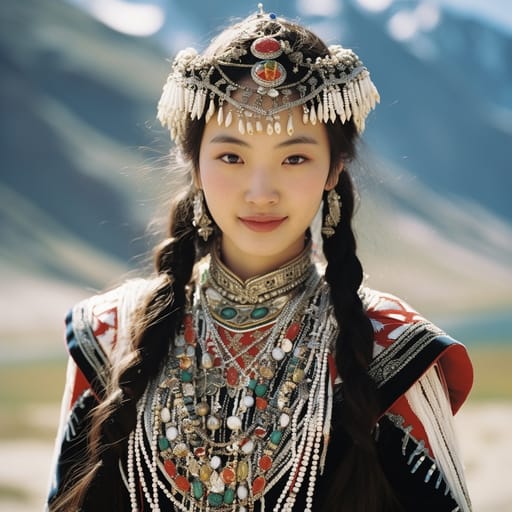
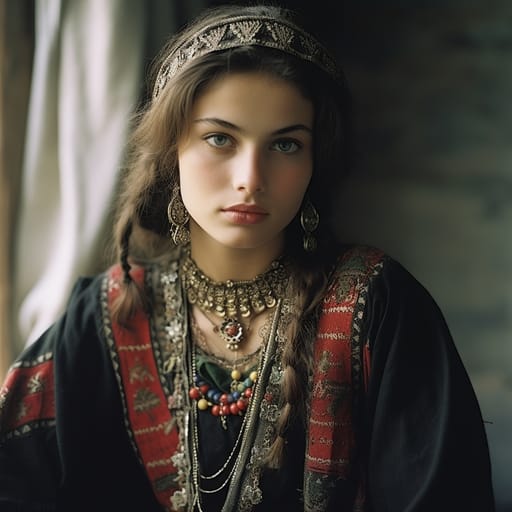
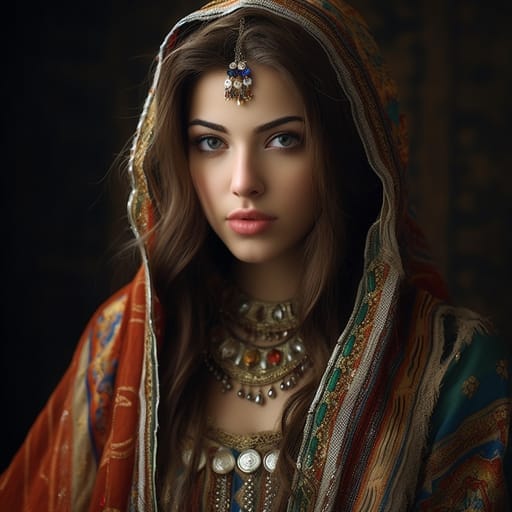
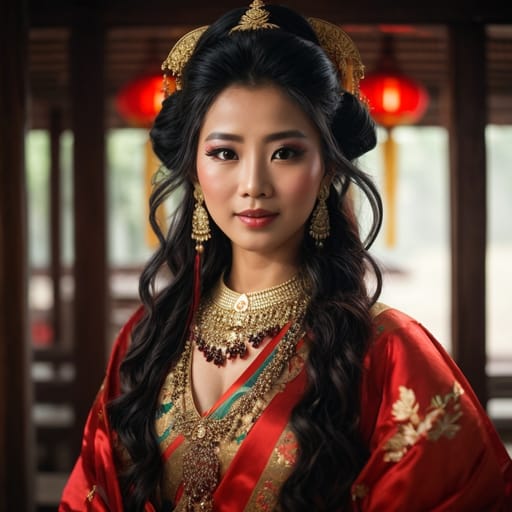
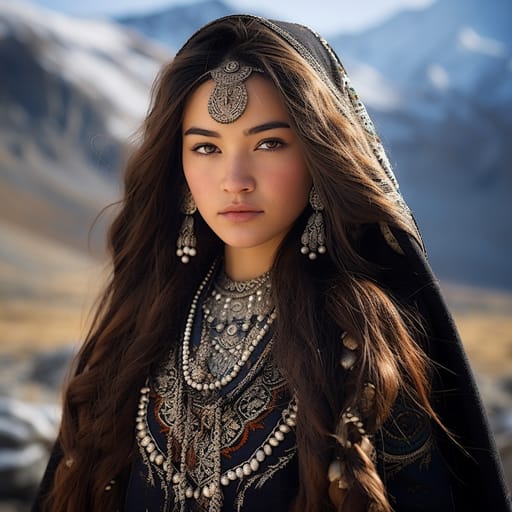
Typical Tajiks Phenotypes
Reference for AI generation: hair, eyes, skin, facial structure, build
Tajiks are the eastern outpost of the Iranian-speaking world, and their phenotype reflects exactly that — a predominantly West Eurasian face shaped by long residence in the high valleys between the Hindu Kush and the Pamirs, with measurable but minority Central Asian admixture in the lowland populations. The result is a population that looks closer to Persians or northern Afghans than to Uzbeks or Kazakhs, though the gradient varies sharply by altitude and region.
Hair is dark brown to black across most of the population, straight to gently wavy, with chestnut and dark-blonde shades surfacing in the Pamiri highlands of Badakhshan — a pocket where lighter pigmentation is genuinely common rather than incidental. Beard growth is heavy in adult men. Eye color follows the same pattern: brown predominates, but green, hazel and a striking pale blue appear at noticeably higher rates among Pamiris and mountain Tajiks than in any neighboring Central Asian group. Eyelids are typically open and almond-shaped without an epicanthic fold; when a fold appears, it signals Uzbek or Turkic admixture rather than baseline Tajik morphology.
Skin sits in the Fitzpatrick III–IV range with warm olive undertones — pale and easily tanning in the highlands, deeper and more sun-weathered in the Tajik plains of Afghanistan. Facial structure leans toward a high straight nose with a defined bridge and narrow alar base, prominent cheekbones, a long jaw, deep-set eyes under a strong brow, and medium lips. The look reads distinctly Iranian rather than steppe-Mongoloid, and the late commander Ahmad Shah Massoud is the textbook anchor for this phenotype.
Build is medium-tall and wiry, with adult men typically 170–178 cm; mountain populations tend lean and sinewy, lowland populations broader. The Chagatai-influenced sub-branch shows somewhat flatter midface and slightly heavier eyelid than the Pamiri or Badakhshi core, but the shift is subtle, not categorical.
Tajiks Body & Anatomy Reference
Central Asian Turkic-Mongolic phenotype: anatomy reference for AI nude generation
Tajiks Boobs & Breasts
Tajiks boobs follow the Central Asian Turkic-Mongolic profile: medium cup, moderate projection. Areolar diameter is usually 30-42mm, and the coloring is medium-brown areolar pigmentation against the tan-to-light-brown skin tone. Breast shape tracks body composition (mesomorph, broader frame than the East Asian norm, mean adult female BMI 23-26), so Tajiks breasts tend to be full and modestly projecting. Expect a forward-set shape, not the smaller East Asian bust.
Tajiks Ass & Hips
Tajiks ass and hip morphology presents as medium, moderate projection, broader hip profile than the East Asian norm, distinctly different from the slim East Asian narrow-hip profile. The Tajiks pelvic profile shows medium iliac crests, moderate gluteal-femoral fat deposition, anchored in the Central Asian Turkic-Mongolic skeletal pattern. Tajiks butt shots in adult AI imagery should render the medium, moderate projection, broader hip profile than the East Asian norm silhouette with the overall build (mesomorph, broader frame than the East Asian norm) and the fat distribution typical of the Central Asian Turkic-Mongolic phenotype.
Tajiks Vagina & Pussy
Tajiks pussy anatomy typically shows medium-brown labial pigmentation. Pubic hair is usually straight-to-wavy medium-coarse texture. In AI-generated Tajiks nudes, labial color should blend into the tan to light-brown skin with a gradual transition, and the hair should keep its straight-to-wavy medium-coarse texture.
Tajiks Dicks & Penis
Penis reference for Tajiks men: regional mean ~13cm erect, moderate girth. Coloring: medium-brown shaft pigmentation. An accurate Tajiks cock in AI imagery matches the surrounding tan to light-brown skin rather than a generic porn default. Circumcision depends on religion and custom, not ancestry.
Tajiks Body, Curves & Build
The Tajiks figure is generally mesomorph, broader frame than the East Asian norm, with mean adult female BMI 23-26, characteristic of Central Asian Turkic-Mongolic ancestry. AI image tools tend to flatten regional body types into a few stock shapes; here the Tajiks build is kept as its own reference.
Tajiks Skin Tone & Hair Texture
Skin: tan to light-brown (Fitzpatrick III-IV). Hair: straight 1A-1B, dark-brown to black. Both are typical of Central Asian Turkic-Mongolic ancestry. The most common mistake in AI nudes of Tajiks women is a body rendered lighter than the face.
Data depth
79/100Coverage of image-grounded phenotype observations · drives AI generation diversity
- Sample size
- 34/40· 37 images
- Image quality
- 30/30· 62% high
- Confidence
- 15/20· mean 0.76
- Source diversity
- 0/10· wikipedia
- ·Wikipedia-only source, not population-representative
Observed Distribution: Image Sample
Empirical observations from analyzed photographs · supplementary signal, not population truth
Sample: 37 images analyzed (37 wikipedia). Quality: 23 high, 6 medium, 7 low, 1 very_low. Avg analyzer confidence: 0.76.
Skin tone (Fitzpatrick): II (5%), III (41%), IV (54%)
Hair color: black (54%), gray/white (38%), blonde (3%), dark brown (3%), unclear (3%)
Hair texture: straight (68%), wavy (14%), shaved (3%), covered (16%)
Eye color: dark brown (89%), unclear (11%)
Epicanthic fold: 11% present, 84% absent, 5% unclear
Caveats: Sample is 100% Wikipedia notable people, which skews toward male, public-life, and modern figures, not population-representative.
Last aggregated: May 7, 2026
Explore phenotype categories
Structured taxonomy with peer-reviewed scales · 22 anatomical categories
Notable Tajiks People
70 reference figures, sourced from Wikipedia
- Burhanuddin Rabbani, former President of Afghanistan, founder of the Jamiat-e Islami.
- Habibullah Kalakani, former King of Afghanistan
- Rustam Emomali, Mayor of Dushanbe and the eldest son of president Emomali Rahmon
- Abdurahmon Karimov, political party chairman in Tajikistan
- Jamshed Karimov, former Prime Minister of Tajikistan and a cousin of former President of Uzbek…
- Ahmed Shah Massoud, Commander and Mujahideen in Afghanistan, assassinated by Al Qaeda
- Rahmon Nabiyev, First Secretary of the Communist Party of Tajikistan and two time President o…
- Emomali Rahmon, current President of Tajikistan
- Kokhir Rasulzoda, current Prime Minister of Tajikistan
- Fawzia Koofi, politician, writer
- Anahita Ratebzad, a socialist and Marxist-Leninist politician
- Meena Keshwar Kamal, Feminist and human rights activist
- Faiz Ahmad, politician
- Abdul Latif Pedram, politician and a Member of Parliament in Afghanistan
- Atta Muhammad Nur, politician
- Karim Massimov, Kazakh politician
- Ahmad Massoud, politician and the founder of the National Resistance Front of Afghanistan
- Ahmad Zia Massoud, politician
- Shirinsho Shotemur, a founding father of Tajikistan
- Amrullah Saleh, former Vice President of Afghanistan
- Sayid Abdulloh Nuri, founder and leader of Islamic Renaissance Party of Tajikistan
- Fatima Payman, Australian politician
- Sherali Mirzo, Minister of Defense since November 2013
- Emomali Sobirzoda, Chief of the General Staff of the Armed Forces of the Republic of Tajikistan
- Negmatullo Kurbanov, Commanding Officer of the Tajik Internal Troops
- Abduhalim Nazarzoda, former Deputy Minister of Defense
- Latif Fayziyev, Commander of the Tajik Mobile Forces
- Saimumin Yatimov, Chairman of the State Committee for National Security
- Ramazon Rahimov, Minister of Internal Affairs
- Gulmurod Khalimov, lieutenant-colonel when commander of the police special forces of the Interio…
- Ismail Khan, Former Minister of Water and Energy and Governor of Herat
- Ahmad Shah Massoud, Afghan military personnel. Fought in the Afghan-soviet war and then the Afgha…
- Mohammad Qasim Fahim, former Marshal of Afghanistan, former Minister of Defense of Afghanistan and …
- Mir Masjidi Khan, Resistance leader against the British Empire in the First Anglo-Afghan War
- Mir Bacha Khan Kohdamani, Resistance leader against the British Empire in the Second Anglo-Afghan War
- Sayyid Husayn, former Minister of Defense and Saqqawist leader
- Purdil Khan, former Marshal and Minister of Defense of Afghanistan, Saqqawist leader
- Faizal Maksum, Tajik Basmachi Leader
- Bismillah Khan, Former Minister of Defense
- Farshad Noor, Professional football player
- Omid Musawi, Professional football player
- Omran Haydary, Professional football player
- Sharif Nazarov, football coach
- Alisher Chingizov, Professional swimmer
- Sherali Dostiev, Professional boxer currently competing in AIBA’s Light flyweight division
- Shamil Aliev, Former professional wrestler who competed in the men's light heavyweight cate…
- Farzad Mansouri, Taekwondo fighter
- Somon Makhmadbekov, Professional judoka wrestler who came 3rd place in 2024 Summer Olympics of Pa…
- Nematullo Asranqulov, Professional Judoka wrestler who won a silver medal for his division (middlew…
- Temur Rakhimov, Professional Judoka wrestler who won bronze medal at 2024 Summer Olympics in …
- Rasul Boqiev, Professional Judoka wrestler who won bronze medal at the 2007 World Judo Cham…
- Komronshokh Ustopiriyon, Professional Judoka wrestler who competed in 2016 Summer Olympics of Rio de J…
- Mukhamadmurod Abdurakhmonov, Judoka wrestler who competed in 2016 Summer Olympics’s Men's +100 kg event
- Sherali Bozorov, Professional Judoka wrestler who won a silver medal for his division (Half-Mi…
- Saidahtam Rahimov, Professional Judoka wrestler who competed in the men's heavyweight event at t…
- Khayrullo Nazriev, Professional Judoka wrestler who competed in the men's half-heavyweight event…
- Akmal Murodov, Professional Judoka wrestler who represented Tajikistan in the men's 81 kg ev…
- Behruzi Khojazoda, Professional sambist and Judoka wrestler
- Khushqadam Khusravov, Professional sambist and Judoka wrestler
- Rustam Boqiev, Professional judoka wrestler
- Rauf Hukmatov, Professional judoka wrestler
- Parviz Sobirov, Professional judoka wrestler
- Makhmud Muradov, Professional MMA fighter who competed in the UFC’s Middleweight division
- Abdul Azim Badakhshi, Former professional MMA fighter and Kickboxer
- Siyar Bahadurzada, Former professional MMA fighter who competed in the UFC’s Welterweight division
- Muhammad Naimov, Professional MMA fighter who currently competes in the UFC’s Featherweight di…
- Roya Mahboob, businesswoman
- Mahmoud Saikal, a Tajik diplomat and international development specialist
- Manizha Wafeq, businesswoman
- Rus Yusupov, Jewish-American co-founder of Vine and the co-founder and CEO of HQ Trivia
Erotic Poses & Sex Positions
From the pose catalog: 219 named positions with reference skeletons
Frequently asked questions about Tajiks people
Where is the Tajiks homeland?
The Tajiks homeland is Afghanistan, Tajikistan, Uzbekistan in Central Asia.
What language do Tajiks people speak?
Tajiks people primarily speak Indo-European / Iranian / Persian / Tajik.
What religion do Tajiks people practice?
The predominant religion among Tajiks people is Islam / Sunni Islam.
What are other names for Tajiks people?
Tajiks people are also known as Tajik.






Make your own Tajiks images
Five a day, free, no credits to buy. The studio starts from this group's phenotype data, so you can set body type, pose and style and keep the traits accurate.
Start with Tajiks