Help us get this right
Does this portrait look right for Tagalogs?
One tap. It takes a second and it is recorded.
1 says it looks right, 0 say it looks off.
Tagalogs Erotic
Also known as: Tagalog
Christianity / Catholicism
Filipino Americans
About Tagalogs People
The Tagalogs are the people of the central and southern reaches of Luzon — Manila and the provinces ringing it: Bulacan, Rizal, Cavite, Laguna, Batangas, Quezon, parts of Mindoro and Marinduque. They are not the largest ethnic group in the Philippines by a wide margin (the Visayans collectively outnumber them), but their language became the basis of Filipino, the national lingua franca, which means the Tagalog ear and Tagalog idiom shape how the country talks to itself. Tagalog sits inside the Philippine branch of the Austronesian family — cousin to Cebuano, Ilocano, Hiligaynon, and more distantly to Malay, Javanese, and the languages of Polynesia. Centuries of contact left the vocabulary heavily layered: Sanskrit and Malay loans from the precolonial trade era, an enormous Spanish stratum from three hundred years of colonial rule, and a steady English overlay from the American period and after. Code-switching between Tagalog and English — Taglish — is not slang but the default register of urban speech.
Catholicism arrived with the Spanish in the sixteenth century and took deep root, and the Philippines remains one of only two majority-Catholic countries in Asia. But the religion as it is practiced is distinctly Tagalog: the Santo Niño devotion, the nine-day Simbang Gabi dawn masses before Christmas, the Black Nazarene procession in Quiapo that draws millions through Manila's streets every January, the Holy Week penitential rites in the Bulacan and Pampanga countryside. Underneath the Catholic surface persists older animist material — the anito spirits, ideas about kapwa (shared self) and hiya (a sense of social shame and propriety) that anthropologists treat as core to Tagalog social psychology rather than as folklore.
The Tagalog homeland is also the political center of gravity of the country. The 1896 revolution against Spain was largely Tagalog-led; Andrés Bonifacio and Emilio Aguinaldo were Tagalogs, and the Katipunan organized in Tagalog. That history is not distant — it shapes how the region understands its relationship to the rest of the archipelago, which sometimes resents Manila's gravitational pull. Outside the Philippines, the Tagalog presence is large and concentrated: Filipino Americans form one of the biggest Asian American communities in the United States, with deep roots in California, Hawai'i, and the Navy towns of the Pacific coast, where Tagalog is spoken at home into the second and third generation.
Related ethnic groups
Groups that share Tagalogs's homeland, region, language, or religious tradition. These are likely candidates for comparative phenotype reference.
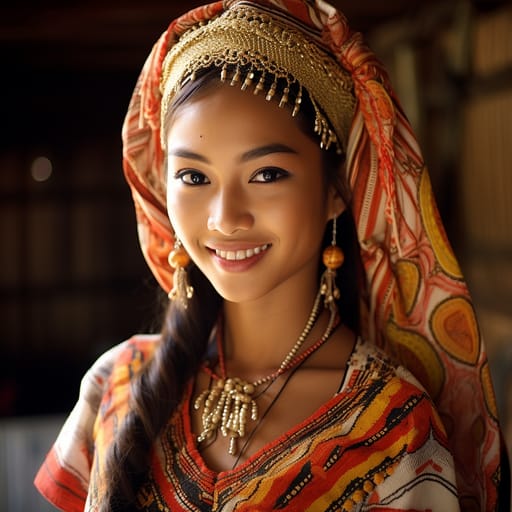
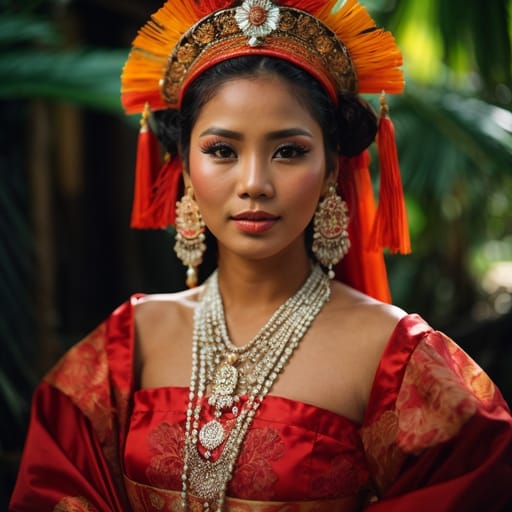
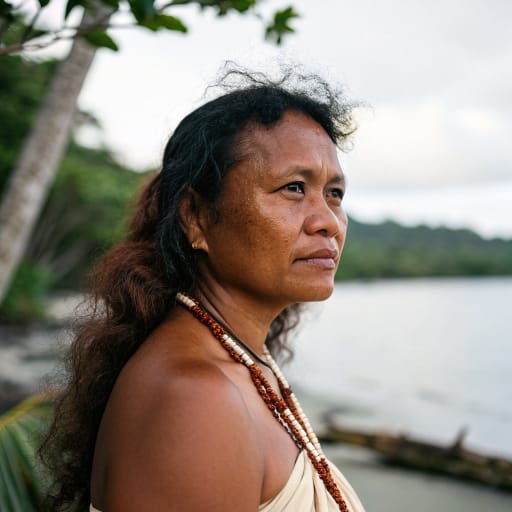
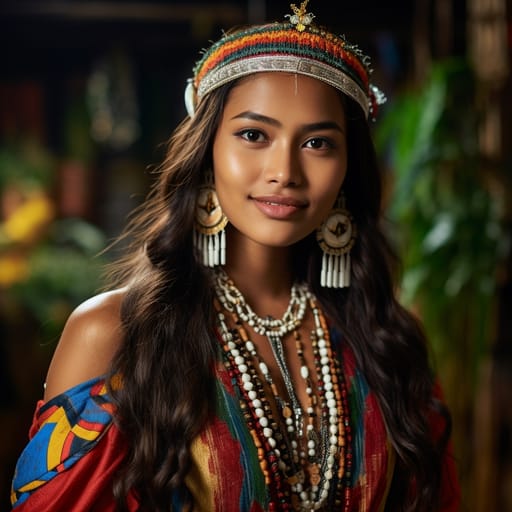
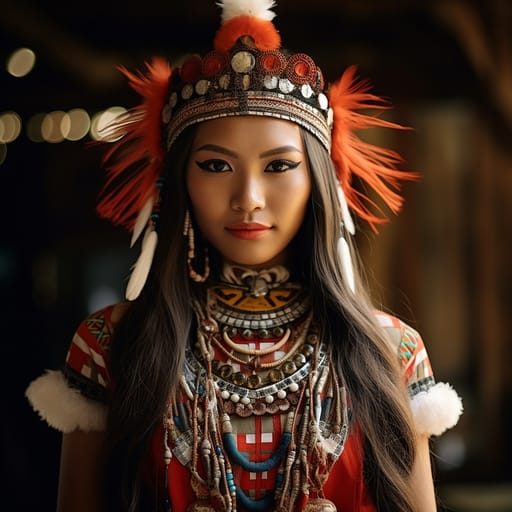
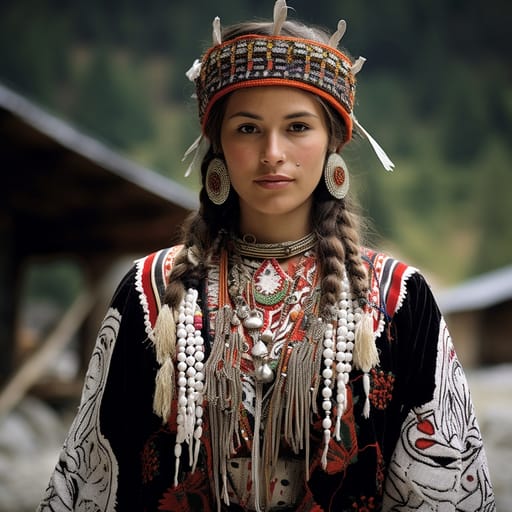
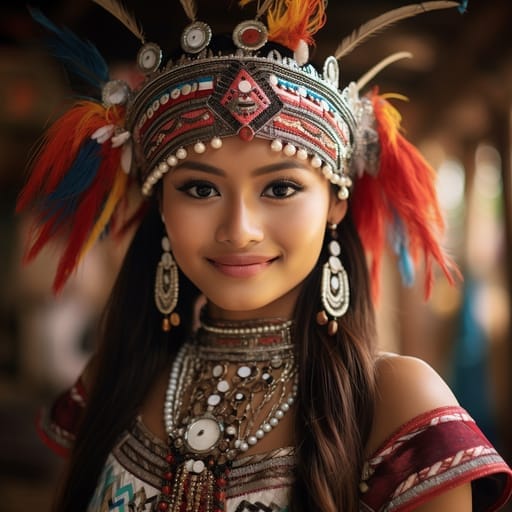
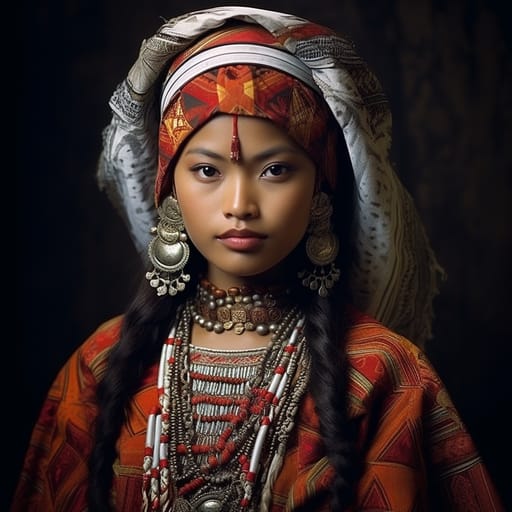
Typical Tagalogs Phenotypes
Reference for AI generation: hair, eyes, skin, facial structure, build
Tagalogs sit at a genetic crossroads — predominantly Austronesian with substantial Negrito substrate and varying degrees of Spanish, Chinese, and American admixture from four centuries of colonial contact. The result is a population with more visible phenotypic range than most Southeast Asian groups, even within a single Manila family.
Hair is almost universally black to very dark brown, straight to gently wavy, with a thick round shaft that holds volume well; loose curls appear occasionally where Negrito ancestry surfaces. Body and facial hair is sparse on men, minimal on women. Eyes run dark brown to near-black, almond-shaped, with a partial or low-tension epicanthic fold — less pronounced than in Han Chinese or Korean populations, which gives Tagalog eyes a more open, rounded read. Double eyelids are common; monolids are a minority but not rare.
Skin spans Fitzpatrick III through V, with golden-tan to warm-brown undertones the modal range. Mestizos with significant Spanish or Chinese ancestry trend lighter (III–IV) with cooler or more olive cast; provincial Tagalogs and those with stronger Negrito heritage land deeper (IV–V) with red-brown undertones. Sun exposure deepens this quickly given equatorial latitude.
Facial structure is typically broad rather than narrow: moderate cheekbones, a relatively short and slightly flat-bridged nose with rounded tip and medium-wide alar base, and full but not heavy lips. Jawlines are softer than in mainland East Asian groups — more rounded chins, less angular gonial flare. The "Filipina look" most foreigners recognize — wide-set dark eyes, broad cheeks, small flat nose, warm tan skin — is the Austronesian baseline; the lighter, sharper-featured mestiza look is a colonial overlay, not the median.
Build is compact. Average stature runs roughly 5'2"–5'3" for women and 5'5"–5'6" for men, among the shorter ranges in Asia. Body composition tends toward slim-to-curvy with low muscle mass, narrow shoulders, and a relatively short torso. Filipino Americans raised on Western diets trend taller and broader-framed but retain the facial signature.
Tagalogs Body & Anatomy Reference
Per-feature anatomical profile for AI nude generation: Southeast Asian Austronesian / Austroasiatic phenotype
Tagalogs Boobs & Breasts
Tagalogs boobs follow the Southeast Asian Austronesian / Austroasiatic profile: small-to-medium cup, modest projection. Areolar diameter is usually 26-38mm, and the coloring is medium-brown to dark-brown areolar pigmentation against the tan-to-medium-brown skin tone. Breast shape tracks body composition (ectomorph, petite frame, mean adult female BMI 20-23), so Tagalogs breasts tend to be firm, modest projection. Expect a forward-set shape, not the fuller South Asian or Polynesian bust.
Tagalogs Ass & Hips
Tagalogs ass and hip morphology presents as small-to-medium, modest projection, narrower hip profile, distinctly different from the fuller glutes of the Pacific Islander phenotype. The Tagalogs pelvic profile shows narrow-to-medium iliac crests, anchored in the Southeast Asian Austronesian / Austroasiatic skeletal pattern. Tagalogs butt shots in adult AI imagery should render the small-to-medium, modest projection, narrower hip profile silhouette with the overall build (ectomorph, petite frame) and the fat distribution typical of the Southeast Asian Austronesian / Austroasiatic phenotype.
Tagalogs Vagina & Pussy
Tagalogs pussy anatomy typically shows medium-brown to dark-brown labial pigmentation. Pubic hair is usually straight-to-wavy fine-to-medium texture. In AI-generated Tagalogs nudes, labial color should blend into the tan to medium-brown skin with a gradual transition, and the hair should keep its straight-to-wavy fine-to-medium texture.
Tagalogs Dicks & Penis
Penis reference for Tagalogs men: regional mean ~11cm erect, moderate girth. Coloring: medium-brown shaft pigmentation. An accurate Tagalogs cock in AI imagery matches the surrounding tan to medium-brown skin rather than a generic porn default. Circumcision depends on religion and custom, not ancestry.
Tagalogs Body, Curves & Build
The Tagalogs figure is generally ectomorph, petite frame, with mean adult female BMI 20-23, characteristic of Southeast Asian Austronesian / Austroasiatic ancestry. AI image tools tend to flatten regional body types into a few stock shapes; here the Tagalogs build is kept as its own reference.
Tagalogs Skin Tone & Hair Texture
Skin: tan to medium-brown (Fitzpatrick III-V). Hair: straight-to-wavy 1A-2A, dark-brown to black. Both are typical of Southeast Asian Austronesian / Austroasiatic ancestry. The most common mistake in AI nudes of Tagalogs women is a body rendered lighter than the face.
Data depth
0/100Coverage of image-grounded phenotype observations · drives AI generation diversity
- Sample size
- 0/40· 0 images
- Image quality
- 0/30· 0% high
- Confidence
- 0/20
- Source diversity
- 0/10
- ·No image observations yet
Explore phenotype categories
Structured taxonomy with peer-reviewed scales · 22 anatomical categories
Erotic Poses & Sex Positions
From the pose catalog: 219 named positions with reference skeletons
Frequently asked questions about Tagalogs people
Where is the Tagalogs homeland?
The Tagalogs homeland is Philippines in Southeast Asia.
What language do Tagalogs people speak?
Tagalogs people primarily speak Austronesian / Philippine / Tagalog.
What religion do Tagalogs people practice?
The predominant religion among Tagalogs people is Christianity / Catholicism.
What are other names for Tagalogs people?
Tagalogs people are also known as Tagalog.






Make your own Tagalogs images
Five a day, free, no credits to buy. The studio starts from this group's phenotype data, so you can set body type, pose and style and keep the traits accurate.
Start with Tagalogs