Help us get this right
Does this portrait look right for Sasak?
Nobody has judged this one yet. You would be the first.
Sasak Erotic
Lombok (Indonesia)
Islam
About Sasak People
The Sasak are the people of Lombok, the island immediately east of Bali across the narrow Lombok Strait — a strait that also happens to be one of the sharpest biogeographical lines on earth. Lombok sits on the Asian side of the Wallace Line in cultural terms but the Australasian side in faunal terms, and the Sasak live with that doubleness: rice terraces and volcanic soils that feel continuous with Java, but a drier, scrubbier landscape than the wet green of their famous western neighbor. They number around three and a half million, and on Lombok itself they are the overwhelming majority, with Balinese, Sumbawan, and Chinese minorities layered into the towns.
Their language, Sasak, is Austronesian and closely related to Balinese and Sumbawan, but it is internally fractured into several mutually intelligible dialects that locals can place by ear within a sentence or two — a marker of village rather than nation. Sasak has its own pre-Islamic script tradition, aksara Sasak, derived from the Old Javanese family and still used for ritual texts and palm-leaf manuscripts called takepan.
Almost all Sasak are Muslim, but the religious texture of the island is unusual. The mainstream community practices ordinary Sunni Islam, oriented toward the same calendar and obligations as Muslims elsewhere in the archipelago. Alongside it survives Wetu Telu — literally "three times" — a syncretic form concentrated around the village of Bayan in the north, in which adherents pray three times a day rather than five and delegate much of the formal religious labor to a class of elders, while keeping pre-Islamic ancestor rites and agricultural ceremonies intact. Wetu Telu has been pressured for decades by reformist Sunni currents and is now small, but it remains the most-discussed feature of Sasak religious life.
Lombok's history runs through Majapahit influence, a long period of Balinese rule from the Karangasem kingdom in the eighteenth and nineteenth centuries, then Dutch conquest in 1894 after the Sasak aristocracy invited the Dutch in to break Balinese control — a bargain whose consequences they then had to live with. That sequence still shapes how Sasak speak about themselves: as people who were dominated, who pushed back, and who came out of it with an island that is theirs. Distinctive customs include peresean, a ritualized stick-and-rattan-shield duel staged at festivals, and nyongkolan, the public wedding procession in which the groom's party walks the bride home through the village to gamelan accompaniment.
Related ethnic groups
Groups that share Sasak's homeland, region, language, or religious tradition. These are likely candidates for comparative phenotype reference.
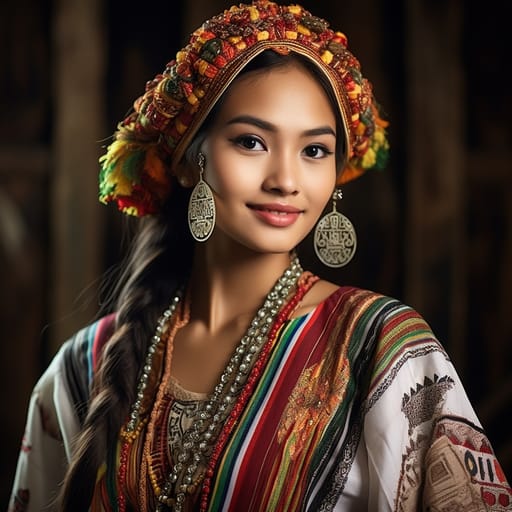
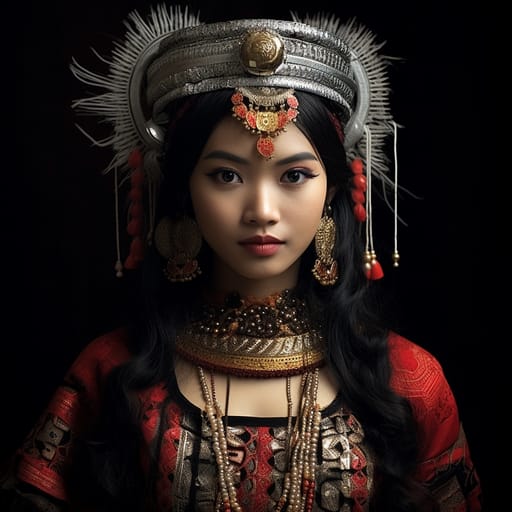
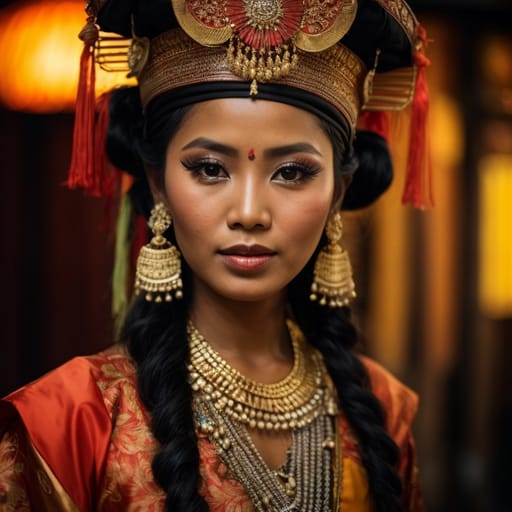
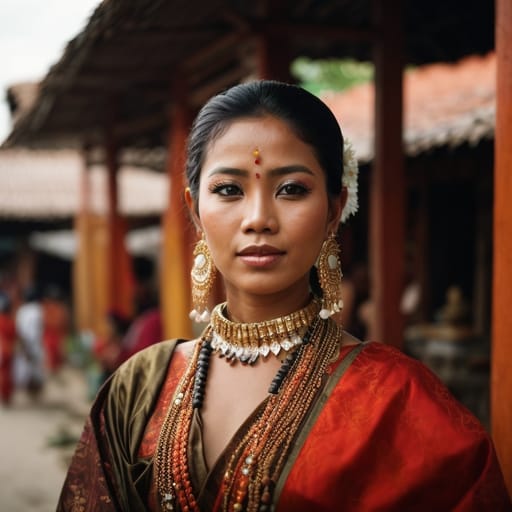
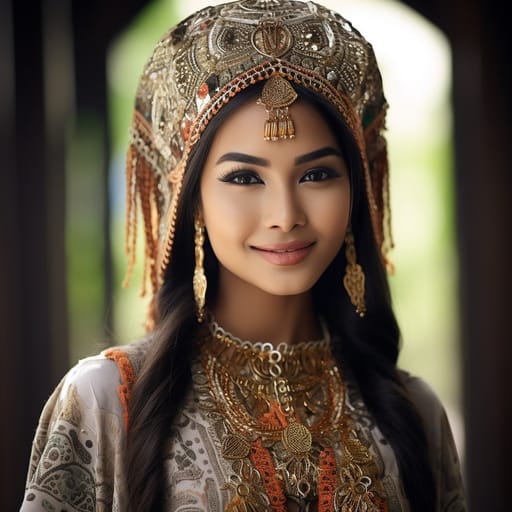
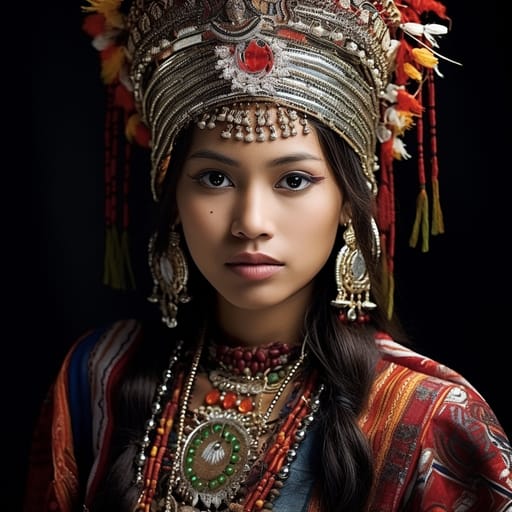
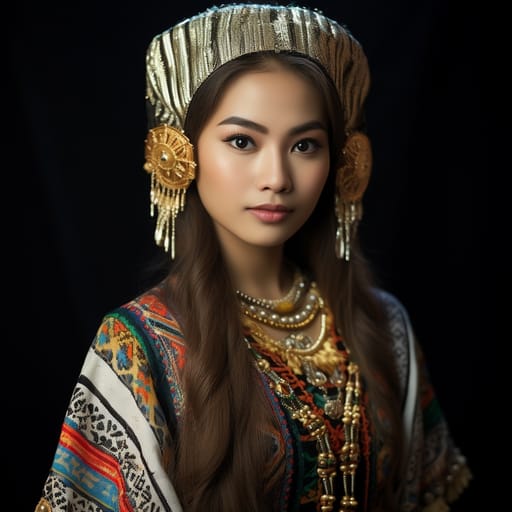
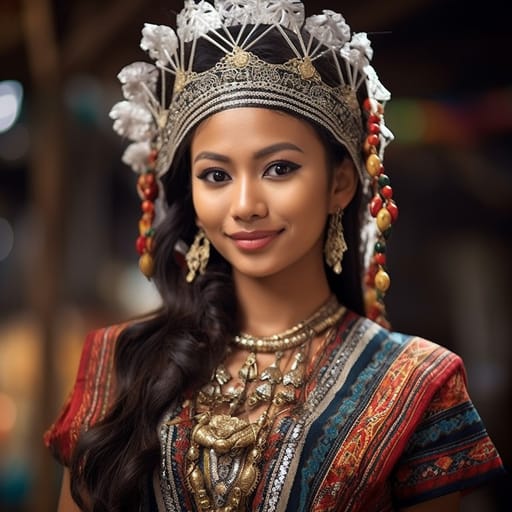
Typical Sasak Phenotypes
Reference for AI generation: hair, eyes, skin, facial structure, build
The Sasak are an Austronesian-speaking population indigenous to Lombok, and their phenotype sits in the transitional zone between western Indonesian Malay populations and the more Melanesian-influenced groups farther east in Nusa Tenggara. Hair is uniformly black or near-black, predominantly straight to gently wavy, with a coarser texture than what's typical of Javanese or Balinese neighbors to the west. Tighter wave patterns and the occasional loose curl appear with measurably higher frequency than on Bali or Java — a signal of the eastward Papuan admixture cline that runs through the Lesser Sundas.
Eyes are dark brown to near-black. The epicanthic fold is present in most Sasak but tends to be lighter and less prominent than in mainland Southeast Asian or East Asian populations; a fully open, almond-shaped eye with only a partial fold is common, and palpebral fissures sit relatively horizontal rather than markedly upslanted.
Skin tone covers a wide band from light olive-brown in the northern and western lowlands to deep warm brown in the rural south and southeast — roughly Fitzpatrick III through V, with undertones running golden to coppery rather than yellow. Sun exposure from rice cultivation and coastal fishing pulls the working population toward the darker end of that range.
Facial structure tends toward broad, softly rounded features: a moderately low and broad nasal bridge, medium to wide alar base, and full but not everted lips. Cheekbones are prominent and set wide, and jaws are typically rounded rather than squared, giving an overall soft-featured oval to round face shape. Foreheads are moderate and brow ridges low.
Build is small to medium-framed. Adult male stature averages around 162–164 cm and female around 151–153 cm, with lean, wiry musculature among rural and fishing populations and a tendency toward compact, lightly-built proportions. Shoulders are narrow to moderate, hips proportionate, and limbs short relative to torso — a build pattern consistent across the wider Lesser Sunda region.
Sasak Body & Anatomy Reference
Per-feature anatomical profile for AI nude generation: Southeast Asian Austronesian / Austroasiatic phenotype
Sasak Boobs & Breasts
The typical Sasak bust is small-to-medium cup, modest projection, in line with the wider Southeast Asian Austronesian / Austroasiatic pattern. Areolas usually fall in the 26-38mm range, with medium-brown to dark-brown areolar pigmentation against the tan-to-medium-brown skin tone. Compared with the fuller South Asian or Polynesian bust, Sasak breasts sit forward and are generally firm, modest projection. A faithful AI render of Sasak tits keeps that shape and areola size.
Sasak Ass & Hips
Butt shape among Sasak women: small-to-medium, modest projection, narrower hip profile, over narrow-to-medium iliac crests. This follows Southeast Asian Austronesian / Austroasiatic ancestry and looks quite unlike the fuller glutes of the Pacific Islander phenotype. An accurate Sasak ass in adult AI imagery keeps both the silhouette and the overall build (ectomorph, petite frame) instead of a generic average.
Sasak Vagina & Pussy
Vulvar anatomy among Sasak women: medium-brown to dark-brown labial pigmentation. Pubic hair tends to be straight-to-wavy fine-to-medium texture, in the usual inverted-triangle pattern. Both follow Southeast Asian Austronesian / Austroasiatic pigmentation, which is why Sasak pussy renders should not fall back on a pale, sparse Western template.
Sasak Dicks & Penis
The Sasak cock profile, from Southeast Asian Austronesian / Austroasiatic anthropometric data: regional mean ~11cm erect; moderate girth; medium-brown shaft pigmentation. Pubic hair has a straight-to-wavy fine-to-medium texture and forms the usual inverted-V pattern. Whether Sasak men are circumcised follows religious and cultural practice rather than phenotype.
Sasak Body, Curves & Build
Build and curves among Sasak women follow the Southeast Asian Austronesian / Austroasiatic pattern: ectomorph, petite frame, mean adult female BMI 20-23. Proportions matter as much as skin tone, so Sasak figures should keep their regional height and limb ratios.
Sasak Skin Tone & Hair Texture
The Sasak skin range is tan to medium-brown (Fitzpatrick III-V), and hair tends to be straight-to-wavy 1A-2A, dark-brown to black. That combination marks the Southeast Asian Austronesian / Austroasiatic phenotype, and skin tone is the trait AI generators most often get wrong for Sasak women.
Data depth
0/100Coverage of image-grounded phenotype observations · drives AI generation diversity
- Sample size
- 0/40· 0 images
- Image quality
- 0/30· 0% high
- Confidence
- 0/20
- Source diversity
- 0/10
- ·No image observations yet
Explore phenotype categories
Structured taxonomy with peer-reviewed scales · 22 anatomical categories
Erotic Poses & Sex Positions
From the pose catalog: 219 named positions with reference skeletons
Frequently asked questions about Sasak people
Where is the Sasak homeland?
The Sasak homeland is Lombok (Indonesia) in Southeast Asia.
What language do Sasak people speak?
Sasak people primarily speak Austronesian / Sasak.
What religion do Sasak people practice?
The predominant religion among Sasak people is Islam.






Make your own Sasak images
Five a day, free, no credits to buy. The studio starts from this group's phenotype data, so you can set body type, pose and style and keep the traits accurate.
Start with Sasak