Help us get this right
Does this portrait look right for Maranao?
One tap. It takes a second and it is recorded.
4 say it looks right, 2 say it looks off.
Maranao Erotic
Lanao (Philippines)
Islam
About Maranao People
The Maranao are the people of the lake — maranao means "people of Lanao," and Lanao means the lake itself, a high freshwater body in the mountains of central Mindanao. Identity here is geographic before it is anything else: the highland plateau around Lake Lanao has been Maranao country for as long as written record reaches, and the community's center of gravity has not really moved. They are one of the three major Muslim peoples of the Philippines, alongside the Tausug and the Maguindanao, but where the Tausug face the sea and the Maguindanao spread across the river plains, the Maranao kept to the cooler upland — a fact that shaped almost everything else about them.
The language is Austronesian, in the broad Philippine cluster, closely related to Maguindanao and Iranun and more distantly to Tagalog and Cebuano; speakers number in the millions, and unlike many regional Philippine languages it has held its ground against Tagalog and English in daily use. Islam arrived through trade and missionary networks moving up from the Sulu archipelago in the late fourteenth and fifteenth centuries, and the Maranao were among the last sizeable groups in the archipelago to convert before Spanish colonization changed the trajectory of the islands. Spanish authority never really took root in Lanao. Neither did American authority, fully. That long history of not being absorbed is part of how Maranao describe themselves.
Social life runs on maratabat — a concept usually translated as honor or pride, though neither word carries the weight. Maratabat is the felt obligation to defend one's name, family, and rank, and it organizes everything from marriage negotiations to political feuds known as rido, which can persist across generations. Society is structured into royal houses and a layered hierarchy traced through the salsila, a written genealogy. The visual culture is unmistakable: okir, the flowing curvilinear woodcarving that ornaments houses, instruments, and especially the torogan — the ancestral residence of a datu, with its enormous sweeping panolong beams jutting from the eaves. The Darangen, a sung epic cycle running to tens of thousands of lines and recognized by UNESCO, is still performed.
The 2017 siege of Marawi, the Maranao capital, leveled much of the old city center, and reconstruction has been slow and contested. The cultural questions raised by that destruction — what to rebuild, what to let stand as ruin, how a Muslim city in a Catholic-majority republic insists on its own continuity — remain open.
Related ethnic groups
Groups that share Maranao's homeland, region, language, or religious tradition. These are likely candidates for comparative phenotype reference.
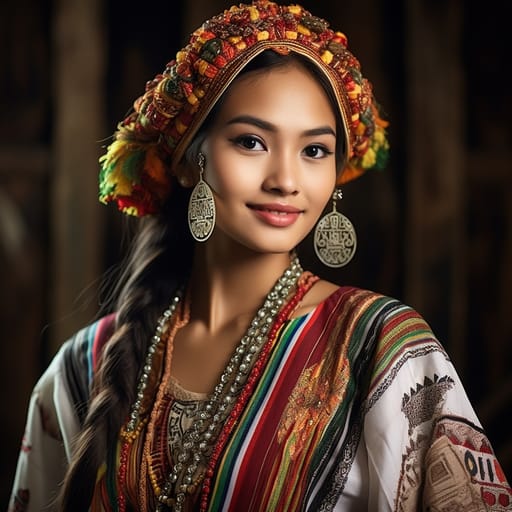
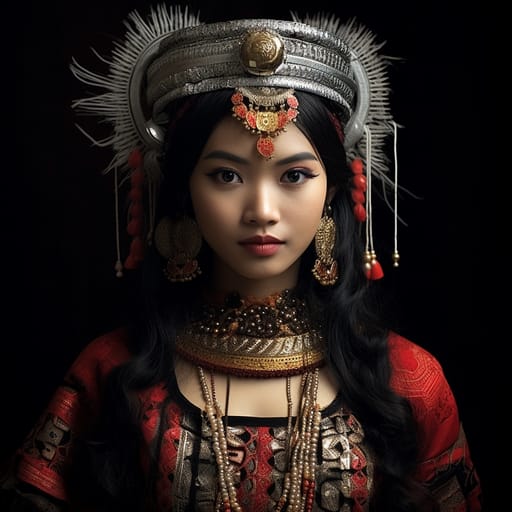
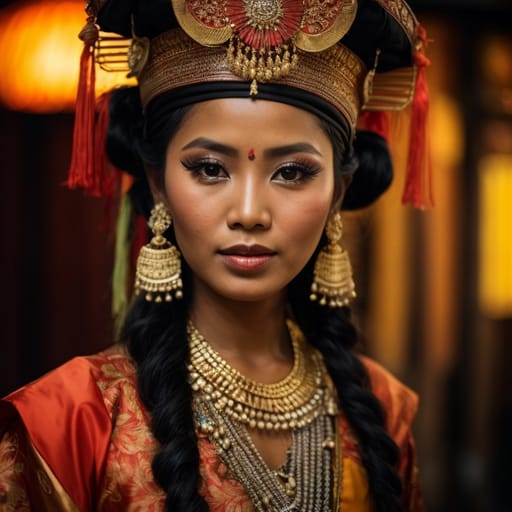
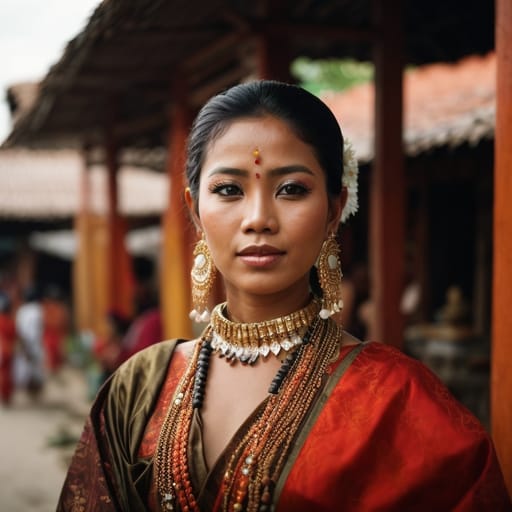
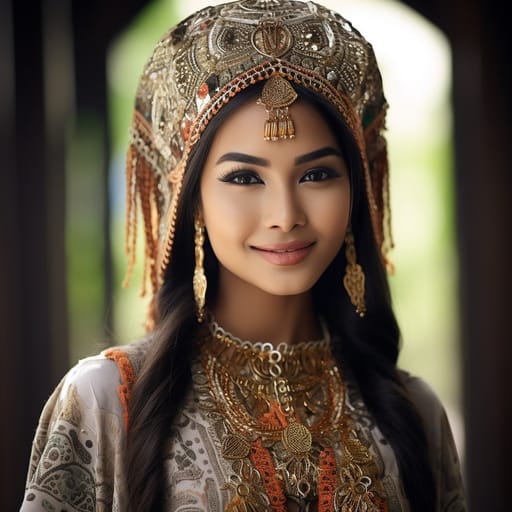
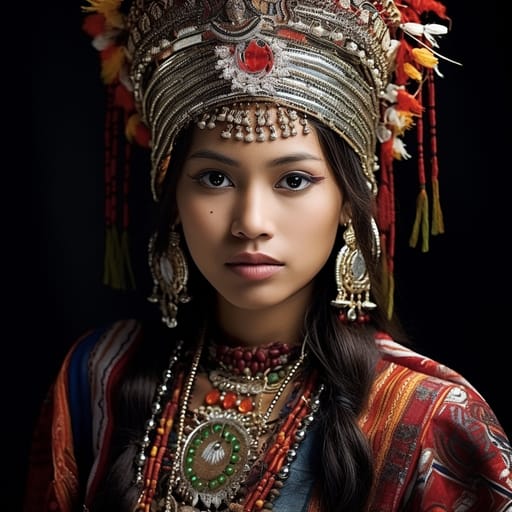
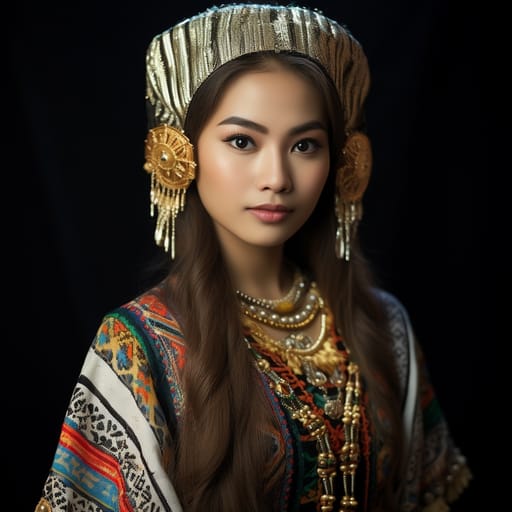
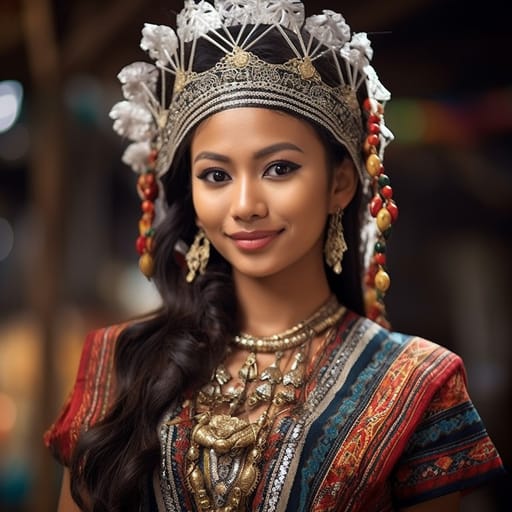
Typical Maranao Phenotypes
Reference for AI generation: hair, eyes, skin, facial structure, build
The Maranao are a lowland Austronesian people of the Lake Lanao basin in Mindanao, and their phenotype sits firmly within the southern Philippine cluster — closer to coastal Visayan and Maguindanao populations than to the upland Lumad or the northern Tagalog/Ilocano range. Skin tone runs across Fitzpatrick III to V, most commonly a warm light-to-medium brown with olive or coppery undertones; deeper bronze tones are common among rural and farming communities, while paler honey-tan complexions appear in urban Marawi families. Sun exposure widens the visible range more than the underlying genotype suggests.
Hair is uniformly black to very dark brown, thick, and coarse-textured, almost always straight or with a loose natural wave; tight curls are uncommon. Graying tends to come late. Eyes are dark brown to near-black, and the epicanthic fold is present in the majority but often softer and less pronounced than in East Asian populations — the eye opening reads as almond-shaped rather than narrowly hooded, with moderately heavy upper lids. Lashes are typically dense and straight.
The facial structure is the most distinctive register. Noses tend to be short with a low-to-medium bridge and a moderately broad, rounded tip — broader alar wings than the East Asian average but narrower than the Melanesian-influenced southern Lumad groups. Cheekbones are wide and softly rounded rather than sharply angular, jaws are moderate, and lip fullness sits in the medium range, with a slightly fuller lower lip common. Faces overall read as broad and softly oval. Public figures like Samira Gutoc-Tomawis show the characteristic combination clearly.
Build is small-to-medium-framed. Men typically stand 160–168 cm, women 150–158 cm, with compact torsos, short-to-moderate limb length, and a tendency toward soft musculature rather than wiry leanness — adult women frequently carry fuller hips and bust relative to overall frame. Visible sub-group variation is minor; the Maranao are relatively endogamous, and phenotype differences between Lanao del Sur and Lanao del Norte families are subtle rather than structural.
Maranao Body & Anatomy Reference
Southeast Asian Austronesian / Austroasiatic phenotype: anatomy reference for AI nude generation
Maranao Boobs & Breasts
Bust reference for Maranao women: small-to-medium cup, modest projection, which is typical of Southeast Asian Austronesian / Austroasiatic ancestry. Areolas measure about 26-38mm across, with medium-brown to dark-brown pigmentation. Body type (ectomorph, petite frame) shapes the bust as well, so Maranao tits are usually firm, modest projection. In AI imagery, keep the forward-set shape rather than drifting toward the fuller South Asian or Polynesian bust.
Maranao Ass & Hips
The Maranao ass is typically small-to-medium, modest projection, narrower hip profile, which sets it apart from the fuller glutes of the Pacific Islander phenotype. Underneath, the pelvis shows narrow-to-medium iliac crests, part of the Southeast Asian Austronesian / Austroasiatic skeletal pattern. For Maranao butt pics and AI renders, match that silhouette and the overall build (ectomorph, petite frame).
Maranao Vagina & Pussy
Maranao pussy and vulvar anatomy presents medium-brown to dark-brown labial pigmentation, consistent with the Southeast Asian Austronesian / Austroasiatic phenotype's pigmentation pattern. Maranao pubic hair is typically straight-to-wavy fine-to-medium texture, in the inverted-triangle pattern. For anatomically accurate Maranao pussy renders the labial coloration should match the surrounding tan to medium-brown skin tone with a continuous gradient, and the hair should keep its straight-to-wavy fine-to-medium texture.
Maranao Dicks & Penis
Maranao dicks follow the Southeast Asian Austronesian / Austroasiatic reference data: regional mean ~11cm erect; moderate girth; medium-brown shaft pigmentation. Shaft color should track the tan to medium-brown skin tone with a smooth change toward the glans, and Maranao pubic hair keeps its straight-to-wavy fine-to-medium texture.
Maranao Body, Curves & Build
Maranao body type and overall build presents as ectomorph, petite frame, with mean adult female BMI 20-23: the characteristic Southeast Asian Austronesian / Austroasiatic habitus. Maranao curves and proportions should keep the regional skeletal frame (height, shoulder-to-hip ratio, limb proportions) rather than a generic mesomorph default.
Maranao Skin Tone & Hair Texture
Maranao skin sits in the tan to medium-brown (Fitzpatrick III-V) band. Hair is typically straight-to-wavy 1A-2A, dark-brown to black, in keeping with the Southeast Asian Austronesian / Austroasiatic phenotype. In nude renders the skin should stay one even tone from face to body, and body, pubic and head hair should match.
Data depth
58/100Coverage of image-grounded phenotype observations · drives AI generation diversity
- Sample size
- 20/40· 11 images
- Image quality
- 23/30· 45% high
- Confidence
- 15/20· mean 0.80
- Source diversity
- 0/10· wikipedia
- ·Modest sample (n<25)
- ·Wikipedia-only source, not population-representative
Observed Distribution: Image Sample
Empirical observations from analyzed photographs · supplementary signal, not population truth
Sample: 11 images analyzed (11 wikipedia). Quality: 5 high, 4 medium, 2 low, 0 very_low. Avg analyzer confidence: 0.80.
Skin tone (Fitzpatrick): IV (91%), V (9%)
Hair color: gray/white (64%), black (27%), unclear (9%)
Hair texture: straight (82%), covered (18%)
Eye color: dark brown (100%)
Epicanthic fold: 100% present, 0% absent, 0% unclear
Caveats: Sample size 11 is modest, so secondary patterns may not be reliable. Sample is 100% Wikipedia notable people, which skews toward male, public-life, and modern figures, not population-representative.
Last aggregated: May 7, 2026
Explore phenotype categories
Structured taxonomy with peer-reviewed scales · 22 anatomical categories
Notable Maranao People
12 reference figures, sourced from Wikipedia
- Abdullah Maute, a jihadist and co-founder of the Maute group and a brother of Omar Maute.
- Omar Maute, a jihadist and co-founder of the Maute group and a brother of Abdullah Maute.
- Saidamen Pangarungan, a lawyer, businessman, and former chairman of COMELEC and National Commission…
- Japar Dimaampao, is a present Associate Justice of the Supreme Court of the Philippines
- Mamintal A.J. Tamano, was a Filipino statesman and a former Senator of the Philippines.
- Adel Tamano, is a Filipino educator, lawyer and former politician.
- Domocao Alonto, is a former Filipino politician and senator of the Philippines. In 1988, he w…
- Mamintal M. Adiong Sr., was a long-time Filipino politician, serving as Governor of Lanao del Sur fro…
- Mamintal Alonto Adiong Jr., is the present governor of the Province of Lanao del Sur.
- Abul Khayr Alonto, is a Filipino businessman and lawyer and a former Moro freedom fighter. He on…
- Dimasangcay Pundato, is a former Moro revolutionary leader and current undersecretary of the Offic…
- Samira Gutoc-Tomawis, is a Filipino civic leader, journalist, environment and women's rights advoca…
Erotic Poses & Sex Positions
From the pose catalog: 219 named positions with reference skeletons
Frequently asked questions about Maranao people
Where is the Maranao homeland?
The Maranao homeland is Lanao (Philippines) in Southeast Asia.
What language do Maranao people speak?
Maranao people primarily speak Austronesian / Philippine / Maranao.
What religion do Maranao people practice?
The predominant religion among Maranao people is Islam.






Make your own Maranao images
Five a day, free, no credits to buy. The studio starts from this group's phenotype data, so you can set body type, pose and style and keep the traits accurate.
Start with Maranao