No portrait yet
Nicoleño Erotic
San Nicolas Island, the outermost of the southern Channel Islands off Southern California, United States
Nicoleño (Uto-Aztecan, probably Takic branch), known only from a few recorded words and songs
Indigenous beliefs, largely unrecorded; the last known survivor was baptized Catholic in 1853
Southern California island peoples; linguistically likely related to the Takic-speaking Tongva and Luiseño
About Nicoleño People
The Nicoleño were the Native people of San Nicolas Island, the most remote of California's Channel Islands. They lived there for thousands of years, until a massacre in 1811 and their removal to the mainland in 1835 ended life on the island. No community carries on as Nicoleño today. Some Southern California tribes on the mainland have claimed cultural ties to the island.
Their home was a low, windswept island about 60 miles off the coast, short on fresh water and almost bare of trees. Daily life faced the ocean: fish, abalone and other shellfish, seals and sea lions, with canoe travel linking them to the other southern islands and the mainland. They spoke a Uto-Aztecan language, most likely from the Takic branch that also includes Tongva and Luiseño. That tied them to the Los Angeles Basin through language, not to the Chumash-speaking islands to the north. Almost none of the language survives: a few words and a couple of songs, recalled by people who heard its last speaker. With so little wood to build with, whale bone did some of the work, and the last known Nicoleño was found living in a shelter framed with it.
Their world fell apart quickly. Around 1811, Alaska Native hunters brought south by Russian fur traders to take sea otters turned on the islanders and killed many of them. By 1835 so few people were left that a schooner was sent to carry them to the mainland, and those who went soon drop out of the record. One woman stayed behind. Accounts of how that happened differ. She lived alone on the island for 18 years. When a hunting party found her in 1853, she wore a dress sewn from cormorant skins and still spoke only her own language. She was taken to Santa Barbara, where no one could understand her, Native or otherwise. She was baptized as Juana Maria and died within about two months.
Her story became the basis for Scott O'Dell's 1960 novel Island of the Blue Dolphins, which is how most Americans have met the Nicoleño, usually without knowing their name. Today the island is a U.S. Navy installation closed to the public. Its shell middens, house sites and buried caches are the main evidence left of a people who made a living on a hard, isolated island for millennia.
Related ethnic groups
Groups that share Nicoleño's homeland, region, language, or religious tradition. These are likely candidates for comparative phenotype reference.
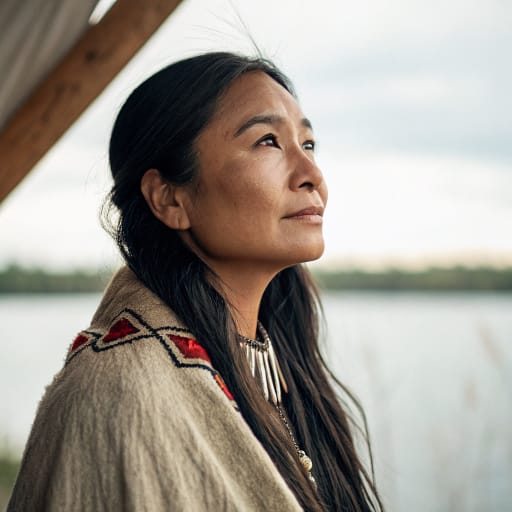
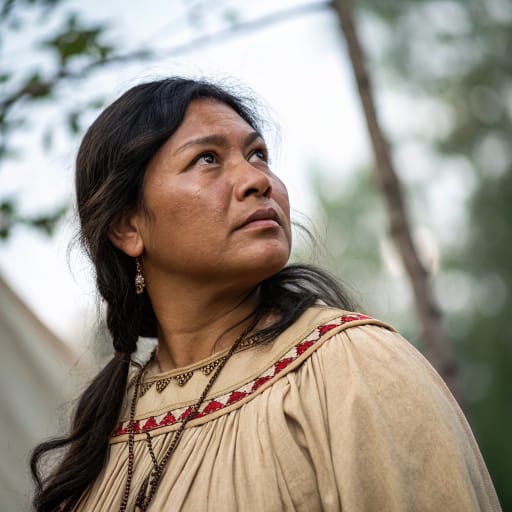

Typical Nicoleño Phenotypes
Reference for AI generation: hair, eyes, skin, facial structure, build
Nicoleño Body & Anatomy Reference
Indigenous Northern American / Algonquian-Iroquoian phenotype: anatomy reference for AI nude generation
Nicoleño Boobs & Breasts
Nicoleño boobs follow the Indigenous Northern American / Algonquian-Iroquoian profile: medium cup, moderate projection. Areolar diameter is usually 30-44mm, and the coloring is medium-brown areolar pigmentation against the copper-to-medium-brown skin tone. Breast shape tracks body composition (mesomorph, broader frame in northern Indigenous populations, mean adult female BMI 25-28), so Nicoleño breasts tend to be full and moderate projection. Expect a forward-set shape, not the smaller East Asian bust.
Nicoleño Ass & Hips
Nicoleño ass and hip morphology presents as medium, moderate-to-full projection, distinctly different from the slim East Asian narrow-hip profile. The Nicoleño pelvic profile shows medium iliac crests, anchored in the Indigenous Northern American / Algonquian-Iroquoian skeletal pattern. Nicoleño butt shots in adult AI imagery should render the medium, moderate-to-full projection silhouette with the overall build (mesomorph, broader frame in northern Indigenous populations) and the fat distribution typical of the Indigenous Northern American / Algonquian-Iroquoian phenotype.
Nicoleño Vagina & Pussy
Nicoleño pussy anatomy typically shows medium-brown labial pigmentation. Pubic hair is usually straight medium-coarse texture. In AI-generated Nicoleño nudes, labial color should blend into the copper to medium-brown skin with a gradual transition, and the hair should keep its straight medium-coarse texture.
Nicoleño Dicks & Penis
Penis reference for Nicoleño men: regional mean ~13cm erect, moderate girth. Coloring: medium-brown shaft pigmentation. An accurate Nicoleño cock in AI imagery matches the surrounding copper to medium-brown skin rather than a generic porn default. Circumcision depends on religion and custom, not ancestry.
Nicoleño Body, Curves & Build
The Nicoleño figure is generally mesomorph, broader frame in northern Indigenous populations, with mean adult female BMI 25-28, characteristic of Indigenous Northern American / Algonquian-Iroquoian ancestry. AI image tools tend to flatten regional body types into a few stock shapes; here the Nicoleño build is kept as its own reference.
Nicoleño Skin Tone & Hair Texture
Skin: copper to medium-brown (Fitzpatrick III-V). Hair: straight 1A, dark-brown to black, often thick and dense. Both are typical of Indigenous Northern American / Algonquian-Iroquoian ancestry. The most common mistake in AI nudes of Nicoleño women is a body rendered lighter than the face.
Explore phenotype categories
Structured taxonomy with peer-reviewed scales · 22 anatomical categories
Erotic Poses & Sex Positions
From the pose catalog: 219 named positions with reference skeletons
Frequently asked questions about Nicoleño people
Where is the Nicoleño homeland?
The Nicoleño homeland is San Nicolas Island, the outermost of the southern Channel Islands off Southern California, United States in North America.
What language do Nicoleño people speak?
Nicoleño people primarily speak Nicoleño (Uto-Aztecan, probably Takic branch), known only from a few recorded words and songs.
What religion do Nicoleño people practice?
The predominant religion among Nicoleño people is Indigenous beliefs, largely unrecorded; the last known survivor was baptized Catholic in 1853.






Make your own Nicoleño images
Five a day, free, no credits to buy. The studio starts from this group's phenotype data, so you can set body type, pose and style and keep the traits accurate.
Start with Nicoleño