Help us get this right
Does this portrait look right for Mattole?
Nobody has judged this one yet. You would be the first.
Mattole Erotic
Mattole River and Bear River valleys and the coast around Cape Mendocino, Humboldt County, northwestern California, United States
Mattole, including the Bear River dialect (Athabaskan, California Athabaskan group); no longer spoken as a first language, descendants speak English
Traditional Indigenous beliefs; Christianity introduced after American settlement in the 1850s
Mattole proper and Bear River people; part of the California Athabaskan peoples; descendants are among the members of the Bear River Band of the Rohnerville Rancheria
About Mattole People
The Mattole are one of the small Athabaskan-speaking peoples of California's far northern coast, and a river still carries their name. Their country ran from the Bear River south past Cape Mendocino and up the Mattole River valley. It is a steep, foggy stretch of Humboldt County that the highway system went around, and outsiders now call it the Lost Coast. The Mattole fished the river's salmon runs, gathered acorns on the tanoak ridges and worked the rocky shoreline for mussels and other shellfish. Two closely related communities shared this ground: the Mattole proper along the lower river and coast, and the Bear River people to the north, who spoke a dialect of the same language. That language is what sets them apart. Mattole belongs to the Athabaskan family, whose heartland lies far to the north in Alaska and western Canada and whose best-known southern members are Navajo and Apache. On this coast it kept unusual company. The Wiyot just to the north spoke an Algic language, a distant relative of the Algonquian languages of the East, while the Sinkyone and Nongatl to the south and east spoke dialects of a different Athabaskan language. In the late 1920s the linguist Fang-Kuei Li worked with the last speakers, and his 1930 grammar of Mattole became an early landmark in Athabaskan studies.
American settlement reached the valley in the 1850s and hit hard. Ranchers claimed the bottomlands, and drillers put down some of California's earliest oil wells near what became Petrolia. Settler violence, disease and removal to reservations cut the Mattole down to a scattered remnant within a generation. Little of their ceremonial life was written down before that world broke apart, and the language lost its last first-language speakers in the decades after Li's work. The people themselves did not vanish. Mattole descendants are among the members of the Bear River Band of the Rohnerville Rancheria, a federally recognized tribe near Loleta that also counts Wiyot families among its members. The rancheria lost federal recognition in the mid-twentieth century and later had it restored. Today the band runs its own government, land and programs in Humboldt County, a few ridges north of the valleys its ancestors were driven from.
Related ethnic groups
Groups that share Mattole's homeland, region, language, or religious tradition. These are likely candidates for comparative phenotype reference.
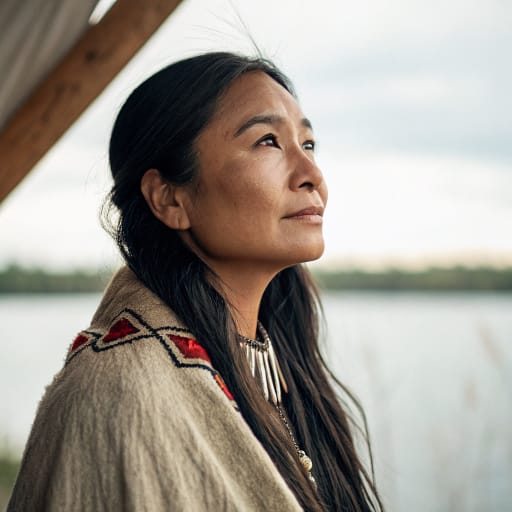
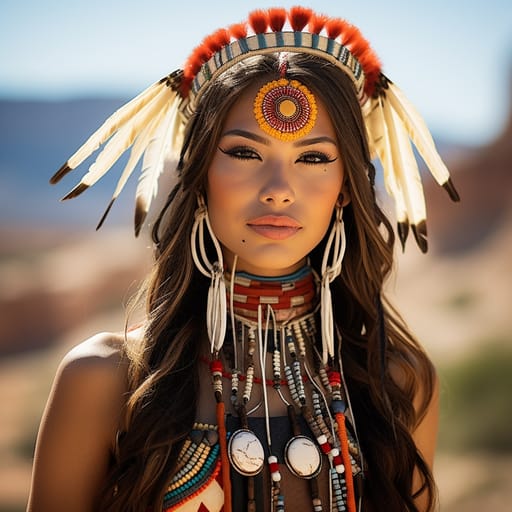
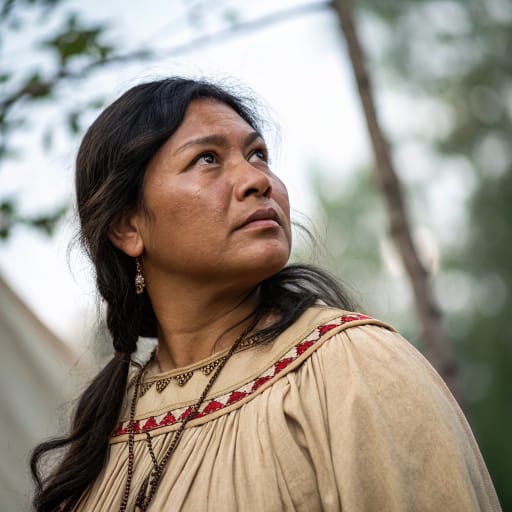
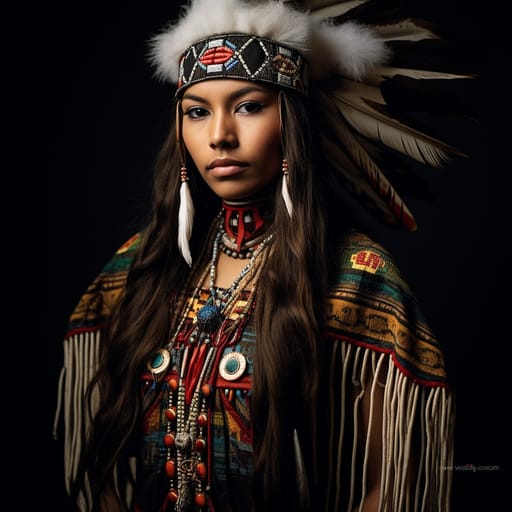
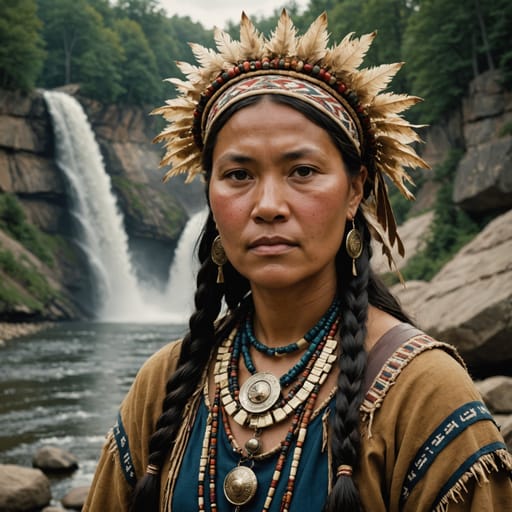
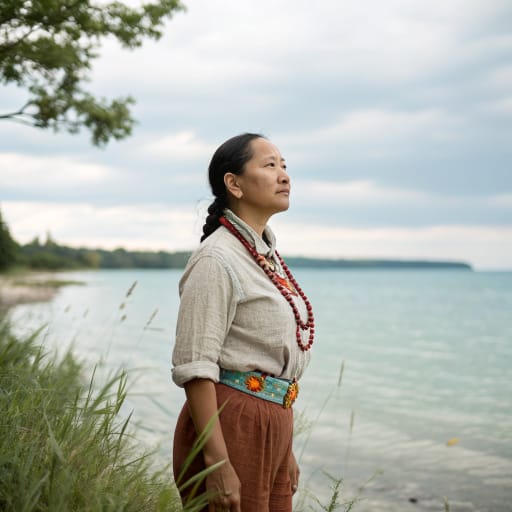
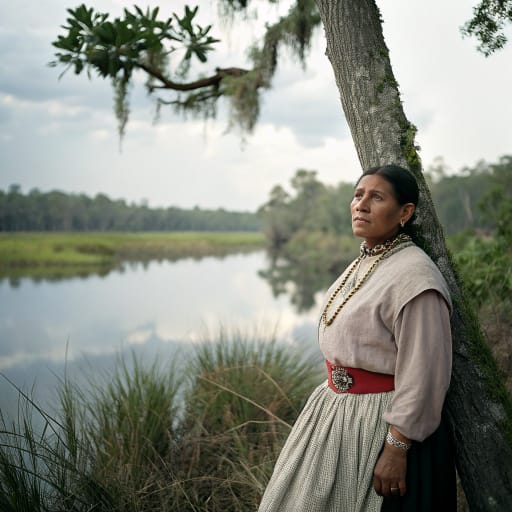
Typical Mattole Phenotypes
Reference for AI generation: hair, eyes, skin, facial structure, build
Mattole Body & Anatomy Reference
Indigenous Northern American / Algonquian-Iroquoian phenotype: anatomy reference for AI nude generation
Mattole Boobs & Breasts
Mattole tits and boobs run medium cup, moderate projection, the classic Indigenous Northern American / Algonquian-Iroquoian bust profile. Mattole nipples and areolas show medium-brown areolar pigmentation against the copper-to-medium-brown skin tone, with areolar diameter typically in the 30-44mm range and forward-set positioning rather than the smaller East Asian bust. Mattole breasts trend full and moderate projection, a function of the mesomorph, broader frame in northern Indigenous populations body habitus and the mean adult female BMI 25-28. For anatomically accurate AI-generated Mattole nudes the render preserves the medium cup, moderate projection shape, 30-44mm areolas with medium-brown pigmentation, and the torso proportions of the Indigenous Northern American / Algonquian-Iroquoian phenotype.
Mattole Ass & Hips
Mattole hips and butt usually read as medium, moderate-to-full projection. The skeletal base is medium iliac crests, the Indigenous Northern American / Algonquian-Iroquoian pattern. Set against the slim East Asian narrow-hip profile, the difference is easy to see, and the hip-to-waist ratio is often what identifies Mattole women in photos.
Mattole Vagina & Pussy
Expect medium-brown labial pigmentation on Mattole women, in keeping with Indigenous Northern American / Algonquian-Iroquoian ancestry. The pubic hair is straight medium-coarse texture. Coloring should run evenly from the copper to medium-brown skin of the thighs to the labia, and Mattole nude imagery should keep the hair's straight medium-coarse texture.
Mattole Dicks & Penis
Mattole dick and penile anatomy in adult AI generation should anchor on the regional reference data: regional mean ~13cm erect, moderate girth, and medium-brown shaft pigmentation. The Mattole cock profile reflects the Indigenous Northern American / Algonquian-Iroquoian population's anthropometric measurements. The shaft pigmentation should track the surrounding copper to medium-brown skin tone, and the pubic hair should keep its straight medium-coarse texture in the typical inverted-V escutcheon.
Mattole Body, Curves & Build
Mattole body type: mesomorph, broader frame in northern Indigenous populations, with mean adult female BMI 25-28. This is the typical Indigenous Northern American / Algonquian-Iroquoian build. Height range, shoulder-to-hip ratio and fat distribution all follow from it, which is what an accurate Mattole nude body should show.
Mattole Skin Tone & Hair Texture
Mattole skin tone falls in the copper to medium-brown (Fitzpatrick III-V) band, the surface signal most often miscalibrated by generic AI nude generators. Mattole hair texture is typically straight 1A, dark-brown to black, often thick and dense, characteristic of the Indigenous Northern American / Algonquian-Iroquoian phenotype. In Mattole nude renders the skin should hold that band consistently across the body.
Explore phenotype categories
Structured taxonomy with peer-reviewed scales · 22 anatomical categories
Erotic Poses & Sex Positions
From the pose catalog: 219 named positions with reference skeletons
Frequently asked questions about Mattole people
Where is the Mattole homeland?
The Mattole homeland is Mattole River and Bear River valleys and the coast around Cape Mendocino, Humboldt County, northwestern California, United States in North America.
What language do Mattole people speak?
Mattole people primarily speak Mattole, including the Bear River dialect (Athabaskan, California Athabaskan group); no longer spoken as a first language, descendants speak English.
What religion do Mattole people practice?
The predominant religion among Mattole people is Traditional Indigenous beliefs; Christianity introduced after American settlement in the 1850s.






Make your own Mattole images
Five a day, free, no credits to buy. The studio starts from this group's phenotype data, so you can set body type, pose and style and keep the traits accurate.
Start with Mattole