- Home/
- World/
- Central Asia/
- Lyuli
Lyuli Erotic
Uzbekistan and Tajikistan, chiefly the Ferghana Valley, the Samarkand and Bukhara regions and the Hisor valley; also Kyrgyzstan, Kazakhstan and northern Afghanistan, with migrant communities in Russia
Tajik Persian with a distinct in-group lexicon (Indo-Iranian, Indo-European); Uzbek widely spoken as a second language; the associated Parya community speaks Parya (Indo-Aryan)
Sunni Islam, Hanafi school
Mugat proper, Parya, Mazang and Tavoktarosh communities; grouped broadly with the Dom and other peripatetic peoples of Indian origin in the Middle East and Central Asia
About Lyuli People
The Lyuli have been named by everyone except themselves. Russian sources say Lyuli, Tajiks say Jugi, Persian usage gives Luli and Ghorbat, and neighbors across the region collapse all of it into "Central Asian Gypsies." The word they use among themselves is Mugat. They live mostly in Uzbekistan and Tajikistan, in settled quarters on the edges of Samarkand, Bukhara, Kokand, Dushanbe and the towns of the Ferghana Valley, with communities in Kyrgyzstan, Kazakhstan and northern Afghanistan, and a large seasonal presence in Russian cities since the 1990s. Their origins lie in India. Persian tradition explains this with a story: the Sasanian king Bahram Gur, wanting music for his subjects, sent to India for thousands of Luri players who afterward scattered. The harder evidence is linguistic. Most Lyuli speak Tajik, an Iranian language, laced with an in-group vocabulary outsiders cannot follow, while the closely associated Parya community still speaks an Indo-Aryan language stranded far to the northwest of every other member of its family.
They are Sunni Muslims of the Hanafi school, and demonstratively so: fasting, shrine visits and pilgrimage carry weight in a way that answers, in part, the standing local suspicion that they are not really from here. Soviet policy tried to fix them in place from the 1920s onward with settlement schemes and collective farms, and it half worked. Many families became sedentary and took wage work, and many registered as Uzbek or Tajik on their documents, which is why every population figure for the group should be read as a floor rather than a count. Their trades ran to horse dealing, sieve making, tinsmithing and the carving of wooden bowls, the specialty that gave the Tavoktarosh their name. When the Union collapsed and Tajikistan fell into civil war, those trades went with it, and the visible edge of the community became women and children asking for money on city streets. That is the image most outsiders now carry, and the pretext for periodic police round-ups. Marriage stays inside the community, kin groups are large and cohesive, and Lyuli women never took up the paranja that once covered their settled neighbors. They move and talk in public with a directness that was long read as scandalous, and is simply theirs.
Related ethnic groups
Groups that share Lyuli's homeland, region, language, or religious tradition — likely candidates for comparative phenotype reference.
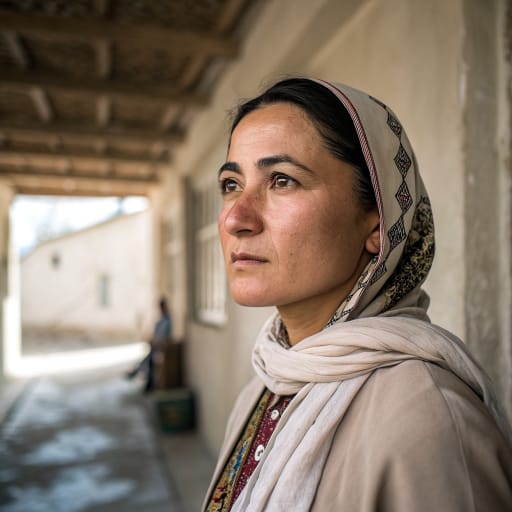
Typical Lyuli Phenotypes
Reference for AI generation — hair, eyes, skin, facial structure, build
Lyuli Body & Anatomy Reference
Per-feature anatomical profile for AI nude generation — Central Asian Turkic-Mongolic phenotype
Lyuli Boobs & Breasts
Lyuli tits and boobs run medium cup, moderate projection — the classic Central Asian Turkic-Mongolic bust profile. Lyuli nipples and areolas show medium-brown areolar pigmentation against the tan-to-light-brown skin tone, with areolar diameter typically in the 30-42mm range and forward-set positioning rather than the the smaller East Asian bust. Lyuli breasts trend full and modestly projecting, a function of the mesomorph, broader frame than the East Asian norm body habitus and the mean adult female BMI 23-26. For anatomically-accurate AI-generated Lyuli nudes the render preserves: medium cup, moderate projection shape, 30-42mm areolas with medium-brown pigmentation, and the torso proportions of the Central Asian Turkic-Mongolic phenotype.
Lyuli Ass & Hips
Lyuli ass and hip morphology presents as medium, moderate projection, broader hip profile than the East Asian norm — distinctly different from the slim East Asian narrow-hip profile. The Lyuli pelvic profile shows medium iliac crests, moderate gluteal-femoral fat deposition, anchored in the Central Asian Turkic-Mongolic skeletal pattern. Lyuli butt shots in adult AI imagery should render the medium, moderate projection, broader hip profile than the East Asian norm silhouette with the mesomorph, broader frame than the East Asian norm build and the gluteal-femoral fat distribution typical of the Central Asian Turkic-Mongolic phenotype rather than defaulting to a globally-averaged "ethnic" butt that generic AI generators produce. The hip-to-waist ratio characteristic of Lyuli women is one of the identifying features of the Central Asian Turkic-Mongolic regional phenotype.
Lyuli Vagina & Pussy
Lyuli pussy and vulvar anatomy presents medium-brown labial pigmentation — consistent with the Central Asian Turkic-Mongolic phenotype's pigmentation pattern. Lyuli pubic hair is typically straight-to-wavy medium-coarse texture, distributed in the inverted-triangle pattern with regional-typical density. AI-generated Lyuli nude imagery should preserve the medium-brown labial pigmentation and the straight-to-wavy medium-coarse texture hair texture rather than defaulting to a Western-European pink-and-sparse template. For anatomically-accurate Lyuli pussy renders the labial pigmentation and coloration should match the surrounding tan to light-brown skin tone of the Central Asian Turkic-Mongolic phenotype, with continuous gradient rather than an abrupt color transition.
Lyuli Dicks & Penis
Lyuli dick and penile anatomy in adult AI generation should anchor on the regional reference data: regional mean ~13cm erect, moderate girth, and medium-brown shaft pigmentation. The Lyuli cock profile reflects the Central Asian Turkic-Mongolic ancestral population's anthropometric measurements rather than a globally-averaged Western-pornography default. For anatomically-accurate Lyuli nude male imagery the shaft pigmentation should track the surrounding tan to light-brown skin tone, the glans-to-shaft pigmentation transition should be continuous, and the pubic hair pattern should match straight-to-wavy medium-coarse texture texture distributed in the typical inverted-V escutcheon. Circumcision status in Lyuli populations varies by religious-cultural tradition rather than ancestral phenotype.
Lyuli Body, Curves & Build
Lyuli body type and overall build presents as mesomorph, broader frame than the East Asian norm, with mean adult female BMI 23-26 — the characteristic Central Asian Turkic-Mongolic habitus. Lyuli curves and proportions in adult AI imagery should preserve the regional skeletal frame (height, shoulder-to-hip ratio, limb proportions) rather than scaling to a Western-European mesomorph default. The Lyuli nude female form, when rendered with anatomical fidelity, shows the height range, frame width, and adipose distribution pattern typical of the Central Asian Turkic-Mongolic phenotype. Generic AI image generators tend to collapse regional body types into a few default shapes; the EthnicErotic phenotype-anchored approach preserves the Lyuli build as its own reference category.
Lyuli Skin Tone & Hair Texture
Lyuli skin tone falls in the tan to light-brown (Fitzpatrick III-IV) band — the surface signal most often miscalibrated by generic AI nude generators trained on Western-photographic datasets. Lyuli hair texture is typically straight 1A-1B, dark-brown to black, characteristic of the Central Asian Turkic-Mongolic phenotype. For anatomically-accurate Lyuli nude renders the skin should hold the Fitzpatrick band consistently across body surface rather than showing the lighter-than-face body shading that AI generators default to. Lyuli hair pigmentation and texture on body, pubic, and head should match across the figure rather than mixing textures (a common AI artefact).
Explore phenotype categories
Structured taxonomy with peer-reviewed scales · 22 anatomical categories
Erotic Poses & Sex Positions
From the pose catalog — 219 named positions with reference skeletons
Frequently asked questions about Lyuli people
Where is the Lyuli homeland?
The Lyuli homeland is Uzbekistan and Tajikistan, chiefly the Ferghana Valley, the Samarkand and Bukhara regions and the Hisor valley; also Kyrgyzstan, Kazakhstan and northern Afghanistan, with migrant communities in Russia in Central Asia.
What language do Lyuli people speak?
Lyuli people primarily speak Tajik Persian with a distinct in-group lexicon (Indo-Iranian, Indo-European); Uzbek widely spoken as a second language; the associated Parya community speaks Parya (Indo-Aryan).
What religion do Lyuli people practice?
The predominant religion among Lyuli people is Sunni Islam, Hanafi school.

What does a typical Lyuli woman look like?
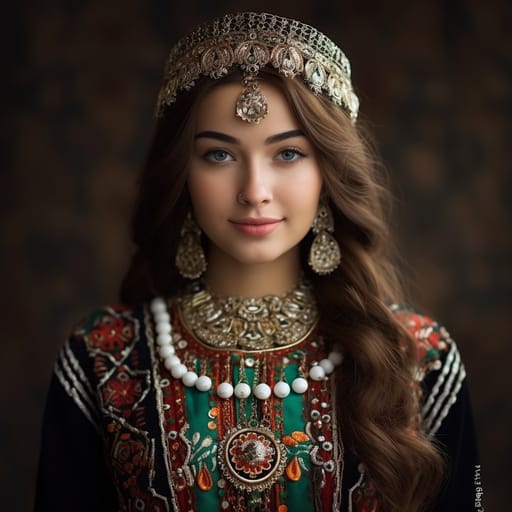
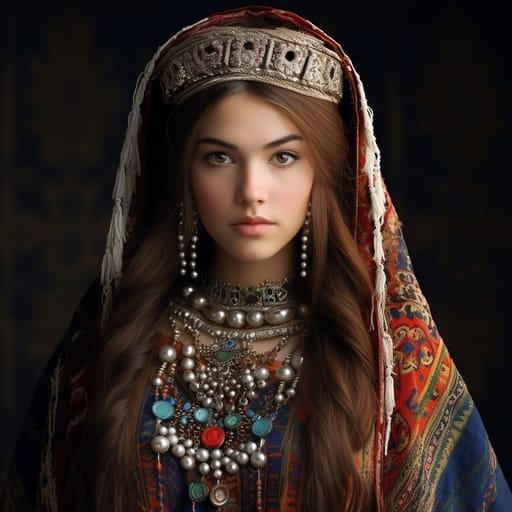
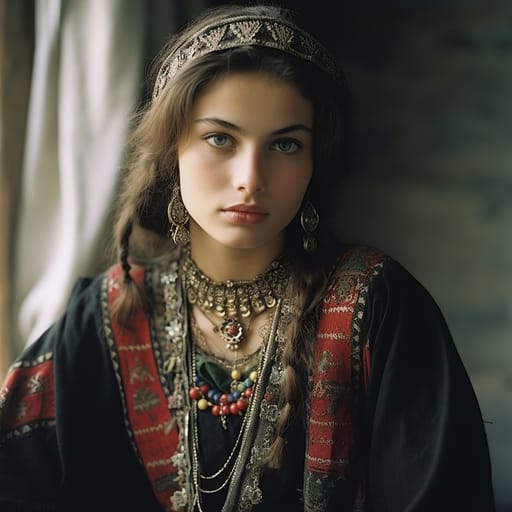
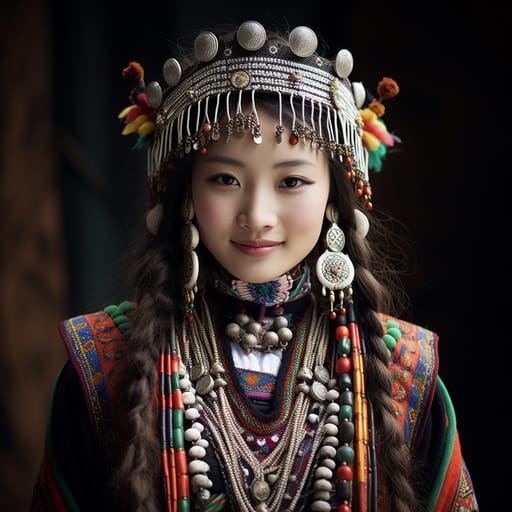
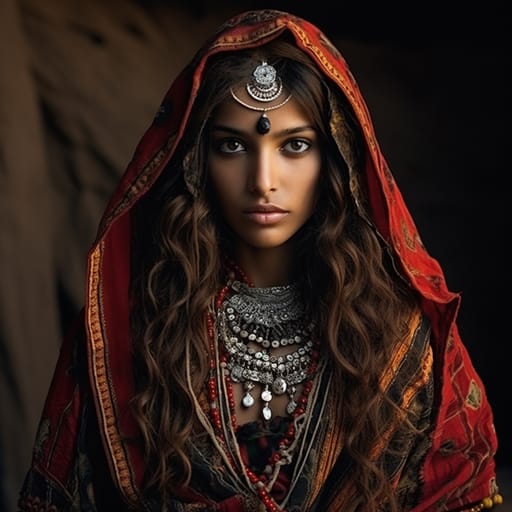
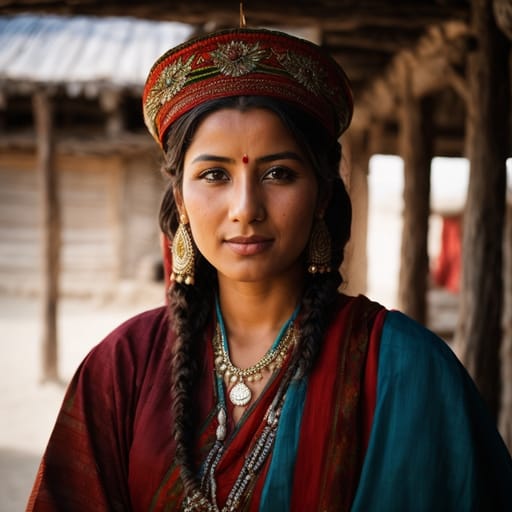
Ethnographic descriptions consistently note darker complexions than among neighboring Tajiks and Uzbeks, with black hair, dark eyes and features often read locally as South Asian. Women wear long, wide dresses of bright printed cloth, frequently layered, with a headscarf tied back rather than drawn across the face, long braids, and silver or beaded jewelry; the paranja worn by settled Uzbek women was never adopted.
Make your own Lyuli images
Five a day, free, no credits to buy. The studio starts from this group's phenotype data, so you can set body type, pose and style and keep the traits accurate.
Start with Lyuli