Help us get this right
Does this portrait look right for Tujia?
One tap. It takes a second and it is recorded.
1 says it looks right, 0 say it looks off.
Tujia Erotic
Wuling Mountains (China)
Nuo folk religion
About Tujia People
The Tujia call themselves Bizika — "the local people" — a name that carries the weight of their argument with history. For centuries the imperial bureaucracy in Beijing classified them as Han, or as some indeterminate frontier population; official recognition as a distinct minority came only in 1957. They number around eight million today, concentrated in the folded ridges where Hunan, Hubei, Guizhou and Chongqing meet, a country of limestone gorges and terraced hillsides drained by the Wu and You rivers. The terrain shaped them: Tujia villages historically clustered in defensible valleys, the wooden stilt-house or diaojiaolou cantilevered out over slopes too steep to build on flat.
Their language sits awkwardly in the Sino-Tibetan family. Linguists place it in the Tibeto-Burman branch but cannot agree on closer relatives, and it has no traditional script — Tujia history was sung, not written. The language is also disappearing. Most ethnic Tujia now speak only a regional Mandarin or the local Xiang and Southwestern Mandarin dialects; perhaps seventy thousand still command Northern Tujia, and Southern Tujia survives in a handful of villages with a few thousand speakers at most. The recognition that arrived in 1957 came late enough that the cultural marker most groups guard hardest was already slipping.
Religious life runs through Nuo, a pre-Buddhist exorcistic tradition the Tujia share with several neighboring peoples but have made particularly their own. Nuo masters wear carved wooden masks to drive out illness, settle debts with ancestors, and open the new year; the ceremonies are theatrical, percussive, and old enough that scholars treat surviving Nuo opera as a living fragment of pre-Han ritual culture. Layered on top are ancestor veneration, white-tiger worship — the white tiger is the Tujia totem, descended in legend from their founding chief Lin Jun — and a steady undercurrent of Han Buddhist and Daoist borrowing.
Two customs are worth knowing. The baishou or hand-waving dance, performed at lunar new year, is a long collective choreography that mimes hunting, planting, weaving and war, and is the closest thing the Tujia have to a national epic in motion. And the crying marriage: a bride traditionally weeps, formally and at length, for days before her wedding, joined by her mother, sisters and aunts in a structured lament that is part grief, part performance, part political commentary on the marriage itself. Brides judged insufficiently tearful were once thought ill-mannered.
Related ethnic groups
Groups that share Tujia's homeland, region, language, or religious tradition. These are likely candidates for comparative phenotype reference.
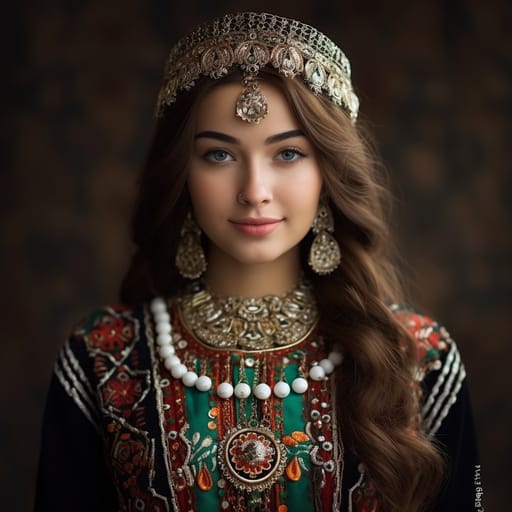
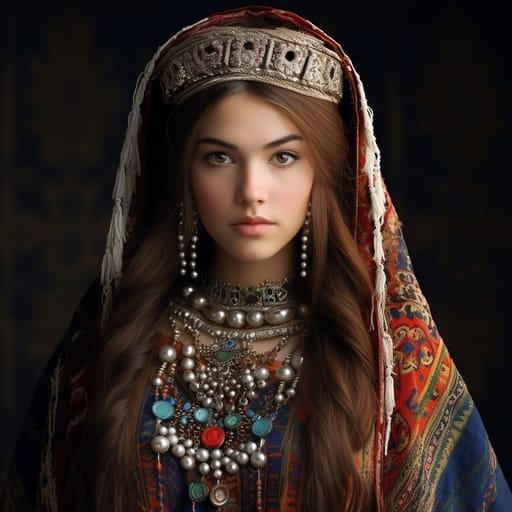
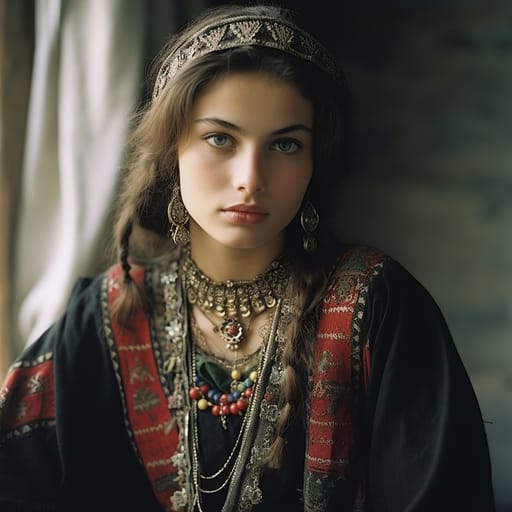
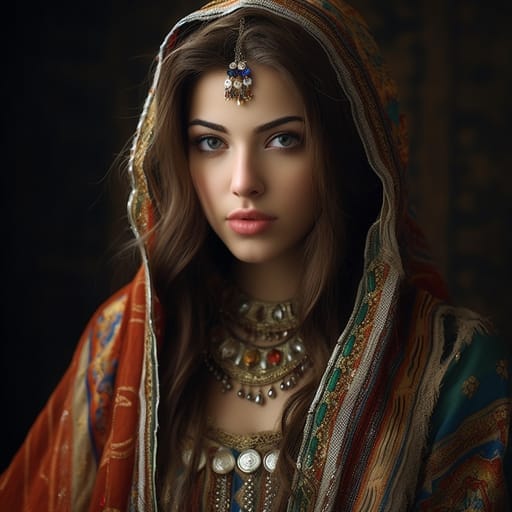
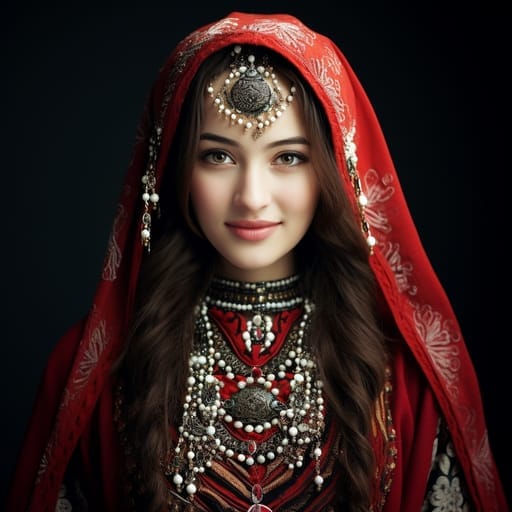
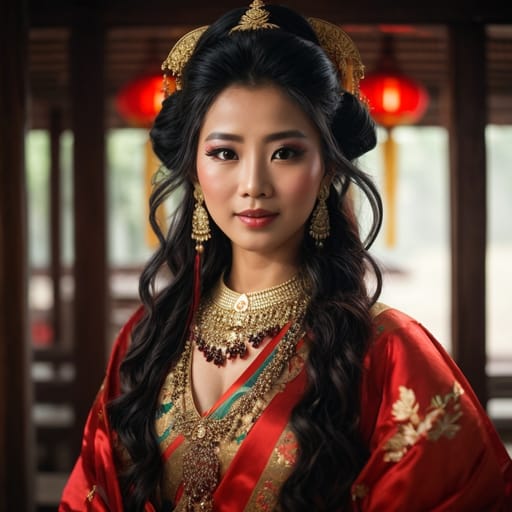
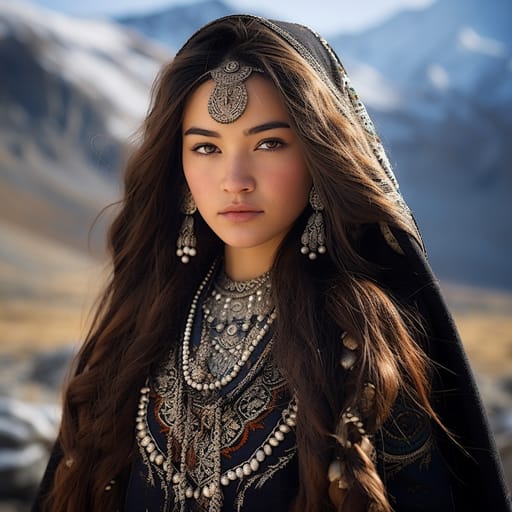
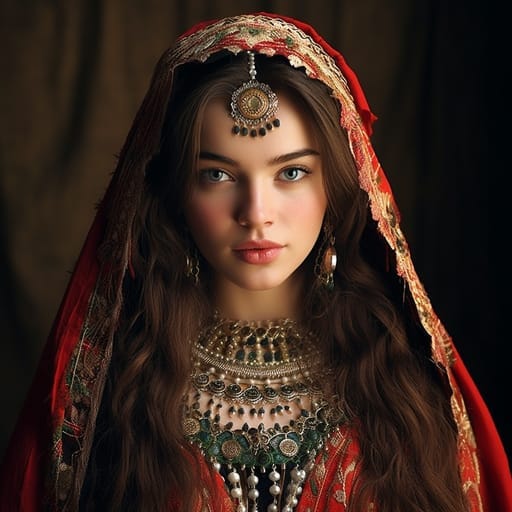
Typical Tujia Phenotypes
Reference for AI generation: hair, eyes, skin, facial structure, build
The Tujia are a Sino-Tibetan-speaking population of roughly eight million concentrated in the Wuling range where Hunan, Hubei, Guizhou, and Chongqing meet. Centuries of relative isolation in a corridor of subtropical river valleys produced a phenotype that reads broadly southern-Han but with a recognizable mountain-minority cast — somewhat shorter, rounder-faced, and with slightly heavier brow and cheekbone structure than coastal Han populations to the east.
Hair is uniformly black, occasionally dark brown-black in older individuals, and predominantly straight to gently wavy with a medium-coarse shaft. Greying tends to come late. Eye color sits in the dark-brown to near-black range with a near-universal epicanthic fold, though the fold is often softer and less pronounced than in northern Han or Mongolic populations — many Tujia carry a partial or "single-edge" lid rather than a deep monolid, and double eyelids are common in younger generations. The palpebral fissure is typically narrow and slightly upturned at the outer canthus.
Skin runs Fitzpatrick II–IV, most commonly a warm ivory to light wheat with yellow-gold undertones; outdoor agricultural workers tan to a deeper olive-tan rather than reddening. Faces tend to be round-to-oval with moderate malar projection, a low-to-medium nasal bridge, and a fairly narrow alar base — noses are rarely broad. Lips are medium-full, with a slightly fuller lower lip than is typical of northern Han. Jaws are softer and less angular than Korean or northeastern Chinese norms.
Build is compact and short-to-mid stature: adult men average around 165 cm, women around 154 cm, with proportionally shorter limbs and a longer torso typical of southern Chinese mountain peoples. Body composition trends lean and wiry in rural populations, with low visceral adiposity but a tendency toward soft subcutaneous fat distribution in women — narrow shoulders, defined waists, and modest hip-to-waist ratios. Sub-regional variation is real but quiet: western Tujia in Guizhou and Chongqing skew slightly darker and more angular, while eastern Hunan-Hubei Tujia carry more visible Han admixture and lighter skin.
Tujia Body & Anatomy Reference
Anatomy by feature, Central Asian Turkic-Mongolic phenotype
Tujia Boobs & Breasts
The typical Tujia bust is medium cup, moderate projection, in line with the wider Central Asian Turkic-Mongolic pattern. Areolas usually fall in the 30-42mm range, with medium-brown areolar pigmentation against the tan-to-light-brown skin tone. Compared with the smaller East Asian bust, Tujia breasts sit forward and are generally full and modestly projecting. A faithful AI render of Tujia tits keeps that shape and areola size.
Tujia Ass & Hips
Butt shape among Tujia women: medium, moderate projection, broader hip profile than the East Asian norm, over medium iliac crests, moderate gluteal-femoral fat deposition. This follows Central Asian Turkic-Mongolic ancestry and looks quite unlike the slim East Asian narrow-hip profile. An accurate Tujia ass in adult AI imagery keeps both the silhouette and the overall build (mesomorph, broader frame than the East Asian norm) instead of a generic average.
Tujia Vagina & Pussy
Vulvar anatomy among Tujia women: medium-brown labial pigmentation. Pubic hair tends to be straight-to-wavy medium-coarse texture, in the usual inverted-triangle pattern. Both follow Central Asian Turkic-Mongolic pigmentation, which is why Tujia pussy renders should not fall back on a pale, sparse Western template.
Tujia Dicks & Penis
The Tujia cock profile, from Central Asian Turkic-Mongolic anthropometric data: regional mean ~13cm erect; moderate girth; medium-brown shaft pigmentation. Pubic hair has a straight-to-wavy medium-coarse texture and forms the usual inverted-V pattern. Whether Tujia men are circumcised follows religious and cultural practice rather than phenotype.
Tujia Body, Curves & Build
Build and curves among Tujia women follow the Central Asian Turkic-Mongolic pattern: mesomorph, broader frame than the East Asian norm, mean adult female BMI 23-26. Proportions matter as much as skin tone, so Tujia figures should keep their regional height and limb ratios.
Tujia Skin Tone & Hair Texture
The Tujia skin range is tan to light-brown (Fitzpatrick III-IV), and hair tends to be straight 1A-1B, dark-brown to black. That combination marks the Central Asian Turkic-Mongolic phenotype, and skin tone is the trait AI generators most often get wrong for Tujia women.
Data depth
0/100Coverage of image-grounded phenotype observations · drives AI generation diversity
- Sample size
- 0/40· 0 images
- Image quality
- 0/30· 0% high
- Confidence
- 0/20
- Source diversity
- 0/10
- ·No image observations yet
Explore phenotype categories
Structured taxonomy with peer-reviewed scales · 22 anatomical categories
Erotic Poses & Sex Positions
From the pose catalog: 219 named positions with reference skeletons
Frequently asked questions about Tujia people
Where is the Tujia homeland?
The Tujia homeland is Wuling Mountains (China) in Central Asia.
What language do Tujia people speak?
Tujia people primarily speak Sino-Tibetan / Tujia.
What religion do Tujia people practice?
The predominant religion among Tujia people is Nuo folk religion.






Make your own Tujia images
Five a day, free, no credits to buy. The studio starts from this group's phenotype data, so you can set body type, pose and style and keep the traits accurate.
Start with Tujia