Help us get this right
Does this portrait look right for Kari?
Nobody has judged this one yet. You would be the first.
Kari Erotic
Northern coast of North Andaman Island and Landfall Island, Andaman Islands, India; descendants live mainly on Strait Island and in Port Blair.
Aka-Cari, also called Sare (Great Andamanese, northern branch), now extinct; descendants speak Hindi and a mixed Great Andamanese speech based largely on Jeru.
Traditional Andamanese belief in the monsoon beings Biliku and Tarai and in spirits of the forest, the sea and the dead; no priesthood or temples.
One of the ten Great Andamanese tribes; part of the northern group with the Kora, Bo and Jeru; a coast-dwelling people.
About Kari People
The Kari, also written Cari and recorded in colonial sources as Chariar, were the northernmost of the ten tribes that made up the Great Andamanese. Their territory was small and entirely maritime: the north coast of North Andaman, Landfall Island across the channel, and the reefs and islets in between. They were shore people in the full sense. They harpooned turtle and dugong from canoes, shot fish in the shallows with bows, gathered shellfish on the reef flats, and went inland mainly for pig, honey and the wood and clay their toolkit required.
Their language, Aka-Cari, called Sare by its last speakers, belonged to the northern branch of the Great Andamanese family alongside Kora, Bo and Jeru. The family has no proven relatives anywhere, not even the Onge and Jarawa languages spoken farther south in the same islands. The Aka- prefix is a piece of grammar, a marker tied to the mouth and to speech, which is why it appears on so many Andamanese tribal names. Religion had no priesthood or temples. Northern Andamanese cosmology turned on Biliku and Tarai, beings bound up with the two monsoon winds, whose anger explained storms, and on spirits of the forest and sea and of the dead. Much of what was written down about these beliefs comes from A. R. Radcliffe-Brown's fieldwork among the northern tribes between 1906 and 1908, when the societies he described were already collapsing. He also recorded the habits that struck visitors most: friends reunited after a separation sat and wept together as a formal greeting, mourners wore the bones of dead relatives as keepsakes, and fire was carried and tended rather than kindled, since no fire-making technique was reported.
The collapse was fast. The British penal settlement at Port Blair, founded in 1858, brought measles, syphilis and influenza, and the Great Andamanese fell from several thousand people to a few dozen within three generations. The Kari, estimated at about a hundred at first contact, were counted at 39 in the 1901 census and at nine in 1931. Survivors of the different tribes were merged into one community, which the Indian government resettled on Strait Island around 1970. By the 1990s only two elderly women there still identified as Cari. Licho, the last person who spoke Sare, died in 2020. Kari ancestry continues among today's Great Andamanese, who speak mostly Hindi alongside a mixed Andamanese speech built largely on Jeru, but the tribe as a separate people with its own coast is gone.
Related ethnic groups
Groups that share Kari's homeland, region, language, or religious tradition. These are likely candidates for comparative phenotype reference.

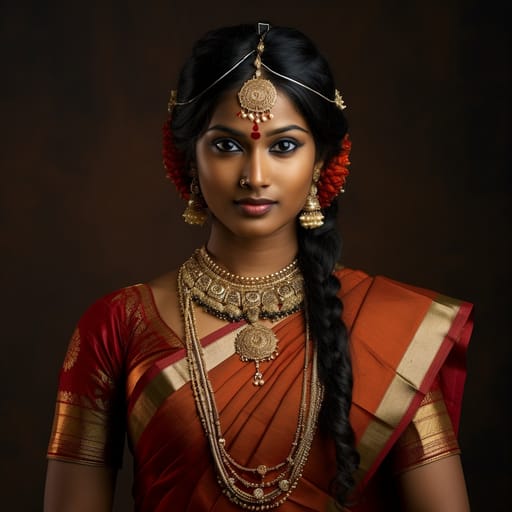
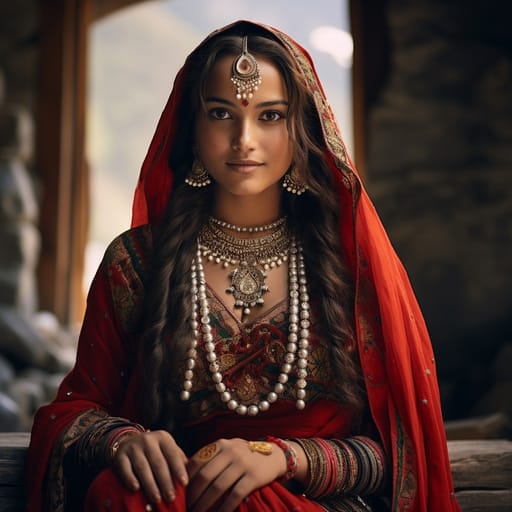
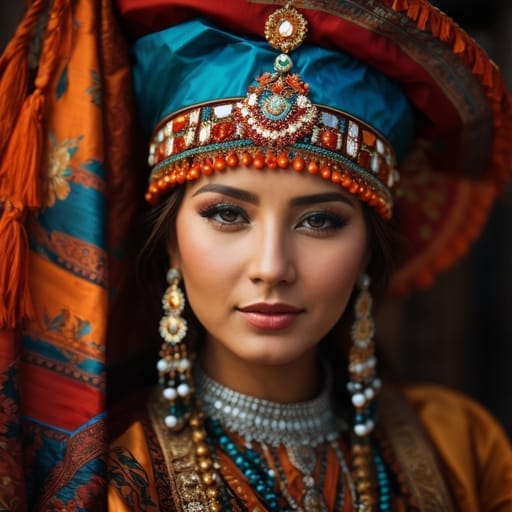
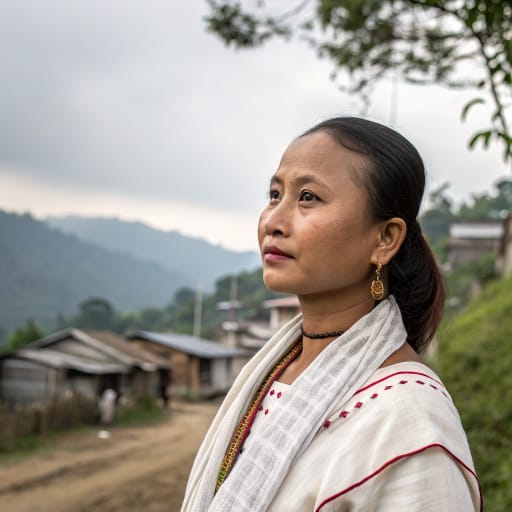
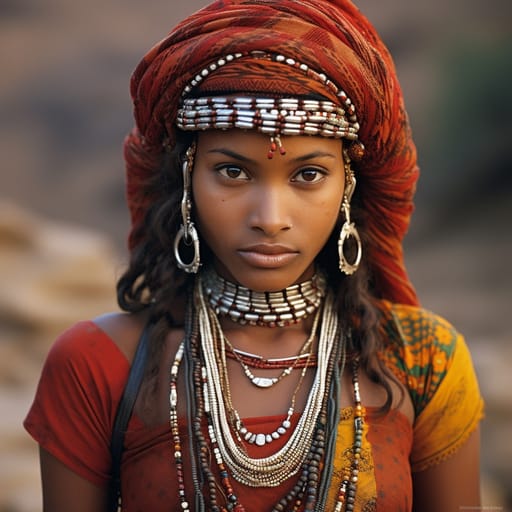

Typical Kari Phenotypes
Reference for AI generation: hair, eyes, skin, facial structure, build
Kari Body & Anatomy Reference
Anatomy by feature, Indo-Aryan / Dravidian South Asian phenotype
Kari Boobs & Breasts
Bust reference for Kari women: medium-to-large cup, moderate-to-full projection, which is typical of Indo-Aryan / Dravidian South Asian ancestry. Areolas measure about 32-46mm across, with medium-brown to dark-brown pigmentation. Body type (endomorph-to-mesomorph with fuller hip deposition) shapes the bust as well, so Kari tits are usually full and soft, generally fuller than the East Asian norm. In AI imagery, keep the forward-set shape rather than drifting toward the smaller East Asian bust profile.
Kari Ass & Hips
The Kari ass is typically medium-to-full, moderate-to-high projection, classic curvy hip profile, which sets it apart from the slim hip profile of East Asian women. Underneath, the pelvis shows medium-to-wide iliac crests, full gluteal-femoral fat distribution, part of the Indo-Aryan / Dravidian South Asian skeletal pattern. For Kari butt pics and AI renders, match that silhouette and the overall build (endomorph-to-mesomorph with fuller hip deposition).
Kari Vagina & Pussy
Kari pussy and vulvar anatomy presents medium-brown to dark-brown labial pigmentation, fuller labia minora projection, consistent with the Indo-Aryan / Dravidian South Asian phenotype's pigmentation pattern. Kari pubic hair is typically straight-to-wavy coarse texture, dense distribution, in the inverted-triangle pattern. For anatomically accurate Kari pussy renders the labial coloration should match the surrounding wheatish to brown skin tone with a continuous gradient, and the hair should keep its straight-to-wavy coarse texture.
Kari Dicks & Penis
Kari dicks follow the Indo-Aryan / Dravidian South Asian reference data: regional mean ~13cm erect; moderate girth; medium-brown shaft pigmentation. Shaft color should track the wheatish to brown skin tone with a smooth change toward the glans, and Kari pubic hair keeps its straight-to-wavy coarse texture.
Kari Body, Curves & Build
Kari body type and overall build presents as endomorph-to-mesomorph with fuller hip deposition, with mean adult female BMI 22-25: the characteristic Indo-Aryan / Dravidian South Asian habitus. Kari curves and proportions should keep the regional skeletal frame (height, shoulder-to-hip ratio, limb proportions) rather than a generic mesomorph default.
Kari Skin Tone & Hair Texture
Kari skin sits in the wheatish to brown (Fitzpatrick III-V) band. Hair is typically straight-to-wavy 1A-2B, dense, dark-brown to black, in keeping with the Indo-Aryan / Dravidian South Asian phenotype. In nude renders the skin should stay one even tone from face to body, and body, pubic and head hair should match.
Explore phenotype categories
Structured taxonomy with peer-reviewed scales · 22 anatomical categories
Erotic Poses & Sex Positions
From the pose catalog: 219 named positions with reference skeletons
Frequently asked questions about Kari people
Where is the Kari homeland?
The Kari homeland is Northern coast of North Andaman Island and Landfall Island, Andaman Islands, India; descendants live mainly on Strait Island and in Port Blair. in Southern Asia.
What language do Kari people speak?
Kari people primarily speak Aka-Cari, also called Sare (Great Andamanese, northern branch), now extinct; descendants speak Hindi and a mixed Great Andamanese speech based largely on Jeru..
What religion do Kari people practice?
The predominant religion among Kari people is Traditional Andamanese belief in the monsoon beings Biliku and Tarai and in spirits of the forest, the sea and the dead; no priesthood or temples..






Make your own Kari images
Five a day, free, no credits to buy. The studio starts from this group's phenotype data, so you can set body type, pose and style and keep the traits accurate.
Start with Kari