Help us get this right
Does this portrait look right for Karamanlides?
Nobody has judged this one yet. You would be the first.
Karamanlides Erotic
Central Anatolia in present-day Turkey, especially Karaman, Konya, Niğde, Kayseri and Cappadocia, with merchant communities in Istanbul; most descendants have lived in Greece since the 1923 population exchange.
Karamanli Turkish (Turkic, Oghuz), written in Greek script as Karamanlidika; descendants in Greece now speak Greek (Hellenic).
Eastern Orthodox Christianity, under the Ecumenical Patriarchate of Constantinople.
Anatolian Orthodox Christians of the Ottoman Rum millet; closely linked to the Cappadocian Greeks; a small Turkish Orthodox community remains in Istanbul.
About Karamanlides People
The Karamanlides don't fit the tidy idea that a shared language and a shared faith make a nation. For centuries they prayed as Orthodox Christians and spoke Turkish at home and in the market. They also wrote that Turkish in Greek letters. Their neighbors called them Karamanli, after the old Ottoman province of Karaman, which covered much of central Anatolia. They called themselves Rum, the Ottoman word for Orthodox Christians, and saw no contradiction in any of it.
Their towns and villages were spread across the plateau, from Karaman and Konya east through Niğde and Kayseri into Cappadocia. There, Orthodox families kept worshiping in a landscape still full of rock-cut churches from an older Christian past. Karamanli merchants also traded in Istanbul and other Ottoman cities. Scholars still argue over how the community came to speak Turkish. One view holds that they were Byzantine Greeks who switched languages under Turkish rule. The other holds that they were Turkic-speaking people who became Orthodox. The community itself never needed the question settled.
What they left behind is a large body of print. From the eighteenth century into the early twentieth, presses turned out Bibles, prayer books, saints' lives, newspapers and fiction in Karamanlidika, which is Turkish set in the Greek alphabet. The Istanbul newspaper Anatoli, edited by Evangelinos Misailidis, ran for decades. His novel Temaşa-i Dünya is counted among the earliest novels written in Turkish. Today these texts are a window onto how ordinary Ottoman subjects actually spoke, rather than how the palace wrote.
That world ended with the 1923 population exchange between Greece and Turkey, which sorted people by religion, not by language. Turkish-speaking Orthodox families were sent to Greece, a country whose language many of them barely spoke. They were resettled in refugee quarters and new villages across northern Greece and around Athens. A small circle stayed in Istanbul around the priest Papa Eftim, who had pushed for a separate Turkish Orthodox church.
In Greece the Turkish faded within a couple of generations, though it survived for a while in songs, prayers and family words. Their descendants are Greek speakers now. They keep the memory alive through hometown associations and feast days, and through return trips to Cappadocia, where many of their grandparents' churches still stand.
Related ethnic groups
Groups that share Karamanlides's homeland, region, language, or religious tradition. These are likely candidates for comparative phenotype reference.
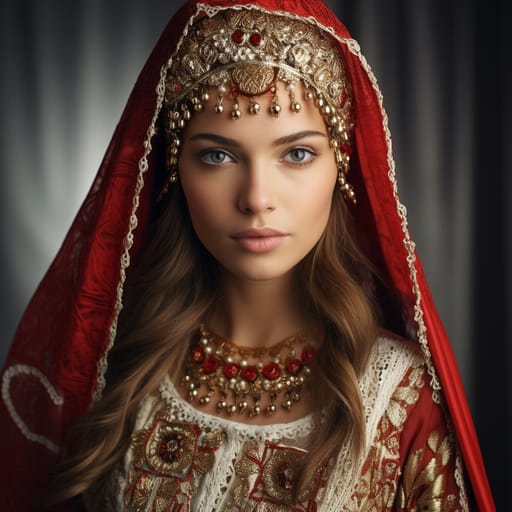
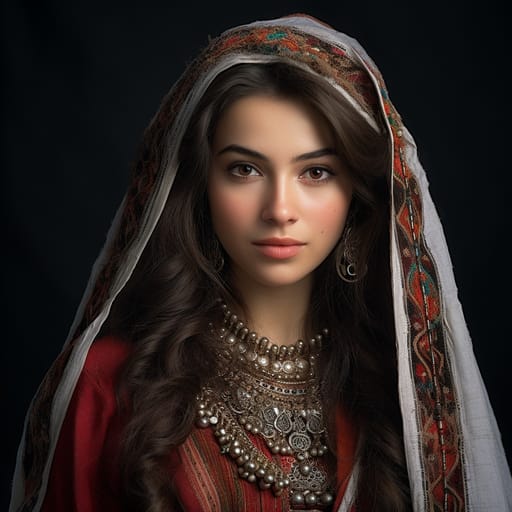
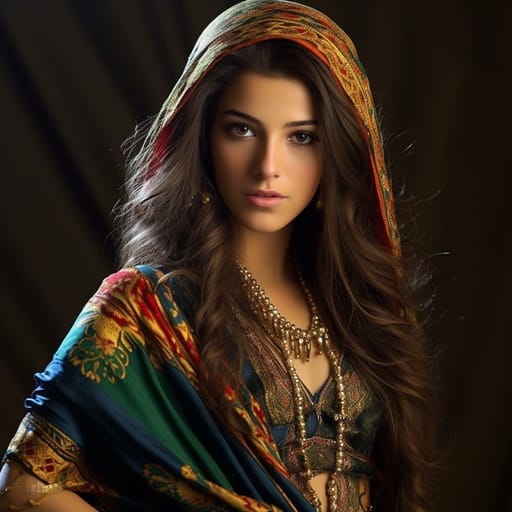
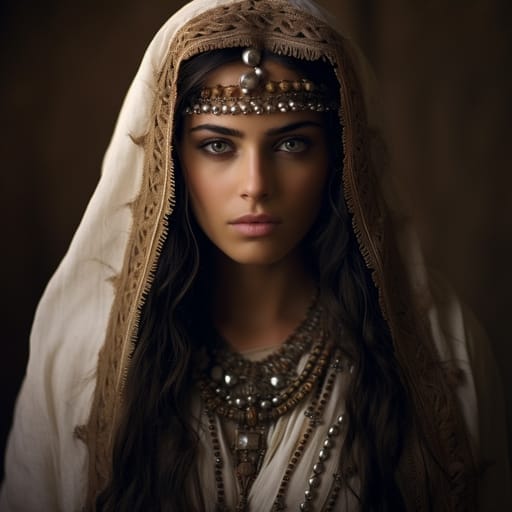
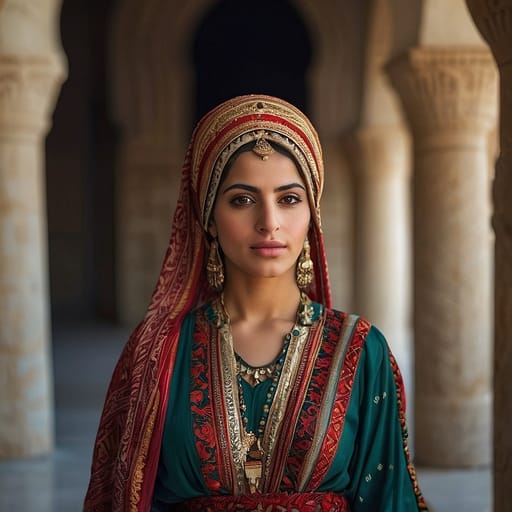
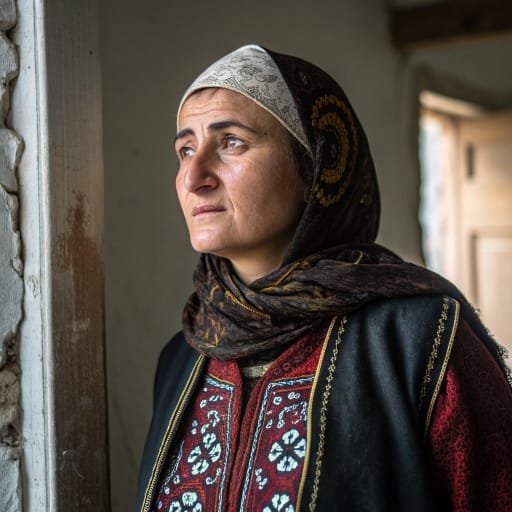
Typical Karamanlides Phenotypes
Reference for AI generation: hair, eyes, skin, facial structure, build
Karamanlides Body & Anatomy Reference
Levantine / Mediterranean Middle Eastern phenotype: anatomy reference for AI nude generation
Karamanlides Boobs & Breasts
Karamanlides boobs follow the Levantine / Mediterranean Middle Eastern profile: medium-to-large cup, full, moderate-to-high projection. Areolar diameter is usually 32-46mm, and the coloring is medium-brown to dark-brown areolar pigmentation against the olive-to-light-brown skin tone. Breast shape tracks body composition (mesomorph with fuller hip-and-bust deposition, mean adult female BMI 25-28), so Karamanlides breasts tend to be full and soft, fuller projection than the North-African Berber norm. Expect a forward-set shape, not the smaller East Asian bust profile.
Karamanlides Ass & Hips
Karamanlides ass and hip morphology presents as medium-to-full, moderate projection, broader hip profile, distinctly different from the slim East Asian narrow-hip profile. The Karamanlides pelvic profile shows medium-to-wide iliac crests, fuller gluteal-femoral deposition, anchored in the Levantine / Mediterranean Middle Eastern skeletal pattern. Karamanlides butt shots in adult AI imagery should render the medium-to-full, moderate projection, broader hip profile silhouette with the overall build (mesomorph with fuller hip-and-bust deposition) and the fat distribution typical of the Levantine / Mediterranean Middle Eastern phenotype.
Karamanlides Vagina & Pussy
Karamanlides pussy anatomy typically shows medium-brown to dark-brown labial pigmentation, fuller labia minora. Pubic hair is usually wavy-to-coiled medium-coarse dark texture, dense distribution. In AI-generated Karamanlides nudes, labial color should blend into the olive to medium-brown skin with a gradual transition, and the hair should keep its wavy-to-coiled medium-coarse dark texture.
Karamanlides Dicks & Penis
Penis reference for Karamanlides men: regional mean ~14cm erect, moderate-to-above-average girth. Coloring: medium-brown shaft pigmentation. An accurate Karamanlides cock in AI imagery matches the surrounding olive to medium-brown skin rather than a generic porn default. Circumcision depends on religion and custom, not ancestry.
Karamanlides Body, Curves & Build
The Karamanlides figure is generally mesomorph with fuller hip-and-bust deposition, with mean adult female BMI 25-28, characteristic of Levantine / Mediterranean Middle Eastern ancestry. AI image tools tend to flatten regional body types into a few stock shapes; here the Karamanlides build is kept as its own reference.
Karamanlides Skin Tone & Hair Texture
Skin: olive to medium-brown (Fitzpatrick III-V). Hair: wavy-to-curly 2B-3B, predominantly dark-brown to black. Both are typical of Levantine / Mediterranean Middle Eastern ancestry. The most common mistake in AI nudes of Karamanlides women is a body rendered lighter than the face.
Explore phenotype categories
Structured taxonomy with peer-reviewed scales · 22 anatomical categories
Erotic Poses & Sex Positions
From the pose catalog: 219 named positions with reference skeletons
Frequently asked questions about Karamanlides people
Where is the Karamanlides homeland?
The Karamanlides homeland is Central Anatolia in present-day Turkey, especially Karaman, Konya, Niğde, Kayseri and Cappadocia, with merchant communities in Istanbul; most descendants have lived in Greece since the 1923 population exchange. in Western Asia.
What language do Karamanlides people speak?
Karamanlides people primarily speak Karamanli Turkish (Turkic, Oghuz), written in Greek script as Karamanlidika; descendants in Greece now speak Greek (Hellenic)..
What religion do Karamanlides people practice?
The predominant religion among Karamanlides people is Eastern Orthodox Christianity, under the Ecumenical Patriarchate of Constantinople..






Make your own Karamanlides images
Five a day, free, no credits to buy. The studio starts from this group's phenotype data, so you can set body type, pose and style and keep the traits accurate.
Start with Karamanlides