Help us get this right
Does this portrait look right for Kabi Kabi?
Nobody has judged this one yet. You would be the first.
Kabi Kabi Erotic
Sunshine Coast and hinterland of southeast Queensland, Australia: Bribie Island north through Noosa and Gympie and along the Mary River valley toward the Burrum River.
Kabi Kabi, also written Gubbi Gubbi (Pama-Nyungan, Waka-Kabic branch); English is the everyday language today.
Traditional Aboriginal law and creation stories tied to country; Christianity widespread since the mission era.
Aboriginal Australian; Waka-Kabic language group with the Wakka Wakka, Butchulla and Gureng Gureng; local clans include the Undumbi and Nalbo; four-section marriage system.
About Kabi Kabi People
The Kabi Kabi are named for their own word for no. It is an old habit of southeast Queensland, where neighboring peoples told each other apart by how they refused, and the Wakka Wakka inland carry a name built the same way. Many families write it Gubbi Gubbi, closer to how it sounds, and the spelling is still argued over. Whichever form you use, it names the traditional owners of what most Australians know as the Sunshine Coast: Bribie Island and the Pumicestone Passage, the Blackall Range, Noosa, Gympie and the long valley of the Mary River, north toward the Burrum. The language sits in the Waka-Kabic branch of Pama-Nyungan, close kin to Butchulla on K'gari and Wakka Wakka to the west. English pushed it nearly out of daily use, but it is being taught again, and locals speak scraps of it without knowing: Gympie comes from gimpi gimpi, the stinging tree, and Maroochy from the red bill of the black swan.
The great institution was the bunya gathering. Every few years the bunya pines of the Blackall Range cropped heavily, messengers went out, and the Kabi Kabi hosted guests from hundreds of kilometers away for weeks of feasting, trade, marriage arrangements, dispute settlement and ceremony. Colonial authorities understood the stakes well enough that in 1842 the governor closed bunya country to settlers and timber cutters. Queensland dropped that protection in 1860, the Gympie gold rush of 1867 brought thousands of miners, and frontier violence and the Native Police did the rest. After the 1897 protection act, many families were removed to Barambah, the reserve later renamed Cherbourg, and descendants still live there as well as on the coast.
An unusual amount of early detail survives because runaway convicts from the Moreton Bay penal settlement, among them James Davis and David Bracewell, lived for years among Kabi Kabi groups through the 1830s. The country itself keeps the older record. Mount Ninderry and Mount Coolum are two men who fought over a woman named Maroochy: Ninderry knocked Coolum's head into the sea, where it sits as Mudjimba Island, and her tears became the Maroochy River. In June 2024 the Federal Court recognized Kabi Kabi native title over a large stretch of that coast and hinterland, a rare result for country so heavily built over. The people are still there, working as rangers, artists and language teachers in plain view of the high-rises.
Related ethnic groups
Groups that share Kabi Kabi's homeland, region, language, or religious tradition. These are likely candidates for comparative phenotype reference.
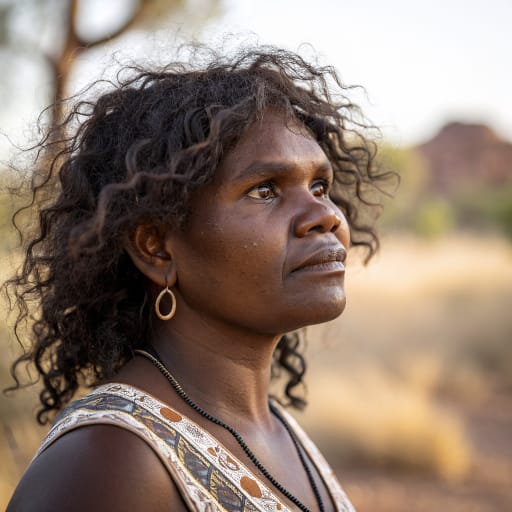
Arrernte
same region (Australia / New Zealand)
Noongar
same region (Australia / New Zealand)
Yolngu
same region (Australia / New Zealand)
Tiwi
same region (Australia / New Zealand)
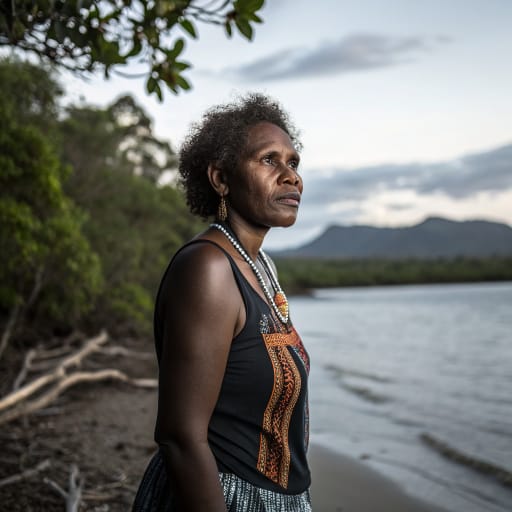
Guugu Yimithirr
same region (Australia / New Zealand)
Ngarrindjeri
same region (Australia / New Zealand)
Wirangu
same region (Australia / New Zealand)
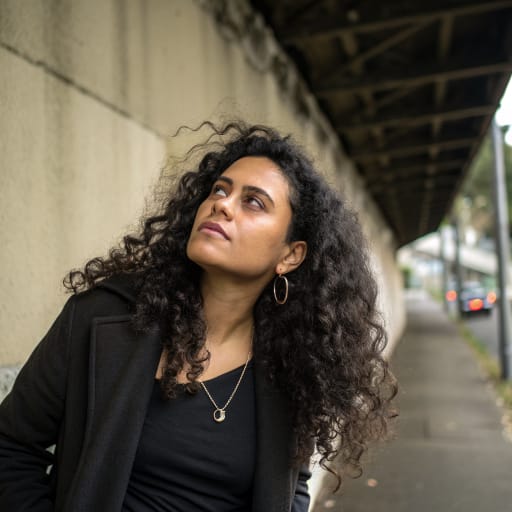
Dunghutti
same region (Australia / New Zealand)
Typical Kabi Kabi Phenotypes
Reference for AI generation: hair, eyes, skin, facial structure, build
Kabi Kabi Body & Anatomy Reference
Per-feature anatomical profile for AI nude generation: Aboriginal Australian phenotype
Kabi Kabi Boobs & Breasts
Kabi Kabi boobs follow the Aboriginal Australian profile: small-to-medium cup, modest-to-moderate projection. Areolar diameter is usually 28-42mm, and the coloring is deep-brown to near-black areolar pigmentation against the deep-brown skin tone. Breast shape tracks body composition (ectomorph-to-mesomorph, lean elongated frame adapted to arid environment, mean adult female BMI 23-26), so Kabi Kabi breasts tend to be modest projection, firm. Expect a forward-set shape, not the fuller Polynesian or West African bust.
Kabi Kabi Ass & Hips
Kabi Kabi ass and hip morphology presents as small-to-medium, modest projection, narrower hip profile, distinctly different from the very full Polynesian gluteal projection. The Kabi Kabi pelvic profile shows narrow-to-medium iliac crests, longer torso and limb proportions, anchored in the Aboriginal Australian skeletal pattern. Kabi Kabi butt shots in adult AI imagery should render the small-to-medium, modest projection, narrower hip profile silhouette with the overall build (ectomorph-to-mesomorph, lean elongated frame adapted to arid environment) and the fat distribution typical of the Aboriginal Australian phenotype.
Kabi Kabi Vagina & Pussy
Kabi Kabi pussy anatomy typically shows deep-brown labial pigmentation. Pubic hair is usually wavy-to-coiled coarse texture. In AI-generated Kabi Kabi nudes, labial color should blend into the deep-brown skin with a gradual transition, and the hair should keep its wavy-to-coiled coarse texture.
Kabi Kabi Dicks & Penis
Penis reference for Kabi Kabi men: regional mean ~13cm erect, moderate girth. Coloring: deep-brown shaft pigmentation. An accurate Kabi Kabi cock in AI imagery matches the surrounding deep-brown skin rather than a generic porn default. Circumcision depends on religion and custom, not ancestry.
Kabi Kabi Body, Curves & Build
The Kabi Kabi figure is generally ectomorph-to-mesomorph, lean elongated frame adapted to arid environment, with mean adult female BMI 23-26, characteristic of Aboriginal Australian ancestry. AI image tools tend to flatten regional body types into a few stock shapes; here the Kabi Kabi build is kept as its own reference.
Kabi Kabi Skin Tone & Hair Texture
Skin: deep-brown (Fitzpatrick V-VI). Hair: wavy-to-curly 2C-3B, dark-brown to black; the distinctive blond-haired Aboriginal sub-population in Central Australia is documented and pigmentation-independent. Both are typical of Aboriginal Australian ancestry. The most common mistake in AI nudes of Kabi Kabi women is a body rendered lighter than the face.
Explore phenotype categories
Structured taxonomy with peer-reviewed scales · 22 anatomical categories
Erotic Poses & Sex Positions
From the pose catalog: 219 named positions with reference skeletons
Frequently asked questions about Kabi Kabi people
Where is the Kabi Kabi homeland?
The Kabi Kabi homeland is Sunshine Coast and hinterland of southeast Queensland, Australia: Bribie Island north through Noosa and Gympie and along the Mary River valley toward the Burrum River. in Australia / New Zealand.
What language do Kabi Kabi people speak?
Kabi Kabi people primarily speak Kabi Kabi, also written Gubbi Gubbi (Pama-Nyungan, Waka-Kabic branch); English is the everyday language today..
What religion do Kabi Kabi people practice?
The predominant religion among Kabi Kabi people is Traditional Aboriginal law and creation stories tied to country; Christianity widespread since the mission era..






Make your own Kabi Kabi images
Five a day, free, no credits to buy. The studio starts from this group's phenotype data, so you can set body type, pose and style and keep the traits accurate.
Start with Kabi Kabi