Help us get this right
Does this portrait look right for Deccani?
Nobody has judged this one yet. You would be the first.
Deccani Erotic
Deccan (South-Central India)
Indo-European / Indo-Iranian / Indo-Aryan→ Urdu / Deccani Urdu
Islam
Hyderabadi
About Deccani People
The Deccani are the Muslim communities of the Deccan plateau — the dry, rocky upland that fills most of south-central India between the Western and Eastern Ghats. They are not a transplanted northern population speaking the language of Delhi; they are the descendants of soldiers, scholars, Sufis, traders, and slaves who came south across several centuries and merged, often genetically and almost always culturally, with the Telugu, Marathi, and Kannada-speaking peoples already living there. The result is a Muslim culture that sits at an angle to the Mughal-flavored Islam of north India: older in some respects, more syncretic, and shaped from the start by the Dravidian south rather than imposed onto it.
Their language, Deccani — sometimes called Dakhni — is the clearest marker. It is classed as a southern register of Urdu, but historically the influence ran the other way: Deccani was a literary language with a substantial poetic tradition before the Urdu of Delhi and Lucknow standardized in the eighteenth and nineteenth centuries. It carries heavy Telugu, Marathi, and Kannada vocabulary and grammar, and to a north Indian ear it sounds softer, slower, and noticeably different. The Bahmani Sultanate of the fourteenth and fifteenth centuries and its successor states — Bijapur, Golconda, Ahmadnagar, Berar, Bidar — were the political vehicle for this culture, and Hyderabad, ruled by the Nizams until 1948, became its long afterlife.
Hyderabadi Muslims are the most visible Deccani sub-group today, and Hyderabad itself remains the cultural capital: the cuisine (haleem, biryani cooked dum-style, the small sour kept-tomato dishes that distinguish it from Lucknowi food), the etiquette of address, the particular cadence of mushaira poetry evenings. Religious life leans Sunni but has a strong, openly visible Shia minority — a legacy of Persian-influenced Golconda and Bijapur — and Sufi shrines still anchor neighborhoods, drawing Hindu visitors as readily as Muslim ones. The community absorbed a hard shock in 1948 when Indian forces annexed the princely state of Hyderabad, and a steady stream of Deccani families have since migrated to the Gulf, particularly Saudi Arabia and the UAE, where Hyderabadi Urdu and Hyderabadi cooking now form a recognizable diaspora layer of their own. What persists at home is a quieter, less assertive Muslim identity than the north's — long settled, intermarried into the southern landscape, and conscious of having been here a very long time.
Related ethnic groups
Groups that share Deccani's homeland, region, language, or religious tradition. These are likely candidates for comparative phenotype reference.
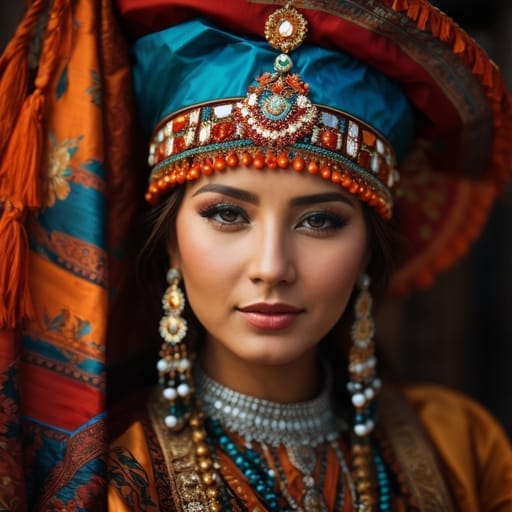
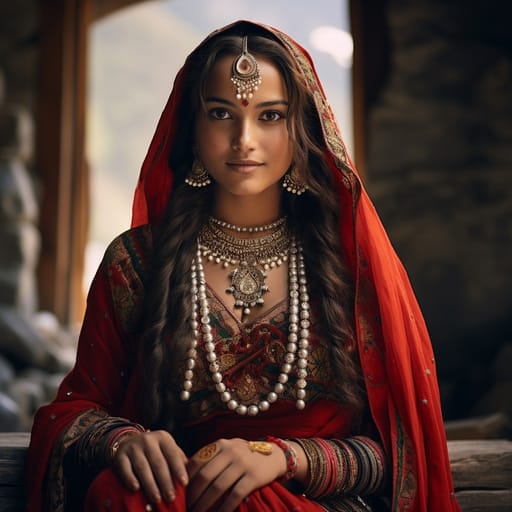
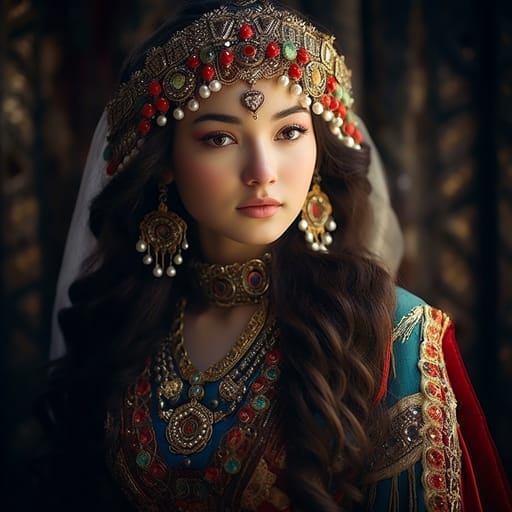
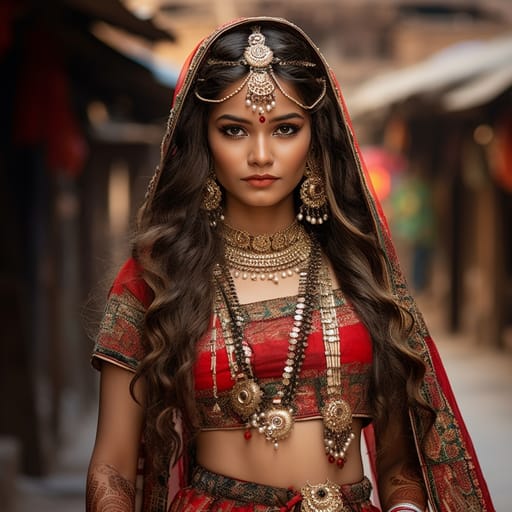
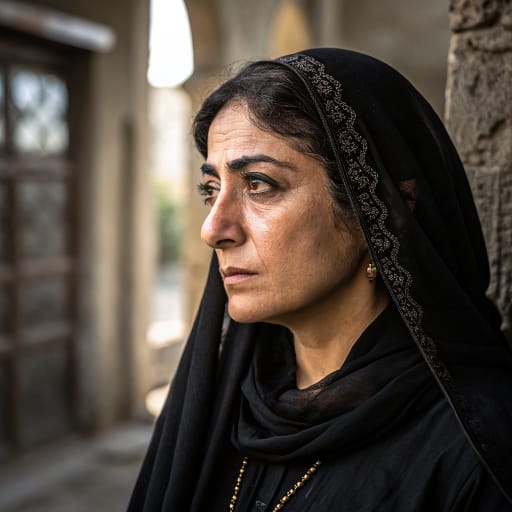
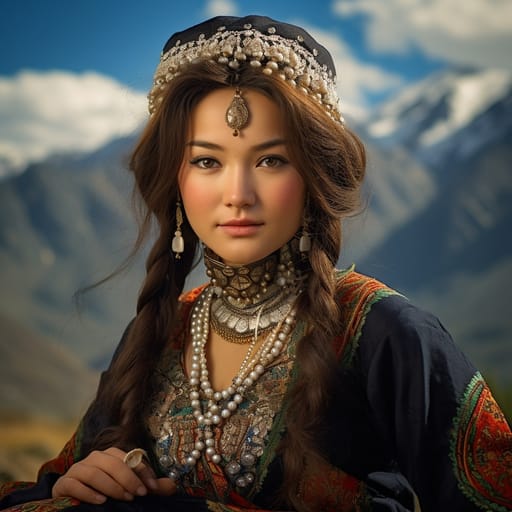
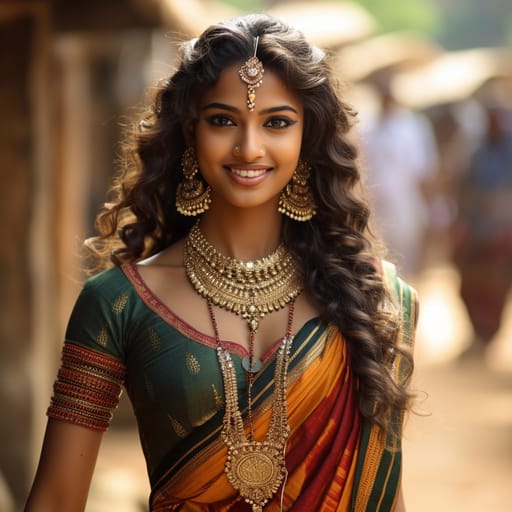
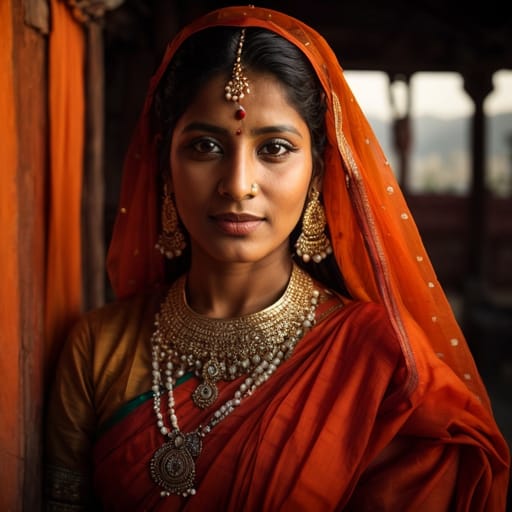
Typical Deccani Phenotypes
Reference for AI generation: hair, eyes, skin, facial structure, build
Deccani phenotype sits at a transitional zone — South Indian Dravidian substrate overlaid by centuries of Persian, Turkic, Arab, and Afghan ancestry that arrived through the Bahmani and later Hyderabadi sultanates. The result is recognisably Indian but visibly admixed: features are often softer and more aquiline than peninsular South Indian baselines, while skin tone stays in the warmer mid-brown range characteristic of the Deccan plateau.
Hair runs near-universally black to very dark brown, almost always straight to loosely wavy with high density and a glossy finish; tight curls are uncommon. Greying tends to come late and stays deep silver rather than washed-out grey. Beards in men grow full and dark, often with a mid-tone undergrowth that catches reddish in sunlight — a Persianate inheritance.
Eyes are most often dark brown to near-black, with a meaningful minority showing lighter hazel or honey-brown — particularly in families tracing descent from Hyderabadi nobility, Hadhrami Arab settlers, or Mughal-era migrants. The eye shape is almond, set under a defined orbital ridge; epicanthic folds are absent. Lashes are typically thick.
Skin spans Fitzpatrick III through V, clustering around IV — a warm wheat-to-light-brown with golden or olive undertones rather than the cooler reddish cast seen further north. Hyderabadi families with stronger West Asian admixture skew lighter; rural Deccani communities tend toward deeper tones.
Facial structure leans toward straight or slightly aquiline noses with a defined bridge — narrower than typical Dravidian alar width — full but well-defined lips, and softly oval faces. Cheekbones are present but not sharp; jawlines are moderate. The overall impression is balanced and rounded rather than angular.
Build is medium-framed: men commonly 5'6"–5'9", women 5'1"–5'4", with a tendency toward soft musculature and central weight distribution rather than lean, wiry physiques. The Hyderabadi sub-group, urbanised for generations, often shows the lighter-skinned, more aquiline end of this range; broader Deccani Muslim populations across Karnataka, Maharashtra, and Andhra Pradesh trend toward the deeper, more peninsular end.
Deccani Body & Anatomy Reference
Anatomy by feature, Indo-Aryan / Dravidian South Asian phenotype
Deccani Boobs & Breasts
The typical Deccani bust is medium-to-large cup, moderate-to-full projection, in line with the wider Indo-Aryan / Dravidian South Asian pattern. Areolas usually fall in the 32-46mm range, with medium-brown to dark-brown areolar pigmentation against the wheatish-to-brown skin tone. Compared with the smaller East Asian bust profile, Deccani breasts sit forward and are generally full and soft, generally fuller than the East Asian norm. A faithful AI render of Deccani tits keeps that shape and areola size.
Deccani Ass & Hips
Butt shape among Deccani women: medium-to-full, moderate-to-high projection, classic curvy hip profile, over medium-to-wide iliac crests, full gluteal-femoral fat distribution. This follows Indo-Aryan / Dravidian South Asian ancestry and looks quite unlike the slim hip profile of East Asian women. An accurate Deccani ass in adult AI imagery keeps both the silhouette and the overall build (endomorph-to-mesomorph with fuller hip deposition) instead of a generic average.
Deccani Vagina & Pussy
Vulvar anatomy among Deccani women: medium-brown to dark-brown labial pigmentation, fuller labia minora projection. Pubic hair tends to be straight-to-wavy coarse texture, dense distribution, in the usual inverted-triangle pattern. Both follow Indo-Aryan / Dravidian South Asian pigmentation, which is why Deccani pussy renders should not fall back on a pale, sparse Western template.
Deccani Dicks & Penis
The Deccani cock profile, from Indo-Aryan / Dravidian South Asian anthropometric data: regional mean ~13cm erect; moderate girth; medium-brown shaft pigmentation. Pubic hair has a straight-to-wavy coarse texture and forms the usual inverted-V pattern. Whether Deccani men are circumcised follows religious and cultural practice rather than phenotype.
Deccani Body, Curves & Build
Build and curves among Deccani women follow the Indo-Aryan / Dravidian South Asian pattern: endomorph-to-mesomorph with fuller hip deposition, mean adult female BMI 22-25. Proportions matter as much as skin tone, so Deccani figures should keep their regional height and limb ratios.
Deccani Skin Tone & Hair Texture
The Deccani skin range is wheatish to brown (Fitzpatrick III-V), and hair tends to be straight-to-wavy 1A-2B, dense, dark-brown to black. That combination marks the Indo-Aryan / Dravidian South Asian phenotype, and skin tone is the trait AI generators most often get wrong for Deccani women.
Data depth
0/100Coverage of image-grounded phenotype observations · drives AI generation diversity
- Sample size
- 0/40· 0 images
- Image quality
- 0/30· 0% high
- Confidence
- 0/20
- Source diversity
- 0/10
- ·No image observations yet
Explore phenotype categories
Structured taxonomy with peer-reviewed scales · 22 anatomical categories
Erotic Poses & Sex Positions
From the pose catalog: 219 named positions with reference skeletons
Frequently asked questions about Deccani people
Where is the Deccani homeland?
The Deccani homeland is Deccan (South-Central India) in Southern Asia.
What language do Deccani people speak?
Deccani people primarily speak Indo-European / Indo-Iranian / Indo-Aryan→ Urdu / Deccani Urdu.
What religion do Deccani people practice?
The predominant religion among Deccani people is Islam.






Make your own Deccani images
Five a day, free, no credits to buy. The studio starts from this group's phenotype data, so you can set body type, pose and style and keep the traits accurate.
Start with Deccani