Help us get this right
Does this portrait look right for Copalis?
Nobody has judged this one yet. You would be the first.
Copalis Erotic
Copalis River and the Pacific beaches between Joe Creek and Grays Harbor, in what is now Grays Harbor County, Washington, United States.
Copalis, a dialect generally grouped with Lower Chehalis and close to Quinault (Salishan, Tsamosan branch); no longer spoken.
Traditional Coast Salish guardian spirit religion with winter ceremonial dances.
Southwestern Coast Salish; usually counted as a Lower Chehalis band alongside the Humptulips and Wynoochee, and closely tied to the Quinault.
About Copalis People
The Copalis were a small Coast Salish people of the Washington coast who lived along the Copalis River and the ocean beaches between Joe Creek and the north side of Grays Harbor, from long before European contact into the late nineteenth century, when the survivors of epidemic and displacement merged into their Quinault and Chehalis neighbors. They no longer exist as a separate tribe. Their descendants are found today among the members of the Quinault Indian Nation and the Chehalis communities.
What set them apart was mostly the ground they held: a flat, surf-beaten run of sand backed by spruce forest and tidal marsh, with some of the most productive razor clam beds in Washington. The Copalis dug clams, netted smelt in the surf, took salmon from the river in season, and hunted elk inland. They wintered in cedar plank houses near the river mouth and traveled by dugout canoe. Their language belonged to the Tsamosan branch of the Salishan family, generally grouped with Lower Chehalis and closely related to Quinault, spoken by the larger people just to the north. Marriage and trade tied them in both directions, and south through the Chehalis to the Chinook traders of the Columbia.
Religious life followed the regional pattern. Young people sought a guardian spirit through fasting and solitude, and the power they gained shaped their skills and standing and was shown in winter dances. Society was ranked, with well-born families, commoners and slaves, and free-born infants had their foreheads flattened on the cradleboard as a visible mark of status.
Lewis and Clark never came this far north, but at Fort Clatsop in the winter of 1805 and 1806 they wrote down what Native informants told them: about 200 people in ten houses. By 1888 only five were reported. The decades between brought smallpox and other introduced diseases, then American settlement around Grays Harbor. The Quinault Reservation, enlarged by executive order in 1873 for the "fish-eating Indians" of the coast, took in survivors from small groups like this one.
The name has outlasted the tribe. It sits on the river, on the communities of Copalis Beach and Copalis Crossing, on a national wildlife refuge of offshore rocks, and on the Copalis ghost forest, a stand of dead red cedars in the river's tidal marsh. Those trees died when the coast dropped and saltwater flooded in during the great Cascadia earthquake of January 1700, an event dated by their rings and by tsunami records in Japan. The families living at the river mouth that winter were, in all likelihood, forebears of the people later called Copalis.
Related ethnic groups
Groups that share Copalis's homeland, region, language, or religious tradition. These are likely candidates for comparative phenotype reference.
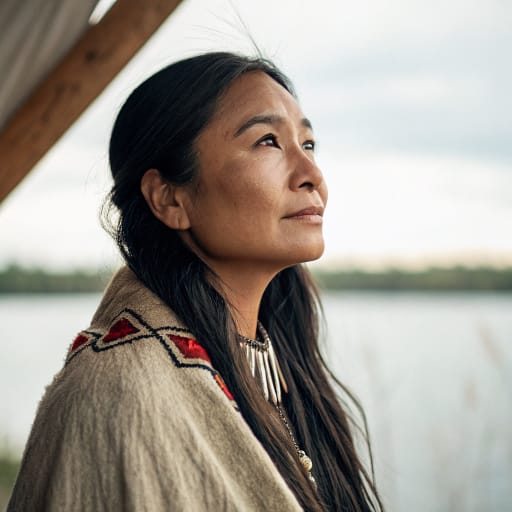
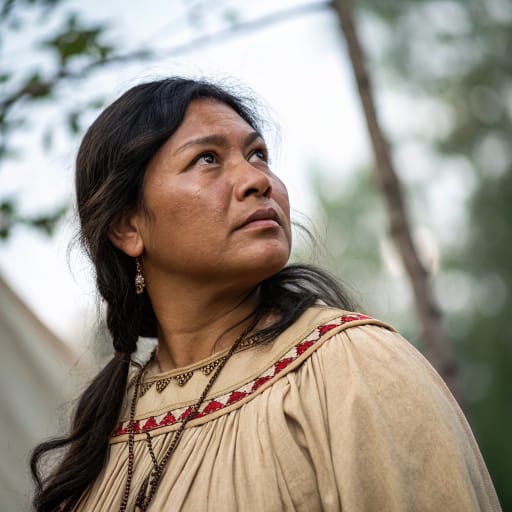
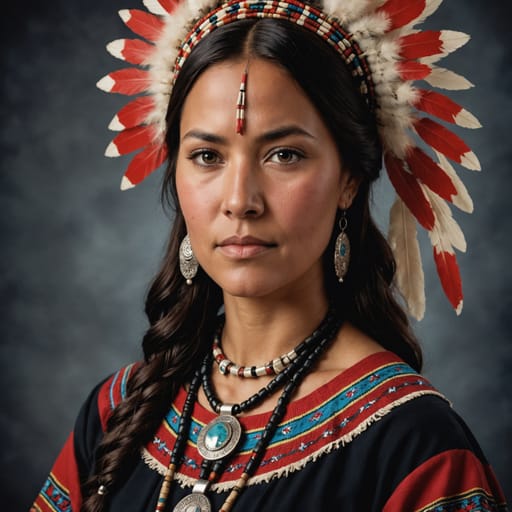
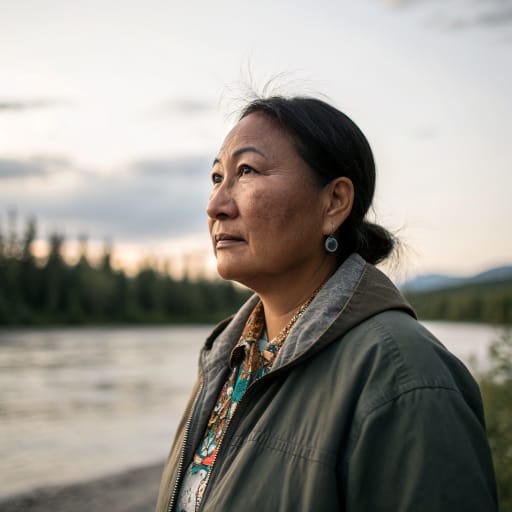
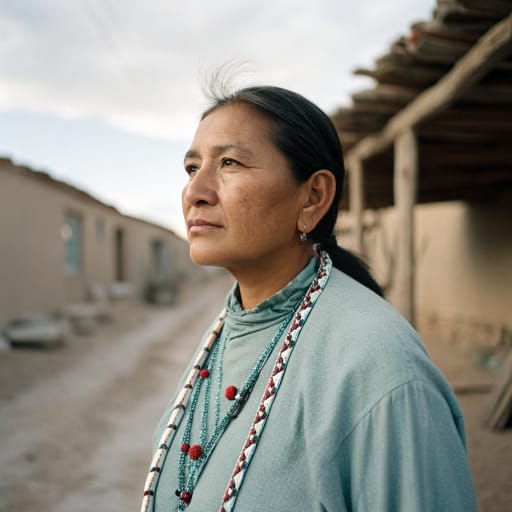
Typical Copalis Phenotypes
Reference for AI generation: hair, eyes, skin, facial structure, build
Copalis Body & Anatomy Reference
Indigenous Northern American / Algonquian-Iroquoian phenotype: anatomy reference for AI nude generation
Copalis Boobs & Breasts
Bust reference for Copalis women: medium cup, moderate projection, which is typical of Indigenous Northern American / Algonquian-Iroquoian ancestry. Areolas measure about 30-44mm across, with medium-brown pigmentation. Body type (mesomorph, broader frame in northern Indigenous populations) shapes the bust as well, so Copalis tits are usually full and moderate projection. In AI imagery, keep the forward-set shape rather than drifting toward the smaller East Asian bust.
Copalis Ass & Hips
The Copalis ass is typically medium, moderate-to-full projection, which sets it apart from the slim East Asian narrow-hip profile. Underneath, the pelvis shows medium iliac crests, part of the Indigenous Northern American / Algonquian-Iroquoian skeletal pattern. For Copalis butt pics and AI renders, match that silhouette and the overall build (mesomorph, broader frame in northern Indigenous populations).
Copalis Vagina & Pussy
Copalis pussy and vulvar anatomy presents medium-brown labial pigmentation, consistent with the Indigenous Northern American / Algonquian-Iroquoian phenotype's pigmentation pattern. Copalis pubic hair is typically straight medium-coarse texture, in the inverted-triangle pattern. For anatomically accurate Copalis pussy renders the labial coloration should match the surrounding copper to medium-brown skin tone with a continuous gradient, and the hair should keep its straight medium-coarse texture.
Copalis Dicks & Penis
Copalis dicks follow the Indigenous Northern American / Algonquian-Iroquoian reference data: regional mean ~13cm erect; moderate girth; medium-brown shaft pigmentation. Shaft color should track the copper to medium-brown skin tone with a smooth change toward the glans, and Copalis pubic hair keeps its straight medium-coarse texture.
Copalis Body, Curves & Build
Copalis body type and overall build presents as mesomorph, broader frame in northern Indigenous populations, with mean adult female BMI 25-28: the characteristic Indigenous Northern American / Algonquian-Iroquoian habitus. Copalis curves and proportions should keep the regional skeletal frame (height, shoulder-to-hip ratio, limb proportions) rather than a generic mesomorph default.
Copalis Skin Tone & Hair Texture
Copalis skin sits in the copper to medium-brown (Fitzpatrick III-V) band. Hair is typically straight 1A, dark-brown to black, often thick and dense, in keeping with the Indigenous Northern American / Algonquian-Iroquoian phenotype. In nude renders the skin should stay one even tone from face to body, and body, pubic and head hair should match.
Explore phenotype categories
Structured taxonomy with peer-reviewed scales · 22 anatomical categories
Erotic Poses & Sex Positions
From the pose catalog: 219 named positions with reference skeletons
Frequently asked questions about Copalis people
Where is the Copalis homeland?
The Copalis homeland is Copalis River and the Pacific beaches between Joe Creek and Grays Harbor, in what is now Grays Harbor County, Washington, United States. in North America.
What language do Copalis people speak?
Copalis people primarily speak Copalis, a dialect generally grouped with Lower Chehalis and close to Quinault (Salishan, Tsamosan branch); no longer spoken..
What religion do Copalis people practice?
The predominant religion among Copalis people is Traditional Coast Salish guardian spirit religion with winter ceremonial dances..






Make your own Copalis images
Five a day, free, no credits to buy. The studio starts from this group's phenotype data, so you can set body type, pose and style and keep the traits accurate.
Start with Copalis