- Home/
- World/
- Southern Asia/
- Bangash
Bangash Erotic
Kohat, Hangu and Kurram districts of Khyber Pakhtunkhwa, Pakistan, with earlier roots near Gardez, Afghanistan
Pashto (Indo-European, Eastern Iranian); Urdu widely used as a second language
Islam, mostly Sunni, with a large Shia community in Kurram and Hangu
Karlani branch of the Pashtuns; main branches include the Miranzai, Baizai and Samilzai
About Bangash People
The Bangash are a Pashtun tribe from the hills and valleys of northwestern Pakistan, around Kohat, Hangu and the Kurram Valley. Descent holds them together more than territory does. Pashtun genealogy places the Bangash in the Karlani branch, and that reckoning still matters. It decides who counts as kin, how land disputes get settled and which elders speak for a village when a jirga is called. Pashtunwali, the Pashtun code of hospitality and honor, shapes daily life here as it does across the Pashtun belt. Its most visible sign is the hujra, the men's guest room where visitors are fed and village business is talked through.
Tribal tradition remembers an older home near Gardez, in what is now eastern Afghanistan. From there the Bangash pushed east into Kurram and down toward Kohat, a town still closely linked with them. They did not keep upper Kurram. The Turi, once a smaller presence in the valley, eventually became the dominant tribe there, though Bangash villages remain. The main branches are the Miranzai, the Baizai and the Samilzai, and they roughly follow geography: the Miranzai Valley around Hangu carries the name of one of them.
One chapter of Bangash history played out far from the frontier. In the early eighteenth century Muhammad Khan Bangash, a commander in Mughal service, founded Farrukhabad on the Gangetic plain in what is now Uttar Pradesh. His descendants ruled it as nawabs until the upheaval of 1857. That history shows how far the tribal name traveled with Pashtun soldiers across northern India.
The Bangash speak Pashto, an Eastern Iranian language. In Kohat they live alongside speakers of Hindko, an Indo-Aryan language, and Urdu is the shared language of school and office. On religion the tribe is less uniform than outsiders expect. Most Bangash are Sunni Muslims, but a large Shia community lives among them, mostly in Kurram and parts of Hangu. In a district where sectarian violence has repeatedly closed roads and markets, that divide has practical consequences. Many Bangash families, like other Pashtuns, now have relatives working in Peshawar, Karachi and the Gulf, and the name goes with them.
Related ethnic groups
Groups that share Bangash's homeland, region, language, or religious tradition — likely candidates for comparative phenotype reference.
Typical Bangash Phenotypes
Reference for AI generation — hair, eyes, skin, facial structure, build
Bangash Body & Anatomy Reference
Per-feature anatomical profile for AI nude generation — Indo-Aryan / Dravidian South Asian phenotype
Bangash Boobs & Breasts
Bangash tits and boobs run medium-to-large cup, moderate-to-full projection — the classic Indo-Aryan / Dravidian South Asian bust profile. Bangash nipples and areolas show medium-brown to dark-brown areolar pigmentation against the wheatish-to-brown skin tone, with areolar diameter typically in the 32-46mm range and forward-set positioning rather than the the smaller East Asian bust profile. Bangash breasts trend full and soft, generally fuller than the East Asian norm, a function of the endomorph-to-mesomorph with fuller hip deposition body habitus and the mean adult female BMI 22-25. For anatomically-accurate AI-generated Bangash nudes the render preserves: medium-to-large cup, moderate-to-full projection shape, 32-46mm areolas with medium-brown to dark-brown pigmentation, and the torso proportions of the Indo-Aryan / Dravidian South Asian phenotype.
Bangash Ass & Hips
Bangash ass and hip morphology presents as medium-to-full, moderate-to-high projection, classic curvy hip profile — distinctly different from the slim hip profile of East Asian women. The Bangash pelvic profile shows medium-to-wide iliac crests, full gluteal-femoral fat distribution, anchored in the Indo-Aryan / Dravidian South Asian skeletal pattern. Bangash butt shots in adult AI imagery should render the medium-to-full, moderate-to-high projection, classic curvy hip profile silhouette with the endomorph-to-mesomorph with fuller hip deposition build and the gluteal-femoral fat distribution typical of the Indo-Aryan / Dravidian South Asian phenotype rather than defaulting to a globally-averaged "ethnic" butt that generic AI generators produce. The hip-to-waist ratio characteristic of Bangash women is one of the identifying features of the Indo-Aryan / Dravidian South Asian regional phenotype.
Bangash Vagina & Pussy
Bangash pussy and vulvar anatomy presents medium-brown to dark-brown labial pigmentation, fuller labia minora projection — consistent with the Indo-Aryan / Dravidian South Asian phenotype's pigmentation pattern. Bangash pubic hair is typically straight-to-wavy coarse texture, dense distribution, distributed in the inverted-triangle pattern with regional-typical density. AI-generated Bangash nude imagery should preserve the medium-brown to dark-brown labial pigmentation and the straight-to-wavy coarse texture hair texture rather than defaulting to a Western-European pink-and-sparse template. For anatomically-accurate Bangash pussy renders the labial pigmentation and coloration should match the surrounding wheatish to brown skin tone of the Indo-Aryan / Dravidian South Asian phenotype, with continuous gradient rather than an abrupt color transition.
Bangash Dicks & Penis
Bangash dick and penile anatomy in adult AI generation should anchor on the regional reference data: regional mean ~13cm erect, moderate girth, and medium-brown shaft pigmentation. The Bangash cock profile reflects the Indo-Aryan / Dravidian South Asian ancestral population's anthropometric measurements rather than a globally-averaged Western-pornography default. For anatomically-accurate Bangash nude male imagery the shaft pigmentation should track the surrounding wheatish to brown skin tone, the glans-to-shaft pigmentation transition should be continuous, and the pubic hair pattern should match straight-to-wavy coarse texture texture distributed in the typical inverted-V escutcheon. Circumcision status in Bangash populations varies by religious-cultural tradition rather than ancestral phenotype.
Bangash Body, Curves & Build
Bangash body type and overall build presents as endomorph-to-mesomorph with fuller hip deposition, with mean adult female BMI 22-25 — the characteristic Indo-Aryan / Dravidian South Asian habitus. Bangash curves and proportions in adult AI imagery should preserve the regional skeletal frame (height, shoulder-to-hip ratio, limb proportions) rather than scaling to a Western-European mesomorph default. The Bangash nude female form, when rendered with anatomical fidelity, shows the height range, frame width, and adipose distribution pattern typical of the Indo-Aryan / Dravidian South Asian phenotype. Generic AI image generators tend to collapse regional body types into a few default shapes; the EthnicErotic phenotype-anchored approach preserves the Bangash build as its own reference category.
Bangash Skin Tone & Hair Texture
Bangash skin tone falls in the wheatish to brown (Fitzpatrick III-V) band — the surface signal most often miscalibrated by generic AI nude generators trained on Western-photographic datasets. Bangash hair texture is typically straight-to-wavy 1A-2B, dense, dark-brown to black, characteristic of the Indo-Aryan / Dravidian South Asian phenotype. For anatomically-accurate Bangash nude renders the skin should hold the Fitzpatrick band consistently across body surface rather than showing the lighter-than-face body shading that AI generators default to. Bangash hair pigmentation and texture on body, pubic, and head should match across the figure rather than mixing textures (a common AI artefact).
Explore phenotype categories
Structured taxonomy with peer-reviewed scales · 22 anatomical categories
Erotic Poses & Sex Positions
From the pose catalog — 219 named positions with reference skeletons
Frequently asked questions about Bangash people
Where is the Bangash homeland?
The Bangash homeland is Kohat, Hangu and Kurram districts of Khyber Pakhtunkhwa, Pakistan, with earlier roots near Gardez, Afghanistan in Southern Asia.
What language do Bangash people speak?
Bangash people primarily speak Pashto (Indo-European, Eastern Iranian); Urdu widely used as a second language.
What religion do Bangash people practice?
The predominant religion among Bangash people is Islam, mostly Sunni, with a large Shia community in Kurram and Hangu.

What does a typical Bangash woman look like?
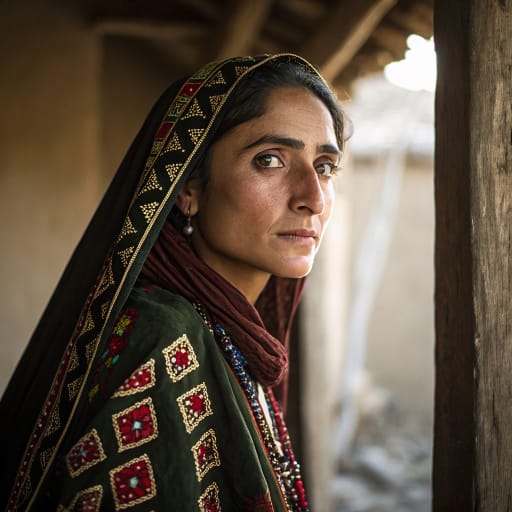
Bangash share the general look of the Pashtuns of the Kohat and Kurram region: skin tones from light olive to medium brown, dark hair and mostly brown eyes, with lighter eyes sometimes seen. Men usually wear the shalwar kameez, often with a waistcoat, a turban, cap or wool pakol, and leather chappals.
Make your own Bangash images
Five a day, free, no credits to buy. The studio starts from this group's phenotype data, so you can set body type, pose and style and keep the traits accurate.
Start with Bangash