Al-Abna' Erotic
Yemen, chiefly Sana'a and the surrounding highlands; the founding soldiers came from the Sasanian Empire (Iran)
Middle Persian (Indo-European, Iranian) among the first generations; later Arabic (Afroasiatic, Semitic)
Islam, adopted from about 628; earlier Zoroastrianism, the religion of the Sasanian state
Descendants of the Sasanian Persian soldiers stationed in Yemen and local Yemeni Arab women; no recorded internal branches
About Al-Abna' People
The Abna' were the descendants of Persian soldiers who took Yemen for the Sasanian Empire in the 570s and stayed. They became a military ruling class centered on Sana'a, accepted Islam during the lifetime of the Prophet Muhammad and blended into the Yemeni Arab population over the following centuries. Their name means the sons, and it fit. They were not the Persians who arrived but the children those men had with Yemeni women. They were local by birth and before long by speech, yet still set apart by descent and by their standing as the Persian crown's men in Arabia.
Their story starts with a request for help. Sayf ibn Dhi Yazan, a Himyarite noble, wanted to drive out the Aksumite rulers from across the Red Sea, who had held Yemen for roughly two generations, and he turned to Khosrow I. Khosrow sent a small force under the commander Wahriz, a few hundred men. According to later Arabic accounts, many of them had been released from Persian prisons for the venture. It won anyway. Yemen became a Persian dependency, first through local client rulers and then under Persian governors. The soldiers settled, married into local families and ran the country for a distant court.
The decisive turn was religious. Islamic tradition holds that Khosrow II ordered the governor Badhan to bring Muhammad before him. Instead, Badhan embraced Islam once news came that Khosrow had been killed in 628. The Abna' followed him and were among the first non-Arab communities to convert. In the last months of Muhammad's life, al-Aswad al-Ansi, a rival claimant to prophecy, seized Sana'a, killed Badhan's son Shahr and married his widow. Abna' leaders, Fayruz al-Daylami and Dadhawayh among them, arranged his killing from inside his own household. Soon after Muhammad's death, the chieftain Qays ibn Makshuh turned on them, murdered Dadhawayh and tried to expel their families. Fayruz rallied tribal allies and, with support from Medina, won their place back.
What came next was quieter. Middle Persian gave way to Arabic, intermarriage continued, and the line between the Abna' and other Yemenis faded until it survived mostly in family trees. Their legacy is as much scholarly as political. Wahb ibn Munabbih, the Yemeni storyteller and collector of biblical and South Arabian lore, came from Abna' stock. So did his brother Hammam, whose written collection of hadith is among the oldest to survive. The name is easy to confuse with the abna' al-dawla of Abbasid Baghdad, the descendants of the army from Khurasan, but that was a separate group that arose nearly two centuries later.
Related ethnic groups
Groups that share Al-Abna''s homeland, region, language, or religious tradition. These are likely candidates for comparative phenotype reference.

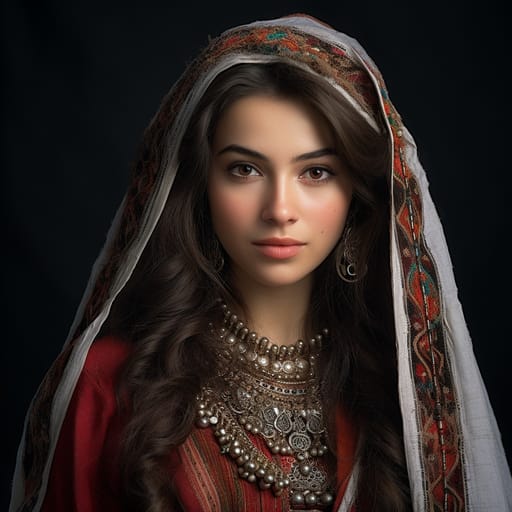


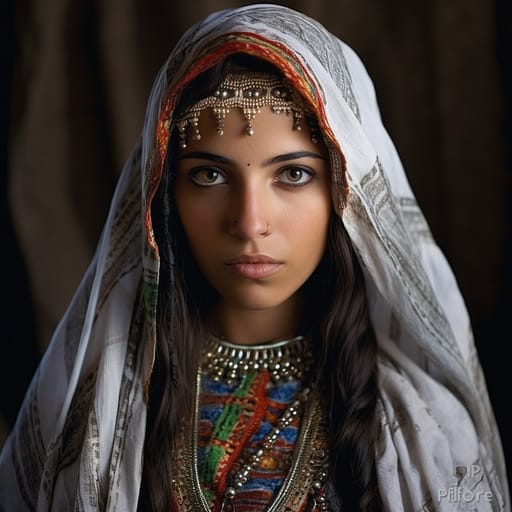
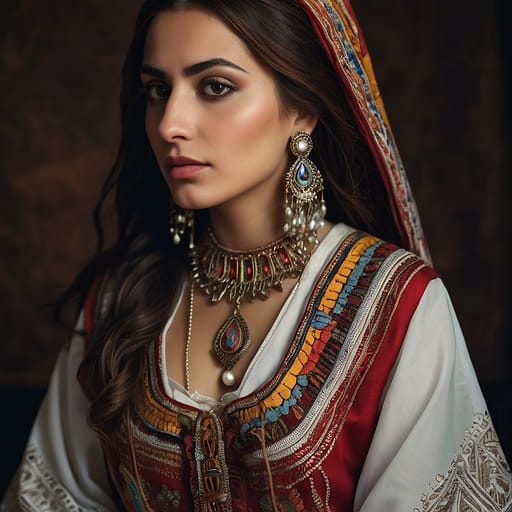
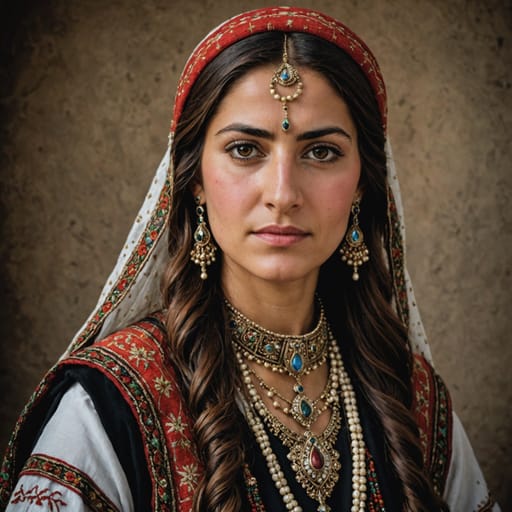
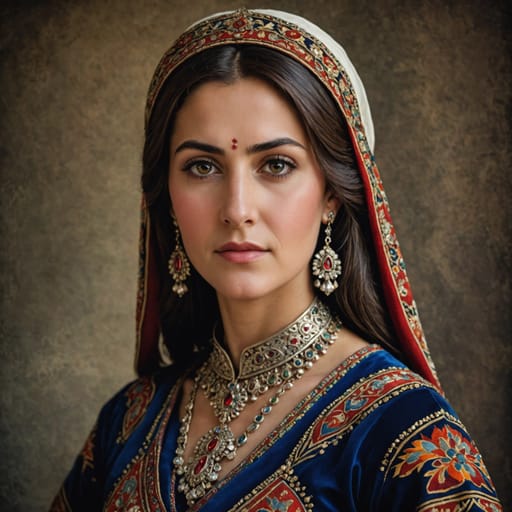
Typical Al-Abna' Phenotypes
Reference for AI generation: hair, eyes, skin, facial structure, build
Al-Abna' Body & Anatomy Reference
Levantine / Mediterranean Middle Eastern phenotype: anatomy reference for AI nude generation
Al-Abna' Boobs & Breasts
The typical Al-Abna' bust is medium-to-large cup, full, moderate-to-high projection, in line with the wider Levantine / Mediterranean Middle Eastern pattern. Areolas usually fall in the 32-46mm range, with medium-brown to dark-brown areolar pigmentation against the olive-to-light-brown skin tone. Compared with the smaller East Asian bust profile, Al-Abna' breasts sit forward and are generally full and soft, fuller projection than the North-African Berber norm. A faithful AI render of Al-Abna' tits keeps that shape and areola size.
Al-Abna' Ass & Hips
Butt shape among Al-Abna' women: medium-to-full, moderate projection, broader hip profile, over medium-to-wide iliac crests, fuller gluteal-femoral deposition. This follows Levantine / Mediterranean Middle Eastern ancestry and looks quite unlike the slim East Asian narrow-hip profile. An accurate Al-Abna' ass in adult AI imagery keeps both the silhouette and the overall build (mesomorph with fuller hip-and-bust deposition) instead of a generic average.
Al-Abna' Vagina & Pussy
Vulvar anatomy among Al-Abna' women: medium-brown to dark-brown labial pigmentation, fuller labia minora. Pubic hair tends to be wavy-to-coiled medium-coarse dark texture, dense distribution, in the usual inverted-triangle pattern. Both follow Levantine / Mediterranean Middle Eastern pigmentation, which is why Al-Abna' pussy renders should not fall back on a pale, sparse Western template.
Al-Abna' Dicks & Penis
The Al-Abna' cock profile, from Levantine / Mediterranean Middle Eastern anthropometric data: regional mean ~14cm erect; moderate-to-above-average girth; medium-brown shaft pigmentation. Pubic hair has a wavy-to-coiled medium-coarse dark texture and forms the usual inverted-V pattern. Whether Al-Abna' men are circumcised follows religious and cultural practice rather than phenotype.
Al-Abna' Body, Curves & Build
Build and curves among Al-Abna' women follow the Levantine / Mediterranean Middle Eastern pattern: mesomorph with fuller hip-and-bust deposition, mean adult female BMI 25-28. Proportions matter as much as skin tone, so Al-Abna' figures should keep their regional height and limb ratios.
Al-Abna' Skin Tone & Hair Texture
The Al-Abna' skin range is olive to medium-brown (Fitzpatrick III-V), and hair tends to be wavy-to-curly 2B-3B, predominantly dark-brown to black. That combination marks the Levantine / Mediterranean Middle Eastern phenotype, and skin tone is the trait AI generators most often get wrong for Al-Abna' women.
Explore phenotype categories
Structured taxonomy with peer-reviewed scales · 22 anatomical categories
Erotic Poses & Sex Positions
From the pose catalog: 219 named positions with reference skeletons
Frequently asked questions about Al-Abna' people
Where is the Al-Abna' homeland?
The Al-Abna' homeland is Yemen, chiefly Sana'a and the surrounding highlands; the founding soldiers came from the Sasanian Empire (Iran) in Western Asia.
What language do Al-Abna' people speak?
Al-Abna' people primarily speak Middle Persian (Indo-European, Iranian) among the first generations; later Arabic (Afroasiatic, Semitic).
What religion do Al-Abna' people practice?
The predominant religion among Al-Abna' people is Islam, adopted from about 628; earlier Zoroastrianism, the religion of the Sasanian state.






Make your own Al-Abna' images
Five a day, free, no credits to buy. The studio starts from this group's phenotype data, so you can set body type, pose and style and keep the traits accurate.
Start with Al-Abna'