Help us get this right
Does this portrait look right for Zapotecs?
Nobody has judged this one yet. You would be the first.
Zapotecs Erotic
Oaxaca (Mexico)
Oto-Manguean / Zapotec
Christianity / Catholicism
Ixtlán
About Zapotecs People
The Zapotecs are one of the oldest continuously settled peoples in the Americas. Their heartland is the central valleys and northern sierras of what is now Oaxaca, in southern Mexico, and they have been there long enough to have built a city — Monte Albán — that was already ancient when the Aztecs were a rumor. They call themselves Be'ena'a or a regional variant of it, meaning, more or less, "the people"; "Zapotec" is a Nahuatl exonym the Spanish inherited and never bothered to retire.
The language is the giveaway. Zapotec is not one tongue but a cluster of dozens, sometimes mutually unintelligible across a single mountain range, all branches of the Oto-Manguean family — a family unrelated to anything spoken outside Mesoamerica and notable for using tone the way Mandarin does, to distinguish words that look identical on paper. A Zapotec from the Isthmus and a Zapotec from Ixtlán, in the northern sierra, may need Spanish to talk to each other, and often do. The Ixtlán branch, high in the cloud forests of the Sierra Norte, has its own distinct varieties and a strong tradition of communal land governance under the system Oaxacans call usos y costumbres: village offices rotated, decided in assembly rather than by ballot, with unpaid service expected from every adult man in turn.
Catholicism arrived with the conquest in the sixteenth century and stuck, but it stuck on its own terms. Patron-saint feasts in Zapotec villages are organized by mayordomos who carry the year's expense as a civic-religious honor, and the underlying logic — reciprocity, obligation to the community, an annual cycle tied to maize — is older than the church on top of it. Pre-Hispanic ritual fragments survive in healing practices, in attitudes toward the dead, and in the elaborate Day of the Dead observances for which Oaxaca is now internationally known.
The other thing worth knowing is that Zapotec society has always been mercantile. The Sunday market at Tlacolula, the textile workshops of Teotitlán del Valle, the mezcal palenques of the southern valleys — these are not folk survivals staged for visitors but functioning economies that long predate them. Migration to Los Angeles and to the agricultural valleys of California has added a transnational layer; remittances now help fund the same village festivals the migrants left to support, and a child raised in Koreatown may still be brought home to Oaxaca to take a turn in the village hierarchy when their name comes up.
Related ethnic groups
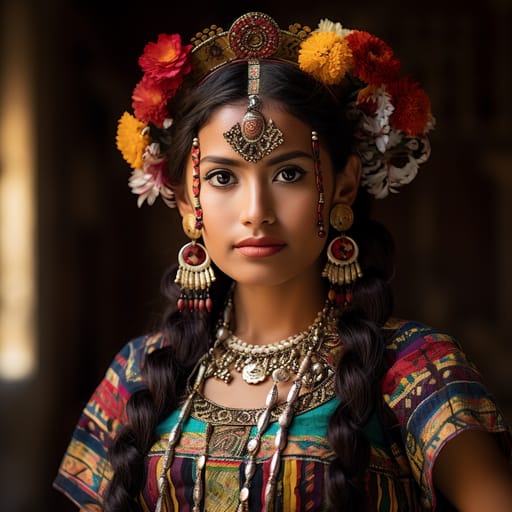
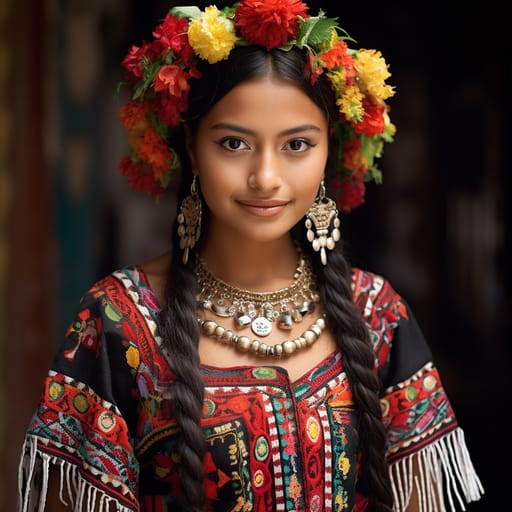
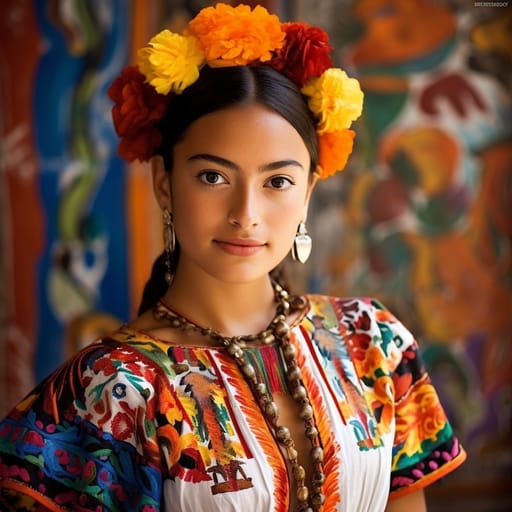
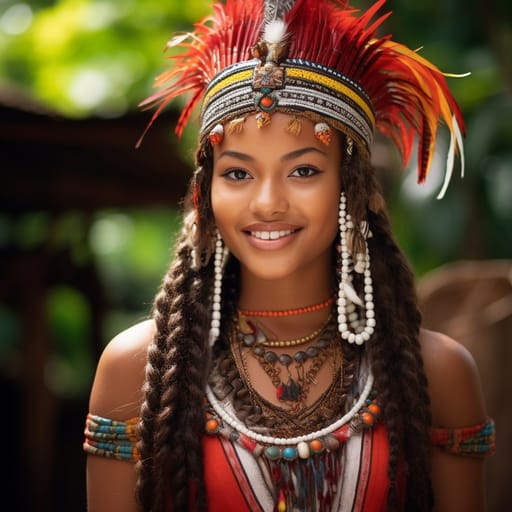
Groups that share Zapotecs's homeland, region, language, or religious tradition. These are likely candidates for comparative phenotype reference.
Geographic Distribution: Zapotecs populations across 1 country
Each row is ranked by the group's share of that country's population, with the source citation drawn from published census and demographic surveys. Click through for the full per-country phenotype profile.
| Country | Share | Source |
|---|---|---|
| Mexico | 1.6% | INEGI 2020, Zapotec speakers and self-identifiers, primarily Oaxaca (~490K) |
Typical Zapotecs Phenotypes
Reference for AI generation: hair, eyes, skin, facial structure, build
Zapotecs are an Indigenous Mesoamerican population centered in the valleys and sierras of Oaxaca, and the phenotype is firmly Indigenous American with very little European admixture in rural and highland communities — markedly less than in central or northern Mexico. Hair is uniformly black to blue-black, thick, coarse in shaft diameter, and almost entirely straight; a slight wave appears in some Isthmus Zapotec individuals but tight curl is essentially absent. Graying tends to come late and stay sparse into the sixties.
Eyes are dark brown to near-black, with the lighter hazel-brown range showing up occasionally in Valley Zapotec but rarely in the sierras. The eyelid usually carries a soft, partial epicanthic fold — not the full tarsal fold of East Asian groups, but a clear inner-corner cover that gives the eye an almond set. Lashes are dense and straight.
Skin runs Fitzpatrick III to V, with warm bronze and copper undertones rather than the olive cast common in mestizo populations. Highland Ixtlán Zapotecs trend lighter — a clearer reddish-bronze that tans deeply — while Isthmus and coastal Zapotecs run noticeably darker, often into a deep umber.
Facially, Zapotecs are known for strong, broad cheekbones, a relatively short midface, and a nose with a low-to-medium bridge and moderately wide alar base — straight or slightly convex in profile, rarely the high aquiline form seen in some northern Mexican groups. Lips are medium-full and well-defined, with a clear cupid's bow. Jaws are square in men, softly rounded in women, and the chin is usually small and recessed rather than projecting.
Build is compact and short — Zapotec men average around 5'2"–5'5" and women 4'10"–5'1", among the shortest documented stature ranges in the Americas. Bodies tend toward stocky with sturdy legs, broad shoulders relative to height, and a tendency to carry weight centrally with age. Isthmus Zapotec women, in particular, are anthropometrically noted for fuller hips and bust against the short frame.
Zapotecs Body & Anatomy Reference
Mesoamerican Indigenous / Mestizo phenotype: anatomy reference for AI nude generation
Zapotecs Boobs & Breasts
Bust reference for Zapotecs women: medium-to-large cup, full, moderate-to-high projection, which is typical of Mesoamerican Indigenous / Mestizo ancestry. Areolas measure about 32-46mm across, with medium-brown to dark-brown pigmentation. Body type (endomorph-to-mesomorph with strong hip-and-bust deposition) shapes the bust as well, so Zapotecs tits are usually full and projecting, classic Latina curvy bust profile. In AI imagery, keep the forward-set shape rather than drifting toward the smaller East Asian bust.
Zapotecs Ass & Hips
The Zapotecs ass is typically medium-to-full, high projection, classic Latina curvy hip profile, which sets it apart from the slim narrow-hip East Asian profile. Underneath, the pelvis shows wide iliac crests, full gluteal-femoral fat deposition, part of the Mesoamerican Indigenous / Mestizo skeletal pattern. For Zapotecs butt pics and AI renders, match that silhouette and the overall build (endomorph-to-mesomorph with strong hip-and-bust deposition).
Zapotecs Vagina & Pussy
Zapotecs pussy and vulvar anatomy presents medium-brown to dark-brown labial pigmentation, fuller labia minora, consistent with the Mesoamerican Indigenous / Mestizo phenotype's pigmentation pattern. Zapotecs pubic hair is typically straight-to-wavy coarse dark texture, dense distribution, in the inverted-triangle pattern. For anatomically accurate Zapotecs pussy renders the labial coloration should match the surrounding tan to medium-brown skin tone with a continuous gradient, and the hair should keep its straight-to-wavy coarse dark texture.
Zapotecs Dicks & Penis
Zapotecs dicks follow the Mesoamerican Indigenous / Mestizo reference data: regional mean ~13cm erect; moderate girth; medium-brown shaft pigmentation. Shaft color should track the tan to medium-brown skin tone with a smooth change toward the glans, and Zapotecs pubic hair keeps its straight-to-wavy coarse dark texture.
Zapotecs Body, Curves & Build
Zapotecs body type and overall build presents as endomorph-to-mesomorph with strong hip-and-bust deposition, with mean adult female BMI 26-29: the characteristic Mesoamerican Indigenous / Mestizo habitus. Zapotecs curves and proportions should keep the regional skeletal frame (height, shoulder-to-hip ratio, limb proportions) rather than a generic mesomorph default.
Zapotecs Skin Tone & Hair Texture
Zapotecs skin sits in the tan to medium-brown (Fitzpatrick III-V) band. Hair is typically straight-to-wavy 1A-2B, dense dark-brown to black, in keeping with the Mesoamerican Indigenous / Mestizo phenotype. In nude renders the skin should stay one even tone from face to body, and body, pubic and head hair should match.
Data depth
0/100Coverage of image-grounded phenotype observations · drives AI generation diversity
- Sample size
- 0/40· 0 images
- Image quality
- 0/30· 0% high
- Confidence
- 0/20
- Source diversity
- 0/10
- ·No image observations yet
Explore phenotype categories
Structured taxonomy with peer-reviewed scales · 22 anatomical categories
Erotic Poses & Sex Positions
From the pose catalog: 219 named positions with reference skeletons
Frequently asked questions about Zapotecs people
Where is the Zapotecs homeland?
The Zapotecs homeland is Oaxaca (Mexico) in Central America.
What countries do Zapotecs people live in?
Zapotecs populations are documented across 1 country: Mexico.
What language do Zapotecs people speak?
Zapotecs people primarily speak Oto-Manguean / Zapotec.
What religion do Zapotecs people practice?
The predominant religion among Zapotecs people is Christianity / Catholicism.






Make your own Zapotecs images
Five a day, free, no credits to buy. The studio starts from this group's phenotype data, so you can set body type, pose and style and keep the traits accurate.
Start with Zapotecs