Help us get this right
Does this portrait look right for Wurundjeri?
One tap. It takes a second and it is recorded.
0 say it looks right, 1 says it looks off.
Wurundjeri Erotic
The Yarra (Birrarung) valley and its tributaries, in and around Melbourne, Victoria, Australia.
Woiwurrung (Kulin branch of Pama-Nyungan), dormant through the twentieth century and now under revival; English in daily use.
Traditional Kulin cosmology centered on Bunjil and Waa; Christianity from the Coranderrk mission era; many people today secular.
Woiwurrung speakers within the Kulin nation, alongside the Boonwurrung, Taungurung, Wathaurong and Dja Dja Wurrung; clans include the Wurundjeri-willam and Wurundjeri-baluk.
About Wurundjeri People
The Wurundjeri are the people of the Birrarung, the river colonists renamed the Yarra, and their country is the ground Melbourne stands on. The name is built from their own words: wurun, the manna gum along the river flats, and djeri, the grub that lives in it. Their land runs from the ranges north and east of the city down through the valley and its creeks toward the bay. Woiwurrung, their language, sits so close to the speech of the Boonwurrung to the south and the Taungurung over the divide that the three are often treated as dialects of a single Pama-Nyungan language, and those peoples together make up the alliance known as the Kulin. Every Wurundjeri person belongs to one of two moieties, Bunjil the wedge-tailed eagle or Waa the crow, and marriage has to cross that line. The rule sounds small. It is the thing that stitched five peoples into one another, generation after generation.
Wealth here was stone. The quarry at Wil-im-ee Moor-ring, Mount William, yielded a greenstone that made the best axe heads in the southeast, and the Wurundjeri family that held it traded blanks hundreds of kilometers into what is now New South Wales and South Australia. In 1835 John Batman produced a document he claimed had bought six hundred thousand acres from eight Kulin headmen. The colonial government voided it within months, but it remains the only occasion on which Europeans in Australia negotiated their arrival rather than simply taking. What followed was quick: sheep stripped out the murnong, the yam daisy that had been a staple root, within a few years. In 1863 Simon Wonga and William Barak walked their people onto land they had chosen themselves near Healesville and built Coranderrk into a farm that won prizes for its hops. When the authorities moved to carve it up, residents petitioned, walked to Melbourne and forced a parliamentary inquiry in 1881, then watched the 1886 legislation push people of mixed descent off the station and break the families that had made it work. Barak, the last traditional ngurungaeta, spent his final years drawing the old ceremonies in ocher and charcoal. His descendants and the other Wurundjeri families are still here, running the corporation that speaks for country across most of Melbourne, reviving Tanderrum, the ceremony that granted visitors safe passage, and sewing possum-skin cloaks again. The 2017 act protecting the Birrarung opens with a preamble in Woiwurrung, the first Victorian law to do so.
Related ethnic groups
Groups that share Wurundjeri's homeland, region, language, or religious tradition. These are likely candidates for comparative phenotype reference.
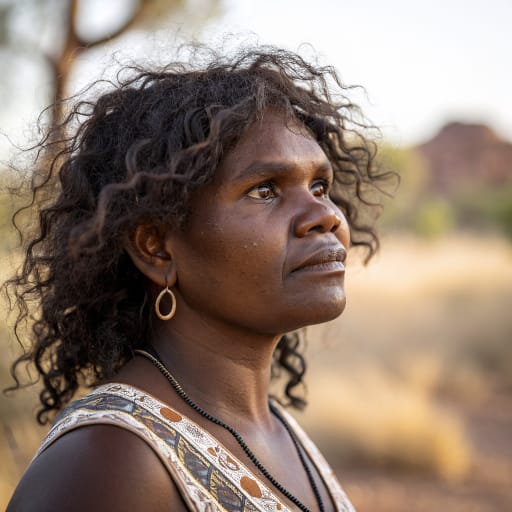
Arrernte
same region (Australia / New Zealand)
Noongar
same region (Australia / New Zealand)
Yolngu
same region (Australia / New Zealand)
Tiwi
same region (Australia / New Zealand)
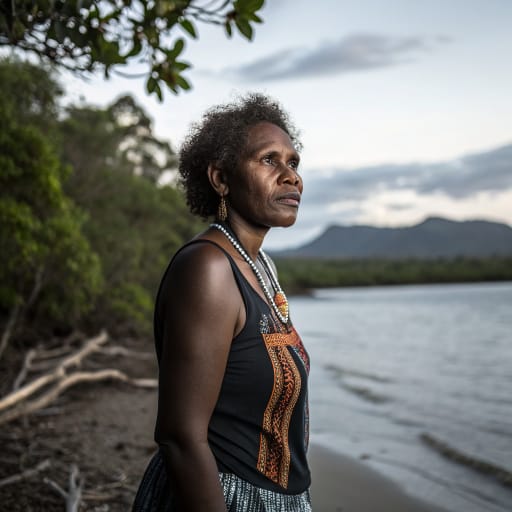
Guugu Yimithirr
same region (Australia / New Zealand)
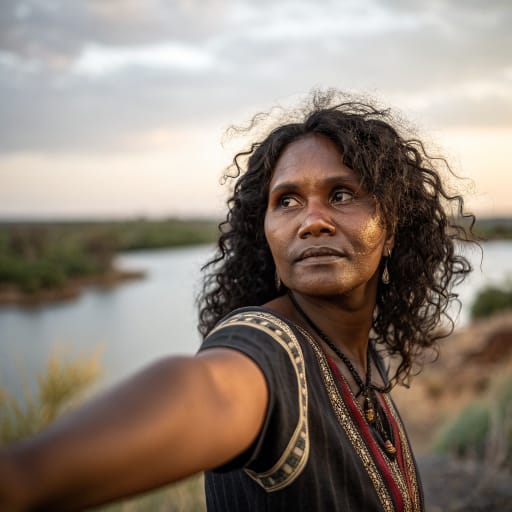
Alyawarre
same region (Australia / New Zealand)
Te Roroa
same region (Australia / New Zealand)
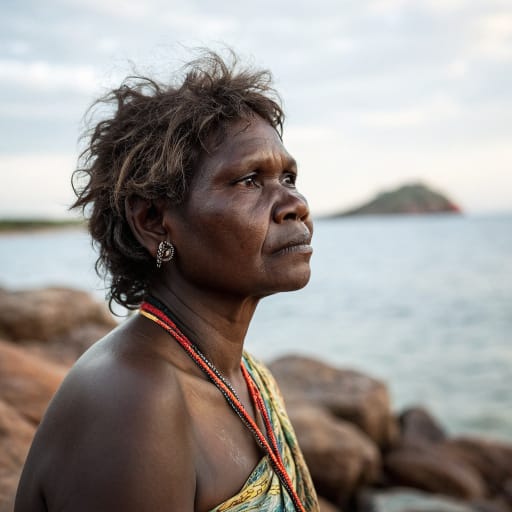
Bardi
same region (Australia / New Zealand)
Typical Wurundjeri Phenotypes
Reference for AI generation: hair, eyes, skin, facial structure, build
Wurundjeri Body & Anatomy Reference
Aboriginal Australian phenotype: anatomy reference for AI nude generation
Wurundjeri Boobs & Breasts
The typical Wurundjeri bust is small-to-medium cup, modest-to-moderate projection, in line with the wider Aboriginal Australian pattern. Areolas usually fall in the 28-42mm range, with deep-brown to near-black areolar pigmentation against the deep-brown skin tone. Compared with the fuller Polynesian or West African bust, Wurundjeri breasts sit forward and are generally modest projection, firm. A faithful AI render of Wurundjeri tits keeps that shape and areola size.
Wurundjeri Ass & Hips
Butt shape among Wurundjeri women: small-to-medium, modest projection, narrower hip profile, over narrow-to-medium iliac crests, longer torso and limb proportions. This follows Aboriginal Australian ancestry and looks quite unlike the very full Polynesian gluteal projection. An accurate Wurundjeri ass in adult AI imagery keeps both the silhouette and the overall build (ectomorph-to-mesomorph, lean elongated frame adapted to arid environment) instead of a generic average.
Wurundjeri Vagina & Pussy
Vulvar anatomy among Wurundjeri women: deep-brown labial pigmentation. Pubic hair tends to be wavy-to-coiled coarse texture, in the usual inverted-triangle pattern. Both follow Aboriginal Australian pigmentation, which is why Wurundjeri pussy renders should not fall back on a pale, sparse Western template.
Wurundjeri Dicks & Penis
The Wurundjeri cock profile, from Aboriginal Australian anthropometric data: regional mean ~13cm erect; moderate girth; deep-brown shaft pigmentation. Pubic hair has a wavy-to-coiled coarse texture and forms the usual inverted-V pattern. Whether Wurundjeri men are circumcised follows religious and cultural practice rather than phenotype.
Wurundjeri Body, Curves & Build
Build and curves among Wurundjeri women follow the Aboriginal Australian pattern: ectomorph-to-mesomorph, lean elongated frame adapted to arid environment, mean adult female BMI 23-26. Proportions matter as much as skin tone, so Wurundjeri figures should keep their regional height and limb ratios.
Wurundjeri Skin Tone & Hair Texture
The Wurundjeri skin range is deep-brown (Fitzpatrick V-VI), and hair tends to be wavy-to-curly 2C-3B, dark-brown to black; the distinctive blond-haired Aboriginal sub-population in Central Australia is documented and pigmentation-independent. That combination marks the Aboriginal Australian phenotype, and skin tone is the trait AI generators most often get wrong for Wurundjeri women.
Explore phenotype categories
Structured taxonomy with peer-reviewed scales · 22 anatomical categories
Erotic Poses & Sex Positions
From the pose catalog: 219 named positions with reference skeletons
Frequently asked questions about Wurundjeri people
Where is the Wurundjeri homeland?
The Wurundjeri homeland is The Yarra (Birrarung) valley and its tributaries, in and around Melbourne, Victoria, Australia. in Australia / New Zealand.
What language do Wurundjeri people speak?
Wurundjeri people primarily speak Woiwurrung (Kulin branch of Pama-Nyungan), dormant through the twentieth century and now under revival; English in daily use..
What religion do Wurundjeri people practice?
The predominant religion among Wurundjeri people is Traditional Kulin cosmology centered on Bunjil and Waa; Christianity from the Coranderrk mission era; many people today secular..






Make your own Wurundjeri images
Five a day, free, no credits to buy. The studio starts from this group's phenotype data, so you can set body type, pose and style and keep the traits accurate.
Start with Wurundjeri