Help us get this right
Does this portrait look right for Tripuri?
One tap. It takes a second and it is recorded.
1 says it looks right, 4 say it looks off.
Tripuri Erotic
Tripura (India)
Hinduism
Jamatia, Murasing
About Tripuri People
The Tripuri are the indigenous people of Tripura, the small hill state wedged between Bangladesh and the rest of northeast India. For centuries before the kingdom's 1949 accession, the Manikya dynasty ruled here, a Tripuri royal house whose chronicle, the Rajmala, traces its line back across nearly two hundred kings. That long, unbroken political memory matters: the Tripuri are not a tribe in the anthropological-curiosity sense but the founders of a state that long predates the Indian republic, now a minority in the territory their ancestors named.
Their language, Kokborok, sits in the Sal branch of Sino-Tibetan, closely related to Boro and Garo across the border in Assam and Meghalaya, which means it is structurally and lexically far from the Indo-Aryan Bengali spoken by the demographic majority around them. Kokborok is now co-official in the state and increasingly written in Bengali script, though debate over whether to standardise on Roman script is a live political question rather than a settled one. The community itself is internally varied: the Jamatia, organised around their hereditary hoda council, are known for tight social discipline and were among the first Tripuri sub-groups to adopt Vaishnavism wholesale; the Murasing, smaller and historically more dispersed across the southern hills, retain a distinct dialect and a stronger thread of pre-Hindu ritual practice.
Religion among the Tripuri is Hindu, but not in a way a visitor from the Gangetic plain would immediately recognise. The fourteen deities collectively called the Chaturdasha Devata, worshipped at the old royal temple in Agartala in the form of unadorned heads, are the heart of state ritual, and their annual Kharchi festival is the Tripuri religious calendar's anchor. Household practice braids these older clan deities with mainstream Hindu observance; conversion to Christianity, though it has reshaped neighbouring Mizo and Naga societies, has touched only some Tripuri sub-groups and unevenly.
Daily life still carries the marks of a hill agricultural society:jhum shifting cultivation, bamboo as a structural material for almost everything, and rice-beer brewed at home for ceremonies the state calendar does not mark. The dominant Tripuri register today, though, is political rather than pastoral: questions of land, language, and demographic displacement after the partition-era influx from East Pakistan continue to shape how the community understands itself.
Related ethnic groups
Groups that share Tripuri's homeland, region, language, or religious tradition. These are likely candidates for comparative phenotype reference.
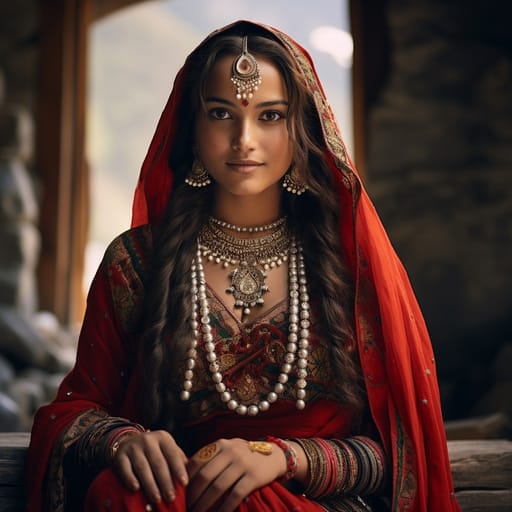
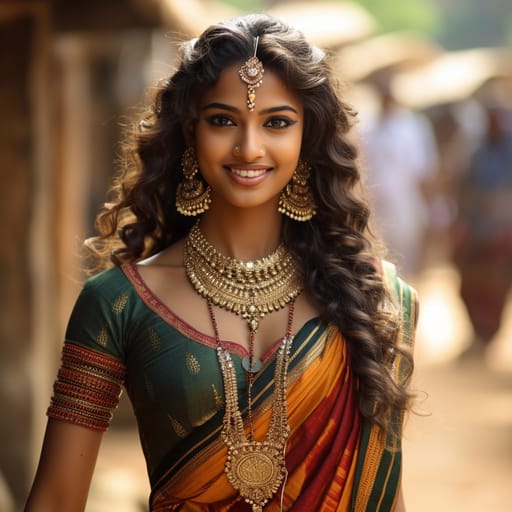
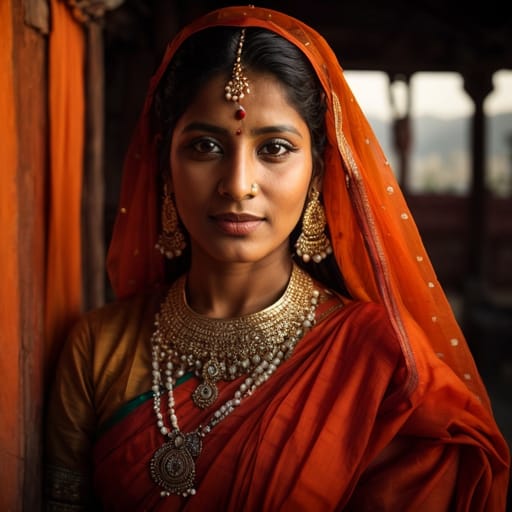
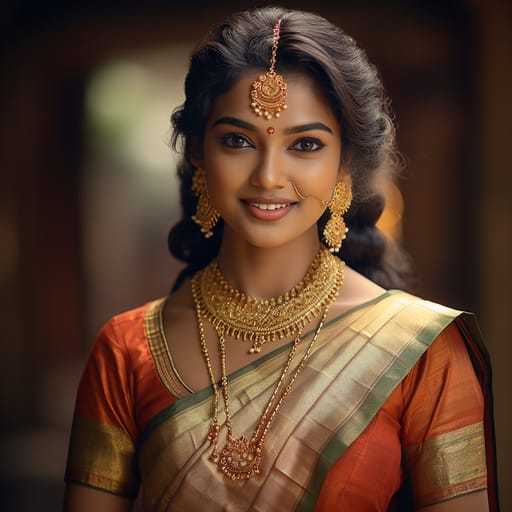
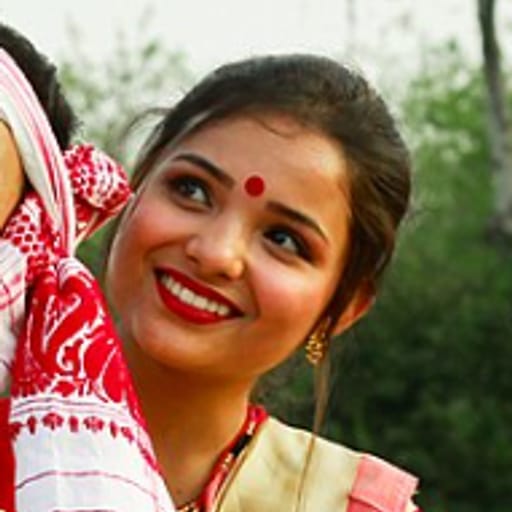
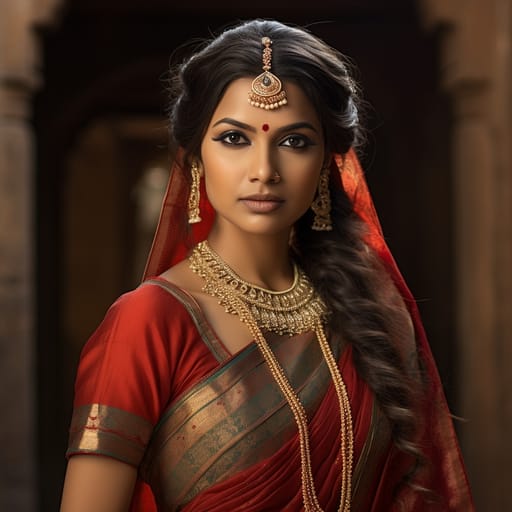
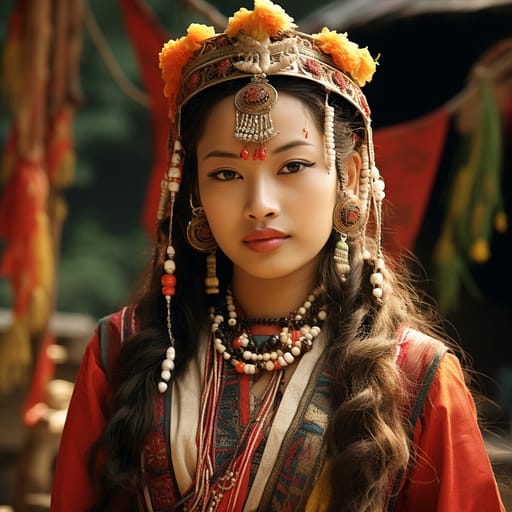
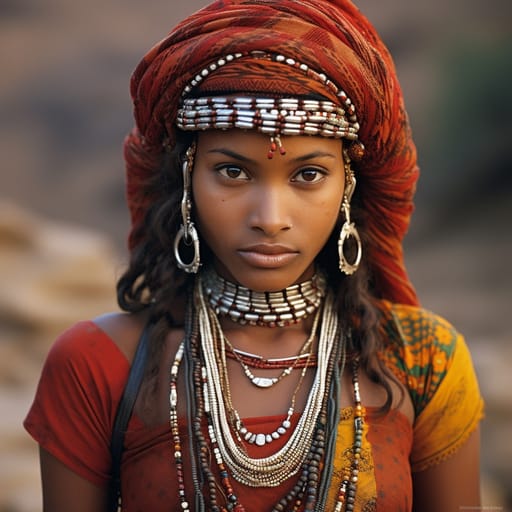
Typical Tripuri Phenotypes
Reference for AI generation: hair, eyes, skin, facial structure, build
The Tripuri phenotype sits at a visible crossroads: a Tibeto-Burman population on the eastern edge of South Asia, with facial structure that reads more East/Southeast Asian than Indo-Aryan, set on a frame and skin tone shaped by sub-tropical Northeast India. Hair is almost uniformly black or very dark brown, straight to faintly wavy, with the coarse-to-medium shaft thickness typical of Sino-Tibetan groups. Premature graying is uncommon; loss of pigment tends to come later than in surrounding Bengali populations. Body hair is light, and male facial hair is generally sparse and slow-growing.
Eyes are dark brown to near-black. The epicanthic fold is present in most individuals, though usually softer and less pronounced than in Han or Tibetan populations; a partial or "incomplete" fold is common, giving the eye a smooth, slightly almond contour rather than a sharply hooded one. Eye openings tend to be moderate, with low-set, gently arched brows.
Skin tone runs a fairly narrow band, Fitzpatrick III to IV, with warm golden-olive to light-brown undertones. It's typically lighter than neighbouring Bengali populations and noticeably warmer in undertone than East Asian skin. Faces are characteristically wide across the cheekbones with a flatter midface, a low-to-medium nasal bridge, moderate alar width, and lips of medium fullness, neither thin nor heavy. Jawlines are softer and rounder than the angular Han profile; the chin is usually small and tapered. The Sen sisters, Riya and Raima, are recognisable public examples of the lighter, finer-boned end of this range.
Build is compact. Stature averages below the Indian mean: roughly 160-168 cm for men, 148-155 cm for women, with slim shoulders, narrow hips, and lean musculature. Among the sub-groups, Jamatia features tend to read slightly more robust and broader-faced, while Murasing phenotype skews finer-featured and more gracile, though overlap is substantial and individual variation outweighs branch averages.
Tripuri Body & Anatomy Reference
Anatomy by feature, Indo-Aryan / Dravidian South Asian phenotype
Tripuri Boobs & Breasts
Bust reference for Tripuri women: medium-to-large cup, moderate-to-full projection, which is typical of Indo-Aryan / Dravidian South Asian ancestry. Areolas measure about 32-46mm across, with medium-brown to dark-brown pigmentation. Body type (endomorph-to-mesomorph with fuller hip deposition) shapes the bust as well, so Tripuri tits are usually full and soft, generally fuller than the East Asian norm. In AI imagery, keep the forward-set shape rather than drifting toward the smaller East Asian bust profile.
Tripuri Ass & Hips
The Tripuri ass is typically medium-to-full, moderate-to-high projection, classic curvy hip profile, which sets it apart from the slim hip profile of East Asian women. Underneath, the pelvis shows medium-to-wide iliac crests, full gluteal-femoral fat distribution, part of the Indo-Aryan / Dravidian South Asian skeletal pattern. For Tripuri butt pics and AI renders, match that silhouette and the overall build (endomorph-to-mesomorph with fuller hip deposition).
Tripuri Vagina & Pussy
Tripuri pussy and vulvar anatomy presents medium-brown to dark-brown labial pigmentation, fuller labia minora projection, consistent with the Indo-Aryan / Dravidian South Asian phenotype's pigmentation pattern. Tripuri pubic hair is typically straight-to-wavy coarse texture, dense distribution, in the inverted-triangle pattern. For anatomically accurate Tripuri pussy renders the labial coloration should match the surrounding wheatish to brown skin tone with a continuous gradient, and the hair should keep its straight-to-wavy coarse texture.
Tripuri Dicks & Penis
Tripuri dicks follow the Indo-Aryan / Dravidian South Asian reference data: regional mean ~13cm erect; moderate girth; medium-brown shaft pigmentation. Shaft color should track the wheatish to brown skin tone with a smooth change toward the glans, and Tripuri pubic hair keeps its straight-to-wavy coarse texture.
Tripuri Body, Curves & Build
Tripuri body type and overall build presents as endomorph-to-mesomorph with fuller hip deposition, with mean adult female BMI 22-25: the characteristic Indo-Aryan / Dravidian South Asian habitus. Tripuri curves and proportions should keep the regional skeletal frame (height, shoulder-to-hip ratio, limb proportions) rather than a generic mesomorph default.
Tripuri Skin Tone & Hair Texture
Tripuri skin sits in the wheatish to brown (Fitzpatrick III-V) band. Hair is typically straight-to-wavy 1A-2B, dense, dark-brown to black, in keeping with the Indo-Aryan / Dravidian South Asian phenotype. In nude renders the skin should stay one even tone from face to body, and body, pubic and head hair should match.
Data depth
72/100Coverage of image-grounded phenotype observations · drives AI generation diversity
- Sample size
- 27/40· 21 images
- Image quality
- 30/30· 62% high
- Confidence
- 15/20· mean 0.74
- Source diversity
- 0/10· wikipedia
- ·Modest sample (n<25)
- ·Wikipedia-only source, not population-representative
Observed Distribution: Image Sample
Empirical observations from analyzed photographs · supplementary signal, not population truth
Sample: 21 images analyzed (21 wikipedia). Quality: 13 high, 5 medium, 3 low, 0 very_low. Avg analyzer confidence: 0.74.
Skin tone (Fitzpatrick): III (10%), IV (81%), V (5%), unclear (5%)
Hair color: black (43%), gray/white (43%), dark brown (10%), unclear (5%)
Hair texture: straight (62%), wavy (14%), shaved (5%), covered (14%), unclear (5%)
Eye color: dark brown (90%), unclear (10%)
Epicanthic fold: 48% present, 38% absent, 5% partial, 10% unclear
Caveats: Sample size 21 is modest, so secondary patterns may not be reliable. Sample is 100% Wikipedia notable people, which skews toward male, public-life, and modern figures, not population-representative.
Last aggregated: May 7, 2026
Explore phenotype categories
Structured taxonomy with peer-reviewed scales · 22 anatomical categories
Notable Tripuri People
64 reference figures, sourced from Wikipedia
- Bir Bikram Kishore Debbarman, 1908-1947, one of the last Kings of Tripura.
- Pradyot Bikram Manikya Deb Barma, Titular King and Current Head of Tripura Royal Family
- Sachin Dev Burman, Bollywood composer and singer.
- Rahul Dev Burman, Bollywood composer and singer.
- Kirit Bikram Kishore Deb Barman, Maharaja of Tripura (1947-2006), MP, and social activist.
- Bibhu Kumari Devi, Rajmata of Tripura
- Kanchan Prava Devi, Queen of Tripura.
- Radha Kishore Manikya, Maharaja of Tripura
- Birendra Kishore Manikya, Maharaja of Tripura
- Maha Manikya, Maharaja of Tripura
- Dharma Manikya I, Maharaja of Tripura
- Ratna Manikya I, Maharaja of Tripura
- Nabadwipchandra Dev Burman, Indian sitarist and Dhrupad singer
- Pratap Manikya, Maharaja of Tripura
- Sefali Debbarma, Kokborok poetess and novelist
- Bikashrai Debbarma, poet, writer, and composer
- Jishnu Dev Varma, Governor of Telangana, and Former Deputy Chief Minister of Tripura.
- Riya Sen Dev Varma, Bollywood actress.
- Raima Sen Dev Varma, Bollywood actress.
- Somdev Devvarman, Indian Tennis Player.
- Narendra Chandra Debbarma, Former Minister for Forests and Revenue, Government of Tripura.
- Dasarath Debbarma, Former Chief Minister of Tripura
- Aghore Debbarma, Former Minister for Tribal Welfare, Agriculture & Animal Resource Development…
- Jitendra Chaudhury, Member of the Tripura legislative assembly 2023
- Rebati Tripura, Former Member of Parliament (India)
- Sudhanwa Debbarma, Former Speaker of Tripura Legislative Assembly.
- Bidya Debbarma, Former Minister in Charge of Tribal Welfare, Govt of Tripura.
- Ranjit Debbarma, Member of the Tripura Legislative Assembly and former Command in General of A…
- Animesh Debbarma, Cabinet Minister in Tripura Government, former Deputy Chief Executive Member …
- Nagendra Jamatia, Former Minister for Agriculture & Horticulture, Govt of Tripura. Former Legis…
- Benichandra Jamatia, Padma Shri Indian folk writer and litterateur
- Mevar Kumar Jamatia, Former Minister of Tribal Welfare and Forest, Tripura.
- Satyaram Reang, Padma Shri Indian folk performer and folk artist
- Harinath Debbarma, Founder of TUJS
- Nanda Kumar Deb Barma, Kokborok Playwright and Composer.
- Manoranjan Debbarma, Politician.
- Rashiram Debbarma, Former Minister of Ministry of Revenue, Govt of Tripura.
- Radhacharan Debbarma, Former CEM of TTAADC
- Purna Chandra Jamatia, CEM of TTAADC
- Naresh Jamatia, Former Minister of Forest, Rural Development and Election, Govt of Tripura.
- Brishaketu Debbarma, Minister of State Industries and Commerce, Government of Tripura.
- Pranab Debbarma, former Member of Tripura Legislative Assembly.
- Jagadish Debbarma, Chairman of TTAADC and former MLA of Tripura Legislative Assembly.
- Pramod Reang, Politician and Member of Tripura Legislative Assembly
- Dhananjoy Tripura, Politician, former Vice Chairman of Tripura Planning Commission and former Me…
- Manindra Reang, Former Minister for Tribal Welfare (TRP & PTG), Home (Jail) and General Admin…
- Purna Mohan Tripura, Former Minister of Finance and Power, Government of Tripura.
- Prem Kumar Reang, Former Ministry of Fisheries, Co-operation and Tribal Welfare (TRP & PTG), Go…
- Rabindra Debbarma, Executive Member of TTAADC and former legislator of Tripura Legislative Assem…
- Bajuban Reang, Former Member of the Parliament of India
- Kriti Devi Debbarman, Member of Parliament of the 18th Lok Sabha.
- Dipayan Debbarma, cricketer
- Manisankar Murasingh, cricketer
- Rita Debbarma, women's cricketer
- Bijoy Debbarma, Prominent opthalmologist, poet, novelist and activist.
- Sukhendu Debbarma, Professor and Dean of Tripura University.
- Naresh Chandra Dev Varma, writer and Padma Shri awardee
- Chandra Kumar Jamatia, Retired IAS and current member of Administrative Reforms Committee, TTAADC.
- Birendra Kishore Roaza, Former Member of Parliament.
- Sushanto Tripura, Bangladesh national team footballer
- Shobha Rani Tripura, Ekushey Padak recipient
- Jotindra Lal Tripura, Former Member of Parliament.
- Kujendra Lal Tripura, Politician, MP (Member of Parliament 299 Constituency) Khagrachari Hill Distr…
- Naba Bikram Kishore Tripura, Former Secretary, Former Additional Inspector General of Bangladesh Police
Erotic Poses & Sex Positions
From the pose catalog: 219 named positions with reference skeletons
Frequently asked questions about Tripuri people
Where is the Tripuri homeland?
The Tripuri homeland is Tripura (India) in Southern Asia.
What language do Tripuri people speak?
Tripuri people primarily speak Sino-Tibetan / Sal / Kokborok.
What religion do Tripuri people practice?
The predominant religion among Tripuri people is Hinduism.
What does a typical Tripuri woman look like?
Tripuri women typically have black or very dark brown hair that is straight to faintly wavy, and dark brown eyes, usually with a soft or partial epicanthic fold. Skin sits in the Fitzpatrick III to IV range with warm golden-olive to light-brown undertones. Faces are wide across the cheekbones, with a low-to-medium nasal bridge, medium lips and a small, tapered chin, and women average about 148 to 155 cm with a slim build.






Make your own Tripuri images
Five a day, free, no credits to buy. The studio starts from this group's phenotype data, so you can set body type, pose and style and keep the traits accurate.
Start with Tripuri