Help us get this right
Does this portrait look right for Totonac?
Nobody has judged this one yet. You would be the first.
Totonac Erotic
Veracruz and Puebla (Totonacapan), Mexico
Totonac (Totonacan)
Roman Catholicism blended with traditional beliefs
About Totonac People
Totonac are an Indigenous people of east-central Mexico, living in the region of Totonacapan across the northern lowlands and adjacent sierra of Veracruz and Puebla. They speak the Totonac languages, part of the Totonacan family, and number in the hundreds of thousands. Their ancestors built the great pre-Columbian city of El Tajín, famous for its Pyramid of the Niches. In 1519 the Totonac of Cempoala became among the first Indigenous peoples to ally with Hernán Cortés against the Aztec empire, a fateful turn in the Spanish conquest of Mexico.
Society and subsistence
The Totonac are farmers of maize, beans, chili, and fruit in a warm and well-watered land, and the sierra around Papantla is a historic center of vanilla, a native orchid the Totonac were among the first to cultivate and cure. They are best known worldwide for the ritual of the Voladores, the flying pole ceremony, in which four performers, having climbed a tall pole, launch themselves head down and spiral slowly to the ground on ropes wound around the pole while a fifth plays flute and drum on the summit, an ancient rite associated with the sun and the four directions that has been recognized by UNESCO as intangible cultural heritage. Catholic and older beliefs are interwoven in community religious life.
Appearance and adornment
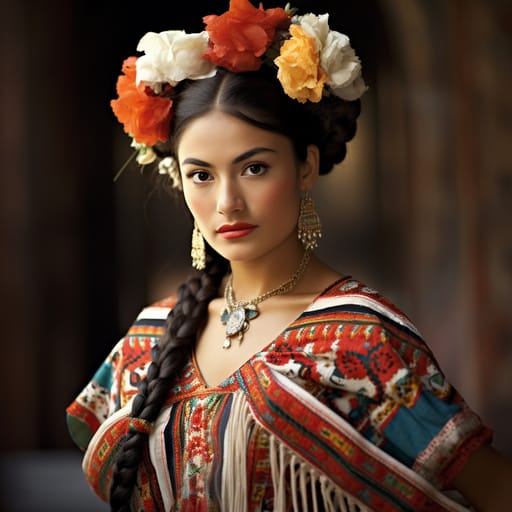
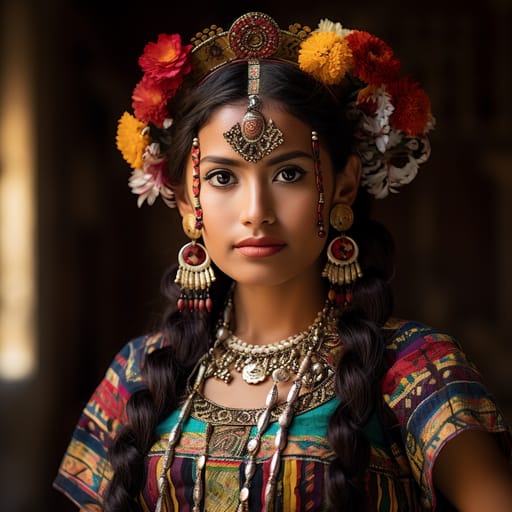
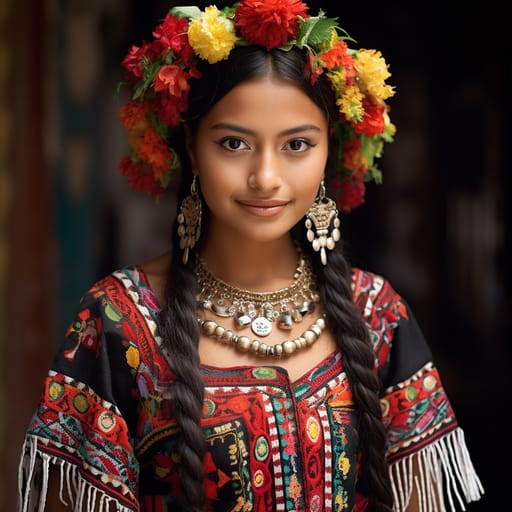
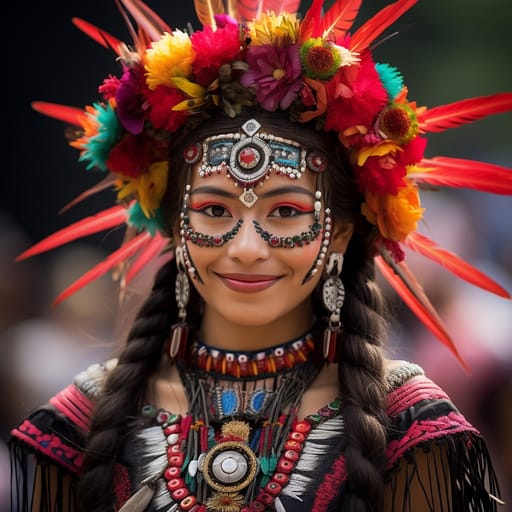
Traditional Totonac women's dress is strikingly white: an embroidered blouse and a wrapped white skirt, worn with a lace-trimmed quechquémitl cape, with the hair braided and wound with colored wool and ribbons and sometimes crowned with a headdress of yarn. Beaded necklaces are worn in quantity. The Voladores wear red trousers and tall conical caps adorned with mirrors, ribbons, paper flowers, and plumes that evoke birds in flight. Everyday dress is modern in many communities, with white embroidered dress kept for ceremony and market.
Related ethnic groups
Groups that share Totonac's homeland, region, language, or religious tradition. These are likely candidates for comparative phenotype reference.
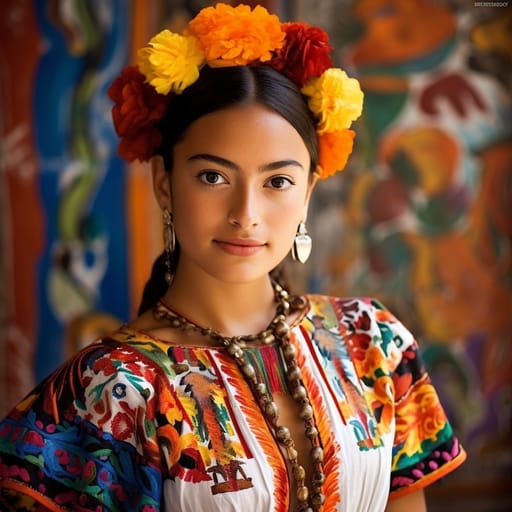
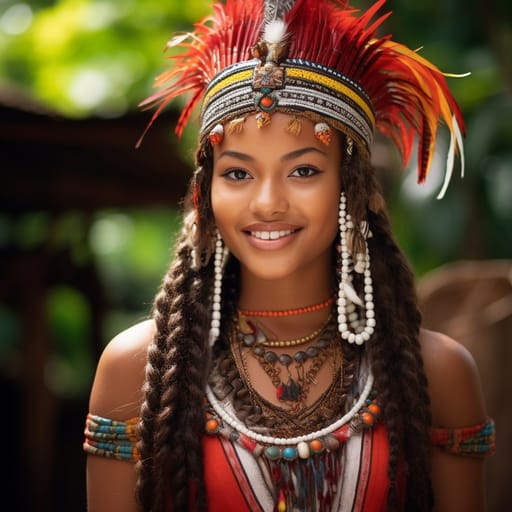
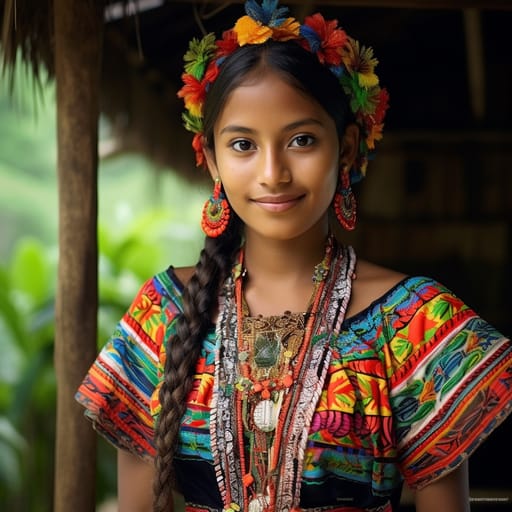
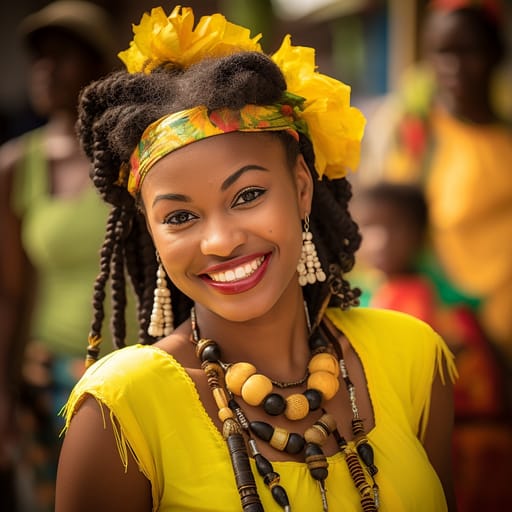
Typical Totonac Phenotypes
Reference for AI generation: hair, eyes, skin, facial structure, build
Totonac Body & Anatomy Reference
Per-feature anatomical profile for AI nude generation: Mesoamerican Indigenous / Mestizo phenotype
Totonac Boobs & Breasts
Totonac boobs follow the Mesoamerican Indigenous / Mestizo profile: medium-to-large cup, full, moderate-to-high projection. Areolar diameter is usually 32-46mm, and the coloring is medium-brown to dark-brown areolar pigmentation against the tan-to-medium-brown skin tone. Breast shape tracks body composition (endomorph-to-mesomorph with strong hip-and-bust deposition, mean adult female BMI 26-29), so Totonac breasts tend to be full and projecting, classic Latina curvy bust profile. Expect a forward-set shape, not the smaller East Asian bust.
Totonac Ass & Hips
Totonac ass and hip morphology presents as medium-to-full, high projection, classic Latina curvy hip profile, distinctly different from the slim narrow-hip East Asian profile. The Totonac pelvic profile shows wide iliac crests, full gluteal-femoral fat deposition, anchored in the Mesoamerican Indigenous / Mestizo skeletal pattern. Totonac butt shots in adult AI imagery should render the medium-to-full, high projection, classic Latina curvy hip profile silhouette with the overall build (endomorph-to-mesomorph with strong hip-and-bust deposition) and the fat distribution typical of the Mesoamerican Indigenous / Mestizo phenotype.
Totonac Vagina & Pussy
Totonac pussy anatomy typically shows medium-brown to dark-brown labial pigmentation, fuller labia minora. Pubic hair is usually straight-to-wavy coarse dark texture, dense distribution. In AI-generated Totonac nudes, labial color should blend into the tan to medium-brown skin with a gradual transition, and the hair should keep its straight-to-wavy coarse dark texture.
Totonac Dicks & Penis
Penis reference for Totonac men: regional mean ~13cm erect, moderate girth. Coloring: medium-brown shaft pigmentation. An accurate Totonac cock in AI imagery matches the surrounding tan to medium-brown skin rather than a generic porn default. Circumcision depends on religion and custom, not ancestry.
Totonac Body, Curves & Build
The Totonac figure is generally endomorph-to-mesomorph with strong hip-and-bust deposition, with mean adult female BMI 26-29, characteristic of Mesoamerican Indigenous / Mestizo ancestry. AI image tools tend to flatten regional body types into a few stock shapes; here the Totonac build is kept as its own reference.
Totonac Skin Tone & Hair Texture
Skin: tan to medium-brown (Fitzpatrick III-V). Hair: straight-to-wavy 1A-2B, dense dark-brown to black. Both are typical of Mesoamerican Indigenous / Mestizo ancestry. The most common mistake in AI nudes of Totonac women is a body rendered lighter than the face.
Explore phenotype categories
Structured taxonomy with peer-reviewed scales · 22 anatomical categories
Erotic Poses & Sex Positions
From the pose catalog: 219 named positions with reference skeletons
Frequently asked questions about Totonac people
Where is the Totonac homeland?
The Totonac homeland is Veracruz and Puebla (Totonacapan), Mexico in Central America.
What language do Totonac people speak?
Totonac people primarily speak Totonac (Totonacan).
What religion do Totonac people practice?
The predominant religion among Totonac people is Roman Catholicism blended with traditional beliefs.






Make your own Totonac images
Five a day, free, no credits to buy. The studio starts from this group's phenotype data, so you can set body type, pose and style and keep the traits accurate.
Start with Totonac