Help us get this right
Does this portrait look right for Tofalar?
Nobody has judged this one yet. You would be the first.
Tofalar Erotic
Nizhneudinsky District, Irkutsk Oblast, Russia (Eastern Sayan)
Shamanism and animism, with Russian Orthodox Christianity
related to the Tozhu Tuvans and the Dukha (Tsaatan)
About Tofalar People
The Tofalar, historically called Karagas, are a small Turkic-speaking people of the Eastern Sayan Mountains in Nizhneudinsky District of Irkutsk Oblast, Russia. They number only around seven hundred people and are one of the officially recognized indigenous small-numbered peoples of the Russian North. Their language, Tofa, belongs to the Sayan group of Turkic and is closely related to Tuvan; it is critically endangered, with very few fluent speakers remaining, as Russian has become the everyday language. A cultural revival since the late twentieth century has encouraged renewed interest in the Tofa language and heritage.
Society and subsistence
The Tofalar were traditionally taiga reindeer herders and hunters who rode and packed their reindeer through mountain forest, hunting sable, elk and wild reindeer and gathering pine nuts and berries. They lived in conical pole-and-hide or bark tents, moved seasonally between hunting grounds, and before Soviet times paid a fur tribute known as yasak to the Russian state. Soviet-era settlement into a few villages, collectivization and the decline of herding transformed this way of life, though hunting and some reindeer keeping continue. Today most Tofalar live in three remote villages, Alygdzher, Nerkha and Verkhnyaya Gutara, reachable mainly by air. Older belief centered on shamanism, animism and reverence for the taiga and its animal spirits, later overlaid by Russian Orthodox Christianity.
Appearance and adornment
Tofalar people display a South Siberian phenotype, generally short to medium in stature, with straight dark hair, dark eyes commonly marked by an epicanthic fold, and broad, high-cheekboned faces adapted to intense cold. Traditional clothing was made from reindeer and elk hide and fur: hooded or high-collared coats, fur hats and soft hide boots, often trimmed and sometimes decorated with beadwork or applique. Everyday dress today is ordinary Russian rural clothing, with fur garments reserved for winter and hunting.
Related ethnic groups
Groups that share Tofalar's homeland, region, language, or religious tradition. These are likely candidates for comparative phenotype reference.
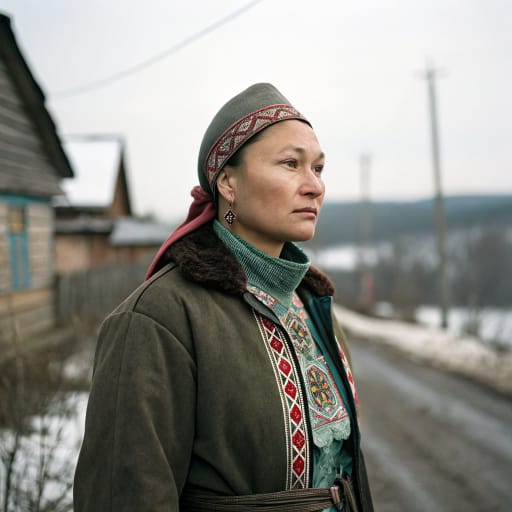
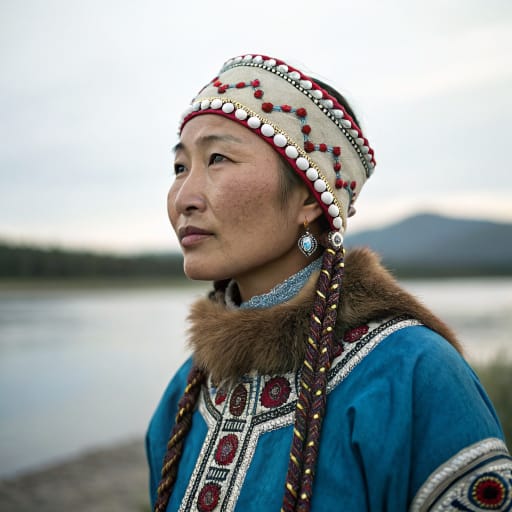

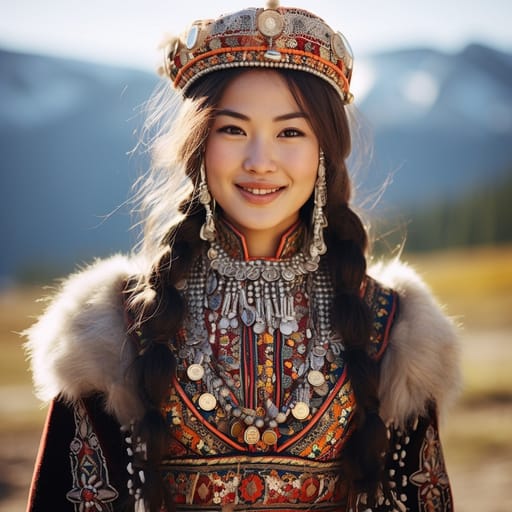
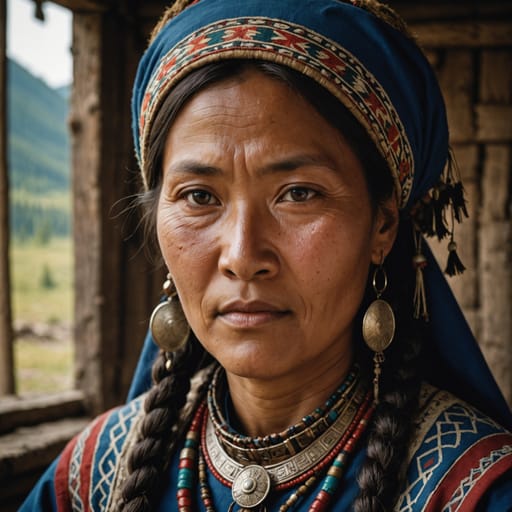
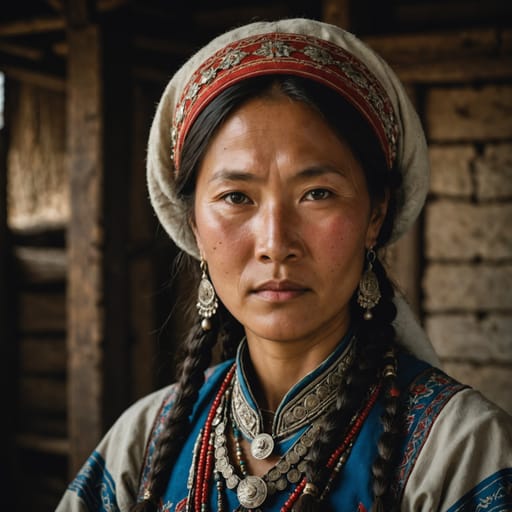
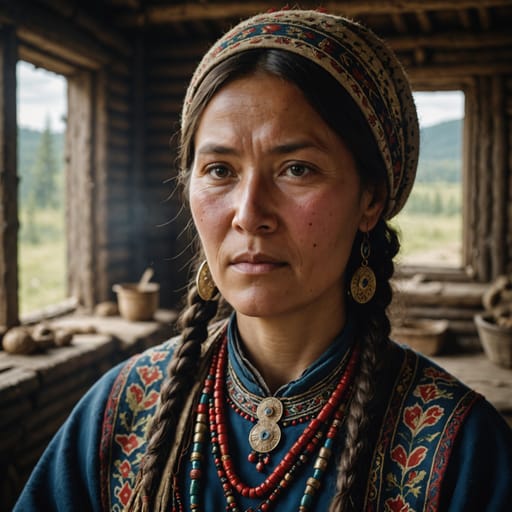
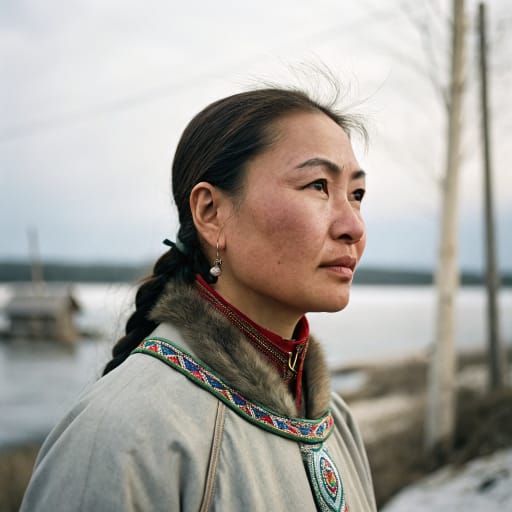
Typical Tofalar Phenotypes
Reference for AI generation: hair, eyes, skin, facial structure, build
Tofalar Body & Anatomy Reference
Anatomy by feature, Siberian Indigenous / Tungusic phenotype
Tofalar Boobs & Breasts
Bust reference for Tofalar women: small-to-medium cup, modest projection, which is typical of Siberian Indigenous / Tungusic ancestry. Areolas measure about 26-38mm across, with medium-brown pigmentation. Body type (mesomorph, broader stocky frame adapted to cold climate) shapes the bust as well, so Tofalar tits are usually firm, modest projection. In AI imagery, keep the forward-set shape rather than drifting toward the fuller Central Asian or East Asian bust.
Tofalar Ass & Hips
The Tofalar ass is typically small-to-medium, modest projection, which sets it apart from the broader Central Asian hip profile. Underneath, the pelvis shows narrow-to-medium iliac crests, part of the Siberian Indigenous / Tungusic skeletal pattern. For Tofalar butt pics and AI renders, match that silhouette and the overall build (mesomorph, broader stocky frame adapted to cold climate).
Tofalar Vagina & Pussy
Tofalar pussy and vulvar anatomy presents medium-brown labial pigmentation, consistent with the Siberian Indigenous / Tungusic phenotype's pigmentation pattern. Tofalar pubic hair is typically straight fine-to-medium texture, sparser distribution, in the inverted-triangle pattern. For anatomically accurate Tofalar pussy renders the labial coloration should match the surrounding light to medium skin tone with a continuous gradient, and the hair should keep its straight fine-to-medium texture.
Tofalar Dicks & Penis
Tofalar dicks follow the Siberian Indigenous / Tungusic reference data: regional mean ~12cm erect; moderate girth; medium-brown shaft pigmentation. Shaft color should track the light to medium skin tone with a smooth change toward the glans, and Tofalar pubic hair keeps its straight fine-to-medium texture.
Tofalar Body, Curves & Build
Tofalar body type and overall build presents as mesomorph, broader stocky frame adapted to cold climate, with mean adult female BMI 22-25: the characteristic Siberian Indigenous / Tungusic habitus. Tofalar curves and proportions should keep the regional skeletal frame (height, shoulder-to-hip ratio, limb proportions) rather than a generic mesomorph default.
Tofalar Skin Tone & Hair Texture
Tofalar skin sits in the light to medium (Fitzpatrick II-IV) band. Hair is typically straight 1A, dark-brown to black, in keeping with the Siberian Indigenous / Tungusic phenotype. In nude renders the skin should stay one even tone from face to body, and body, pubic and head hair should match.
Explore phenotype categories
Structured taxonomy with peer-reviewed scales · 22 anatomical categories
Erotic Poses & Sex Positions
From the pose catalog: 219 named positions with reference skeletons
Frequently asked questions about Tofalar people
Where is the Tofalar homeland?
The Tofalar homeland is Nizhneudinsky District, Irkutsk Oblast, Russia (Eastern Sayan) in Northern Asia.
What language do Tofalar people speak?
Tofalar people primarily speak Tofa / Tofalar (Turkic, Sayan).
What religion do Tofalar people practice?
The predominant religion among Tofalar people is Shamanism and animism, with Russian Orthodox Christianity.






Make your own Tofalar images
Five a day, free, no credits to buy. The studio starts from this group's phenotype data, so you can set body type, pose and style and keep the traits accurate.
Start with Tofalar