Help us get this right
Does this portrait look right for Tibetans?
One tap. It takes a second and it is recorded.
28 say it looks right, 7 say it looks off.
Tibetans Erotic
Also known as: Tibetan
Buddhism / Tibetan Buddhism
Amdolese (including Golok and Tebbu), Khams, Ü-Tsang (including Ngari and Walung), Changpa, Baima
About Tibetans People
Tibetans are a high-altitude people in the most literal sense: their genetic adaptations to thin air, distinct from those of Andean populations, let them live and work above 4,000 meters where lowlanders falter within hours. The plateau they call home sits at the headwaters of most of Asia's major rivers, and the cultural geography matches the physical one. Three broad regions divide the Tibetan world: Ü-Tsang in the center and west, the political and religious heartland around Lhasa and Shigatse; Kham in the east, whose people have a long-standing reputation for independence and martial bearing; and Amdo in the northeast, a more pastoral, more cosmopolitan frontier that produced both the current Dalai Lama and the reformer Tsongkhapa. Smaller branches sit at the edges: the Changpa nomads of the western highlands, the Baima of Sichuan whose status as Tibetan is itself contested, the Walung and Ngari traders of the western corridors.
The language belongs to the Tibetic branch of Sino-Tibetan and is striking for the gap between its conservative written form, codified in the seventh century, and its modern spoken varieties: Lhasa Tibetan, Khams, and Amdo are not always mutually intelligible, and a Khampa and an Amdowa often default to a written script their spoken tongues no longer match. The shared script is part of what holds the diaspora together.
Tibetan Buddhism is not one thing layered onto secular life but the structuring frame of it. Four major schools (Nyingma, Kagyu, Sakya, and Gelug) coexist with the older indigenous Bön tradition, which has absorbed and been absorbed by Buddhism over a thousand years of contact. Monasticism is unusually heavy: in pre-1950 Tibet roughly one in six men was a monk, and the institutions ran the schools, the law courts, and much of the economy. Sky burial, in which the body is offered to vultures on a charnel ground, follows from a worldview that treats the corpse as a useful donation rather than a relic to preserve.
The 1950 incorporation into the People's Republic of China and the 1959 flight of the fourteenth Dalai Lama to Dharamsala split the population in two: a homeland under tightening administrative control and a diaspora that has, paradoxically, made Tibetan Buddhism one of the most widely studied religious traditions of the past half-century. Both halves are still arguing over what counts as continuity.
Related ethnic groups
Groups that share Tibetans's homeland, region, language, or religious tradition. These are likely candidates for comparative phenotype reference.
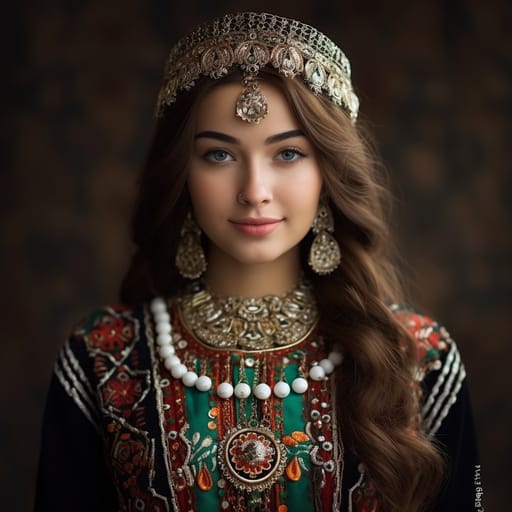
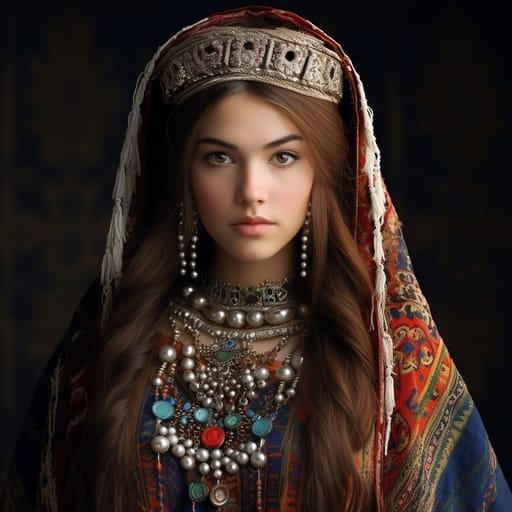
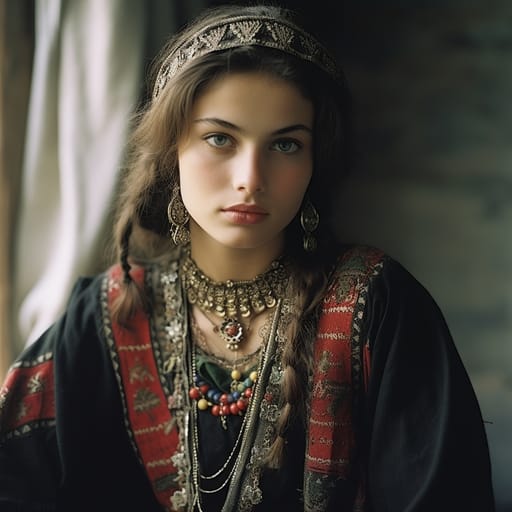
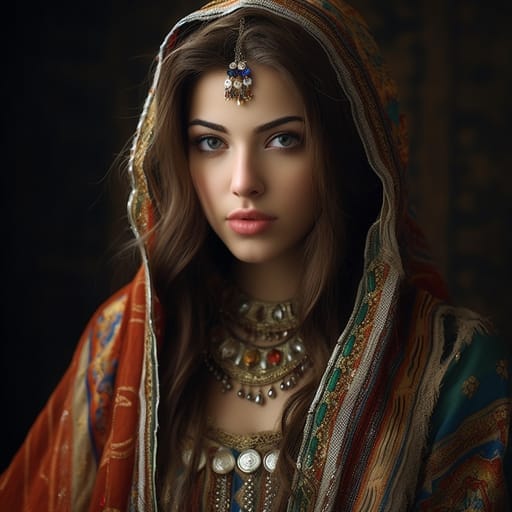
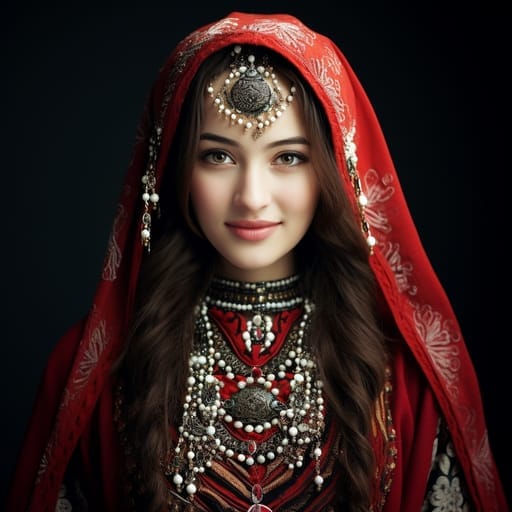
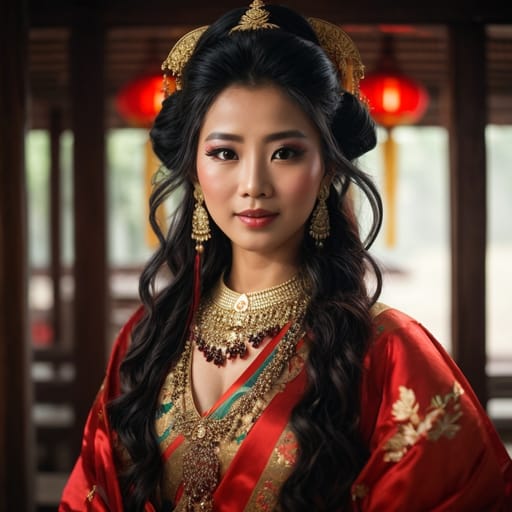
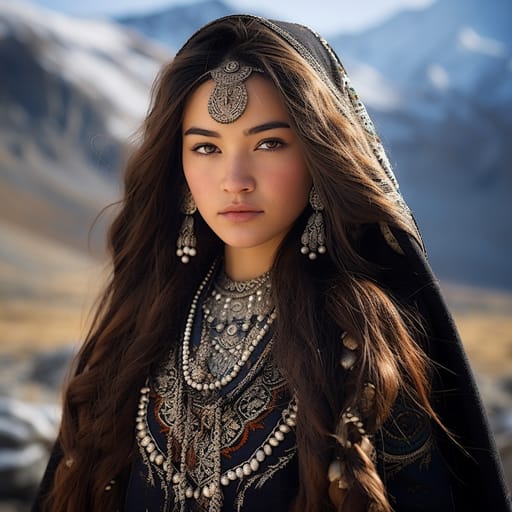
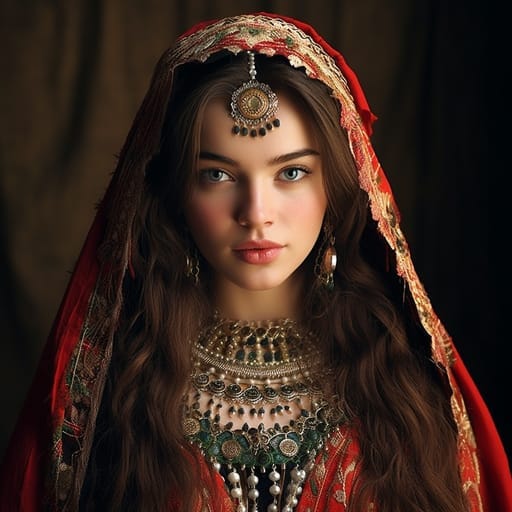
Typical Tibetans Phenotypes
Reference for AI generation: hair, eyes, skin, facial structure, build
Tibetans carry a phenotype shaped by roughly four millennia of selection at altitudes above 3,500 meters: the high-cheekboned, weather-set face that comes from living where the air holds 40% less oxygen and UV radiation is brutal year-round. Hair is uniformly black or near-black, coarse to medium in texture, and almost always straight or with a slight wave; graying tends to come late, and natural lightening from sun exposure gives many older Tibetans a reddish-brown cast at the ends. Eyes are dark brown to near-black, with the epicanthic fold present in the great majority but typically softer and less pronounced than in Han Chinese or Mongol populations; the eye opening reads as longer and more almond than narrow.
Skin sits in Fitzpatrick III-IV with warm coppery or olive undertones, and on nomads and farmers from the high plateau the cheeks carry the characteristic high-altitude flush, a permanent rose-to-burgundy patch over the zygomatic arch from chronic capillary dilation and sun. Faces tend toward broad, flat-planed structure: wide malar bones, a relatively low and broad nasal bridge with moderate alar width, full but not protruding lips, and a square-to-rounded jaw. Foreheads read as moderate, and the overall facial impression is open and horizontally weighted rather than elongated.
Build is compact and barrel-chested; Tibetans have measurably larger lung capacity and wider thoracic dimensions than lowland populations, an adaptation tied to the EPAS1 gene variant inherited from Denisovans. Stature is moderate, men averaging around 165-170 cm and women around 155 cm, with sturdy limbs and dense muscling on pastoralists. Sub-group variation is real: Khampas from the eastern highlands tend taller and more rugged-featured, Amdolese share more morphological overlap with neighboring Mongolic peoples, Ü-Tsang central Tibetans show the classic plateau phenotype, and Changpa nomads carry the most weathered, sun-burnished version of it.
Tibetans Body & Anatomy Reference
Per-feature anatomical profile for AI nude generation: Central Asian Turkic-Mongolic phenotype
Tibetans Boobs & Breasts
Tibetans tits and boobs run medium cup, moderate projection, the classic Central Asian Turkic-Mongolic bust profile. Tibetans nipples and areolas show medium-brown areolar pigmentation against the tan-to-light-brown skin tone, with areolar diameter typically in the 30-42mm range and forward-set positioning rather than the smaller East Asian bust. Tibetans breasts trend full and modestly projecting, a function of the mesomorph, broader frame than the East Asian norm body habitus and the mean adult female BMI 23-26. For anatomically accurate AI-generated Tibetans nudes the render preserves the medium cup, moderate projection shape, 30-42mm areolas with medium-brown pigmentation, and the torso proportions of the Central Asian Turkic-Mongolic phenotype.
Tibetans Ass & Hips
Tibetans hips and butt usually read as medium, moderate projection, broader hip profile than the East Asian norm. The skeletal base is medium iliac crests, moderate gluteal-femoral fat deposition, the Central Asian Turkic-Mongolic pattern. Set against the slim East Asian narrow-hip profile, the difference is easy to see, and the hip-to-waist ratio is often what identifies Tibetans women in photos.
Tibetans Vagina & Pussy
Expect medium-brown labial pigmentation on Tibetans women, in keeping with Central Asian Turkic-Mongolic ancestry. The pubic hair is straight-to-wavy medium-coarse texture. Coloring should run evenly from the tan to light-brown skin of the thighs to the labia, and Tibetans nude imagery should keep the hair's straight-to-wavy medium-coarse texture.
Tibetans Dicks & Penis
Tibetans dick and penile anatomy in adult AI generation should anchor on the regional reference data: regional mean ~13cm erect, moderate girth, and medium-brown shaft pigmentation. The Tibetans cock profile reflects the Central Asian Turkic-Mongolic population's anthropometric measurements. The shaft pigmentation should track the surrounding tan to light-brown skin tone, and the pubic hair should keep its straight-to-wavy medium-coarse texture in the typical inverted-V escutcheon.
Tibetans Body, Curves & Build
Tibetans body type: mesomorph, broader frame than the East Asian norm, with mean adult female BMI 23-26. This is the typical Central Asian Turkic-Mongolic build. Height range, shoulder-to-hip ratio and fat distribution all follow from it, which is what an accurate Tibetans nude body should show.
Tibetans Skin Tone & Hair Texture
Tibetans skin tone falls in the tan to light-brown (Fitzpatrick III-IV) band, the surface signal most often miscalibrated by generic AI nude generators. Tibetans hair texture is typically straight 1A-1B, dark-brown to black, characteristic of the Central Asian Turkic-Mongolic phenotype. In Tibetans nude renders the skin should hold that band consistently across the body.
Data depth
0/100Coverage of image-grounded phenotype observations · drives AI generation diversity
- Sample size
- 0/40· 0 images
- Image quality
- 0/30· 0% high
- Confidence
- 0/20
- Source diversity
- 0/10
- ·No image observations yet
Explore phenotype categories
Structured taxonomy with peer-reviewed scales · 22 anatomical categories
Erotic Poses & Sex Positions
From the pose catalog: 219 named positions with reference skeletons
Frequently asked questions about Tibetans people
Where is the Tibetans homeland?
The Tibetans homeland is Tibet (China), Nepal, Bhutan in Central Asia.
What language do Tibetans people speak?
Tibetans people primarily speak Sino-Tibetan / Tibetic.
What religion do Tibetans people practice?
The predominant religion among Tibetans people is Buddhism / Tibetan Buddhism.
What does a typical Tibetans woman look like?
Tibetan women typically have black or near-black hair that is straight or slightly wavy, dark brown eyes with a soft epicanthic fold, and skin in the Fitzpatrick III to IV range with warm coppery or olive undertones. Faces tend to be broad, with wide cheekbones, a low, broad nasal bridge and full lips. Builds are compact and sturdy, and women average around 155 cm tall.
What are other names for Tibetans people?
Tibetans people are also known as Tibetan.






Make your own Tibetans images
Five a day, free, no credits to buy. The studio starts from this group's phenotype data, so you can set body type, pose and style and keep the traits accurate.
Start with Tibetans