No portrait yet
Sawi Erotic
Lowland river and swamp forest of southern New Guinea, in Indonesia's South Papua province
Sawi, also written Sawuy (Papuan; Trans-New Guinea, grouped with the Awyu-Dumut languages); Indonesian as a second language
Largely Christian, following Protestant mission work that began in 1962; formerly a traditional ancestral and spirit religion
Organized by village and clan rather than named branches; related by language to the Awyu and Dumut peoples of the southern New Guinea lowlands
About Sawi People
The Sawi are a river and swamp people of southern New Guinea. There are a few thousand of them, held together by a shared Papuan language and a network of villages in the waterlogged lowland forest of the island's south. Outside their own country they are known almost entirely through one book. In 1962 the Canadian missionary Don Richardson and his wife Carol settled among them, and his 1974 account, Peace Child, made the Sawi a fixture of mission reading around the world. That fame is a mixed inheritance, since much of what outsiders believe about them comes filtered through one man's story, and he wrote it with a purpose.
Their homeland lies in what is now Indonesia's South Papua province, a country of slow brown rivers, sago palm groves and forest that floods in the wet season. Travel has long been by dugout canoe. Sago starch is the daily staple. It is filled out with fish, wild pig and the fat grubs that grow inside felled sago trunks, a prized food at feasts. Houses traditionally stood on tall poles, and some were built high in the trees. That was a defensive habit from the years when villages raided each other as a matter of course. The Sawi language is Papuan rather than Austronesian, and it is usually grouped with the Awyu and Dumut languages of neighboring lowland peoples. Indonesian is the language of school and government.
Richardson described a society where headhunting and cannibalism were still practiced and where treachery carried real prestige: befriending a man before killing him was admired as the height of cunning. The counterweight was the tarop tim, the peace child. To end a feud, a father handed an infant son over to the enemy village, and everyone there who laid hands on the child accepted the peace. The peace held for as long as the child lived. Richardson built his preaching on that custom, and most Sawi became Christians in the decades that followed.
Read the book, but keep its angle in mind. Mission stories tend to make the time before conversion look darker so the time after looks brighter, and the Sawi did not stop being themselves when they joined a church. Today they live in villages linked by river traffic, schools and churches. They still process sago and fish the channels, and they face the same outside development and in-migration felt across Indonesian Papua.
Related ethnic groups
Groups that share Sawi's homeland, region, language, or religious tradition. These are likely candidates for comparative phenotype reference.
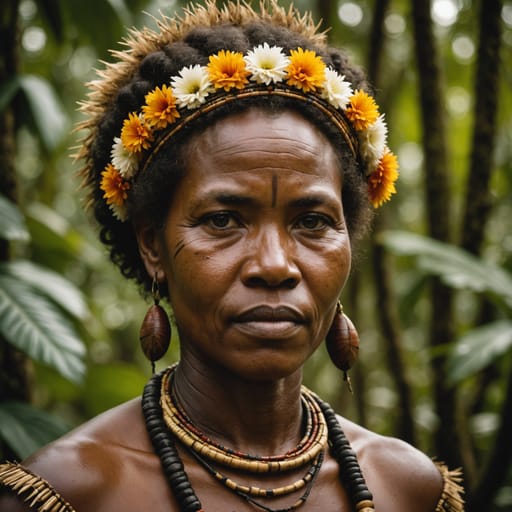
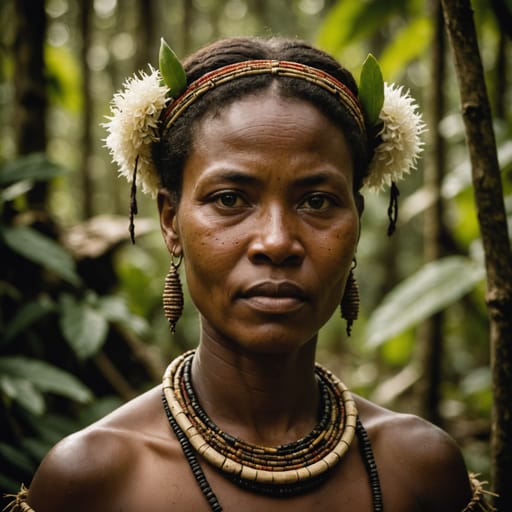
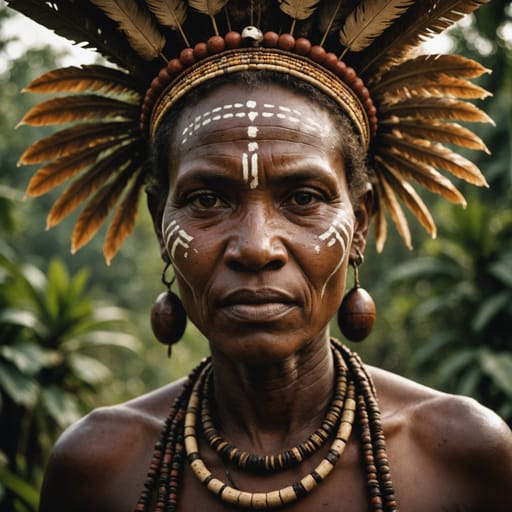
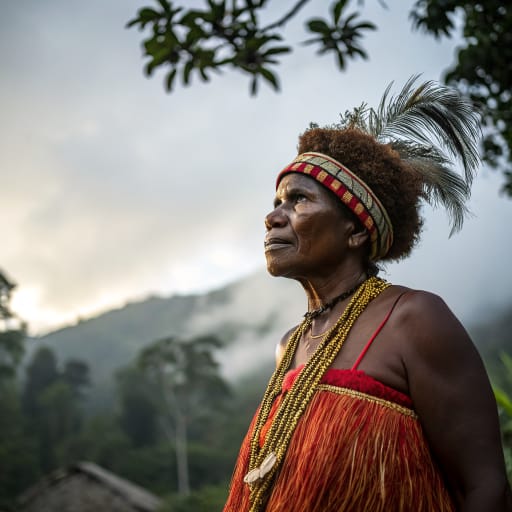
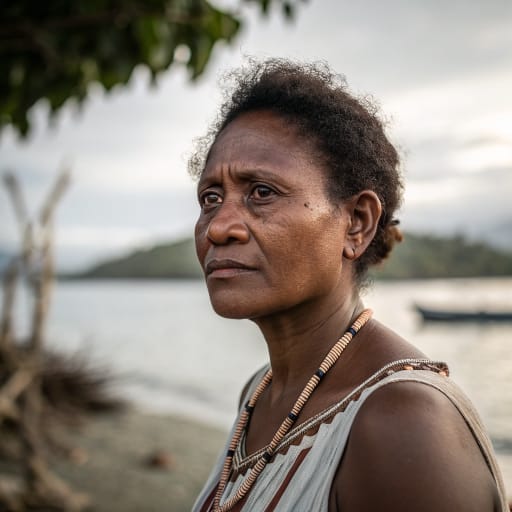
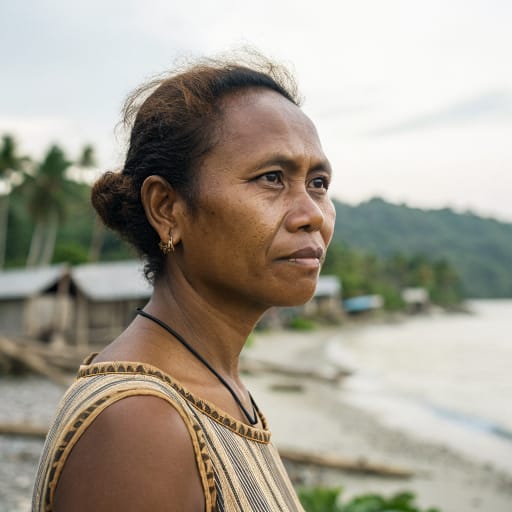
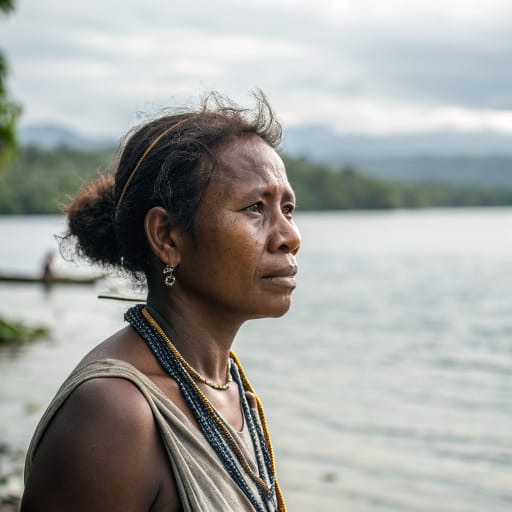
Typical Sawi Phenotypes
Reference for AI generation: hair, eyes, skin, facial structure, build
Sawi Body & Anatomy Reference
Per-feature anatomical profile for AI nude generation: Melanesian / Papuan phenotype
Sawi Boobs & Breasts
Sawi boobs follow the Melanesian / Papuan profile: medium-to-large cup, full, moderate projection. Areolar diameter is usually 32-46mm, and the coloring is deep-brown to near-black areolar pigmentation against the deep-brown skin tone. Breast shape tracks body composition (mesomorph, mean adult female BMI 25-28), so Sawi breasts tend to be full, moderate projection. Expect a forward-set shape, not the smaller Aboriginal Australian bust.
Sawi Ass & Hips
Sawi ass and hip morphology presents as medium-to-full, moderate-to-high projection, distinctly different from the slim Aboriginal Australian narrow-hip profile. The Sawi pelvic profile shows medium-to-wide iliac crests, full gluteal-femoral fat deposition, anchored in the Melanesian / Papuan skeletal pattern. Sawi butt shots in adult AI imagery should render the medium-to-full, moderate-to-high projection silhouette with the overall build (mesomorph) and the fat distribution typical of the Melanesian / Papuan phenotype.
Sawi Vagina & Pussy
Sawi pussy anatomy typically shows deep-brown labial pigmentation. Pubic hair is usually tightly-coiled coarse texture, dense distribution. In AI-generated Sawi nudes, labial color should blend into the deep-brown skin with a gradual transition, and the hair should keep its tightly-coiled coarse texture.
Sawi Dicks & Penis
Penis reference for Sawi men: regional mean ~13cm erect, moderate-to-above-average girth. Coloring: deep-brown shaft pigmentation. An accurate Sawi cock in AI imagery matches the surrounding deep-brown skin rather than a generic porn default. Circumcision depends on religion and custom, not ancestry.
Sawi Body, Curves & Build
The Sawi figure is generally mesomorph, with mean adult female BMI 25-28, characteristic of Melanesian / Papuan ancestry. AI image tools tend to flatten regional body types into a few stock shapes; here the Sawi build is kept as its own reference.
Sawi Skin Tone & Hair Texture
Skin: deep-brown (Fitzpatrick V-VI); the distinctive blond-hair-on-dark-skin trait widely documented in Solomon Islands populations. Hair: tight 4A-4C coil; the blond-on-dark trait is a TYRP1 variant unique to Melanesia. Both are typical of Melanesian / Papuan ancestry. The most common mistake in AI nudes of Sawi women is a body rendered lighter than the face.
Explore phenotype categories
Structured taxonomy with peer-reviewed scales · 22 anatomical categories
Erotic Poses & Sex Positions
From the pose catalog: 219 named positions with reference skeletons
Frequently asked questions about Sawi people
Where is the Sawi homeland?
The Sawi homeland is Lowland river and swamp forest of southern New Guinea, in Indonesia's South Papua province in Melanesia.
What language do Sawi people speak?
Sawi people primarily speak Sawi, also written Sawuy (Papuan; Trans-New Guinea, grouped with the Awyu-Dumut languages); Indonesian as a second language.
What religion do Sawi people practice?
The predominant religion among Sawi people is Largely Christian, following Protestant mission work that began in 1962; formerly a traditional ancestral and spirit religion.






Make your own Sawi images
Five a day, free, no credits to buy. The studio starts from this group's phenotype data, so you can set body type, pose and style and keep the traits accurate.
Start with Sawi