Help us get this right
Does this portrait look right for Angu?
Nobody has judged this one yet. You would be the first.
Angu Erotic
Rugged interior mountains where Morobe, Eastern Highlands and Gulf provinces meet, around Menyamya and Aseki, Papua New Guinea
About a dozen Angan languages, including Menya, Hamtai, Baruya, Simbari, Yagwoia and Ankave (Angan, usually classed within Trans-New Guinea)
Mostly Christian, with older beliefs about spirits and sorcery persisting
Angan-speaking peoples including the Menya, Hamtai (Kamea), Baruya, Simbari (Sambia), Yagwoia, Ankave and Akoye
About Angu People
The Angu, more often written Anga in the ethnographic literature, are the mountain peoples of the steep, cold, cloud-soaked ranges where Papua New Guinea's Morobe, Eastern Highlands and Gulf provinces meet. What binds them is not a single village or chiefdom. It is a shared family of languages, a common way of working hard country, and a long reputation among outsiders. Gold miners, coastal traders and colonial officers called them Kukukuku, a name that stayed in print for decades and that many Angu now regard as an insult.
The Angan family has roughly a dozen languages, among them Menya, Hamtai, Baruya, Simbari, Yagwoia and Ankave. Linguists usually place it inside the large Trans-New Guinea grouping, but it stands well apart from the Austronesian languages of the Markham Valley below and from the Highlands languages to the north. Political life was local, built around clans and kin groups rather than any chief over the whole. Communities were small and spread along ridges and river headwaters, living from sweet potato gardens, pigs, hunting and trade.
Their history with the outside world turned on gold. When prospectors pushed into the Wau and Bulolo fields in the 1920s and 1930s, clashes with Angu warriors became part of colonial lore. The Australian administration did not set up a lasting post at Menyamya until around 1950. Missions followed, and today most Angu are Christian, though older beliefs about spirits and sorcery have not gone away.
Several customs set the Angu apart. Around Aseki, the bodies of respected dead were once smoke-dried, coated in red ochre and set in cliffside shelters above the village, where some can still be seen. Among the Baruya, bars of salt made from the ash of a cultivated grass moved along trade routes and worked much like money. Across many Angu groups, boys went through long initiations in stages that took them away from their mothers and made them men. That system drew anthropologists such as Maurice Godelier and Gilbert Herdt into decades of fieldwork. The bark cape, worn against mountain rain and cold, is still the best-known piece of Angu dress.
Related ethnic groups
Groups that share Angu's homeland, region, language, or religious tradition. These are likely candidates for comparative phenotype reference.
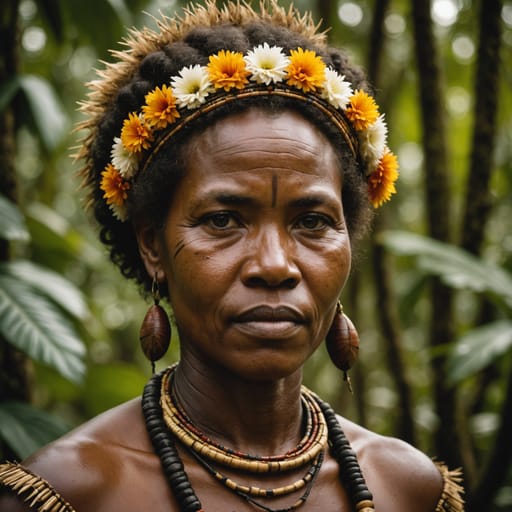
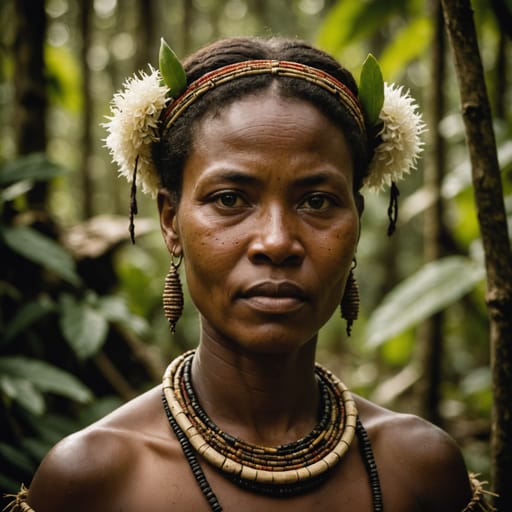
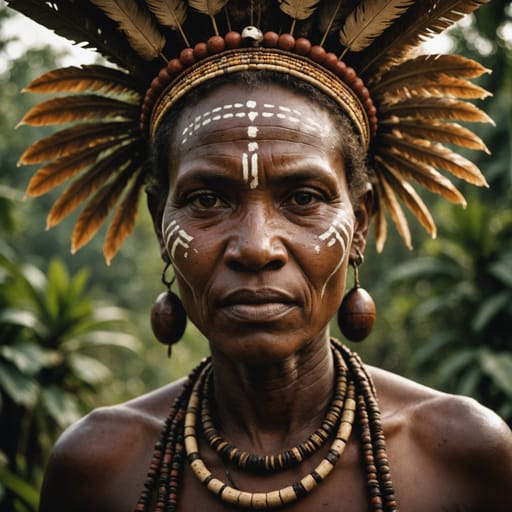
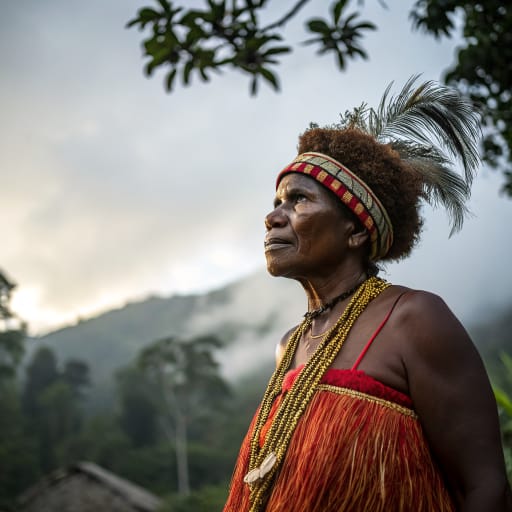
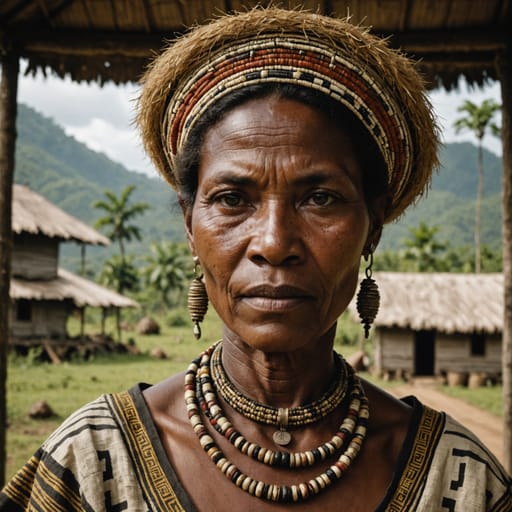
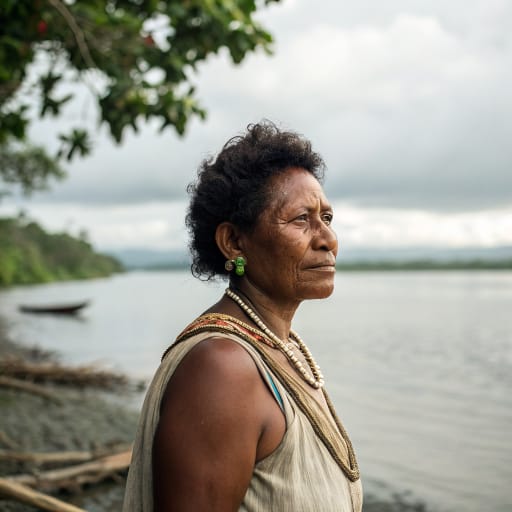
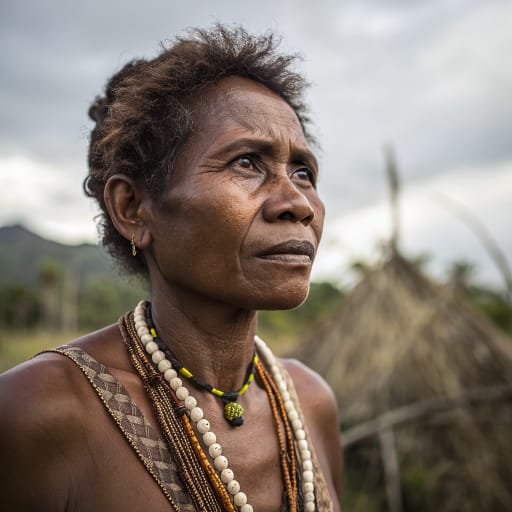
Typical Angu Phenotypes
Reference for AI generation: hair, eyes, skin, facial structure, build
Angu Body & Anatomy Reference
Melanesian / Papuan phenotype: anatomy reference for AI nude generation
Angu Boobs & Breasts
The typical Angu bust is medium-to-large cup, full, moderate projection, in line with the wider Melanesian / Papuan pattern. Areolas usually fall in the 32-46mm range, with deep-brown to near-black areolar pigmentation against the deep-brown skin tone. Compared with the smaller Aboriginal Australian bust, Angu breasts sit forward and are generally full, moderate projection. A faithful AI render of Angu tits keeps that shape and areola size.
Angu Ass & Hips
Butt shape among Angu women: medium-to-full, moderate-to-high projection, over medium-to-wide iliac crests, full gluteal-femoral fat deposition. This follows Melanesian / Papuan ancestry and looks quite unlike the slim Aboriginal Australian narrow-hip profile. An accurate Angu ass in adult AI imagery keeps both the silhouette and the overall build (mesomorph) instead of a generic average.
Angu Vagina & Pussy
Vulvar anatomy among Angu women: deep-brown labial pigmentation. Pubic hair tends to be tightly-coiled coarse texture, dense distribution, in the usual inverted-triangle pattern. Both follow Melanesian / Papuan pigmentation, which is why Angu pussy renders should not fall back on a pale, sparse Western template.
Angu Dicks & Penis
The Angu cock profile, from Melanesian / Papuan anthropometric data: regional mean ~13cm erect; moderate-to-above-average girth; deep-brown shaft pigmentation. Pubic hair has a tightly-coiled coarse texture and forms the usual inverted-V pattern. Whether Angu men are circumcised follows religious and cultural practice rather than phenotype.
Angu Body, Curves & Build
Build and curves among Angu women follow the Melanesian / Papuan pattern: mesomorph, mean adult female BMI 25-28. Proportions matter as much as skin tone, so Angu figures should keep their regional height and limb ratios.
Angu Skin Tone & Hair Texture
The Angu skin range is deep-brown (Fitzpatrick V-VI); the distinctive blond-hair-on-dark-skin trait widely documented in Solomon Islands populations, and hair tends to be tight 4A-4C coil; the blond-on-dark trait is a TYRP1 variant unique to Melanesia. That combination marks the Melanesian / Papuan phenotype, and skin tone is the trait AI generators most often get wrong for Angu women.
Explore phenotype categories
Structured taxonomy with peer-reviewed scales · 22 anatomical categories
Erotic Poses & Sex Positions
From the pose catalog: 219 named positions with reference skeletons
Frequently asked questions about Angu people
Where is the Angu homeland?
The Angu homeland is Rugged interior mountains where Morobe, Eastern Highlands and Gulf provinces meet, around Menyamya and Aseki, Papua New Guinea in Melanesia.
What language do Angu people speak?
Angu people primarily speak About a dozen Angan languages, including Menya, Hamtai, Baruya, Simbari, Yagwoia and Ankave (Angan, usually classed within Trans-New Guinea).
What religion do Angu people practice?
The predominant religion among Angu people is Mostly Christian, with older beliefs about spirits and sorcery persisting.






Make your own Angu images
Five a day, free, no credits to buy. The studio starts from this group's phenotype data, so you can set body type, pose and style and keep the traits accurate.
Start with Angu