Help us get this right
Does this portrait look right for Bauzi?
Nobody has judged this one yet. You would be the first.
Bauzi Erotic
Middle Mamberamo river basin, Mamberamo Raya Regency, Papua, Indonesia
Bauzi (Papuan, East Geelvink Bay family), with Indonesian as a second language
Predominantly Christian, mostly evangelical Protestant, alongside persisting belief in place spirits
East Geelvink Bay language family; one of the Papuan peoples of the Mamberamo basin
About Bauzi People
The Bauzi are a people of the swamp forest, and that is not a figure of speech. Their country is the middle Mamberamo basin in Indonesian Papua, flat land that the river reworks every wet season: a lattice of black channels, oxbows and standing water under a canopy that closes over the water. Villages are small and strung along tributaries, and the whole population is counted in the low thousands. Sago sits at the center of the food economy. A palm is felled, the pith rasped out and washed, and the starch that settles will feed a household for weeks. Around that go fishing, hunting for wild pig and cassowary, small gardens, and the habit of moving: a family may spend long stretches at a forest camp near a good stand of sago and treat the village as the place it returns to rather than the place it stays.
They are identifiable first by language. Bauzi is Papuan, part of the small East Geelvink Bay family, unrelated to the Austronesian languages of the Papuan coasts and unrelated to Indonesian, which arrives with school, clinic and market. Missionary linguists worked on it for years and produced a dictionary and a translation of the New Testament, which for a language this size is a substantial event: it fixed a spelling, made literacy possible in the mother tongue, and came bundled with steel tools, cloth, medicine and an airstrip. Contact was late here. The Mamberamo gorge, the malaria and the mud kept colonial administration to the edges well into the twentieth century, and for many Bauzi the first sustained outside presence arrived by light aircraft rather than overland.
Most Bauzi today identify as Christian and church is a fixture of village life, though older understanding of spirits attached to particular places, and the caution that goes with it, has not simply been replaced. The larger pressure now comes from the map. Their forest lies inside one of the largest protected areas in the region, the Mamberamo Foja reserve, drawn by people who do not live in it, and the same basin has been eyed for logging, mining and a hydroelectric dam for decades. The Bauzi did not ask to be either a wilderness or a resource, and they are still working out, on their own terms, what to do about the traffic that keeps arriving.
Related ethnic groups
Groups that share Bauzi's homeland, region, language, or religious tradition. These are likely candidates for comparative phenotype reference.
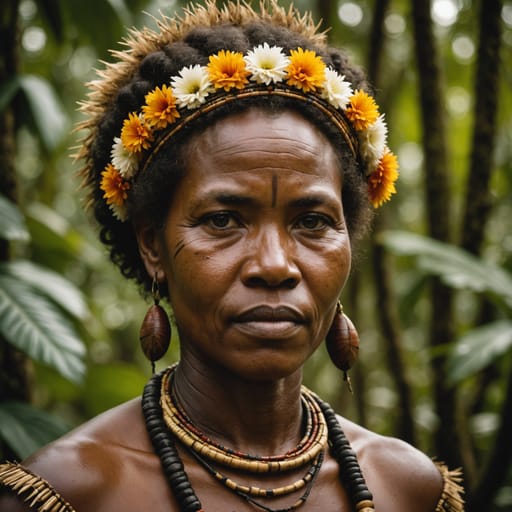
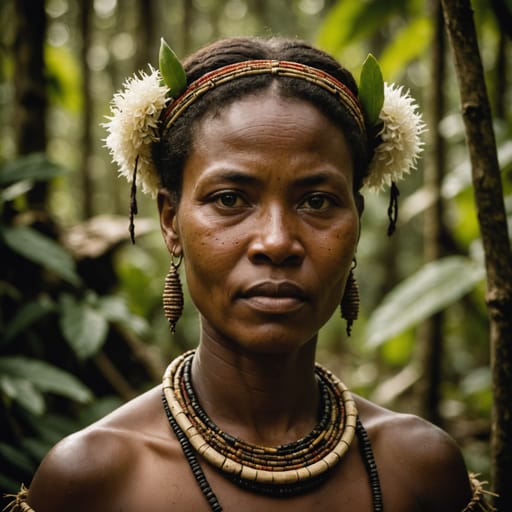
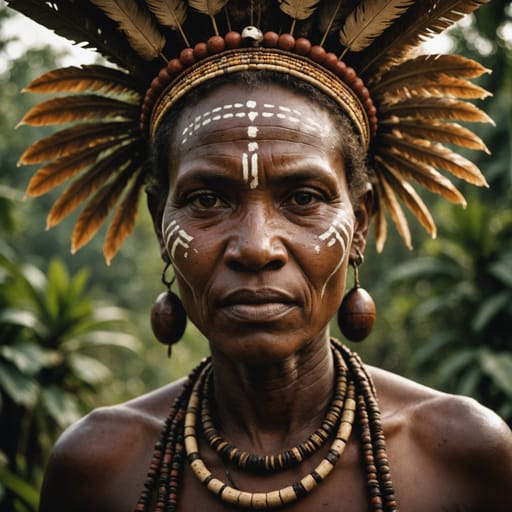
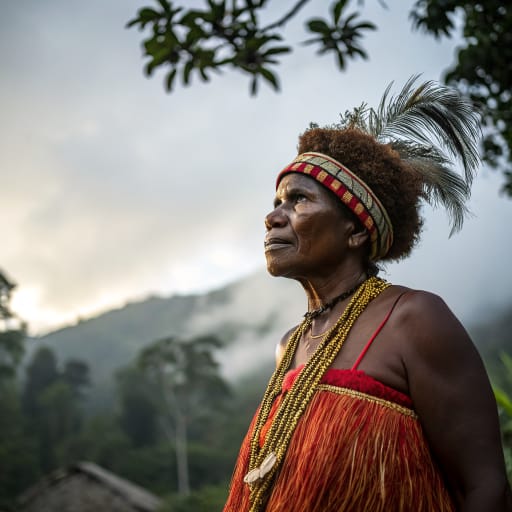
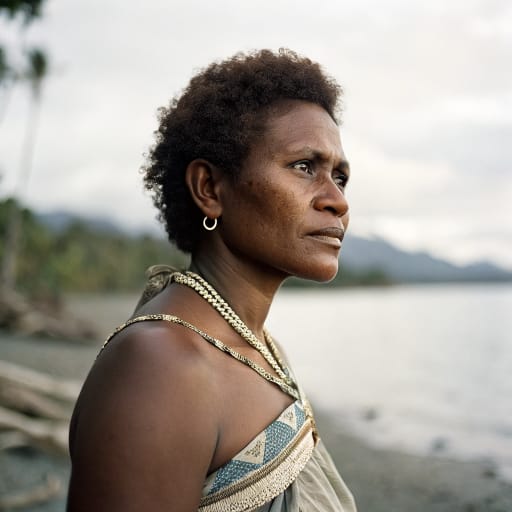
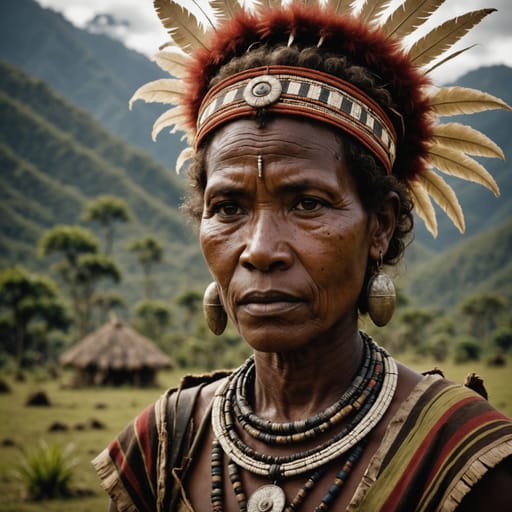
Typical Bauzi Phenotypes
Reference for AI generation: hair, eyes, skin, facial structure, build
Bauzi Body & Anatomy Reference
Anatomy by feature, Melanesian / Papuan phenotype
Bauzi Boobs & Breasts
The typical Bauzi bust is medium-to-large cup, full, moderate projection, in line with the wider Melanesian / Papuan pattern. Areolas usually fall in the 32-46mm range, with deep-brown to near-black areolar pigmentation against the deep-brown skin tone. Compared with the smaller Aboriginal Australian bust, Bauzi breasts sit forward and are generally full, moderate projection. A faithful AI render of Bauzi tits keeps that shape and areola size.
Bauzi Ass & Hips
Butt shape among Bauzi women: medium-to-full, moderate-to-high projection, over medium-to-wide iliac crests, full gluteal-femoral fat deposition. This follows Melanesian / Papuan ancestry and looks quite unlike the slim Aboriginal Australian narrow-hip profile. An accurate Bauzi ass in adult AI imagery keeps both the silhouette and the overall build (mesomorph) instead of a generic average.
Bauzi Vagina & Pussy
Vulvar anatomy among Bauzi women: deep-brown labial pigmentation. Pubic hair tends to be tightly-coiled coarse texture, dense distribution, in the usual inverted-triangle pattern. Both follow Melanesian / Papuan pigmentation, which is why Bauzi pussy renders should not fall back on a pale, sparse Western template.
Bauzi Dicks & Penis
The Bauzi cock profile, from Melanesian / Papuan anthropometric data: regional mean ~13cm erect; moderate-to-above-average girth; deep-brown shaft pigmentation. Pubic hair has a tightly-coiled coarse texture and forms the usual inverted-V pattern. Whether Bauzi men are circumcised follows religious and cultural practice rather than phenotype.
Bauzi Body, Curves & Build
Build and curves among Bauzi women follow the Melanesian / Papuan pattern: mesomorph, mean adult female BMI 25-28. Proportions matter as much as skin tone, so Bauzi figures should keep their regional height and limb ratios.
Bauzi Skin Tone & Hair Texture
The Bauzi skin range is deep-brown (Fitzpatrick V-VI); the distinctive blond-hair-on-dark-skin trait widely documented in Solomon Islands populations, and hair tends to be tight 4A-4C coil; the blond-on-dark trait is a TYRP1 variant unique to Melanesia. That combination marks the Melanesian / Papuan phenotype, and skin tone is the trait AI generators most often get wrong for Bauzi women.
Explore phenotype categories
Structured taxonomy with peer-reviewed scales · 22 anatomical categories
Erotic Poses & Sex Positions
From the pose catalog: 219 named positions with reference skeletons
Frequently asked questions about Bauzi people
Where is the Bauzi homeland?
The Bauzi homeland is Middle Mamberamo river basin, Mamberamo Raya Regency, Papua, Indonesia in Melanesia.
What language do Bauzi people speak?
Bauzi people primarily speak Bauzi (Papuan, East Geelvink Bay family), with Indonesian as a second language.
What religion do Bauzi people practice?
The predominant religion among Bauzi people is Predominantly Christian, mostly evangelical Protestant, alongside persisting belief in place spirits.






Make your own Bauzi images
Five a day, free, no credits to buy. The studio starts from this group's phenotype data, so you can set body type, pose and style and keep the traits accurate.
Start with Bauzi