Help us get this right
Does this portrait look right for Amungme?
Nobody has judged this one yet. You would be the first.
Amungme Erotic
Highland valleys of the Sudirman Range south of Puncak Jaya, and the adjoining lowlands around Timika, in Central Papua, Indonesia.
Amungkal, also called Amung or Damal (Papuan, usually placed in the Trans-New Guinea family, though its position is disputed); Indonesian is widely spoken as a second language.
Predominantly Christian, mainly Protestant with Catholic communities, alongside surviving ancestral beliefs centered on the mountains.
Paired closely with the Damal (Uhunduni) of the northern slopes; organized internally by valley communities such as Tsinga, Waa and Aroanop; part of the wider Papuan population of the New Guinea highlands.
About Amungme People
The Amungme call themselves the real people, and they say it from the flanks of the highest mountains between the Himalayas and the Andes. Their country is vertical: valleys falling south from Puncak Jaya, gardens stacked at different altitudes, families moving between them through the year. Sweet potato and taro at one level, pandanus and hunting higher up, pigs walking along with the household. The settlements most often named, Tsinga, Waa and Aroanop, sit high enough that it frosts at night, and the distance between them is measured in days on foot rather than in kilometers.
Their language, Amungkal, pairs with Damal, spoken by close relatives on the northern side of the range, and it sits awkwardly inside the Trans-New Guinea family; linguists have argued for decades about where exactly to file it. Nothing nearby sounds like it. The Moni are to the west, Dani-speaking peoples to the east, and far below, in the mangrove and swamp of the south coast, the Kamoro, with whom the Amungme have traded highland goods for lowland ones for as long as there is any record of it.
Protestant missions arrived in the middle of the twentieth century, and most Amungme are Christian now, largely Protestant with Catholic communities alongside; the church carries much of the ordinary business of village life. The older understanding of the land did not disappear underneath it. The highlands are read as the head of a mother whose body runs down to the sea, and Nemangkawi, the peak outsiders call Puncak Jaya, is not scenery. That belief ran directly into geology. A Dutch expedition in 1936 recorded an exposed body of ore in these mountains, Forbes Wilson reached it again in 1960, and a contract signed with Jakarta in 1967, two years before Papua's disputed vote on its own future, opened what became one of the largest gold and copper operations on earth.
Everything after that is the central fact of modern Amungme life: people moved off highland ground, mine tailings pushed into the Ajkwa river system, an agreement in 1974 that Amungme leaders have described ever since as something signed under pressure, documented killings by Indonesian security forces around the mine in the mid-1990s, and a long fight for redress that built its own institutions. The tribal council LEMASA was founded in 1994. Yosepha Alomang took the case abroad and won the Goldman Environmental Prize in 2001. None of it is settled, and it shapes both how the Amungme are seen and how they talk about themselves.
Related ethnic groups
Groups that share Amungme's homeland, region, language, or religious tradition. These are likely candidates for comparative phenotype reference.
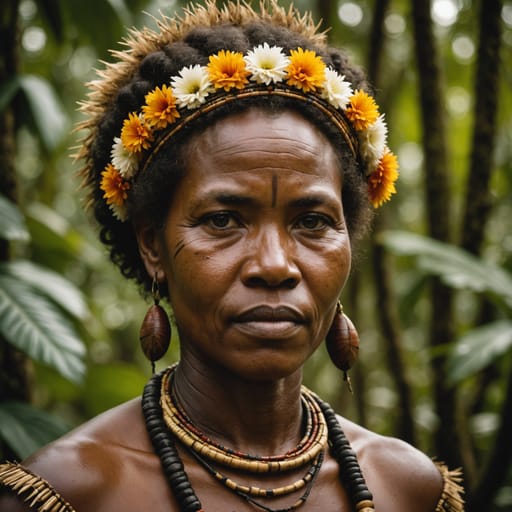
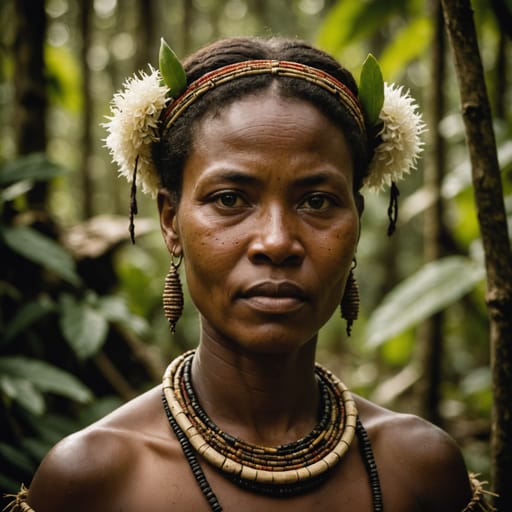
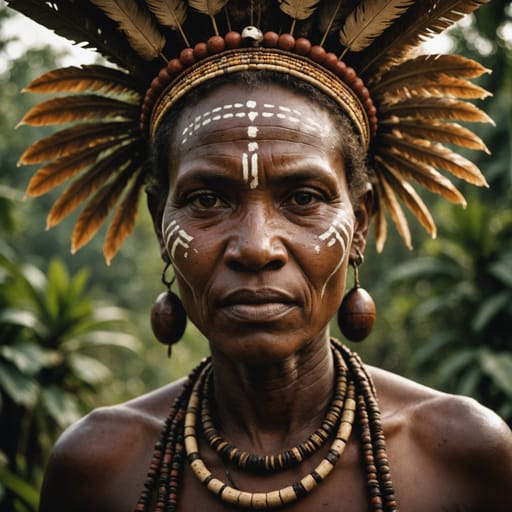
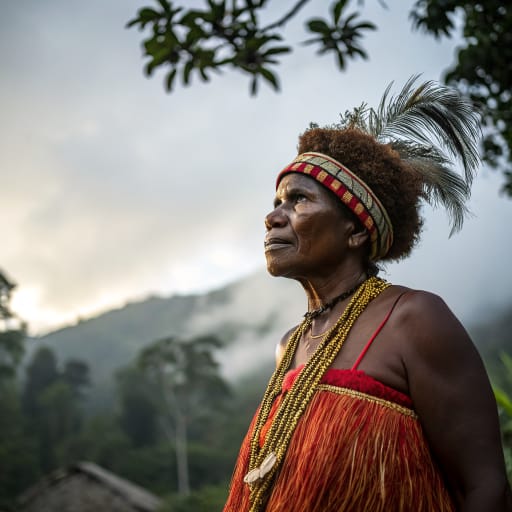
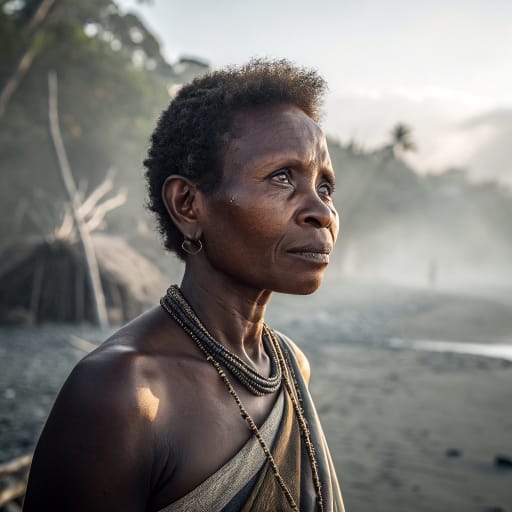
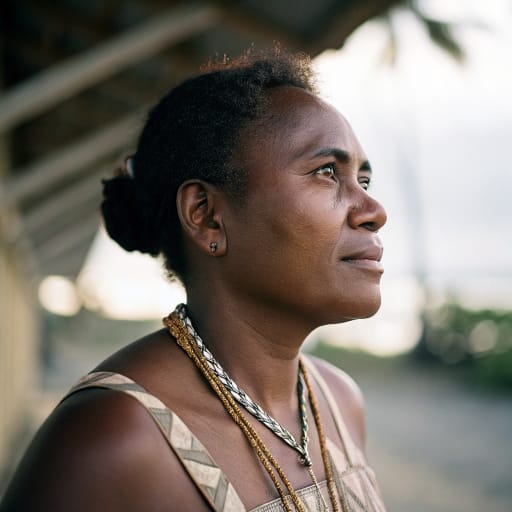
Typical Amungme Phenotypes
Reference for AI generation: hair, eyes, skin, facial structure, build
Amungme Body & Anatomy Reference
Melanesian / Papuan phenotype: anatomy reference for AI nude generation
Amungme Boobs & Breasts
Amungme tits and boobs run medium-to-large cup, full, moderate projection, the classic Melanesian / Papuan bust profile. Amungme nipples and areolas show deep-brown to near-black areolar pigmentation against the deep-brown skin tone, with areolar diameter typically in the 32-46mm range and forward-set positioning rather than the smaller Aboriginal Australian bust. Amungme breasts trend full, moderate projection, a function of the mesomorph body habitus and the mean adult female BMI 25-28. For anatomically accurate AI-generated Amungme nudes the render preserves the medium-to-large cup, full, moderate projection shape, 32-46mm areolas with deep-brown to near-black pigmentation, and the torso proportions of the Melanesian / Papuan phenotype.
Amungme Ass & Hips
Amungme hips and butt usually read as medium-to-full, moderate-to-high projection. The skeletal base is medium-to-wide iliac crests, full gluteal-femoral fat deposition, the Melanesian / Papuan pattern. Set against the slim Aboriginal Australian narrow-hip profile, the difference is easy to see, and the hip-to-waist ratio is often what identifies Amungme women in photos.
Amungme Vagina & Pussy
Expect deep-brown labial pigmentation on Amungme women, in keeping with Melanesian / Papuan ancestry. The pubic hair is tightly-coiled coarse texture, dense distribution. Coloring should run evenly from the deep-brown skin of the thighs to the labia, and Amungme nude imagery should keep the hair's tightly-coiled coarse texture.
Amungme Dicks & Penis
Amungme dick and penile anatomy in adult AI generation should anchor on the regional reference data: regional mean ~13cm erect, moderate-to-above-average girth, and deep-brown shaft pigmentation. The Amungme cock profile reflects the Melanesian / Papuan population's anthropometric measurements. The shaft pigmentation should track the surrounding deep-brown skin tone, and the pubic hair should keep its tightly-coiled coarse texture in the typical inverted-V escutcheon.
Amungme Body, Curves & Build
Amungme body type: mesomorph, with mean adult female BMI 25-28. This is the typical Melanesian / Papuan build. Height range, shoulder-to-hip ratio and fat distribution all follow from it, which is what an accurate Amungme nude body should show.
Amungme Skin Tone & Hair Texture
Amungme skin tone falls in the deep-brown (Fitzpatrick V-VI); the distinctive blond-hair-on-dark-skin trait widely documented in Solomon Islands populations band, the surface signal most often miscalibrated by generic AI nude generators. Amungme hair texture is typically tight 4A-4C coil; the blond-on-dark trait is a TYRP1 variant unique to Melanesia, characteristic of the Melanesian / Papuan phenotype. In Amungme nude renders the skin should hold that band consistently across the body.
Explore phenotype categories
Structured taxonomy with peer-reviewed scales · 22 anatomical categories
Erotic Poses & Sex Positions
From the pose catalog: 219 named positions with reference skeletons
Frequently asked questions about Amungme people
Where is the Amungme homeland?
The Amungme homeland is Highland valleys of the Sudirman Range south of Puncak Jaya, and the adjoining lowlands around Timika, in Central Papua, Indonesia. in Melanesia.
What language do Amungme people speak?
Amungme people primarily speak Amungkal, also called Amung or Damal (Papuan, usually placed in the Trans-New Guinea family, though its position is disputed); Indonesian is widely spoken as a second language..
What religion do Amungme people practice?
The predominant religion among Amungme people is Predominantly Christian, mainly Protestant with Catholic communities, alongside surviving ancestral beliefs centered on the mountains..






Make your own Amungme images
Five a day, free, no credits to buy. The studio starts from this group's phenotype data, so you can set body type, pose and style and keep the traits accurate.
Start with Amungme