No portrait yet
Orokaiva Erotic
Inland lowlands and foothills of Oro (formerly Northern) Province, Papua New Guinea, around Popondetta, Kokoda, the Kumusi River and Mount Lamington
Orokaiva, with several local dialects (Binanderean, Trans-New Guinea); Tok Pisin and English also widely used
Predominantly Anglican Christian, with lingering traditional beliefs about ancestral spirits and garden ritual
Numerous local tribes and dialect groups; part of the wider Binanderean-speaking family of Oro Province that includes the Binandere, Hunjara, Aeka and Korafe
About Orokaiva People
The Orokaiva are the people of the inland lowlands of Oro Province in Papua New Guinea. It is hot country cut by rivers, lying between the Owen Stanley Range and the Solomon Sea, where Popondetta sits and the Kokoda Track comes down out of the mountains. The name is largely a colonial-era umbrella over a cluster of related tribes and clans who thought of themselves first by hamlet and local group, and it has since become a name people use for themselves. Their language, also called Orokaiva, belongs to the Binanderean branch of the Trans-New Guinea family and is close kin to Binandere, Hunjara and Aeka. Its dialects shift from one valley to the next, while English and Tok Pisin are used in school and town. Village life turns on taro. It is the food that counts and the crop that carries prestige, and together with pigs it is the stuff of feasts and of the exchanges that tie families and villages together. Initiation once took girls and boys alike into seclusion before bringing them out at a feast in feathers and painted barkcloth. Anglican missionaries reached this coast around 1900, and the Anglican church is now the dominant faith, built into village routines and local leadership. Older ideas about the continuing presence of the dead have not gone away.
Their modern history has been unusually rough. Gold miners and patrol officers pushed inland in the 1890s, and there was violence on both sides. In the 1910s and 1920s a possession movement that outsiders called the Taro Cult spread from village to village, with rites for the gardens and communal feasting. F. E. Williams, the government anthropologist of Papua, documented it, and his books on the Orokaiva remain the starting point for anyone who wants to go deeper. In 1942 the Kokoda campaign and the battles at Buna and Gona were fought across their land, and many men worked as carriers for the armies, often under compulsion. Then, in January 1951, Mount Lamington erupted. Few had recognized it as a volcano. The eruption killed nearly three thousand people, most of them Orokaiva from the villages on its slopes, and wiped out the government station at Higaturu. Survivors were resettled and the administration moved to Popondetta. Since then smallholder oil palm and cocoa have spread through the district, grown alongside the taro gardens rather than in place of them.
Related ethnic groups
Groups that share Orokaiva's homeland, region, language, or religious tradition. These are likely candidates for comparative phenotype reference.
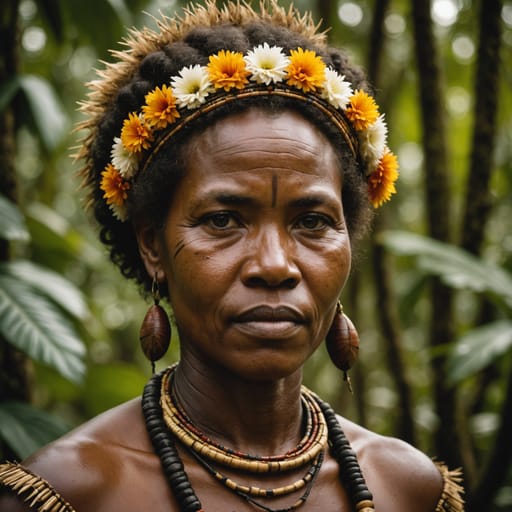
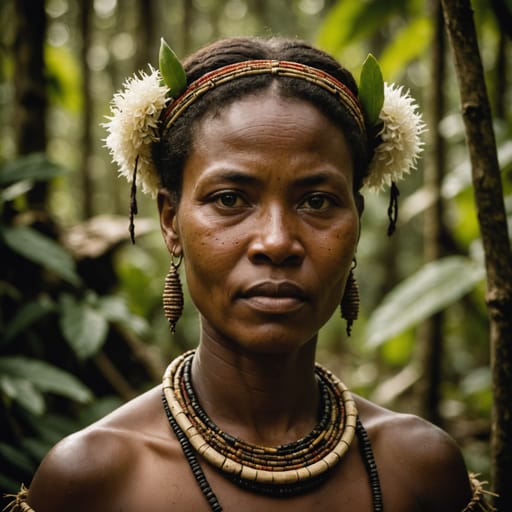
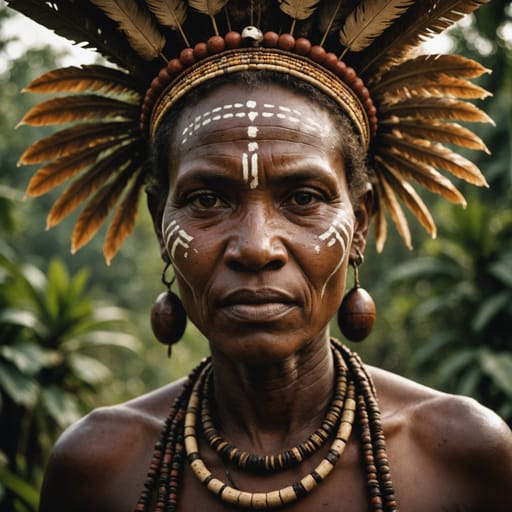
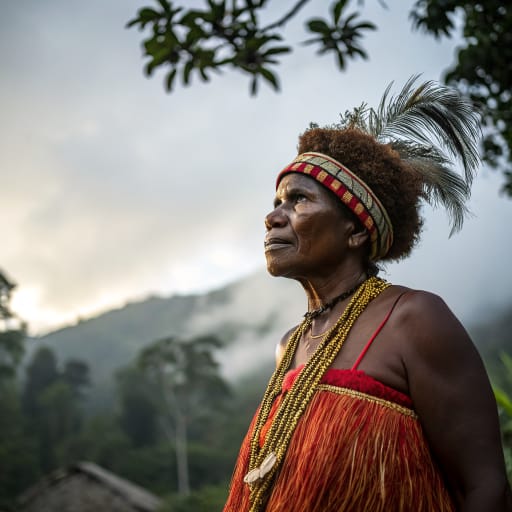
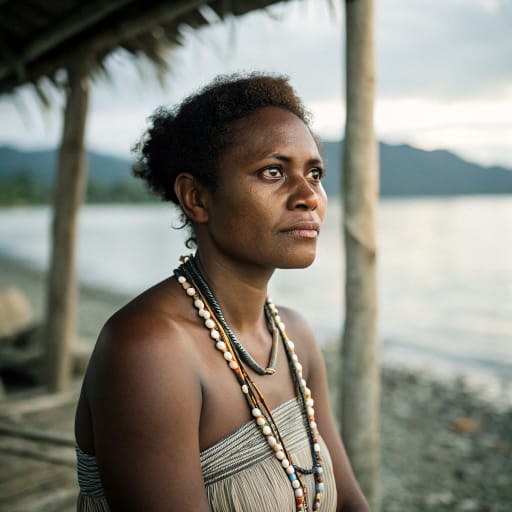
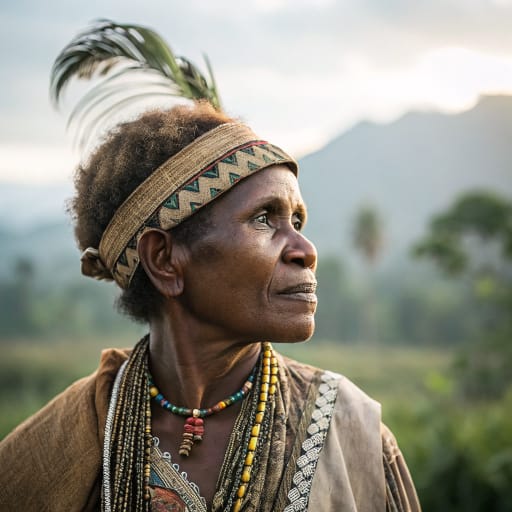
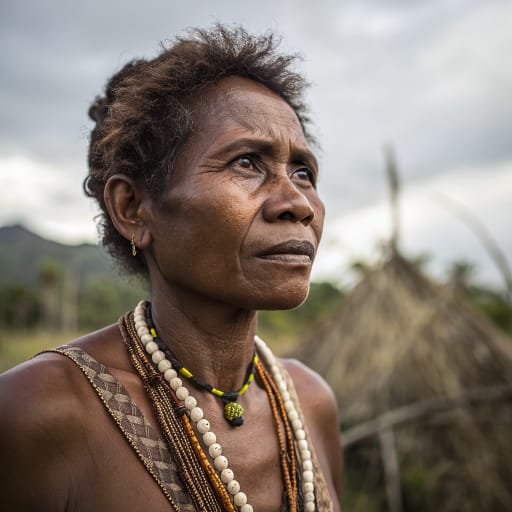
Typical Orokaiva Phenotypes
Reference for AI generation: hair, eyes, skin, facial structure, build
Orokaiva Body & Anatomy Reference
Anatomy by feature, Melanesian / Papuan phenotype
Orokaiva Boobs & Breasts
Orokaiva boobs follow the Melanesian / Papuan profile: medium-to-large cup, full, moderate projection. Areolar diameter is usually 32-46mm, and the coloring is deep-brown to near-black areolar pigmentation against the deep-brown skin tone. Breast shape tracks body composition (mesomorph, mean adult female BMI 25-28), so Orokaiva breasts tend to be full, moderate projection. Expect a forward-set shape, not the smaller Aboriginal Australian bust.
Orokaiva Ass & Hips
Orokaiva ass and hip morphology presents as medium-to-full, moderate-to-high projection, distinctly different from the slim Aboriginal Australian narrow-hip profile. The Orokaiva pelvic profile shows medium-to-wide iliac crests, full gluteal-femoral fat deposition, anchored in the Melanesian / Papuan skeletal pattern. Orokaiva butt shots in adult AI imagery should render the medium-to-full, moderate-to-high projection silhouette with the overall build (mesomorph) and the fat distribution typical of the Melanesian / Papuan phenotype.
Orokaiva Vagina & Pussy
Orokaiva pussy anatomy typically shows deep-brown labial pigmentation. Pubic hair is usually tightly-coiled coarse texture, dense distribution. In AI-generated Orokaiva nudes, labial color should blend into the deep-brown skin with a gradual transition, and the hair should keep its tightly-coiled coarse texture.
Orokaiva Dicks & Penis
Penis reference for Orokaiva men: regional mean ~13cm erect, moderate-to-above-average girth. Coloring: deep-brown shaft pigmentation. An accurate Orokaiva cock in AI imagery matches the surrounding deep-brown skin rather than a generic porn default. Circumcision depends on religion and custom, not ancestry.
Orokaiva Body, Curves & Build
The Orokaiva figure is generally mesomorph, with mean adult female BMI 25-28, characteristic of Melanesian / Papuan ancestry. AI image tools tend to flatten regional body types into a few stock shapes; here the Orokaiva build is kept as its own reference.
Orokaiva Skin Tone & Hair Texture
Skin: deep-brown (Fitzpatrick V-VI); the distinctive blond-hair-on-dark-skin trait widely documented in Solomon Islands populations. Hair: tight 4A-4C coil; the blond-on-dark trait is a TYRP1 variant unique to Melanesia. Both are typical of Melanesian / Papuan ancestry. The most common mistake in AI nudes of Orokaiva women is a body rendered lighter than the face.
Explore phenotype categories
Structured taxonomy with peer-reviewed scales · 22 anatomical categories
Erotic Poses & Sex Positions
From the pose catalog: 219 named positions with reference skeletons
Frequently asked questions about Orokaiva people
Where is the Orokaiva homeland?
The Orokaiva homeland is Inland lowlands and foothills of Oro (formerly Northern) Province, Papua New Guinea, around Popondetta, Kokoda, the Kumusi River and Mount Lamington in Melanesia.
What language do Orokaiva people speak?
Orokaiva people primarily speak Orokaiva, with several local dialects (Binanderean, Trans-New Guinea); Tok Pisin and English also widely used.
What religion do Orokaiva people practice?
The predominant religion among Orokaiva people is Predominantly Anglican Christian, with lingering traditional beliefs about ancestral spirits and garden ritual.






Make your own Orokaiva images
Five a day, free, no credits to buy. The studio starts from this group's phenotype data, so you can set body type, pose and style and keep the traits accurate.
Start with Orokaiva