Help us get this right
Does this portrait look right for Santal?
One tap. It takes a second and it is recorded.
0 say it looks right, 1 says it looks off.
Santal Erotic
India (West Bengal, Jharkhand, Odisha)
Christianity / Catholicism
About Santal People
The Santal are one of the largest of India's adivasi peoples — the indigenous communities who were already in the subcontinent before successive waves of Indo-Aryan and Dravidian migration, and who never fully merged into the caste system that organized those later societies. Their territory is the eastern lip of the Chota Nagpur plateau, a band of forested upland and red-soil farmland that runs across what is now Jharkhand, the western districts of West Bengal, and northern Odisha. Most Santal villages still sit at the edge of cultivated land and what remains of the sal forests, an arrangement that shapes almost everything: the agricultural calendar, the hunting rituals, the architecture of the long single-row hamlet with its swept earthen courtyards.
Santali belongs to the Munda branch of the Austroasiatic family, which makes it a deep linguistic outlier in its own neighborhood — its closest relatives are not the Bengali or Odia spoken on every side, but languages found across Southeast Asia. The Santals fought hard to keep it written. The Ol Chiki script, designed in the 1920s by Pandit Raghunath Murmu specifically for Santali rather than borrowed from Devanagari or Bengali, is now the official script and a quiet point of pride; Santali is one of the scheduled languages of the Indian constitution.
The religious picture is genuinely layered. A significant Santal population is Christian — the result of intensive Lutheran and Catholic missionary work in the 19th and early 20th centuries, which left behind churches, schools, and a sizeable literate intelligentsia. But the older religion, Sarna, has not gone away. It centers on Marang Buru, the great mountain spirit, on a pantheon of bongas tied to particular places, and on the sacred grove at the edge of the village where no tree may be cut. Many Santals, including some who attend mass, still observe the seasonal festivals — Sohrai after the rice harvest, Baha when the sal trees flower in spring — and the dances that go with them, performed in long lines to the double-headed tamak drum.
The defining historical event in Santal memory is the Hul of 1855, a mass uprising against landlords, moneylenders, and the East India Company led by the brothers Sidhu and Kanhu Murmu. It was crushed within a year, but it forced the colonial administration to carve out protected tribal areas, and it remains the reference point for Santal political identity today.
Related ethnic groups
Groups that share Santal's homeland, region, language, or religious tradition. These are likely candidates for comparative phenotype reference.
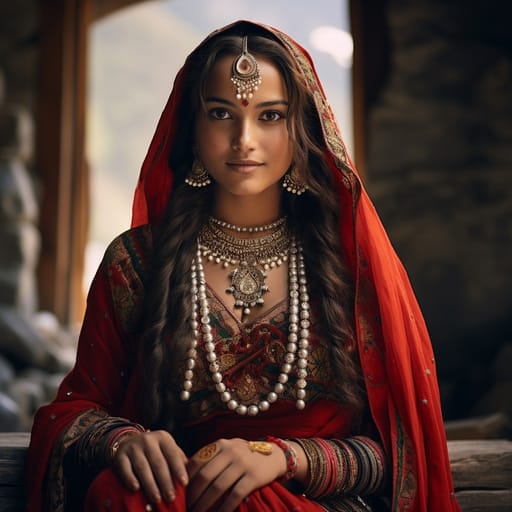
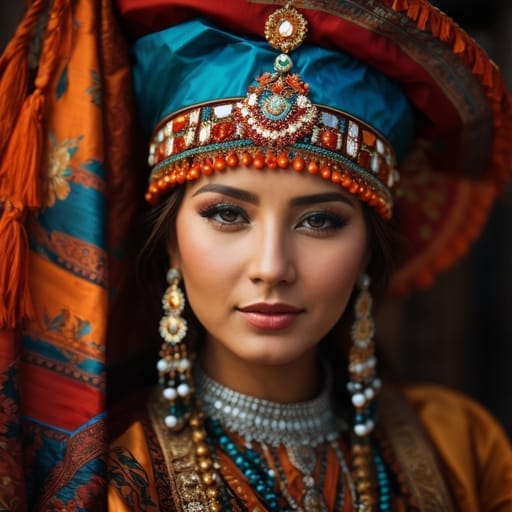
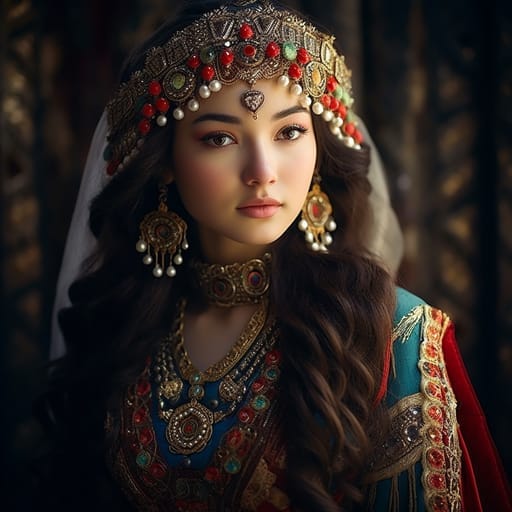
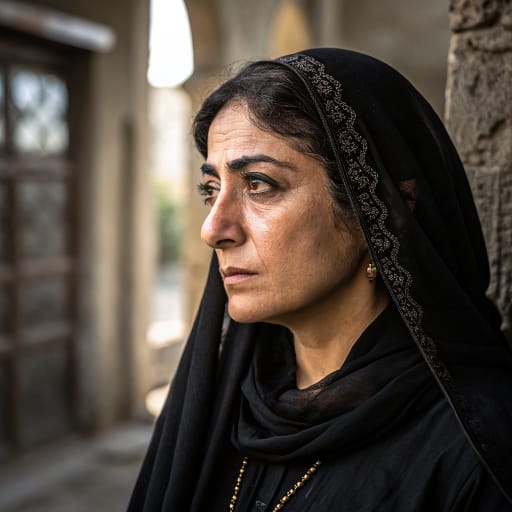
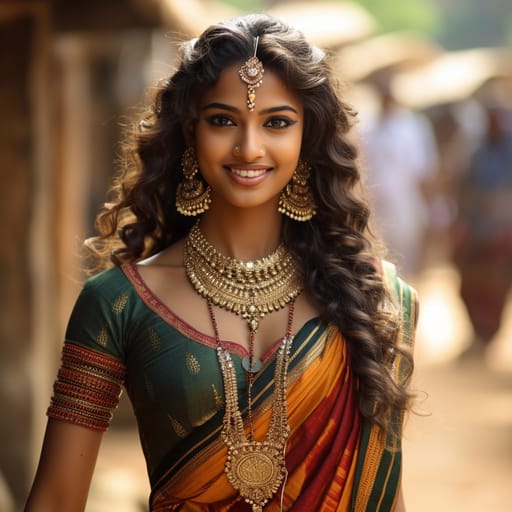
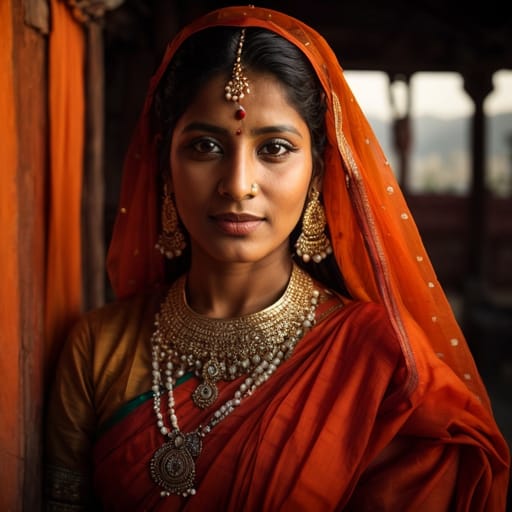
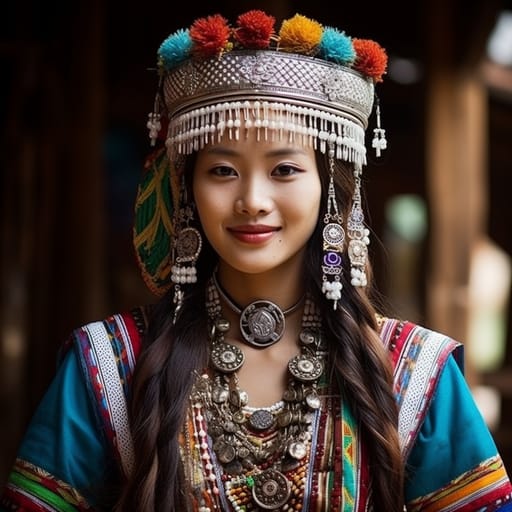
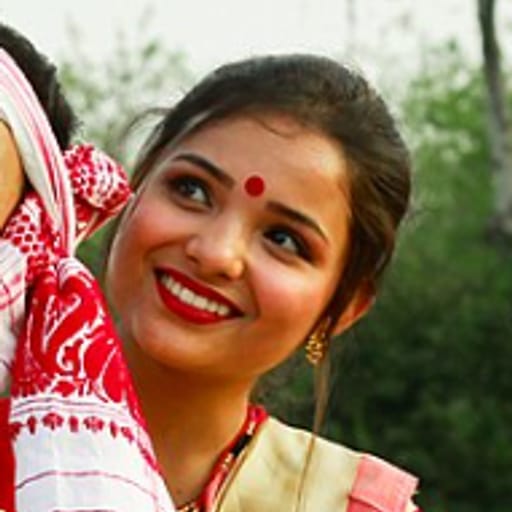
Typical Santal Phenotypes
Reference for AI generation: hair, eyes, skin, facial structure, build
The Santal are an Austroasiatic-speaking Adivasi population of the Chota Nagpur plateau, and their phenotype sits distinct from the surrounding Indo-Aryan and Dravidian populations of eastern India. The most consistent feature is skin tone in the Fitzpatrick V to VI range — deep brown to very dark brown, often with a warm reddish or coppery undertone rather than the olive cast common in upper-caste Bengali or Odia neighbors. Sun exposure from agricultural and forest work tends to deepen this further on the face, forearms, and lower legs, leaving a noticeable contrast on covered skin.
Hair is uniformly black, straight to gently wavy, with a fine-to-medium texture; tight curls are rare. Greying tends to come late. Eye color is dark brown to near-black, almond-shaped, with a slight epicanthic fold present in a meaningful minority — a low-level Austroasiatic signature that distinguishes Santal faces from purely South Asian profiles. Brows are typically straight and medium-thick.
Facial structure is where the group reads most distinctively: broad, relatively flat midfaces, prominent malar (cheekbone) projection, and a nose that is short with a low-to-medium bridge and moderately wide alae — broader than in Indo-Aryan populations, narrower than in many West African ones. Lips are medium-full, often with a well-defined vermilion border. Jaws are squared rather than tapered, giving the face a strong rectangular frame, well illustrated by President Droupadi Murmu.
Build runs short to medium — adult men typically 160–168 cm, women 150–158 cm — with compact, wiry musculature and low body fat in rural populations; stockier, rounder builds appear with urban diet. Shoulders are proportionally broad relative to height, and hips on women tend to be modest. Phenotype is fairly homogeneous across the West Bengal, Jharkhand, and Odisha homelands; the clearest variation is gradient rather than branch-based, with slightly more pronounced epicanthic folds and flatter midfaces toward the eastern and northern edges of Santal territory.
Santal Body & Anatomy Reference
Indo-Aryan / Dravidian South Asian phenotype: anatomy reference for AI nude generation
Santal Boobs & Breasts
The typical Santal bust is medium-to-large cup, moderate-to-full projection, in line with the wider Indo-Aryan / Dravidian South Asian pattern. Areolas usually fall in the 32-46mm range, with medium-brown to dark-brown areolar pigmentation against the wheatish-to-brown skin tone. Compared with the smaller East Asian bust profile, Santal breasts sit forward and are generally full and soft, generally fuller than the East Asian norm. A faithful AI render of Santal tits keeps that shape and areola size.
Santal Ass & Hips
Butt shape among Santal women: medium-to-full, moderate-to-high projection, classic curvy hip profile, over medium-to-wide iliac crests, full gluteal-femoral fat distribution. This follows Indo-Aryan / Dravidian South Asian ancestry and looks quite unlike the slim hip profile of East Asian women. An accurate Santal ass in adult AI imagery keeps both the silhouette and the overall build (endomorph-to-mesomorph with fuller hip deposition) instead of a generic average.
Santal Vagina & Pussy
Vulvar anatomy among Santal women: medium-brown to dark-brown labial pigmentation, fuller labia minora projection. Pubic hair tends to be straight-to-wavy coarse texture, dense distribution, in the usual inverted-triangle pattern. Both follow Indo-Aryan / Dravidian South Asian pigmentation, which is why Santal pussy renders should not fall back on a pale, sparse Western template.
Santal Dicks & Penis
The Santal cock profile, from Indo-Aryan / Dravidian South Asian anthropometric data: regional mean ~13cm erect; moderate girth; medium-brown shaft pigmentation. Pubic hair has a straight-to-wavy coarse texture and forms the usual inverted-V pattern. Whether Santal men are circumcised follows religious and cultural practice rather than phenotype.
Santal Body, Curves & Build
Build and curves among Santal women follow the Indo-Aryan / Dravidian South Asian pattern: endomorph-to-mesomorph with fuller hip deposition, mean adult female BMI 22-25. Proportions matter as much as skin tone, so Santal figures should keep their regional height and limb ratios.
Santal Skin Tone & Hair Texture
The Santal skin range is wheatish to brown (Fitzpatrick III-V), and hair tends to be straight-to-wavy 1A-2B, dense, dark-brown to black. That combination marks the Indo-Aryan / Dravidian South Asian phenotype, and skin tone is the trait AI generators most often get wrong for Santal women.
Data depth
63/100Coverage of image-grounded phenotype observations · drives AI generation diversity
- Sample size
- 23/40· 15 images
- Image quality
- 30/30· 60% high
- Confidence
- 10/20· mean 0.63
- Source diversity
- 0/10· wikipedia
- ·Modest sample (n<25)
- ·Wikipedia-only source, not population-representative
Observed Distribution: Image Sample
Empirical observations from analyzed photographs · supplementary signal, not population truth
Sample: 15 images analyzed (15 wikipedia). Quality: 9 high, 2 medium, 4 low, 0 very_low. Avg analyzer confidence: 0.63.
Skin tone (Fitzpatrick): V (87%), unclear (13%)
Hair color: gray/white (60%), black (27%), unclear (13%)
Hair texture: straight (53%), wavy (20%), coily (7%), covered (7%), unclear (13%)
Eye color: dark brown (73%), unclear (27%)
Epicanthic fold: 0% present, 73% absent, 27% unclear
Caveats: Sample size 15 is modest, so secondary patterns may not be reliable. Sample is 100% Wikipedia notable people, which skews toward male, public-life, and modern figures, not population-representative.
Last aggregated: May 7, 2026
Explore phenotype categories
Structured taxonomy with peer-reviewed scales · 22 anatomical categories
Notable Santal People
20 reference figures, sourced from Wikipedia
- G. C. Murmu, 14th CAG of India and first lieutenant governor of Jammu and Kashmir
- Rathin Kisku, Baul singer.
- Sidhu and Kanhu Murmu, leader of Santhal rebellion.
- Sarada Prasad Kisku, writer from Purulia
- Raghunath Murmu, inventor of Ol Chiki script. He is also known as Olguru.
- Sadhu Ramchand Murmu, Santali poet, known as Kabiguru.
- Kherwal Soren, writer and politician
- Birbaha Hansda, Santali-language actress and politician, Forest Minister, Government of West …
- Mohan Charan Majhi, Chief Minister of Odisha
- Babulal Marandi, first chief minister of Jharkhand
- Droupadi Murmu, 15th president of India, former governor of Jharkhand, former minister, Gover…
- Khagen Murmu, an Indian politician and a Member of Parliament from Maldaha Uttar (Lok Sabha…
- Salkhan Murmu, Indian socio-political activist, former MP from Mayurbhanj[citation needed]
- Uma Saren, politician, former MP from Jhargram
- Hemant Soren, Chief Minister of Jharkhand
- Shibu Soren, former chief minister of Jharkhand and founder of Jharkhand Mukti Morcha. He …
- Naresh Chandra Murmu, chief scientist and director of Central Mechanical Engineering Research Insti…
- Purnima Hembram, track-and-field athlete
- Rafayel Tudu, football player
- Shanti Mardi, football player
Erotic Poses & Sex Positions
From the pose catalog: 219 named positions with reference skeletons
Frequently asked questions about Santal people
Where is the Santal homeland?
The Santal homeland is India (West Bengal, Jharkhand, Odisha) in Southern Asia.
What language do Santal people speak?
Santal people primarily speak Austroasiatic / Munda / Santali.
What religion do Santal people practice?
The predominant religion among Santal people is Christianity / Catholicism.






Make your own Santal images
Five a day, free, no credits to buy. The studio starts from this group's phenotype data, so you can set body type, pose and style and keep the traits accurate.
Start with Santal