Help us get this right
Does this portrait look right for Rarámuri (Tarahumara)?
One tap. It takes a second and it is recorded.
0 say it looks right, 1 says it looks off.
Rarámuri (Tarahumara) Erotic
Sierra Madre Occidental (Copper Canyon), Chihuahua, Mexico
Rarámuri / Tarahumara (Uto-Aztecan, Tarahumaran)
Traditional religion blended with Roman Catholicism
Tarahumara (exonym)
About Rarámuri (Tarahumara) People
Rarámuri, widely known as the Tarahumara, are an Indigenous people of the Sierra Madre Occidental in the state of Chihuahua, Mexico, including the deep gorges of the Copper Canyon country. They speak Rarámuri, a Uto-Aztecan language, and are one of the larger Indigenous groups of northern Mexico, numbering on the order of one hundred thousand. Their name is often translated as "those who run well" or "light-footed ones."
Society and subsistence
The Rarámuri farm maize, beans, and squash on canyon and highland plots and keep goats and cattle, moving seasonally between higher summer settlements and warmer canyon bottoms in winter, some living in caves and cliff shelters. They are famous worldwide for long-distance running: in the kickball race called rarajipari, teams of men kick a wooden ball over many kilometers of rugged terrain, sometimes running through a day and a night, while women race with a hoop and stick in the ariweta. Maize beer, tesgüino, is central to communal work parties and religious festivals. Their religious year blends Catholic feasts with older ceremonies such as the yúmari and matachine dances, and Holy Week is marked by distinctive processions through the sierra. The people have long kept a marked distance from outside society, retreating into the sierra to preserve their independence.
Appearance and adornment
Rarámuri men traditionally wear a white cotton loincloth (zapeta) held by a woven sash, with a loose full-sleeved shirt and a folded cloth headband (koyera) tied around the brow. Women wear layered, brightly colored full skirts and blouses, often several skirts at once, with a headscarf. Both wear huarache sandals soled with leather or salvaged tire rubber, well suited to running the sierra. Adornment is modest: beaded necklaces, woven sashes, and colorful cloth. The lean, enduring physique and the white loincloth and headband are enduring visual markers.
Related ethnic groups
Groups that share Rarámuri (Tarahumara)'s homeland, region, language, or religious tradition. These are likely candidates for comparative phenotype reference.
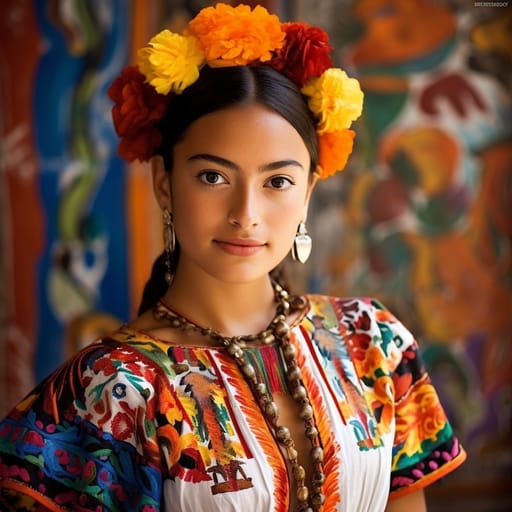
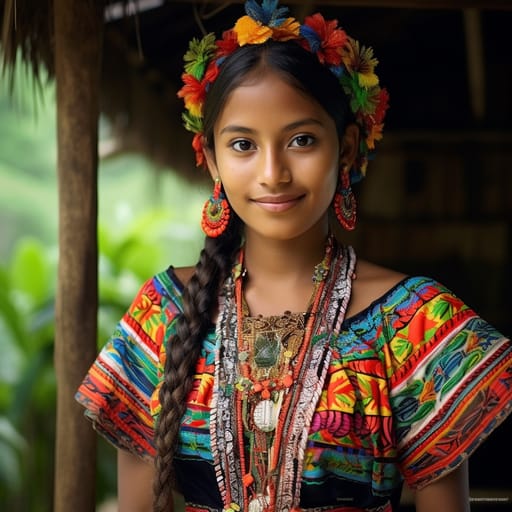
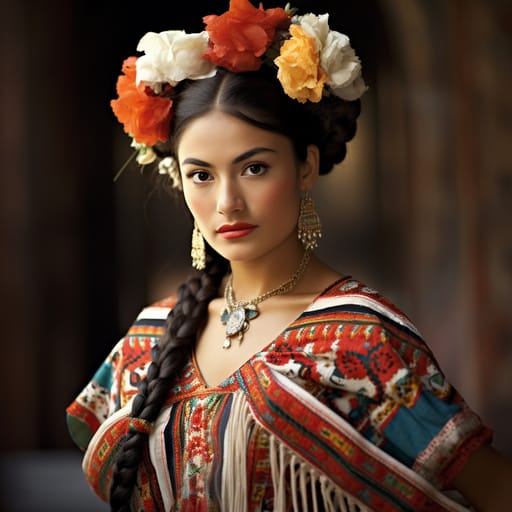
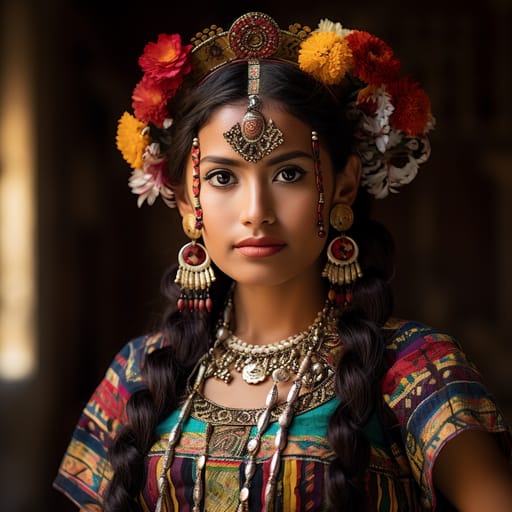
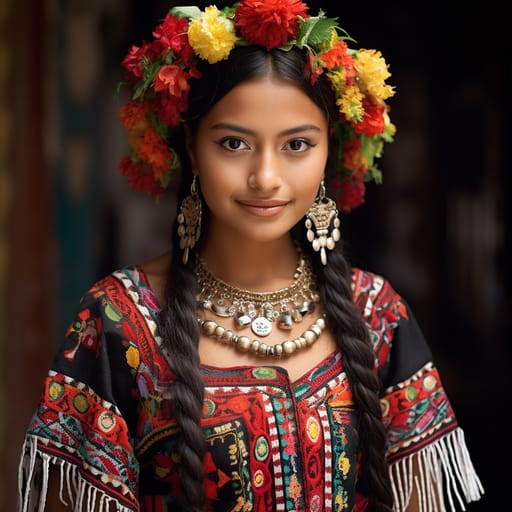
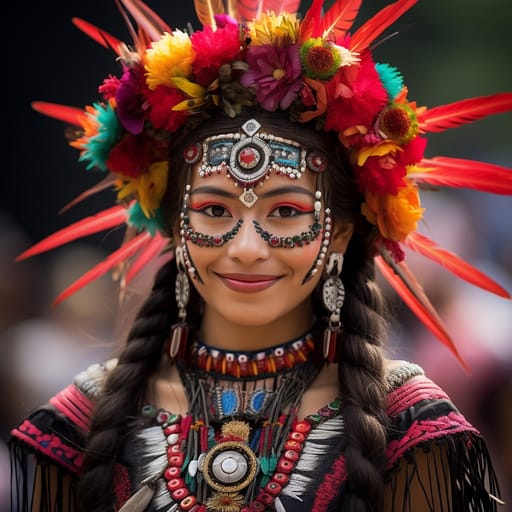
Typical Rarámuri (Tarahumara) Phenotypes
Reference for AI generation: hair, eyes, skin, facial structure, build
Rarámuri (Tarahumara) Body & Anatomy Reference
Per-feature anatomical profile for AI nude generation: Mesoamerican Indigenous / Mestizo phenotype
Rarámuri (Tarahumara) Boobs & Breasts
Rarámuri (Tarahumara) tits and boobs run medium-to-large cup, full, moderate-to-high projection, the classic Mesoamerican Indigenous / Mestizo bust profile. Rarámuri (Tarahumara) nipples and areolas show medium-brown to dark-brown areolar pigmentation against the tan-to-medium-brown skin tone, with areolar diameter typically in the 32-46mm range and forward-set positioning rather than the smaller East Asian bust. Rarámuri (Tarahumara) breasts trend full and projecting, classic Latina curvy bust profile, a function of the endomorph-to-mesomorph with strong hip-and-bust deposition body habitus and the mean adult female BMI 26-29. For anatomically accurate AI-generated Rarámuri (Tarahumara) nudes the render preserves the medium-to-large cup, full, moderate-to-high projection shape, 32-46mm areolas with medium-brown to dark-brown pigmentation, and the torso proportions of the Mesoamerican Indigenous / Mestizo phenotype.
Rarámuri (Tarahumara) Ass & Hips
Rarámuri (Tarahumara) hips and butt usually read as medium-to-full, high projection, classic Latina curvy hip profile. The skeletal base is wide iliac crests, full gluteal-femoral fat deposition, the Mesoamerican Indigenous / Mestizo pattern. Set against the slim narrow-hip East Asian profile, the difference is easy to see, and the hip-to-waist ratio is often what identifies Rarámuri (Tarahumara) women in photos.
Rarámuri (Tarahumara) Vagina & Pussy
Expect medium-brown to dark-brown labial pigmentation, fuller labia minora on Rarámuri (Tarahumara) women, in keeping with Mesoamerican Indigenous / Mestizo ancestry. The pubic hair is straight-to-wavy coarse dark texture, dense distribution. Coloring should run evenly from the tan to medium-brown skin of the thighs to the labia, and Rarámuri (Tarahumara) nude imagery should keep the hair's straight-to-wavy coarse dark texture.
Rarámuri (Tarahumara) Dicks & Penis
Rarámuri (Tarahumara) dick and penile anatomy in adult AI generation should anchor on the regional reference data: regional mean ~13cm erect, moderate girth, and medium-brown shaft pigmentation. The Rarámuri (Tarahumara) cock profile reflects the Mesoamerican Indigenous / Mestizo population's anthropometric measurements. The shaft pigmentation should track the surrounding tan to medium-brown skin tone, and the pubic hair should keep its straight-to-wavy coarse dark texture in the typical inverted-V escutcheon.
Rarámuri (Tarahumara) Body, Curves & Build
Rarámuri (Tarahumara) body type: endomorph-to-mesomorph with strong hip-and-bust deposition, with mean adult female BMI 26-29. This is the typical Mesoamerican Indigenous / Mestizo build. Height range, shoulder-to-hip ratio and fat distribution all follow from it, which is what an accurate Rarámuri (Tarahumara) nude body should show.
Rarámuri (Tarahumara) Skin Tone & Hair Texture
Rarámuri (Tarahumara) skin tone falls in the tan to medium-brown (Fitzpatrick III-V) band, the surface signal most often miscalibrated by generic AI nude generators. Rarámuri (Tarahumara) hair texture is typically straight-to-wavy 1A-2B, dense dark-brown to black, characteristic of the Mesoamerican Indigenous / Mestizo phenotype. In Rarámuri (Tarahumara) nude renders the skin should hold that band consistently across the body.
Explore phenotype categories
Structured taxonomy with peer-reviewed scales · 22 anatomical categories
Notable Rarámuri (Tarahumara) People
7 reference figures, sourced from Wikipedia
- Carmelita Little Turtle, photographer
- Daniel Ponce de León, two division former, WBC featherweight and WBO world junior featherweight cha…
- Edwin Bustillos, agricultural engineer
- Isidro Baldenegro López, community leader and activist
- María Lorena Ramírez, ultra marathoner
- Mario Trejo, footballer
- Rochelle Gutierrez, professor of education
Erotic Poses & Sex Positions
From the pose catalog: 219 named positions with reference skeletons
Frequently asked questions about Rarámuri (Tarahumara) people
Where is the Rarámuri (Tarahumara) homeland?
The Rarámuri (Tarahumara) homeland is Sierra Madre Occidental (Copper Canyon), Chihuahua, Mexico in Central America.
What language do Rarámuri (Tarahumara) people speak?
Rarámuri (Tarahumara) people primarily speak Rarámuri / Tarahumara (Uto-Aztecan, Tarahumaran).
What religion do Rarámuri (Tarahumara) people practice?
The predominant religion among Rarámuri (Tarahumara) people is Traditional religion blended with Roman Catholicism.






Make your own Rarámuri (Tarahumara) images
Five a day, free, no credits to buy. The studio starts from this group's phenotype data, so you can set body type, pose and style and keep the traits accurate.
Start with Rarámuri (Tarahumara)