No portrait yet
Nenets Erotic
Arctic tundra of northern Russia, from the Kanin Peninsula and the Nenets Autonomous Okrug across the Yamal Peninsula to the Taymyr district, concentrated in the Yamalo-Nenets Autonomous Okrug.
Tundra Nenets and Forest Nenets (Uralic, Samoyedic branch); Russian widely spoken
Traditional animism and shamanism layered with Russian Orthodoxy; some evangelical Protestant converts since the 1990s
Tundra Nenets and Forest Nenets; part of the Samoyedic peoples alongside the Enets, Nganasan and Selkup
About Nenets People
The Nenets are the people who carried large-scale nomadic reindeer herding into the twenty-first century, on a scale no one else in the Arctic matches. Their country is the tundra rimming the Barents and Kara seas, from the Kanin Peninsula in European Russia across the Yamal Peninsula to the Yenisei mouth and the western edge of Taymyr. Most of the roughly fifty thousand Nenets live in the Yamalo-Nenets Autonomous Okrug, with smaller populations in the Nenets Autonomous Okrug around Naryan-Mar and in the Taymyr district. Herding families still move with the seasons, north to the coast in summer and back to the forest edge in winter, and some Yamal routes run more than a thousand kilometers a year. The whole household travels on reindeer-drawn sleds, and the conical hide tent, the chum, goes up at every stop. Women own that work: they raise the tent, drive their own sleds and sew the fur clothing that makes the migration survivable. Men handle the herd, the lasso and the dogs, and the small white herding laika of the tundra is the ancestor of the Samoyed breed known abroad.
The name Nenets simply means a person. Outsiders long called them Samoyeds or Yuraks, and the older label stuck to the language family. Samoyedic is the branch of Uralic that diverged first, so the Nenets are distant cousins of Finns and Hungarians and near kin only to the small Enets, Nganasan and Selkup groups of the Siberian north. Two Nenets languages exist: Tundra Nenets, spoken by most of the people, and Forest Nenets, a language of the Pur and Agan river taiga with about a thousand speakers and limited mutual intelligibility with its northern relative. Along the Ob they border the Khanty, another Uralic people, and to the west the Komi, whose Izhma herders learned large-scale reindeer keeping from them.
Traditional religion is animist, with a sky god called Num, an underworld figure named Nga and a set of household spirits carried on a sacred sled that travels with the family. The space behind the hearth in the chum remains a zone women do not enter. Vaygach Island was the great sanctuary until Orthodox missionaries in the 1820s, and Soviet officials a century later, destroyed its idols. Shamans were persecuted through the 1930s, the same decade Yamal Nenets rose in the mandalada revolts against collectivization and the seizure of their herds. Orthodox baptism reached many families early, evangelical missions have arrived since the 1990s, and in practice the layers coexist. The pressure now comes from gas: Bovanenkovo, Sabetta and the railway across Yamal all cut through migration routes, and a growing share of Nenets live settled lives in villages and okrug towns.
Related ethnic groups
Groups that share Nenets's homeland, region, language, or religious tradition. These are likely candidates for comparative phenotype reference.
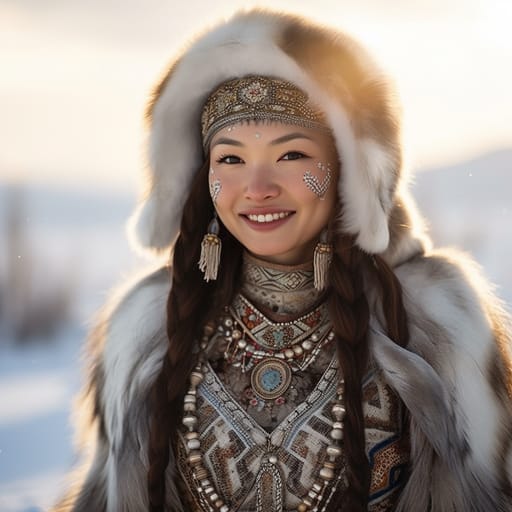
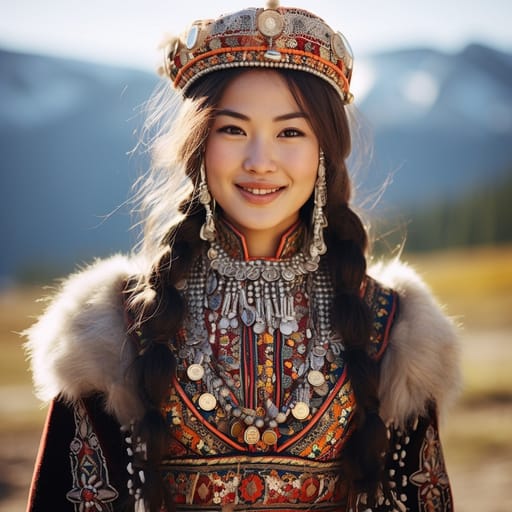
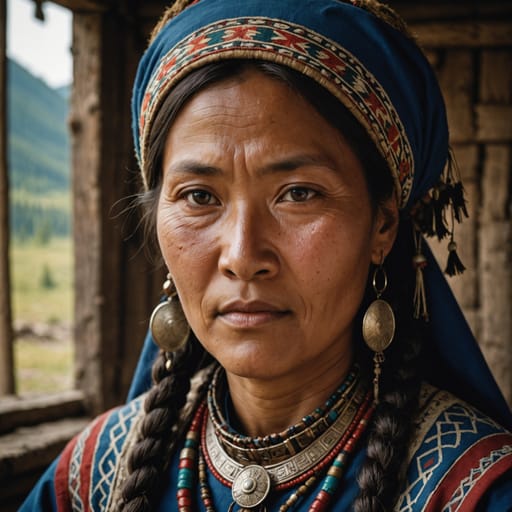
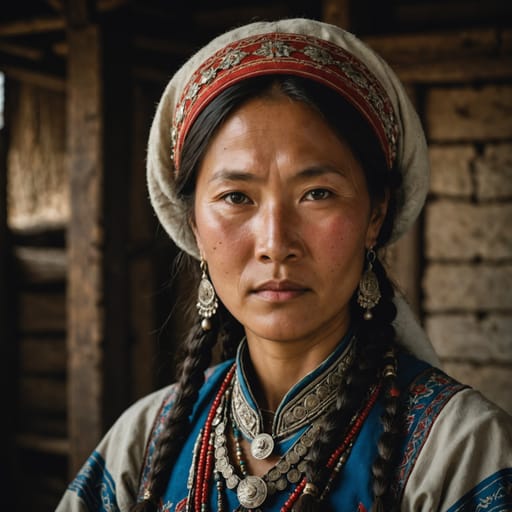
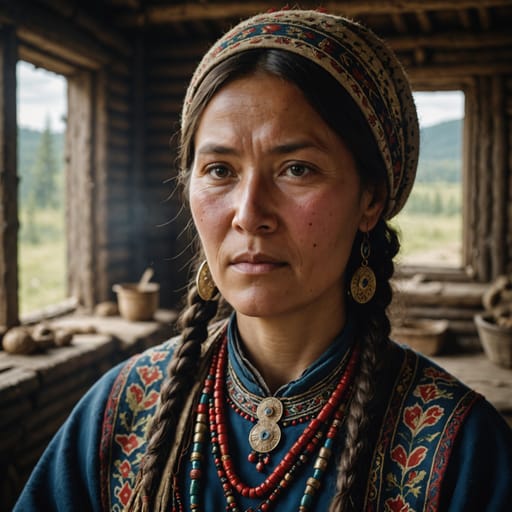
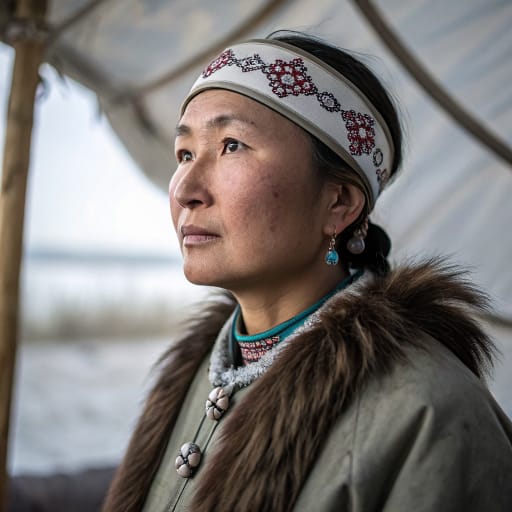
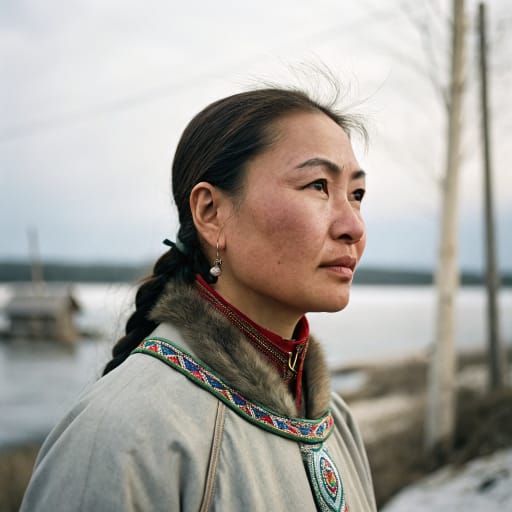
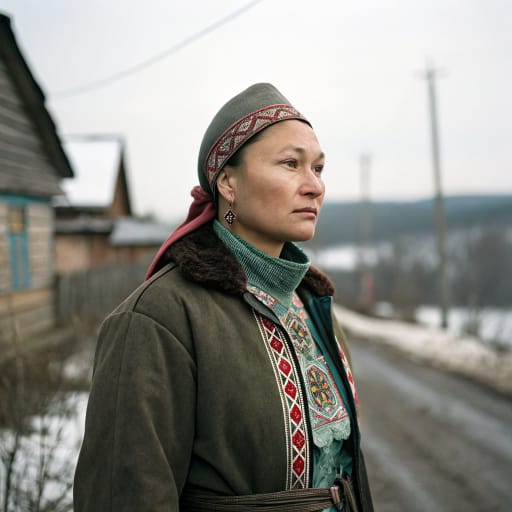
Typical Nenets Phenotypes
Reference for AI generation: hair, eyes, skin, facial structure, build
Nenets Body & Anatomy Reference
Siberian Indigenous / Tungusic phenotype: anatomy reference for AI nude generation
Nenets Boobs & Breasts
Bust reference for Nenets women: small-to-medium cup, modest projection, which is typical of Siberian Indigenous / Tungusic ancestry. Areolas measure about 26-38mm across, with medium-brown pigmentation. Body type (mesomorph, broader stocky frame adapted to cold climate) shapes the bust as well, so Nenets tits are usually firm, modest projection. In AI imagery, keep the forward-set shape rather than drifting toward the fuller Central Asian or East Asian bust.
Nenets Ass & Hips
The Nenets ass is typically small-to-medium, modest projection, which sets it apart from the broader Central Asian hip profile. Underneath, the pelvis shows narrow-to-medium iliac crests, part of the Siberian Indigenous / Tungusic skeletal pattern. For Nenets butt pics and AI renders, match that silhouette and the overall build (mesomorph, broader stocky frame adapted to cold climate).
Nenets Vagina & Pussy
Nenets pussy and vulvar anatomy presents medium-brown labial pigmentation, consistent with the Siberian Indigenous / Tungusic phenotype's pigmentation pattern. Nenets pubic hair is typically straight fine-to-medium texture, sparser distribution, in the inverted-triangle pattern. For anatomically accurate Nenets pussy renders the labial coloration should match the surrounding light to medium skin tone with a continuous gradient, and the hair should keep its straight fine-to-medium texture.
Nenets Dicks & Penis
Nenets dicks follow the Siberian Indigenous / Tungusic reference data: regional mean ~12cm erect; moderate girth; medium-brown shaft pigmentation. Shaft color should track the light to medium skin tone with a smooth change toward the glans, and Nenets pubic hair keeps its straight fine-to-medium texture.
Nenets Body, Curves & Build
Nenets body type and overall build presents as mesomorph, broader stocky frame adapted to cold climate, with mean adult female BMI 22-25: the characteristic Siberian Indigenous / Tungusic habitus. Nenets curves and proportions should keep the regional skeletal frame (height, shoulder-to-hip ratio, limb proportions) rather than a generic mesomorph default.
Nenets Skin Tone & Hair Texture
Nenets skin sits in the light to medium (Fitzpatrick II-IV) band. Hair is typically straight 1A, dark-brown to black, in keeping with the Siberian Indigenous / Tungusic phenotype. In nude renders the skin should stay one even tone from face to body, and body, pubic and head hair should match.
Explore phenotype categories
Structured taxonomy with peer-reviewed scales · 22 anatomical categories
Erotic Poses & Sex Positions
From the pose catalog: 219 named positions with reference skeletons
Frequently asked questions about Nenets people
Where is the Nenets homeland?
The Nenets homeland is Arctic tundra of northern Russia, from the Kanin Peninsula and the Nenets Autonomous Okrug across the Yamal Peninsula to the Taymyr district, concentrated in the Yamalo-Nenets Autonomous Okrug. in Northern Asia.
What language do Nenets people speak?
Nenets people primarily speak Tundra Nenets and Forest Nenets (Uralic, Samoyedic branch); Russian widely spoken.
What religion do Nenets people practice?
The predominant religion among Nenets people is Traditional animism and shamanism layered with Russian Orthodoxy; some evangelical Protestant converts since the 1990s.






Make your own Nenets images
Five a day, free, no credits to buy. The studio starts from this group's phenotype data, so you can set body type, pose and style and keep the traits accurate.
Start with Nenets