Mi’kmaw Erotic
Mi'kma'ki: Nova Scotia, New Brunswick, Prince Edward Island, the Gaspé Peninsula of Quebec and the island of Newfoundland in Canada, plus northern Maine in the United States
Mi'kmaq, also Mi'kmawi'simk (Eastern Algonquian, Algic family), alongside English, and French in Quebec
Roman Catholic since the early 1600s, practiced alongside traditional Mi'kmaw spirituality
Seven traditional districts of Mi'kma'ki (Unama'kik, Eskikewa'kik, Sipekne'katik, Epekwitk aq Piktuk, Kespukwitk, Siknikt, Kespek), plus Ktaqmkuk in Newfoundland. One of the five nations of the Wabanaki Confederacy.
About Mi’kmaw People
The Mi'kmaq call themselves L'nu, the people. The name everyone else uses comes from ni'kmaq, "my kin-friends," a greeting that hardened into an ethnonym. They are the easternmost nation of the Wabanaki Confederacy, and their country, Mi'kma'ki, takes in all of Nova Scotia and Prince Edward Island, most of New Brunswick, the Gaspé Peninsula of Quebec, and the island of Newfoundland. It is a coastal country and they have always been a saltwater people: the birchbark canoe had gunwales that rose amidships to take open-water swells, and the seasonal round ran from summer shore camps, living on cod, eel, seal and shellfish, to inland winter hunting for moose and caribou.
Their language, Mi'kmawi'simk, is Eastern Algonquian, close kin to Maliseet-Passamaquoddy and a more distant cousin of Abenaki. Several thousand people still speak it, many in Cape Breton, where Eskasoni, the largest Mi'kmaw community anywhere, is its stronghold. Less widely known is that the Mi'kmaq had a script by the late 1600s: a hieroglyphic system that French missionaries recorded and expanded for prayer books, possibly built on older mnemonic marks.
Contact came early and never let up. Basque and Breton fishing crews were trading on these shores in the early 1500s, and in 1610 the chief Membertou accepted Catholic baptism at Port-Royal. Catholicism has been woven into Mi'kmaw life ever since. Saint Anne is the patron, and her July mission at Potlotek on the Bras d'Or Lake is still the year's great gathering. It sits alongside older practice rather than replacing it: the culture hero Kluskap, sweat lodges, smudging, and the Grand Council, Sante' Mawiomi, whose Grand Chief and captains predate any colonial government and still meet. The seven districts of Mi'kma'ki remain the council's map.
Relations with Britain were set by the Peace and Friendship Treaties of 1725 to 1779, which ceded no land. In 1999 the Supreme Court of Canada's Marshall decision affirmed a treaty right to fish and trade for a moderate livelihood, and that ruling still drives conflict over the lobster fishery. The twentieth century brought the Shubenacadie residential school and a 1942 policy that tried to centralize Nova Scotia's Mi'kmaq onto two reserves, both within living memory. The craft tradition outlasted all of it. Porcupine-quill boxes on birchbark, worked in the double-curve motif, rank among the finest quillwork in North America, and the hornbeam "Mic-Mac" hockey stick carved by Mi'kmaw makers in Nova Scotia was the standard stick for decades before factory production. Treaty Day on October 1 and the eight-pointed star are the public face of a nation that has been negotiating with Europeans longer than almost anyone else on the continent.
Related ethnic groups
Groups that share Mi’kmaw's homeland, region, language, or religious tradition — likely candidates for comparative phenotype reference.
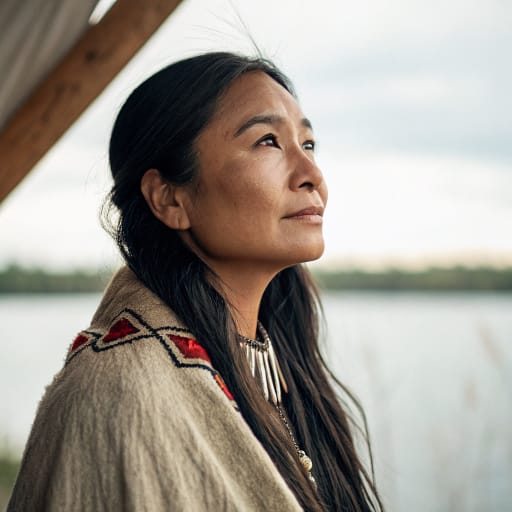
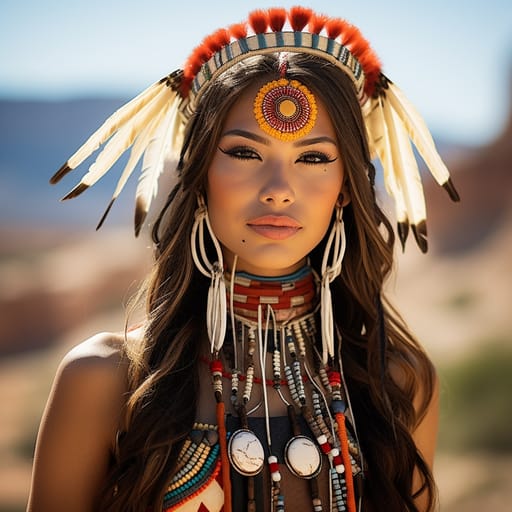
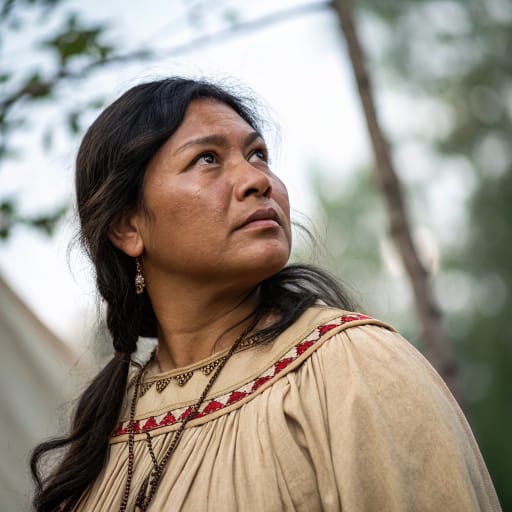
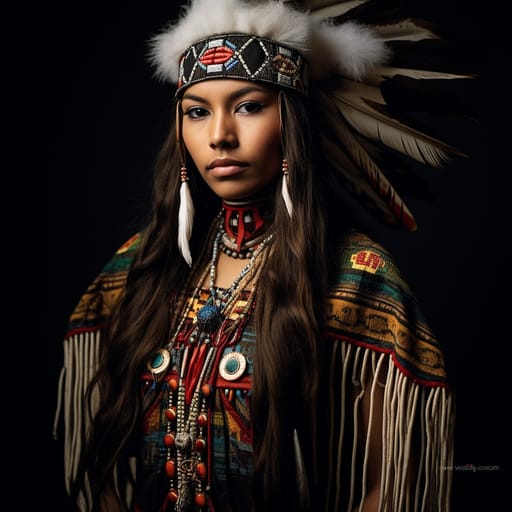
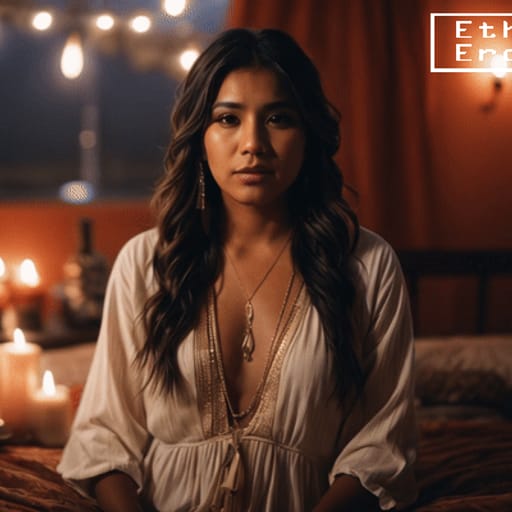
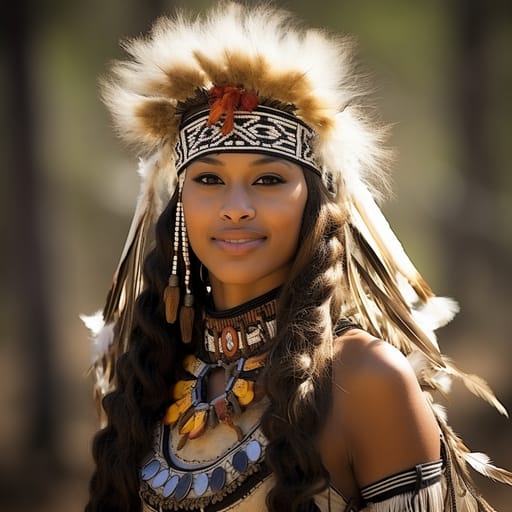
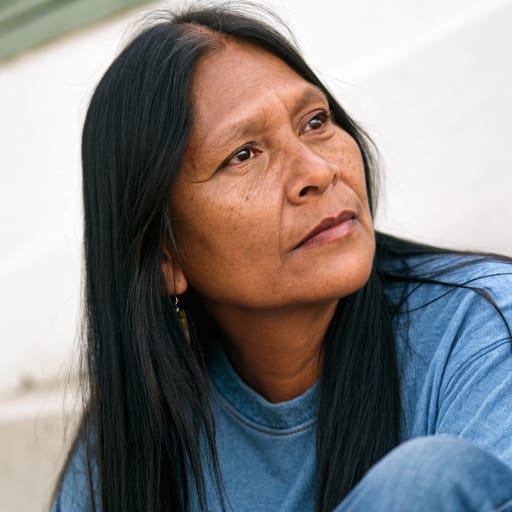
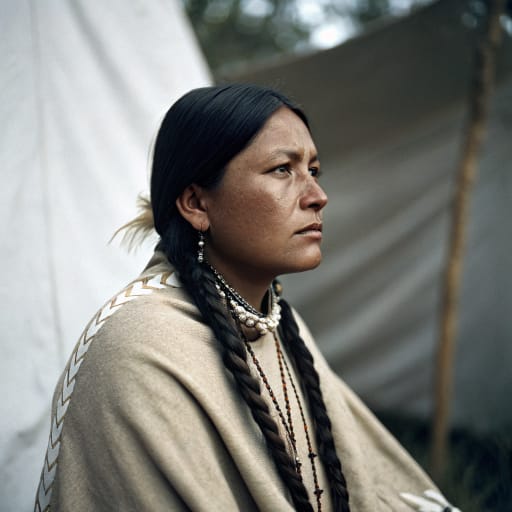
Typical Mi’kmaw Phenotypes
Reference for AI generation — hair, eyes, skin, facial structure, build
Mi’kmaw Body & Anatomy Reference
Per-feature anatomical profile for AI nude generation — Indigenous Northern American / Algonquian-Iroquoian phenotype
Mi’kmaw Boobs & Breasts
Mi’kmaw tits and boobs run medium cup, moderate projection — the classic Indigenous Northern American / Algonquian-Iroquoian bust profile. Mi’kmaw nipples and areolas show medium-brown areolar pigmentation against the copper-to-medium-brown skin tone, with areolar diameter typically in the 30-44mm range and forward-set positioning rather than the the smaller East Asian bust. Mi’kmaw breasts trend full and moderate projection, a function of the mesomorph, broader frame in northern Indigenous populations body habitus and the mean adult female BMI 25-28. For anatomically-accurate AI-generated Mi’kmaw nudes the render preserves: medium cup, moderate projection shape, 30-44mm areolas with medium-brown pigmentation, and the torso proportions of the Indigenous Northern American / Algonquian-Iroquoian phenotype.
Mi’kmaw Ass & Hips
Mi’kmaw ass and hip morphology presents as medium, moderate-to-full projection — distinctly different from the slim East Asian narrow-hip profile. The Mi’kmaw pelvic profile shows medium iliac crests, anchored in the Indigenous Northern American / Algonquian-Iroquoian skeletal pattern. Mi’kmaw butt shots in adult AI imagery should render the medium, moderate-to-full projection silhouette with the mesomorph, broader frame in northern Indigenous populations build and the gluteal-femoral fat distribution typical of the Indigenous Northern American / Algonquian-Iroquoian phenotype rather than defaulting to a globally-averaged "ethnic" butt that generic AI generators produce. The hip-to-waist ratio characteristic of Mi’kmaw women is one of the identifying features of the Indigenous Northern American / Algonquian-Iroquoian regional phenotype.
Mi’kmaw Vagina & Pussy
Mi’kmaw pussy and vulvar anatomy presents medium-brown labial pigmentation — consistent with the Indigenous Northern American / Algonquian-Iroquoian phenotype's pigmentation pattern. Mi’kmaw pubic hair is typically straight medium-coarse texture, distributed in the inverted-triangle pattern with regional-typical density. AI-generated Mi’kmaw nude imagery should preserve the medium-brown labial pigmentation and the straight medium-coarse texture hair texture rather than defaulting to a Western-European pink-and-sparse template. For anatomically-accurate Mi’kmaw pussy renders the labial pigmentation and coloration should match the surrounding copper to medium-brown skin tone of the Indigenous Northern American / Algonquian-Iroquoian phenotype, with continuous gradient rather than an abrupt color transition.
Mi’kmaw Dicks & Penis
Mi’kmaw dick and penile anatomy in adult AI generation should anchor on the regional reference data: regional mean ~13cm erect, moderate girth, and medium-brown shaft pigmentation. The Mi’kmaw cock profile reflects the Indigenous Northern American / Algonquian-Iroquoian ancestral population's anthropometric measurements rather than a globally-averaged Western-pornography default. For anatomically-accurate Mi’kmaw nude male imagery the shaft pigmentation should track the surrounding copper to medium-brown skin tone, the glans-to-shaft pigmentation transition should be continuous, and the pubic hair pattern should match straight medium-coarse texture texture distributed in the typical inverted-V escutcheon. Circumcision status in Mi’kmaw populations varies by religious-cultural tradition rather than ancestral phenotype.
Mi’kmaw Body, Curves & Build
Mi’kmaw body type and overall build presents as mesomorph, broader frame in northern Indigenous populations, with mean adult female BMI 25-28 — the characteristic Indigenous Northern American / Algonquian-Iroquoian habitus. Mi’kmaw curves and proportions in adult AI imagery should preserve the regional skeletal frame (height, shoulder-to-hip ratio, limb proportions) rather than scaling to a Western-European mesomorph default. The Mi’kmaw nude female form, when rendered with anatomical fidelity, shows the height range, frame width, and adipose distribution pattern typical of the Indigenous Northern American / Algonquian-Iroquoian phenotype. Generic AI image generators tend to collapse regional body types into a few default shapes; the EthnicErotic phenotype-anchored approach preserves the Mi’kmaw build as its own reference category.
Mi’kmaw Skin Tone & Hair Texture
Mi’kmaw skin tone falls in the copper to medium-brown (Fitzpatrick III-V) band — the surface signal most often miscalibrated by generic AI nude generators trained on Western-photographic datasets. Mi’kmaw hair texture is typically straight 1A, dark-brown to black, often thick and dense, characteristic of the Indigenous Northern American / Algonquian-Iroquoian phenotype. For anatomically-accurate Mi’kmaw nude renders the skin should hold the Fitzpatrick band consistently across body surface rather than showing the lighter-than-face body shading that AI generators default to. Mi’kmaw hair pigmentation and texture on body, pubic, and head should match across the figure rather than mixing textures (a common AI artefact).
Explore phenotype categories
Structured taxonomy with peer-reviewed scales · 22 anatomical categories
Erotic Poses & Sex Positions
From the pose catalog — 219 named positions with reference skeletons
Frequently asked questions about Mi’kmaw people
Where is the Mi’kmaw homeland?
The Mi’kmaw homeland is Mi'kma'ki: Nova Scotia, New Brunswick, Prince Edward Island, the Gaspé Peninsula of Quebec and the island of Newfoundland in Canada, plus northern Maine in the United States in North America.
What language do Mi’kmaw people speak?
Mi’kmaw people primarily speak Mi'kmaq, also Mi'kmawi'simk (Eastern Algonquian, Algic family), alongside English, and French in Quebec.
What religion do Mi’kmaw people practice?
The predominant religion among Mi’kmaw people is Roman Catholic since the early 1600s, practiced alongside traditional Mi'kmaw spirituality.
What does a typical Mi’kmaw woman look like?
Skin tones range from light to medium brown, with dark, typically straight hair that both men and women traditionally wore long. Historical dress was tanned hide, later replaced by dark wool broadcloth trimmed with silk ribbon and beadwork in the double-curve motif.






Make your own Mi’kmaw images
Five a day, free, no credits to buy. The studio starts from this group's phenotype data, so you can set body type, pose and style and keep the traits accurate.
Start with Mi’kmaw