Help us get this right
Does this portrait look right for Mehinaku?
One tap. It takes a second and it is recorded.
2 say it looks right, 0 say it looks off.
Mehinaku Erotic
Upper Xingu, Xingu Indigenous Park, Mato Grosso, Brazil
Mehináku (Arawakan family)
Traditional animism
About Mehinaku People
The Mehinaku (also spelled Mehináku or Mehinacu) are an Indigenous people of the Upper Xingu region in Mato Grosso, central Brazil, who live within the Xingu Indigenous Park. Numbering only a few hundred, they speak an Arawakan language and belong to the multiethnic Upper Xingu society, a cluster of peoples who share a common ritual culture and material style while speaking languages from several unrelated families. Their settlement is a ring of large thatched houses around a central plaza that holds the men's house and the sacred flutes, an arrangement typical of the region.
Society and subsistence
The Mehinaku are widely known through the ethnographies of the anthropologist Thomas Gregor, who documented their daily life across several decades. Subsistence rests on fishing in the region's rivers and lagoons, supplemented by the intensive cultivation of bitter manioc, which is processed into flour and flat bread. Land game is largely avoided, and the diet centers on fish, birds, and cultivated plants. The Upper Xingu peoples are noted for their peaceful relations and for inter-village ceremonies, including the Kwarup, a mortuary festival honoring the dead, and huka-huka wrestling matches that build alliances between communities. Craft specialization links the villages, with each group known for particular trade goods such as pottery, shell belts, or bows.
Appearance and adornment
Everyday dress is minimal, and the body is decorated rather than covered. Skin is painted with red annatto (urucum) and black genipapo dye arranged in geometric patterns, while ceremonial occasions call for feather ornaments, shell belts, and cotton bands tied at the arms and below the knee. Men traditionally wear the small uluri, and hair is cut in a distinctive bowl-shaped fringe. Body decoration signals age, status, and readiness for ritual, and physical beauty is a recurring theme in Mehinaku aesthetics, wrestling, and courtship, where a well-groomed and painted body is admired.
Related ethnic groups
Groups that share Mehinaku's homeland, region, language, or religious tradition. These are likely candidates for comparative phenotype reference.
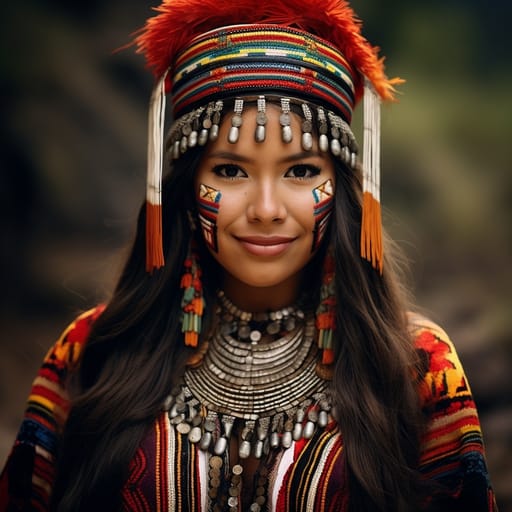
Quechua
same region (South America)
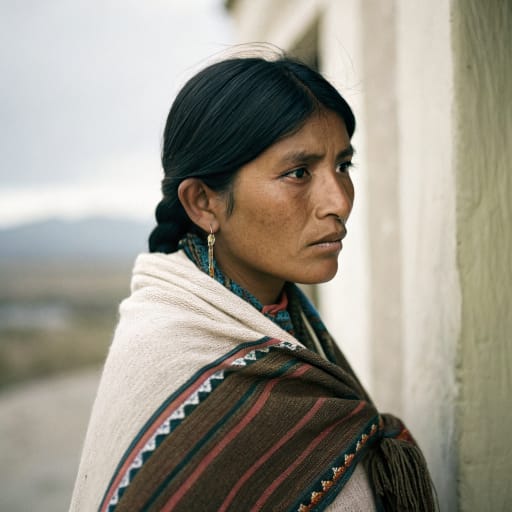
Aymara
same region (South America)
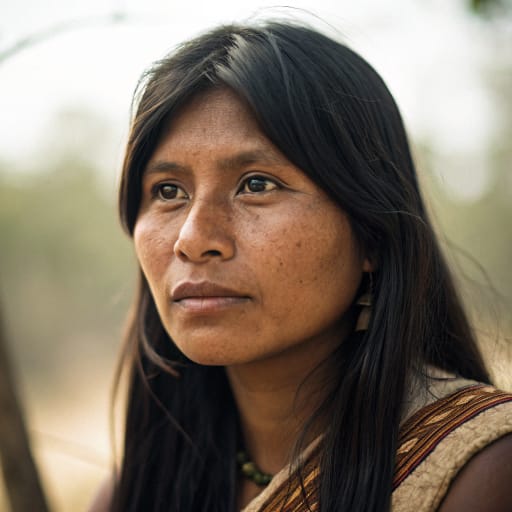
Guaraní
same region (South America)
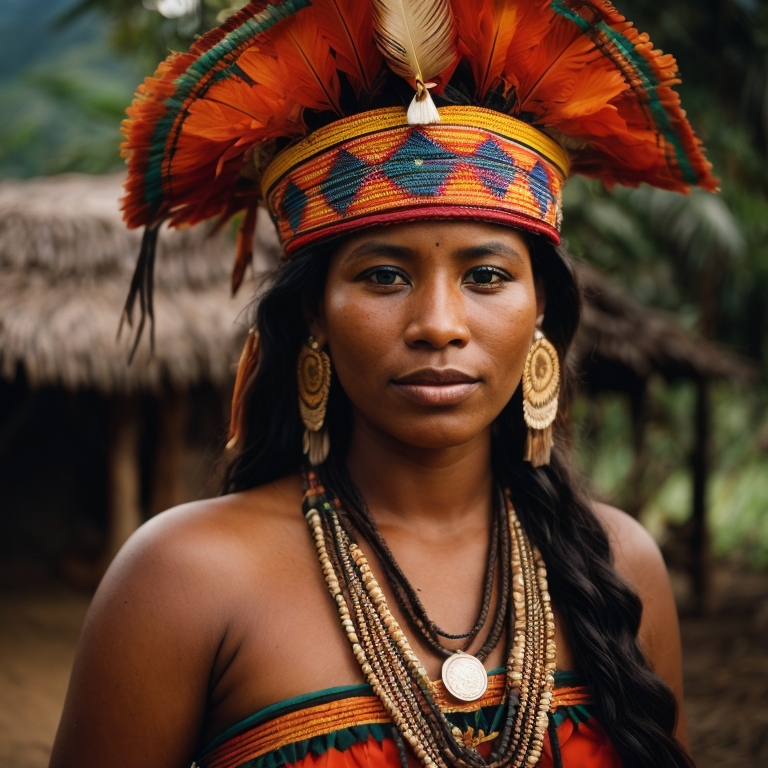
Emberá
same region (South America)
Mapuche
same region (South America)
White Argentine
same region (South America)
Mestizo Argentine
same region (South America)
Middle Eastern Argentine
same region (South America)
Typical Mehinaku Phenotypes
Reference for AI generation: hair, eyes, skin, facial structure, build
Mehinaku Body & Anatomy Reference
Anatomy by feature, South American Indigenous / European-Mestizo / Afro-Latino mix phenotype
Mehinaku Boobs & Breasts
Mehinaku boobs follow the South American Indigenous / European-Mestizo / Afro-Latino mix profile: medium-to-large cup, full, high projection. Areolar diameter is usually 32-46mm, and the coloring is medium-brown to dark-brown areolar pigmentation against the tan-to-deep-brown skin tone. Breast shape tracks body composition (endomorph-to-mesomorph with high gluteal-femoral deposition, mean adult female BMI 25-28), so Mehinaku breasts tend to be the classic Brazilian / Latina curvy bust profile in lowland populations; smaller and shorter-set in Andean Indigenous populations. Expect a forward-set shape, not the smaller bust profile of Andean Indigenous sub-populations.
Mehinaku Ass & Hips
Mehinaku ass and hip morphology presents as full, high projection, the famous Brazilian / Latina bunda profile, distinctly different from the slim narrow-hip East Asian profile. The Mehinaku pelvic profile shows wide iliac crests, very full gluteal-femoral fat deposition (the hallmark Brazilian / Latina hip-to-waist ratio), anchored in the South American Indigenous / European-Mestizo / Afro-Latino mix skeletal pattern. Mehinaku butt shots in adult AI imagery should render the full, high projection, the famous Brazilian / Latina bunda profile silhouette with the overall build (endomorph-to-mesomorph with high gluteal-femoral deposition) and the fat distribution typical of the South American Indigenous / European-Mestizo / Afro-Latino mix phenotype.
Mehinaku Vagina & Pussy
Mehinaku pussy anatomy typically shows medium-brown to dark-brown labial pigmentation, fuller labia minora. Pubic hair is usually wavy-to-curly coarse dark texture, dense distribution. In AI-generated Mehinaku nudes, labial color should blend into the tan to deep-brown skin with a gradual transition, and the hair should keep its wavy-to-curly coarse dark texture.
Mehinaku Dicks & Penis
Penis reference for Mehinaku men: regional mean ~13cm erect, moderate-to-above-average girth. Coloring: medium-brown shaft pigmentation. An accurate Mehinaku cock in AI imagery matches the surrounding tan to deep-brown skin rather than a generic porn default. Circumcision depends on religion and custom, not ancestry.
Mehinaku Body, Curves & Build
The Mehinaku figure is generally endomorph-to-mesomorph with high gluteal-femoral deposition, with mean adult female BMI 25-28, characteristic of South American Indigenous / European-Mestizo / Afro-Latino mix ancestry. AI image tools tend to flatten regional body types into a few stock shapes; here the Mehinaku build is kept as its own reference.
Mehinaku Skin Tone & Hair Texture
Skin: tan to deep-brown (Fitzpatrick III-VI). Hair: straight-to-curly 1A-3C, varies widely by ancestral composition. Both are typical of South American Indigenous / European-Mestizo / Afro-Latino mix ancestry. The most common mistake in AI nudes of Mehinaku women is a body rendered lighter than the face.
Explore phenotype categories
Structured taxonomy with peer-reviewed scales · 22 anatomical categories
Erotic Poses & Sex Positions
From the pose catalog: 219 named positions with reference skeletons
Frequently asked questions about Mehinaku people
Where is the Mehinaku homeland?
The Mehinaku homeland is Upper Xingu, Xingu Indigenous Park, Mato Grosso, Brazil in South America.
What language do Mehinaku people speak?
Mehinaku people primarily speak Mehináku (Arawakan family).
What religion do Mehinaku people practice?
The predominant religion among Mehinaku people is Traditional animism.
What does a typical Mehinaku woman look like?
Mehinaku women typically have warm brown skin and straight black hair worn in a rounded bowl fringe. Traditional body decoration uses red urucum and black genipapo in geometric bands, and women wear plain waist strings.






Make your own Mehinaku images
Five a day, free, no credits to buy. The studio starts from this group's phenotype data, so you can set body type, pose and style and keep the traits accurate.
Start with Mehinaku