Help us get this right
Does this portrait look right for Mee?
Nobody has judged this one yet. You would be the first.
Mee Erotic
The Paniai lakes basin and surrounding highland valleys of Papua, Indonesia, mainly the Paniai, Deiyai and Dogiyai regencies, with communities down toward Nabire.
Ekari, also called Mee or Ekagi (Trans-New Guinea, Paniai Lakes group)
Predominantly Christian, both Catholic and Protestant, alongside surviving beliefs centered on the creator Ugatame.
One of the Paniai Lakes highland peoples, closely tied to the neighboring Wolani, Moni and Auye; internally identified by valley, mainly Kamu, Mapia, Tigi and Paniai.
About Mee People
Mee means the people, which is what they call themselves. Almost everyone else has called them something else: Kapauku, borrowed from lowland Mimika neighbors, and Ekari or Ekagi, the spellings Dutch officials settled on in the 1930s. All three still turn up in older ethnography and in library catalogs, so they are worth knowing if you go looking. The Mee live in the central highlands of Papua, Indonesia, in the basin of the Paniai lakes and the valleys around them, Kamu, Mapia and Tigi among them, spread across the Paniai, Deiyai and Dogiyai regencies. It is cool, wet, steep country between roughly 1,500 and 2,000 meters, and the economy rests on two things: sweet potato gardens cut into the slopes, and the pigs those gardens feed. Their language, usually written Ekari, belongs to the Trans-New Guinea family and to a small Paniai Lakes cluster shared with Wolani and Moni. It is unrelated to the Austronesian languages of the coast, and with something on the order of a hundred thousand speakers it is one of the larger Papuan languages anywhere.
What made the Mee famous in anthropology was money. Leopold Pospisil, who lived in the Kamu Valley in the 1950s, described a society running on cowrie shell currency, priced transactions, credit, interest and enforceable contract, with remarkably little given away free between adults, kin included. Leadership follows from that. A tonowi, literally a rich man, holds influence by accumulating pigs and shells and then lending them out. Followers are debtors. Hoard instead of lend, and the influence evaporates. Nothing passes down by birth. Dutch aircraft sighted the lakes in 1936, Catholic and Protestant missions arrived close behind, and most Mee today are Christian, with Catholic parishes thick around Paniai. Older ideas have not gone anywhere either, including Ugatame, the creator understood to be behind everything that exists, the bad along with the good. Indonesian administration arrived in 1963 and has been contested ever since. The Mee are among the most politically vocal peoples in Papua and they carry the cost of it: the shooting of four teenagers at Enarotali in December 2014 is still the case the province argues over. Meanwhile the gardens are still cut into the same slopes, pigs still settle debts and marriages, and the noken, the looped string bag carried by a strap across the forehead, still does the work a backpack does elsewhere.
Related ethnic groups
Groups that share Mee's homeland, region, language, or religious tradition. These are likely candidates for comparative phenotype reference.
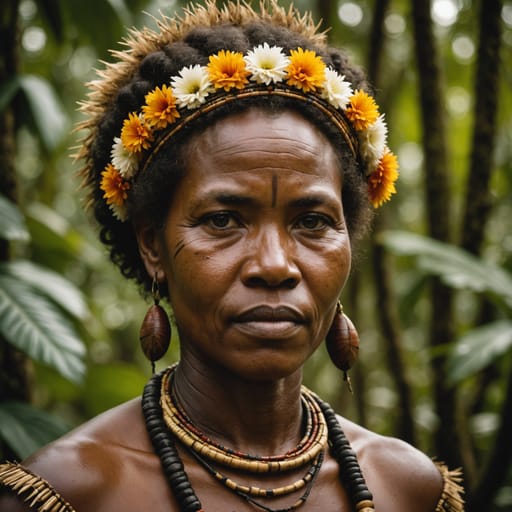
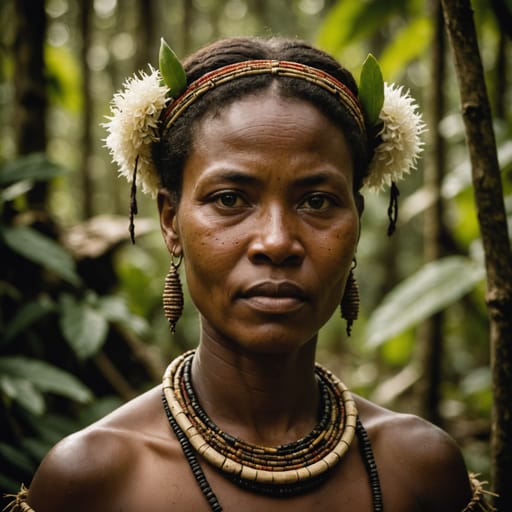
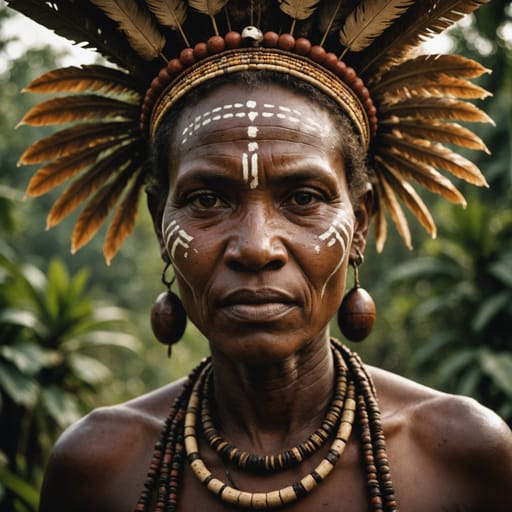
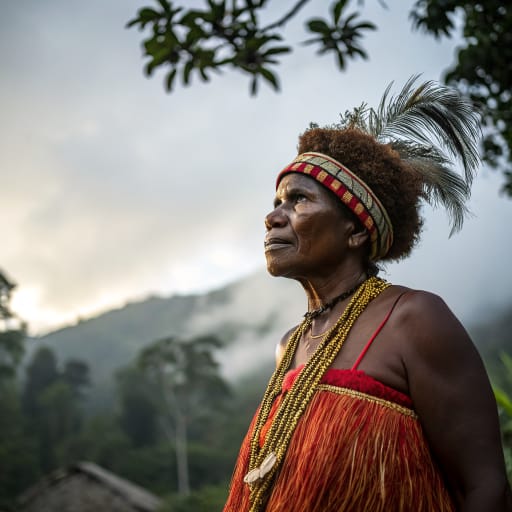
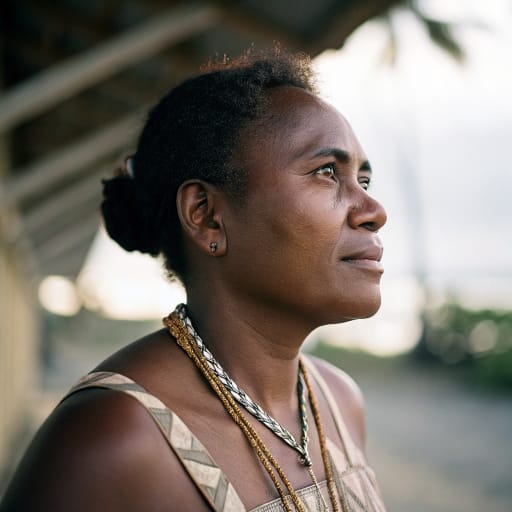
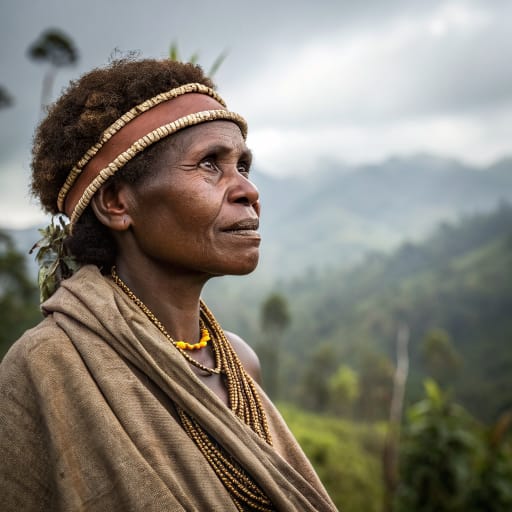
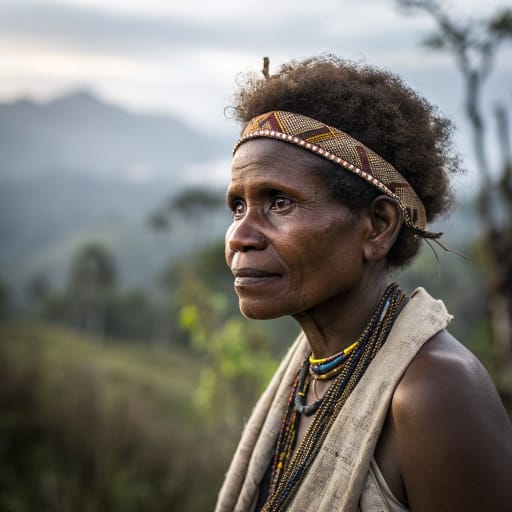
Typical Mee Phenotypes
Reference for AI generation: hair, eyes, skin, facial structure, build
Mee Body & Anatomy Reference
Anatomy by feature, Melanesian / Papuan phenotype
Mee Boobs & Breasts
The typical Mee bust is medium-to-large cup, full, moderate projection, in line with the wider Melanesian / Papuan pattern. Areolas usually fall in the 32-46mm range, with deep-brown to near-black areolar pigmentation against the deep-brown skin tone. Compared with the smaller Aboriginal Australian bust, Mee breasts sit forward and are generally full, moderate projection. A faithful AI render of Mee tits keeps that shape and areola size.
Mee Ass & Hips
Butt shape among Mee women: medium-to-full, moderate-to-high projection, over medium-to-wide iliac crests, full gluteal-femoral fat deposition. This follows Melanesian / Papuan ancestry and looks quite unlike the slim Aboriginal Australian narrow-hip profile. An accurate Mee ass in adult AI imagery keeps both the silhouette and the overall build (mesomorph) instead of a generic average.
Mee Vagina & Pussy
Vulvar anatomy among Mee women: deep-brown labial pigmentation. Pubic hair tends to be tightly-coiled coarse texture, dense distribution, in the usual inverted-triangle pattern. Both follow Melanesian / Papuan pigmentation, which is why Mee pussy renders should not fall back on a pale, sparse Western template.
Mee Dicks & Penis
The Mee cock profile, from Melanesian / Papuan anthropometric data: regional mean ~13cm erect; moderate-to-above-average girth; deep-brown shaft pigmentation. Pubic hair has a tightly-coiled coarse texture and forms the usual inverted-V pattern. Whether Mee men are circumcised follows religious and cultural practice rather than phenotype.
Mee Body, Curves & Build
Build and curves among Mee women follow the Melanesian / Papuan pattern: mesomorph, mean adult female BMI 25-28. Proportions matter as much as skin tone, so Mee figures should keep their regional height and limb ratios.
Mee Skin Tone & Hair Texture
The Mee skin range is deep-brown (Fitzpatrick V-VI); the distinctive blond-hair-on-dark-skin trait widely documented in Solomon Islands populations, and hair tends to be tight 4A-4C coil; the blond-on-dark trait is a TYRP1 variant unique to Melanesia. That combination marks the Melanesian / Papuan phenotype, and skin tone is the trait AI generators most often get wrong for Mee women.
Explore phenotype categories
Structured taxonomy with peer-reviewed scales · 22 anatomical categories
Erotic Poses & Sex Positions
From the pose catalog: 219 named positions with reference skeletons
Frequently asked questions about Mee people
Where is the Mee homeland?
The Mee homeland is The Paniai lakes basin and surrounding highland valleys of Papua, Indonesia, mainly the Paniai, Deiyai and Dogiyai regencies, with communities down toward Nabire. in Melanesia.
What language do Mee people speak?
Mee people primarily speak Ekari, also called Mee or Ekagi (Trans-New Guinea, Paniai Lakes group).
What religion do Mee people practice?
The predominant religion among Mee people is Predominantly Christian, both Catholic and Protestant, alongside surviving beliefs centered on the creator Ugatame..






Make your own Mee images
Five a day, free, no credits to buy. The studio starts from this group's phenotype data, so you can set body type, pose and style and keep the traits accurate.
Start with Mee