Help us get this right
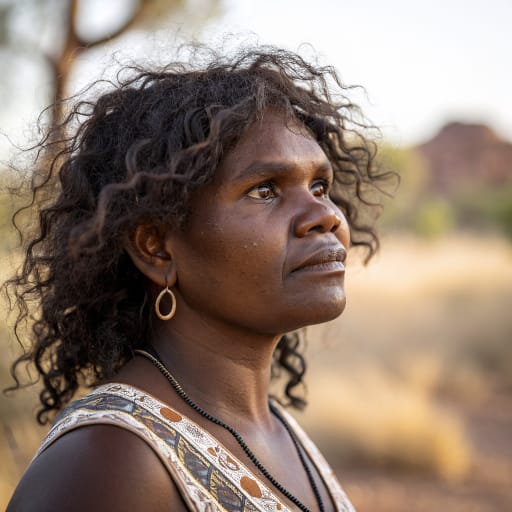
Does this portrait look right for Martu?
Nobody has judged this one yet. You would be the first.
Martu Erotic
Great Sandy, Little Sandy and Gibson deserts of Western Australia, around Karlamilyi (Rudall River), Lake Disappointment and the Percival Lakes; communities include Jigalong, Punmu, Parnngurr, Kunawarritji and Newman
Martu Wangka and related Western Desert dialects including Manyjilyjarra, Kartujarra and Putijarra (Pama-Nyungan, Wati branch); English
Jukurrpa (Dreaming) law and ceremony, alongside Christianity introduced through the Jigalong mission
Manyjilyjarra, Kartujarra, Kiyajarra, Putijarra, Warnman and neighboring dialect groups; part of the wider Western Desert cultural bloc
About Martu People
Martu is a word from the desert itself. In the language of the people who use it, it simply means a person, one of us. Over the twentieth century it became the shared name for families from several neighboring dialect groups, among them Manyjilyjarra, Kartujarra, Kiyajarra, Putijarra and Warnman. Their country covers parts of the Great Sandy, Little Sandy and Gibson deserts of Western Australia, around Lake Disappointment, the Percival Lakes and the Rudall River, now Karlamilyi National Park. They are held together by shared law, marriage between groups and a long history of moving between the same soaks, rockholes and hunting grounds.
Martu speak the Western Desert Language, a long chain of dialects that neighbors across the arid interior can largely understand. It belongs to the Pama-Nyungan family, which covers most of the continent. Martu Wangka took shape at Jigalong, where speakers of different dialects were thrown together, and it is still the language of home and community. English is kept for school, work and government.
Contact came late and hard. In 1906 Alfred Canning's survey party chained Aboriginal men and forced them to lead the way to water, and the stock route that followed cut straight through Martu country. Jigalong started as a depot on the rabbit-proof fence and later became a mission. In 1931 three girls were taken from there to the Moore River settlement near Perth. Molly and Daisy walked back along the fence all the way home, a story later told in a book and a film. Some families stayed out in the desert into the 1960s, until patrol officers cleared the flight path of rockets fired from Woomera. One couple, Warri and Yatungka, lived alone in the desert until they were found in 1977.
The move back onto country since the 1980s is the other half of the story. Families set up communities at Punmu, Parnngurr and Kunawarritji, Parnngurr partly as a stand against uranium exploration at nearby Kintyre. In 2002 the Federal Court recognized Martu native title over one of the largest areas in Australia. Law business and initiation still shape the year. The Jukurrpa, or Dreaming, lives alongside a Christianity picked up in the mission years without being replaced by it. Martu women still hunt sand goannas by burning small patches of spinifex, and ecologists now credit the practice with keeping the desert a patchwork of old and new growth. Martu ranger teams turn that knowledge into paid land work, and painters at Martumili Artists put the same country onto canvas.
Related ethnic groups
Groups that share Martu's homeland, region, language, or religious tradition. These are likely candidates for comparative phenotype reference.
Arrernte
same region (Australia / New Zealand)
Noongar
same region (Australia / New Zealand)
Yolngu
same region (Australia / New Zealand)
Tiwi
same region (Australia / New Zealand)
Kaurna
same region (Australia / New Zealand)
Kaytetye
same region (Australia / New Zealand)

Bunurong
same region (Australia / New Zealand)
Wirangu
same region (Australia / New Zealand)
Typical Martu Phenotypes
Reference for AI generation: hair, eyes, skin, facial structure, build
Martu Body & Anatomy Reference
Per-feature anatomical profile for AI nude generation: Aboriginal Australian phenotype
Martu Boobs & Breasts
Bust reference for Martu women: small-to-medium cup, modest-to-moderate projection, which is typical of Aboriginal Australian ancestry. Areolas measure about 28-42mm across, with deep-brown to near-black pigmentation. Body type (ectomorph-to-mesomorph, lean elongated frame adapted to arid environment) shapes the bust as well, so Martu tits are usually modest projection, firm. In AI imagery, keep the forward-set shape rather than drifting toward the fuller Polynesian or West African bust.
Martu Ass & Hips
The Martu ass is typically small-to-medium, modest projection, narrower hip profile, which sets it apart from the very full Polynesian gluteal projection. Underneath, the pelvis shows narrow-to-medium iliac crests, longer torso and limb proportions, part of the Aboriginal Australian skeletal pattern. For Martu butt pics and AI renders, match that silhouette and the overall build (ectomorph-to-mesomorph, lean elongated frame adapted to arid environment).
Martu Vagina & Pussy
Martu pussy and vulvar anatomy presents deep-brown labial pigmentation, consistent with the Aboriginal Australian phenotype's pigmentation pattern. Martu pubic hair is typically wavy-to-coiled coarse texture, in the inverted-triangle pattern. For anatomically accurate Martu pussy renders the labial coloration should match the surrounding deep-brown skin tone with a continuous gradient, and the hair should keep its wavy-to-coiled coarse texture.
Martu Dicks & Penis
Martu dicks follow the Aboriginal Australian reference data: regional mean ~13cm erect; moderate girth; deep-brown shaft pigmentation. Shaft color should track the deep-brown skin tone with a smooth change toward the glans, and Martu pubic hair keeps its wavy-to-coiled coarse texture.
Martu Body, Curves & Build
Martu body type and overall build presents as ectomorph-to-mesomorph, lean elongated frame adapted to arid environment, with mean adult female BMI 23-26: the characteristic Aboriginal Australian habitus. Martu curves and proportions should keep the regional skeletal frame (height, shoulder-to-hip ratio, limb proportions) rather than a generic mesomorph default.
Martu Skin Tone & Hair Texture
Martu skin sits in the deep-brown (Fitzpatrick V-VI) band. Hair is typically wavy-to-curly 2C-3B, dark-brown to black; the distinctive blond-haired Aboriginal sub-population in Central Australia is documented and pigmentation-independent, in keeping with the Aboriginal Australian phenotype. In nude renders the skin should stay one even tone from face to body, and body, pubic and head hair should match.
Explore phenotype categories
Structured taxonomy with peer-reviewed scales · 22 anatomical categories
Erotic Poses & Sex Positions
From the pose catalog: 219 named positions with reference skeletons
Frequently asked questions about Martu people
Where is the Martu homeland?
The Martu homeland is Great Sandy, Little Sandy and Gibson deserts of Western Australia, around Karlamilyi (Rudall River), Lake Disappointment and the Percival Lakes; communities include Jigalong, Punmu, Parnngurr, Kunawarritji and Newman in Australia / New Zealand.
What language do Martu people speak?
Martu people primarily speak Martu Wangka and related Western Desert dialects including Manyjilyjarra, Kartujarra and Putijarra (Pama-Nyungan, Wati branch); English.
What religion do Martu people practice?
The predominant religion among Martu people is Jukurrpa (Dreaming) law and ceremony, alongside Christianity introduced through the Jigalong mission.






Make your own Martu images
Five a day, free, no credits to buy. The studio starts from this group's phenotype data, so you can set body type, pose and style and keep the traits accurate.
Start with Martu