Help us get this right
Does this portrait look right for Lawangan?
Nobody has judged this one yet. You would be the first.
Lawangan Erotic
Eastern Barito River basin of Central Kalimantan (East, South and North Barito regencies), extending into West Kutai in East Kalimantan, Indonesian Borneo.
Lawangan (Austronesian, East Barito branch), closely related to Taboyan and Ma'anyan; Banjarese and Indonesian widely spoken as second languages.
Kaharingan (officially classed as Hindu Kaharingan), Protestant and Catholic Christianity, some Islam.
A Dayak people of the East Barito (Dusun) cluster; traditionally divided into about twenty-one small tribes, including Lawangan Karau and Taboyan; linked to the wider Luangan family with the Benuaq and Bentian.
About Lawangan People
Lawangan is less a single tribe than a name that gathers a string of related river communities on the eastern side of the Barito basin in Indonesian Borneo. In Central Kalimantan the word is Lawangan; across the provincial line in East Kalimantan the same people are usually called Luangan, and anthropologists have used that spelling as an umbrella for a wider family that takes in the Benuaq, Bentian and Taboyan. The Dayak statesman and writer Tjilik Riwut counted twenty-one small tribes under the Lawangan heading, which gives a fair sense of how loose the label is. What holds it together is language, ritual and a shared map of rivers: the Karau and the Teweh, and the hill country running east toward West Kutai.
The Lawangan language belongs to the East Barito branch of Austronesian, a small branch with an outsized story: it includes neighboring Ma'anyan and, an ocean away, Malagasy, carried to Madagascar by seafarers from this corner of Borneo well over a thousand years ago. At home, Lawangan speakers live among Ma'anyan, Dusun, Bakumpai and Banjar neighbors, and most move easily between their own speech, Banjarese market talk and Indonesian.
Religion is where the Lawangan are most distinctive. Many still follow Kaharingan, the indigenous Dayak religion, which the Indonesian state agreed to recognize in 1980 only by filing it under Hinduism. Its working core is the belian, a curing ritual in which a specialist chants, dances and bargains with spirits through the night on behalf of a sick person. Death is handled in two stages. After burial, a family saves, sometimes for years, toward the wara, a secondary funeral of several days in which ritual experts escort the soul to its resting place on Mount Lumut, a real peak in the hills of North Barito. Larger versions call for the sacrifice of a water buffalo and feed a whole village. Protestant and Catholic churches have grown steadily since the mission era, and some families are Muslim, though conversion to Islam historically tended to pull people toward a Malay or Banjar identity.
Daily life still turns on swidden rice, rubber and rattan gardens, fishing and forest produce, but the forest is no longer a given. The Barito uplands sit on coal, and mining concessions, logging roads and oil palm estates have pressed hard on customary land over the past few decades. Younger Lawangan work in the mines, in district towns such as Muara Teweh, Ampah and Tamiang Layang, or farther off in Palangka Raya and Banjarmasin. The wara still draws them home.
Related ethnic groups
Groups that share Lawangan's homeland, region, language, or religious tradition. These are likely candidates for comparative phenotype reference.
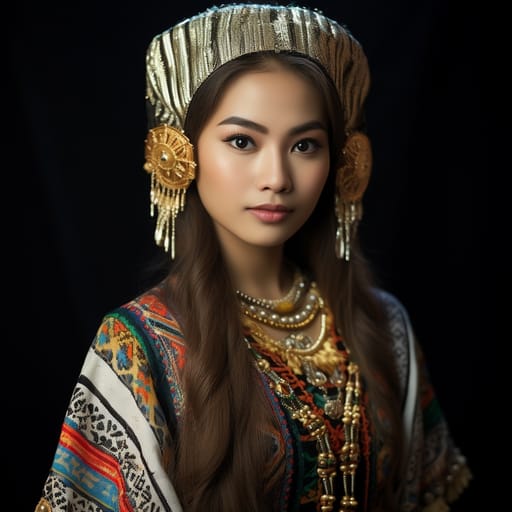
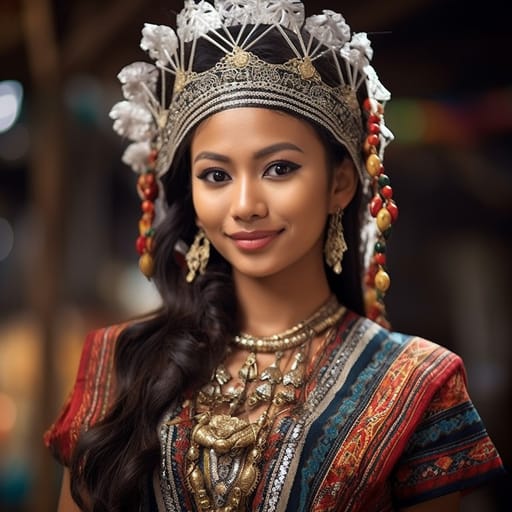
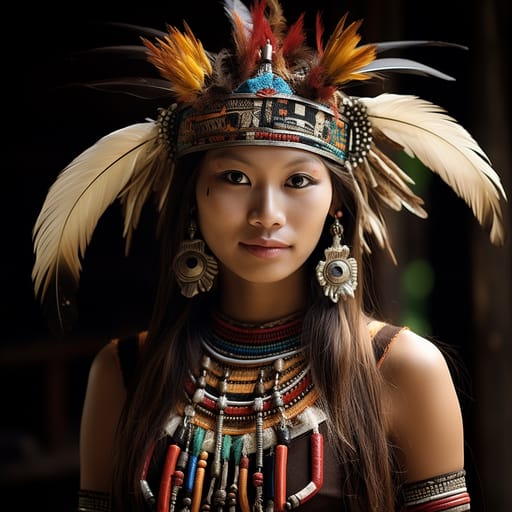
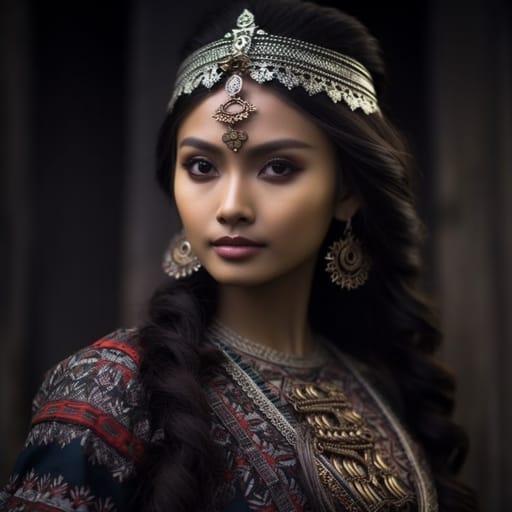
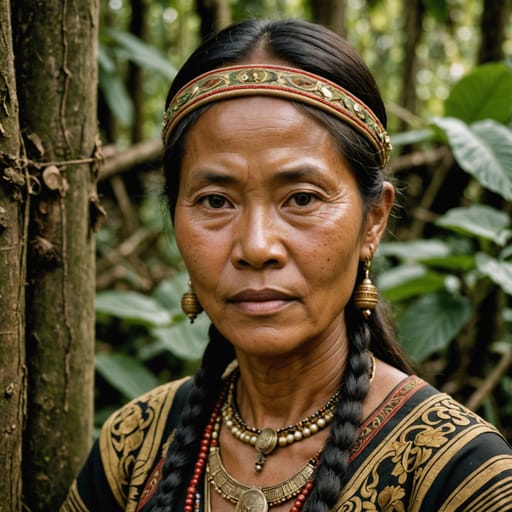
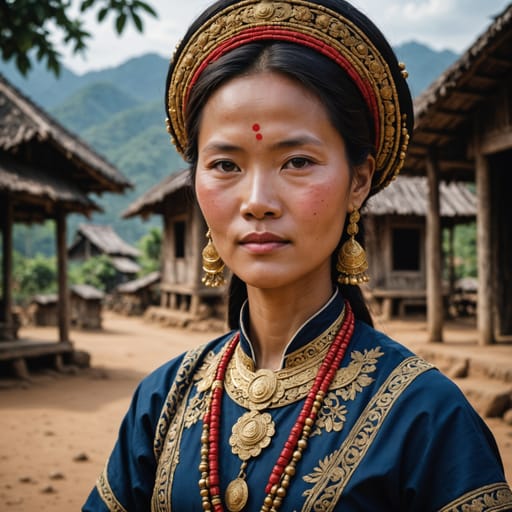
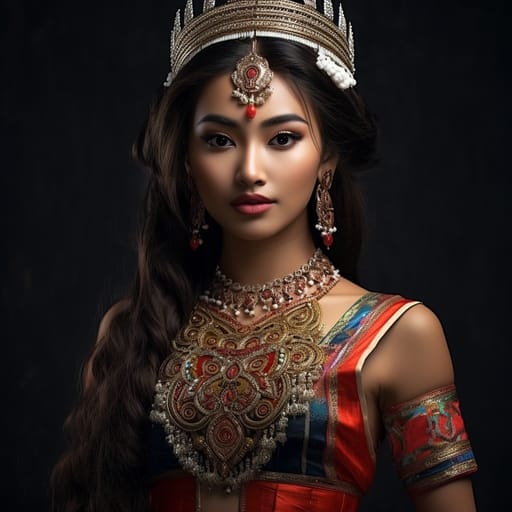
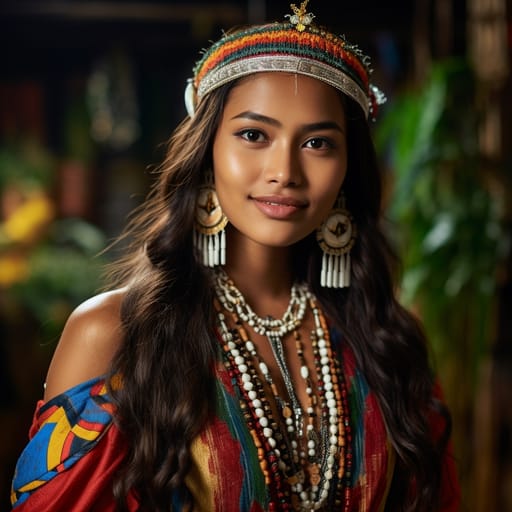
Typical Lawangan Phenotypes
Reference for AI generation: hair, eyes, skin, facial structure, build
Lawangan Body & Anatomy Reference
Southeast Asian Austronesian / Austroasiatic phenotype: anatomy reference for AI nude generation
Lawangan Boobs & Breasts
The typical Lawangan bust is small-to-medium cup, modest projection, in line with the wider Southeast Asian Austronesian / Austroasiatic pattern. Areolas usually fall in the 26-38mm range, with medium-brown to dark-brown areolar pigmentation against the tan-to-medium-brown skin tone. Compared with the fuller South Asian or Polynesian bust, Lawangan breasts sit forward and are generally firm, modest projection. A faithful AI render of Lawangan tits keeps that shape and areola size.
Lawangan Ass & Hips
Butt shape among Lawangan women: small-to-medium, modest projection, narrower hip profile, over narrow-to-medium iliac crests. This follows Southeast Asian Austronesian / Austroasiatic ancestry and looks quite unlike the fuller glutes of the Pacific Islander phenotype. An accurate Lawangan ass in adult AI imagery keeps both the silhouette and the overall build (ectomorph, petite frame) instead of a generic average.
Lawangan Vagina & Pussy
Vulvar anatomy among Lawangan women: medium-brown to dark-brown labial pigmentation. Pubic hair tends to be straight-to-wavy fine-to-medium texture, in the usual inverted-triangle pattern. Both follow Southeast Asian Austronesian / Austroasiatic pigmentation, which is why Lawangan pussy renders should not fall back on a pale, sparse Western template.
Lawangan Dicks & Penis
The Lawangan cock profile, from Southeast Asian Austronesian / Austroasiatic anthropometric data: regional mean ~11cm erect; moderate girth; medium-brown shaft pigmentation. Pubic hair has a straight-to-wavy fine-to-medium texture and forms the usual inverted-V pattern. Whether Lawangan men are circumcised follows religious and cultural practice rather than phenotype.
Lawangan Body, Curves & Build
Build and curves among Lawangan women follow the Southeast Asian Austronesian / Austroasiatic pattern: ectomorph, petite frame, mean adult female BMI 20-23. Proportions matter as much as skin tone, so Lawangan figures should keep their regional height and limb ratios.
Lawangan Skin Tone & Hair Texture
The Lawangan skin range is tan to medium-brown (Fitzpatrick III-V), and hair tends to be straight-to-wavy 1A-2A, dark-brown to black. That combination marks the Southeast Asian Austronesian / Austroasiatic phenotype, and skin tone is the trait AI generators most often get wrong for Lawangan women.
Explore phenotype categories
Structured taxonomy with peer-reviewed scales · 22 anatomical categories
Erotic Poses & Sex Positions
From the pose catalog: 219 named positions with reference skeletons
Frequently asked questions about Lawangan people
Where is the Lawangan homeland?
The Lawangan homeland is Eastern Barito River basin of Central Kalimantan (East, South and North Barito regencies), extending into West Kutai in East Kalimantan, Indonesian Borneo. in Southeast Asia.
What language do Lawangan people speak?
Lawangan people primarily speak Lawangan (Austronesian, East Barito branch), closely related to Taboyan and Ma'anyan; Banjarese and Indonesian widely spoken as second languages..
What religion do Lawangan people practice?
The predominant religion among Lawangan people is Kaharingan (officially classed as Hindu Kaharingan), Protestant and Catholic Christianity, some Islam..






Make your own Lawangan images
Five a day, free, no credits to buy. The studio starts from this group's phenotype data, so you can set body type, pose and style and keep the traits accurate.
Start with Lawangan