Help us get this right
Does this portrait look right for Bisaya?
Nobody has judged this one yet. You would be the first.
Bisaya Erotic
Northwest Borneo: the Limbang valley of Sarawak and the Beaufort and Kuala Penyu districts of Sabah in Malaysia, plus communities in Brunei.
Bisaya (Austronesian, Dusunic branch), closely related to Brunei Dusun and Tatana; Malay widely spoken as a second language.
Predominantly Sunni Islam, with a Christian minority and older animist customs tied to the farming year.
Sarawak (Limbang), Sabah and Brunei Bisaya; part of the wider Dusunic peoples of Borneo, and one of Brunei's seven officially recognized indigenous Malay groups.
About Bisaya People
The Bisaya are a farming people of northwest Borneo. What holds them together is not a border but a shared language, a shared way of working the land and a web of villages around Brunei Bay and the country behind it. Their heartland is the Limbang valley in Sarawak. More communities live in the Beaufort and Kuala Penyu districts of Sabah and in Brunei, so one people now lives under three governments in two countries. That split has a date. In 1890 Rajah Charles Brooke of Sarawak took Limbang from the Brunei sultanate, which cut the old kingdom into two separate pieces and put the Bisaya heartland under Brooke rule. In Brunei, the Bisaya are one of the seven indigenous groups the state formally counts as Malay. That legal category folds them into the national majority and leaves them to keep their own identity alive at home. The name also causes steady confusion with the Visayans of the central Philippines. They are distinct peoples with distinct languages, and any old link between the two names is speculation, not record.
Bisaya belongs to the Dusunic branch of the Austronesian family. It sits close to Brunei Dusun and Tatana and is clearly different from the Malay spoken in nearby towns. Most Bisaya also speak Malay fluently, and in Brunei especially, younger people have been shifting toward it, which puts the language under real pressure. The majority are Sunni Muslims, and Islam sets the pattern of ordinary life: daily prayer, the fasting month, what goes on the table at a wedding feast. There are Christian Bisaya as well, and older animist ideas tied to the farming year still show up in custom. That farming year is at the center of traditional life: wet rice worked with water buffalo, along with sago and fishing. The buffalo is also the star of the community's best known public event, the Babulang festival in Limbang, where buffalo races run alongside traditional games, music, food and a festival queen contest. It began as a Bisaya celebration and is now a fixture of the Sarawak calendar and the most visible public expression of Bisaya identity.
Related ethnic groups
Groups that share Bisaya's homeland, region, language, or religious tradition. These are likely candidates for comparative phenotype reference.
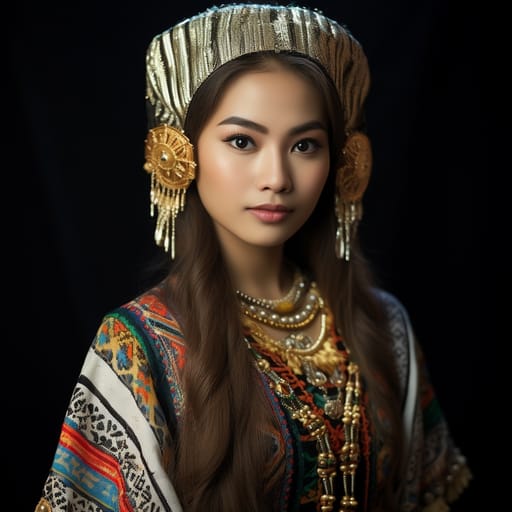
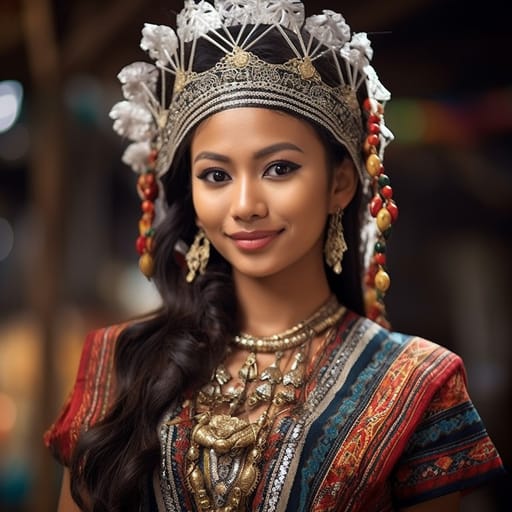
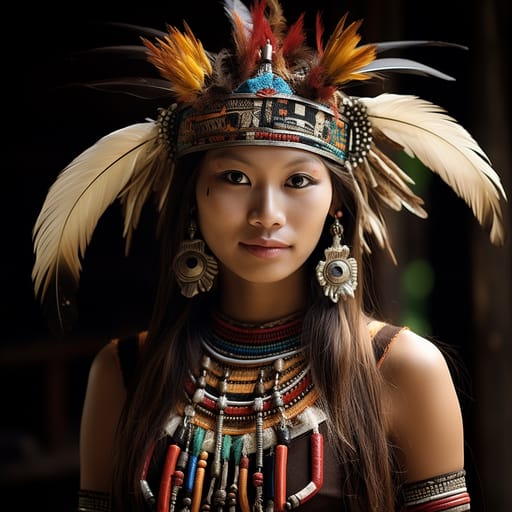
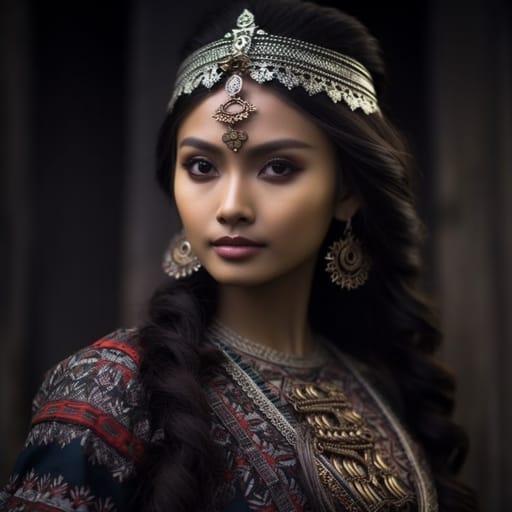
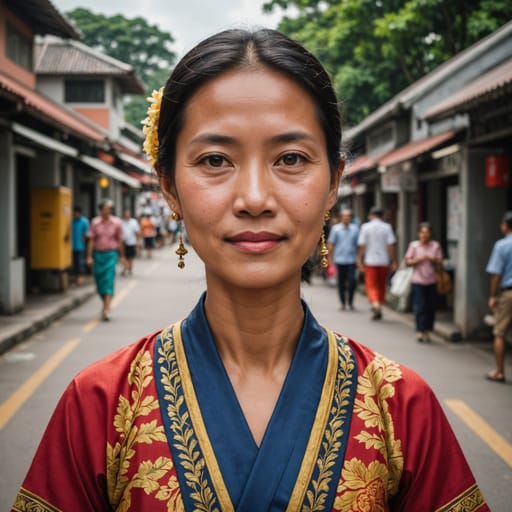
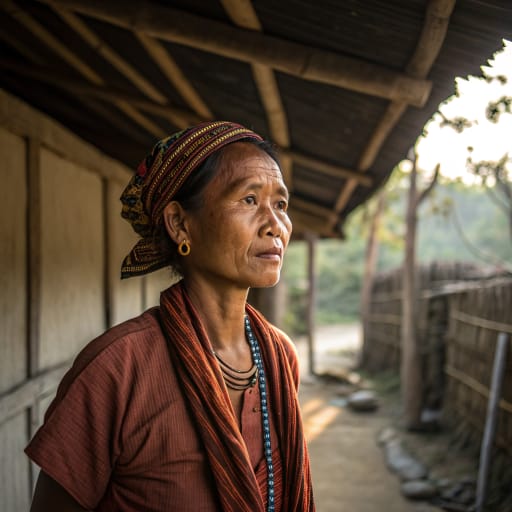
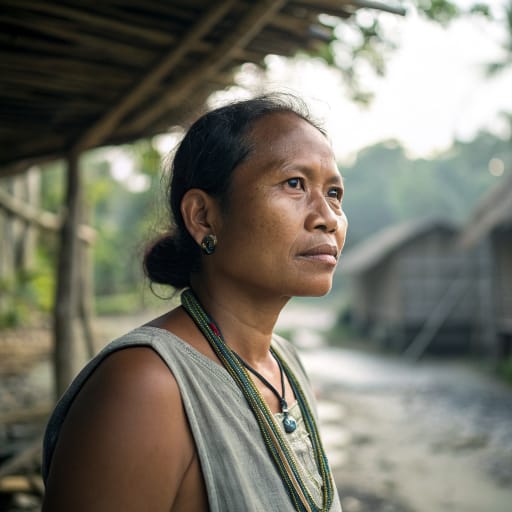
Typical Bisaya Phenotypes
Reference for AI generation: hair, eyes, skin, facial structure, build
Bisaya Body & Anatomy Reference
Anatomy by feature, Southeast Asian Austronesian / Austroasiatic phenotype
Bisaya Boobs & Breasts
The typical Bisaya bust is small-to-medium cup, modest projection, in line with the wider Southeast Asian Austronesian / Austroasiatic pattern. Areolas usually fall in the 26-38mm range, with medium-brown to dark-brown areolar pigmentation against the tan-to-medium-brown skin tone. Compared with the fuller South Asian or Polynesian bust, Bisaya breasts sit forward and are generally firm, modest projection. A faithful AI render of Bisaya tits keeps that shape and areola size.
Bisaya Ass & Hips
Butt shape among Bisaya women: small-to-medium, modest projection, narrower hip profile, over narrow-to-medium iliac crests. This follows Southeast Asian Austronesian / Austroasiatic ancestry and looks quite unlike the fuller glutes of the Pacific Islander phenotype. An accurate Bisaya ass in adult AI imagery keeps both the silhouette and the overall build (ectomorph, petite frame) instead of a generic average.
Bisaya Vagina & Pussy
Vulvar anatomy among Bisaya women: medium-brown to dark-brown labial pigmentation. Pubic hair tends to be straight-to-wavy fine-to-medium texture, in the usual inverted-triangle pattern. Both follow Southeast Asian Austronesian / Austroasiatic pigmentation, which is why Bisaya pussy renders should not fall back on a pale, sparse Western template.
Bisaya Dicks & Penis
The Bisaya cock profile, from Southeast Asian Austronesian / Austroasiatic anthropometric data: regional mean ~11cm erect; moderate girth; medium-brown shaft pigmentation. Pubic hair has a straight-to-wavy fine-to-medium texture and forms the usual inverted-V pattern. Whether Bisaya men are circumcised follows religious and cultural practice rather than phenotype.
Bisaya Body, Curves & Build
Build and curves among Bisaya women follow the Southeast Asian Austronesian / Austroasiatic pattern: ectomorph, petite frame, mean adult female BMI 20-23. Proportions matter as much as skin tone, so Bisaya figures should keep their regional height and limb ratios.
Bisaya Skin Tone & Hair Texture
The Bisaya skin range is tan to medium-brown (Fitzpatrick III-V), and hair tends to be straight-to-wavy 1A-2A, dark-brown to black. That combination marks the Southeast Asian Austronesian / Austroasiatic phenotype, and skin tone is the trait AI generators most often get wrong for Bisaya women.
Explore phenotype categories
Structured taxonomy with peer-reviewed scales · 22 anatomical categories
Erotic Poses & Sex Positions
From the pose catalog: 219 named positions with reference skeletons
Frequently asked questions about Bisaya people
Where is the Bisaya homeland?
The Bisaya homeland is Northwest Borneo: the Limbang valley of Sarawak and the Beaufort and Kuala Penyu districts of Sabah in Malaysia, plus communities in Brunei. in Southeast Asia.
What language do Bisaya people speak?
Bisaya people primarily speak Bisaya (Austronesian, Dusunic branch), closely related to Brunei Dusun and Tatana; Malay widely spoken as a second language..
What religion do Bisaya people practice?
The predominant religion among Bisaya people is Predominantly Sunni Islam, with a Christian minority and older animist customs tied to the farming year..






Make your own Bisaya images
Five a day, free, no credits to buy. The studio starts from this group's phenotype data, so you can set body type, pose and style and keep the traits accurate.
Start with Bisaya