Help us get this right
Does this portrait look right for Kunama?
One tap. It takes a second and it is recorded.
1 says it looks right, 1 says it looks off.
Kunama Erotic
Christianity / Oriental Orthodoxy
About Kunama People
The Kunama live in the lowland country between the Gash and Setit rivers in southwestern Eritrea, with smaller communities across the border in Ethiopia's Tigray region. They are one of the oldest continuous populations in the Horn — older than the Tigrinya and Tigre who surround them, and culturally distinct from both. That deep rootedness in a single river basin shapes almost everything about how they live: cultivation of sorghum and millet on flood-fed soils, cattle on the drier margins, and a sharp sense of who belongs to the land and who arrived later.
Their language is a Nilo-Saharan outlier in a region otherwise dominated by Semitic and Cushitic tongues. Linguists generally place Kunama in its own branch with no close relatives, which fits the pattern: a small, encircled population whose speech has drifted on its own trajectory for a very long time. Most Kunama also speak Tigrinya or Arabic to deal with neighbors and markets, but the home language remains the marker of identity and is passed on without much erosion.
Religiously the Kunama are mixed. A significant share follow Eritrean Orthodox Tewahedo Christianity, the Oriental Orthodox tradition that anchors much of the highland Horn; others are Muslim, and an older substrate of indigenous belief — centered on a creator figure called Anna and on ancestor veneration — survives underneath both, particularly in rural districts. Funerary rites and seasonal observances tend to draw on this substrate regardless of whichever world religion a household formally claims.
Kunama society is organized along matrilineal lines, which is unusual for the region. Descent, inheritance of certain rights, and clan membership pass through the mother, and a child's primary kin obligations run to the maternal uncle's lineage rather than the father's. This has made them culturally legible to themselves but persistently misread by patrilineal neighbors, and it threads through their politics as well as their domestic life.
The twentieth century treated them roughly. The Ethiopian–Eritrean war and the long border conflict that followed displaced thousands of Kunama, and the group's small numbers — somewhere in the low hundreds of thousands — make them politically marginal in both states they inhabit. Diaspora communities now exist in Sudan, Kenya, and further afield, but the cultural center of gravity remains the river country.
Related ethnic groups
Groups that share Kunama's homeland, region, language, or religious tradition. These are likely candidates for comparative phenotype reference.
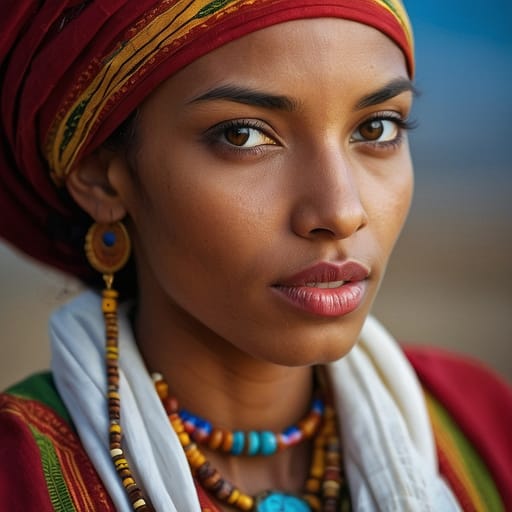
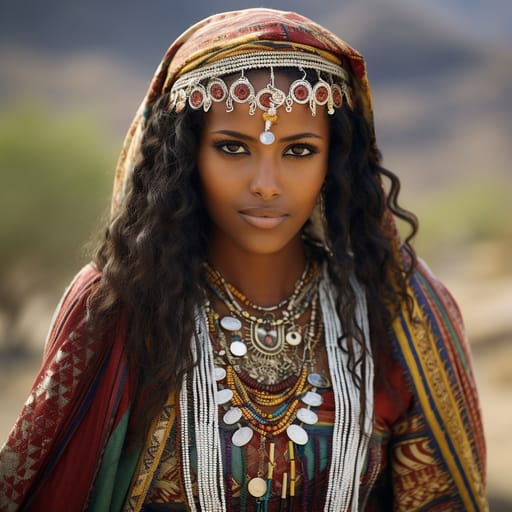
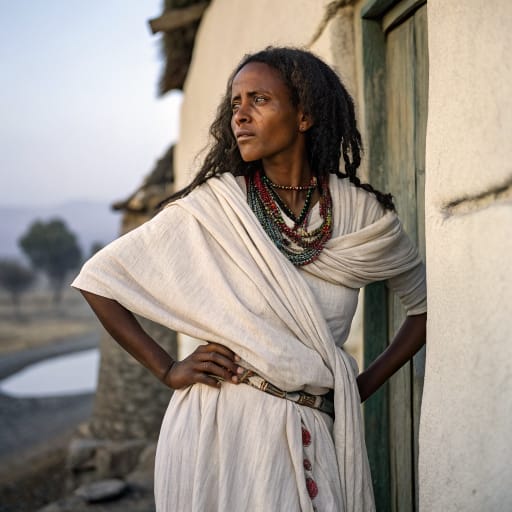
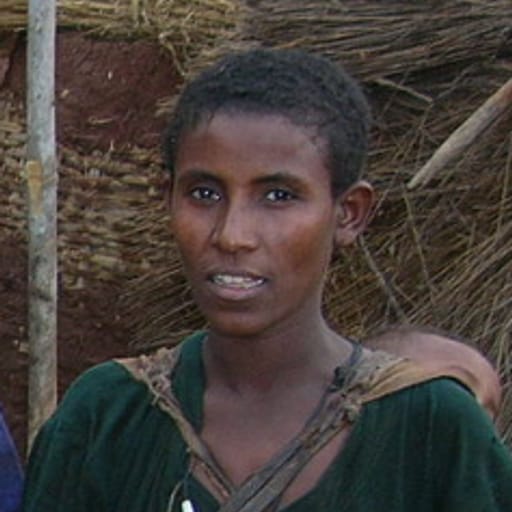
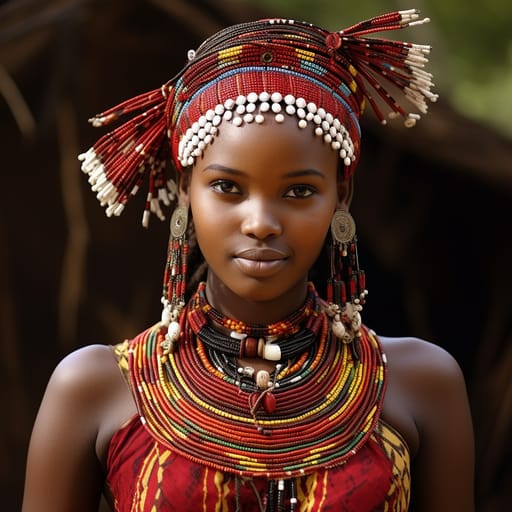
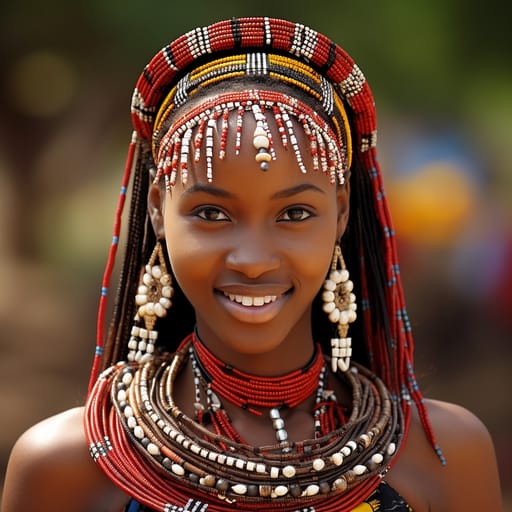
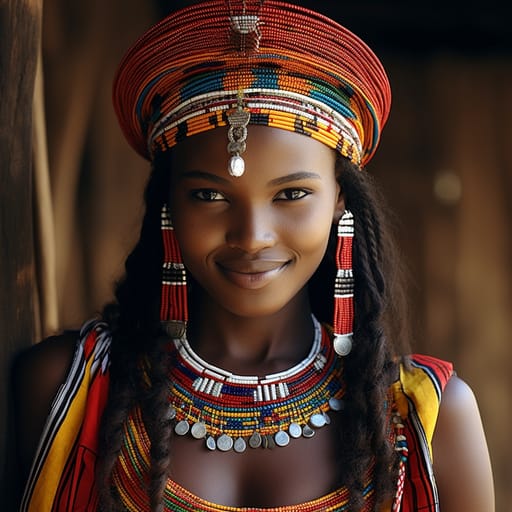
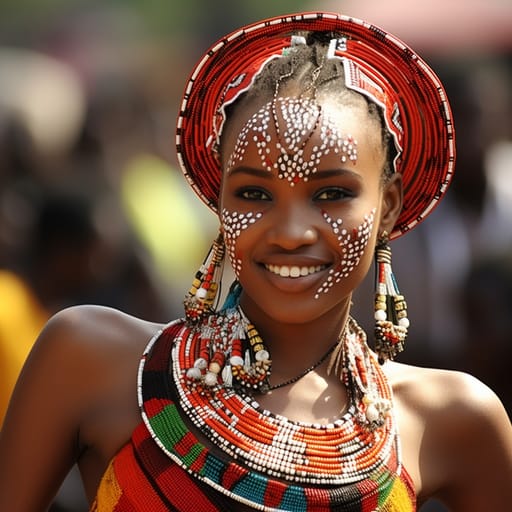
Geographic Distribution: Kunama populations across 1 country
Each row is ranked by the group's share of that country's population, with the source citation drawn from published census and demographic surveys. Click through for the full per-country phenotype profile.
| Country | Share | Source |
|---|---|---|
| Eritrea | 2.0% | Eritrea estimates; Kunama (~2%); Nilo-Saharan source population |
Typical Kunama Phenotypes
Reference for AI generation: hair, eyes, skin, facial structure, build
The Kunama are one of the few Nilo-Saharan-speaking populations in the Horn of Africa, and their phenotype reflects that ancestry — they read visibly distinct from the Tigrinya, Tigre, and Amhara neighbors who dominate the surrounding highlands. Skin tone sits in the deep brown to near-black range, typically Fitzpatrick V–VI, with cool to neutral undertones rather than the reddish or olive cast common in Cushitic and Semitic Eritreans. Sun exposure in the Gash-Setit lowlands keeps the upper register dark year-round.
Hair is tightly coiled, Type 4B–4C, dense and short-stapled. It is almost universally worn close-cropped on men and in fine plaits, twists, or short natural styles on women; older traditional styling includes butter-and-ochre dressing similar to other Nilotic-adjacent groups. Color is uniformly black; greying is the only common deviation. Eyes are dark brown to near-black, almond-shaped, set under a pronounced supraorbital ridge — the epicanthic fold is absent.
Facial structure is where the Kunama diverge most sharply from highland Habesha phenotypes. Noses tend toward a broader alar base and a lower, flatter bridge — closer to Sudanese Nilotic norms than to the narrow, high-bridged Tigrinya nose. Lips are full, often with a well-defined vermilion border. Jawlines are square and the chin projects strongly; cheekbones are wide but not as high-set as in Cushitic populations. Foreheads are broad.
Build is lean and long-limbed, with the elongated lower-leg-to-torso ratio typical of lowland East African groups, though the Kunama are not as tall as the Nilotic peoples further west — adult men commonly fall in the 170–178 cm range, women 158–165 cm. Body composition is naturally low-fat, with narrow hips on men and a notably high gluteofemoral fat distribution on women relative to waist. Within the group, the Marda, Tika, and Bitama subgroups show no consistent phenotypic separation; variation is individual rather than clan-based.
Kunama Body & Anatomy Reference
Anatomy by feature, Cushitic / Nilo-Cushitic East African phenotype
Kunama Boobs & Breasts
The typical Kunama bust is small-to-medium-cup, high-set, conical, in line with the wider Cushitic / Nilo-Cushitic East African pattern. Areolas usually fall in the 28-38mm range, with moderate-to-high areolar pigmentation against the brown-to-deep-brown skin tone. Compared with the lateral spread of the West African phenotype, Kunama breasts sit forward and are generally firmer and less projecting than the African-American or West African norm. A faithful AI render of Kunama tits keeps that shape and areola size.
Kunama Ass & Hips
Butt shape among Kunama women: small-to-medium, high-set, rounded, over narrow-to-medium iliac crests, longer torso-to-leg ratio. This follows Cushitic / Nilo-Cushitic East African ancestry and looks quite unlike the wide-set heavy-projection West African or African-American norm. An accurate Kunama ass in adult AI imagery keeps both the silhouette and the overall build (lean ectomorph-to-mesomorph) instead of a generic average.
Kunama Vagina & Pussy
Vulvar anatomy among Kunama women: brown-to-deep-brown labial pigmentation, narrow-to-medium labia minora projection. Pubic hair tends to be tightly-coiled coarse texture, densely distributed, in the usual inverted-triangle pattern. Both follow Cushitic / Nilo-Cushitic East African pigmentation, which is why Kunama pussy renders should not fall back on a pale, sparse Western template.
Kunama Dicks & Penis
The Kunama cock profile, from Cushitic / Nilo-Cushitic East African anthropometric data: regional mean ~13.5cm erect; moderate girth, ~12cm circumference; deeper-pigmented than the West African norm. Pubic hair has a tightly-coiled coarse texture and forms the usual inverted-V pattern. Whether Kunama men are circumcised follows religious and cultural practice rather than phenotype.
Kunama Body, Curves & Build
Build and curves among Kunama women follow the Cushitic / Nilo-Cushitic East African pattern: lean ectomorph-to-mesomorph, mean adult female BMI 19-22. Proportions matter as much as skin tone, so Kunama figures should keep their regional height and limb ratios.
Kunama Skin Tone & Hair Texture
The Kunama skin range is brown to deep brown (Fitzpatrick V-VI), and hair tends to be tight 4A-4C coil, often worn natural or in braided/twisted protective styles. That combination marks the Cushitic / Nilo-Cushitic East African phenotype, and skin tone is the trait AI generators most often get wrong for Kunama women.
Data depth
0/100Coverage of image-grounded phenotype observations · drives AI generation diversity
- Sample size
- 0/40· 0 images
- Image quality
- 0/30· 0% high
- Confidence
- 0/20
- Source diversity
- 0/10
- ·No image observations yet
Explore phenotype categories
Structured taxonomy with peer-reviewed scales · 22 anatomical categories
Erotic Poses & Sex Positions
From the pose catalog: 219 named positions with reference skeletons
Frequently asked questions about Kunama people
Where is the Kunama homeland?
The Kunama homeland is Eritrea, Ethiopia in Eastern Africa.
What countries do Kunama people live in?
Kunama populations are documented across 1 country: Eritrea.
What language do Kunama people speak?
Kunama people primarily speak Nilo-Saharan / Kunama.
What religion do Kunama people practice?
The predominant religion among Kunama people is Christianity / Oriental Orthodoxy.






Make your own Kunama images
Five a day, free, no credits to buy. The studio starts from this group's phenotype data, so you can set body type, pose and style and keep the traits accurate.
Start with Kunama