Help us get this right
Does this portrait look right for Kotoko?
Nobody has judged this one yet. You would be the first.
Kotoko Erotic
Floodplains of the lower Logone and Chari rivers south and east of Lake Chad: Far North Cameroon, southwestern Chad, and adjacent northeastern Nigeria.
Kotoko languages: Lagwan, Mser, Mpade, Malgbe, Afade, Maslam (Central Chadic, Afro-Asiatic); Kanuri, Chadian Arabic and French widely used as second languages.
Sunni Islam, effectively universal, established through Bornu influence; older local observance persists around chieftaincy and the river.
Town-based polities, each with its own language: Logone-Birni (Lagwan), Kousseri (Mser), Makari (Mpade), Goulfey (Malgbe), Afade, Maslam. Claimed descendants of the Sao of the Chad basin.
About Kotoko People
The Kotoko are, first and last, town people, and they built their towns in a place that argues against towns. Their homeland is the floodplain of the lower Logone and Chari, the rivers that come up from the south to fill Lake Chad, and much of it goes under water for part of every year. The Kotoko answer was to go up: raise a mound, wall it in fired brick, then pack the interior with lanes narrow enough that two people pass sideways. Logone-Birni still reads that way, and the sultan's palace there is less a single building than several centuries of walls, each ruler adding his own. Loyalty runs to the town before it runs to the ethnic name. Ask where someone is from and you will hear Makari, or Goulfey, or Afade, or Kousseri, each with its own court and its own language, several of which the next town cannot follow. They trace themselves to the Sao, the people whose terracotta heads and bronze figures keep coming out of these same mounds, and the claim is not decorative: it is what entitles a Kotoko town to the ground it stands on.
The Kotoko languages belong to the Central Chadic branch of Afro-Asiatic, which makes them distant kin of Hausa and no relation at all to the Kanuri and Kanembu who surround them and whose Bornu empire once collected their tribute. Most Kotoko now also carry Kanuri, Chadian Arabic or French, and in the smaller towns the local speech is thinning. Islam came with Bornu's reach and is the whole religious frame today, though the ruler is still called mai, a Bornu title, and the courts keep a formality around him that is older than the mosque. Work is water: dugout canoes, nets set as the flood withdraws, smoked and dried fish moving west into Nigerian markets, sorghum and millet on the drained land, cattle where there is room. That economy has taken two hard blows in living memory. Lake Chad lost most of its surface between the 1960s and the 1980s and has never fully returned, and since 2014 the insurgency in the basin has emptied villages, closed fishing grounds under military order, and pushed Kotoko families into displacement sites and into Kousseri, now a crowded city facing N'Djamena across the Chari. The towns are older than all of it, which is the sort of thing a Kotoko will point out to you unprompted.
Related ethnic groups
Groups that share Kotoko's homeland, region, language, or religious tradition. These are likely candidates for comparative phenotype reference.
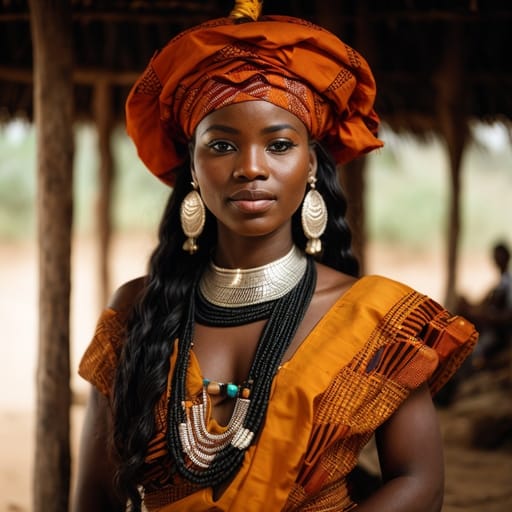
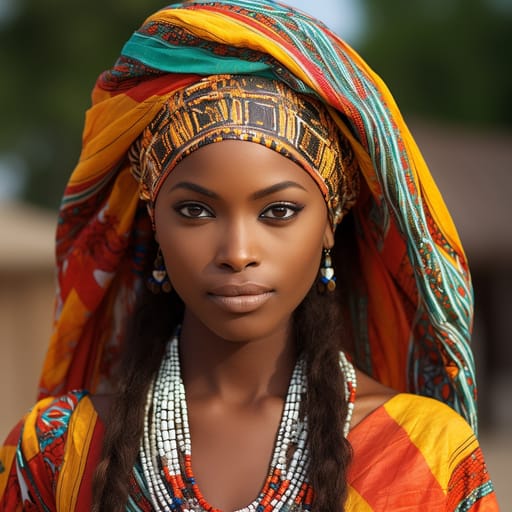
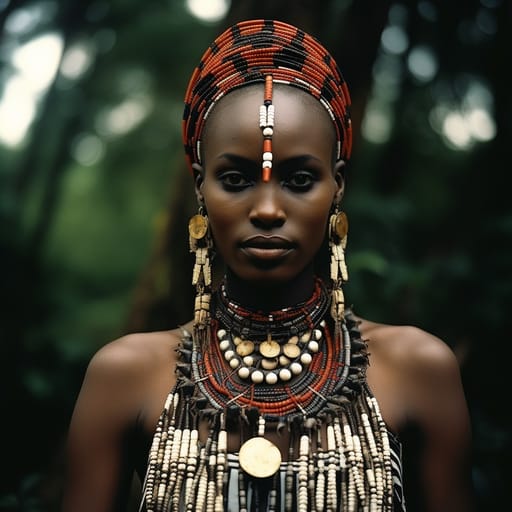
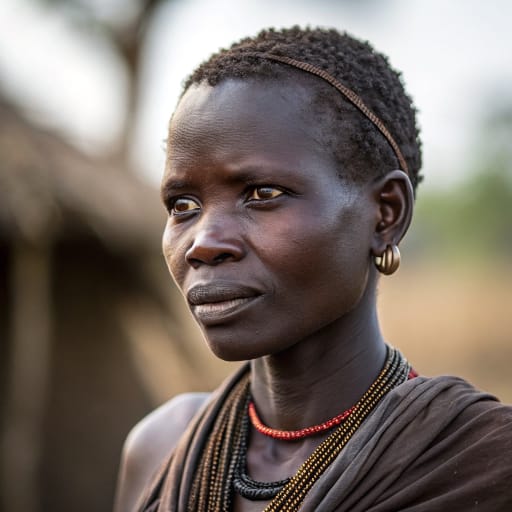
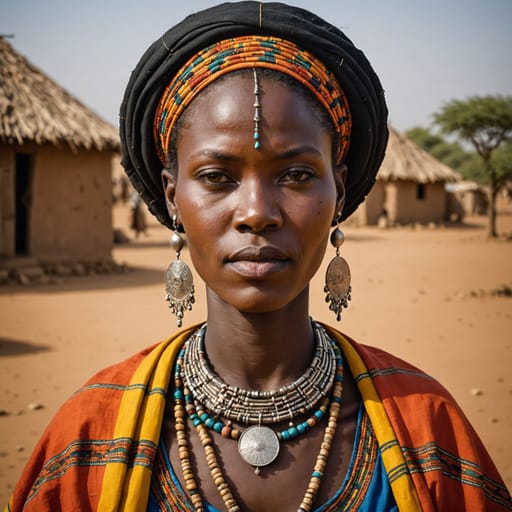
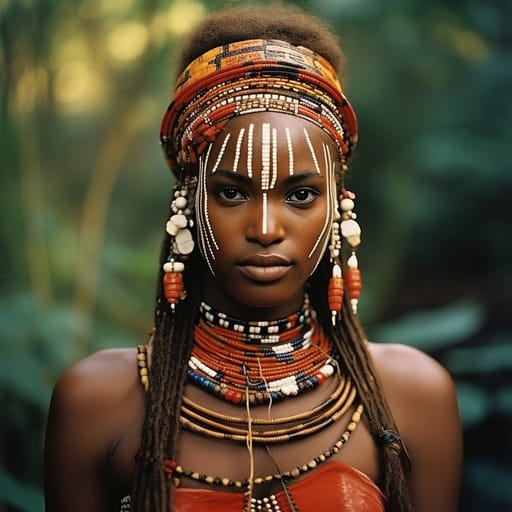

Typical Kotoko Phenotypes
Reference for AI generation: hair, eyes, skin, facial structure, build
Kotoko Body & Anatomy Reference
Anatomy by feature, Bantu / Central African Niger-Congo phenotype
Kotoko Boobs & Breasts
Bust reference for Kotoko women: medium-to-large cup, full, projecting, which is typical of Bantu / Central African Niger-Congo ancestry. Areolas measure about 32-48mm across, with deep-brown pigmentation. Body type (mesomorph with strong gluteal-femoral fat deposition) shapes the bust as well, so Kotoko tits are usually fuller projection than East African; comparable to West African norm. In AI imagery, keep the forward-set shape rather than drifting toward the smaller East African conical profile.
Kotoko Ass & Hips
The Kotoko ass is typically full, projected, wide-set glutes, which sets it apart from the slim narrow-hip Cushitic East African profile. Underneath, the pelvis shows broad iliac crests, gynoid pelvic pattern, part of the Bantu / Central African Niger-Congo skeletal pattern. For Kotoko butt pics and AI renders, match that silhouette and the overall build (mesomorph with strong gluteal-femoral fat deposition).
Kotoko Vagina & Pussy
Kotoko pussy and vulvar anatomy presents deep-brown labial pigmentation, fuller labia minora, consistent with the Bantu / Central African Niger-Congo phenotype's pigmentation pattern. Kotoko pubic hair is typically tightly-coiled coarse texture, dense distribution, in the inverted-triangle pattern. For anatomically accurate Kotoko pussy renders the labial coloration should match the surrounding deep-brown skin tone with a continuous gradient, and the hair should keep its tightly-coiled coarse texture.
Kotoko Dicks & Penis
Kotoko dicks follow the Bantu / Central African Niger-Congo reference data: regional mean ~14cm erect; above-average girth; deep-brown shaft pigmentation. Shaft color should track the deep-brown skin tone with a smooth change toward the glans, and Kotoko pubic hair keeps its tightly-coiled coarse texture.
Kotoko Body, Curves & Build
Kotoko body type and overall build presents as mesomorph with strong gluteal-femoral fat deposition, with mean adult female BMI 23-26: the characteristic Bantu / Central African Niger-Congo habitus. Kotoko curves and proportions should keep the regional skeletal frame (height, shoulder-to-hip ratio, limb proportions) rather than a generic mesomorph default.
Kotoko Skin Tone & Hair Texture
Kotoko skin sits in the deep-brown (Fitzpatrick VI) band. Hair is typically tight 4A-4C coil, in keeping with the Bantu / Central African Niger-Congo phenotype. In nude renders the skin should stay one even tone from face to body, and body, pubic and head hair should match.
Explore phenotype categories
Structured taxonomy with peer-reviewed scales · 22 anatomical categories
Erotic Poses & Sex Positions
From the pose catalog: 219 named positions with reference skeletons
Frequently asked questions about Kotoko people
Where is the Kotoko homeland?
The Kotoko homeland is Floodplains of the lower Logone and Chari rivers south and east of Lake Chad: Far North Cameroon, southwestern Chad, and adjacent northeastern Nigeria. in Central Africa.
What language do Kotoko people speak?
Kotoko people primarily speak Kotoko languages: Lagwan, Mser, Mpade, Malgbe, Afade, Maslam (Central Chadic, Afro-Asiatic); Kanuri, Chadian Arabic and French widely used as second languages..
What religion do Kotoko people practice?
The predominant religion among Kotoko people is Sunni Islam, effectively universal, established through Bornu influence; older local observance persists around chieftaincy and the river..






Make your own Kotoko images
Five a day, free, no credits to buy. The studio starts from this group's phenotype data, so you can set body type, pose and style and keep the traits accurate.
Start with Kotoko